
It often starts with something small but unsettling. A debit card suddenly stops working. A utility bill goes unpaid. A spouse who always handled the finances moves out, and overnight the sense of security you relied on disappears. In that moment, divorce stops feeling like a legal process and starts feeling like a personal crisis. Temporary Texas Spousal Support During Divorce exists for this exact reason—to keep families financially steady while the case is pending and life feels anything but stable.
At The Law Office of Bryan Fagan, PLLC, we regularly meet parents who are less worried about winning a legal battle and more worried about keeping life normal for their children. Can the mortgage be paid? Will the lights stay on? Can routines at home remain calm and predictable? Texas law, including Texas Family Code §6.502, gives courts the authority to step in with temporary spousal support so one spouse is not left struggling while the divorce moves forward. This financial stability often becomes the foundation that allows families—especially children—to feel safe during an emotionally turbulent time.
Led by Bryan Joseph Fagan, a South Texas College of Law graduate and recognized authority on Texas divorce and custody law, our Houston-based firm approaches these cases with both legal precision and human understanding. In the sections ahead, we will walk you through how temporary spousal support works in Texas, why courts see it as a tool for stability rather than leverage, and how thoughtful legal guidance can help families reclaim peace of mind during one of life’s hardest transitions.
Key Takeaways
- Texas courts may order temporary spousal support during pending divorce proceedings to help maintain financial stability for the lower earning spouse under Texas Family Code §§6.501–6.502
- Temporary support is fundamentally different from post-divorce spousal maintenance and uses different legal standards, with eligibility for one not guaranteeing eligibility for the other
- The requesting spouse must prove financial need and inability to cover necessary expenses, while the paying spouse’s ability to afford support is equally important to the court’s determination
- Temporary support orders last only until the final divorce decree and do not automatically convert to long-term spousal maintenance payments
- Working with an experienced Texas divorce attorney significantly improves your chances of obtaining fair temporary support orders through proper evidence presentation and legal advocacy

Your Family’s Future Starts Here
Don’t navigate your legal journey alone. Schedule a consultation now and get the clarity and support you deserve.
Temporary Texas Spousal Support During Divorce: An Overview
Temporary spousal support is a critical safeguard for families navigating divorce, and Temporary Texas Spousal Support During Divorce exists to ensure that neither spouse is left financially vulnerable while a case is pending. Under Texas Family Code § 6.502(a)(2), Texas courts are expressly authorized to issue temporary orders requiring one spouse to provide financial support to the other during the divorce process. These provisions—reflecting the most current version of the Texas Family Code—are designed to promote fairness, stability, and continuity while the court works toward a final resolution.
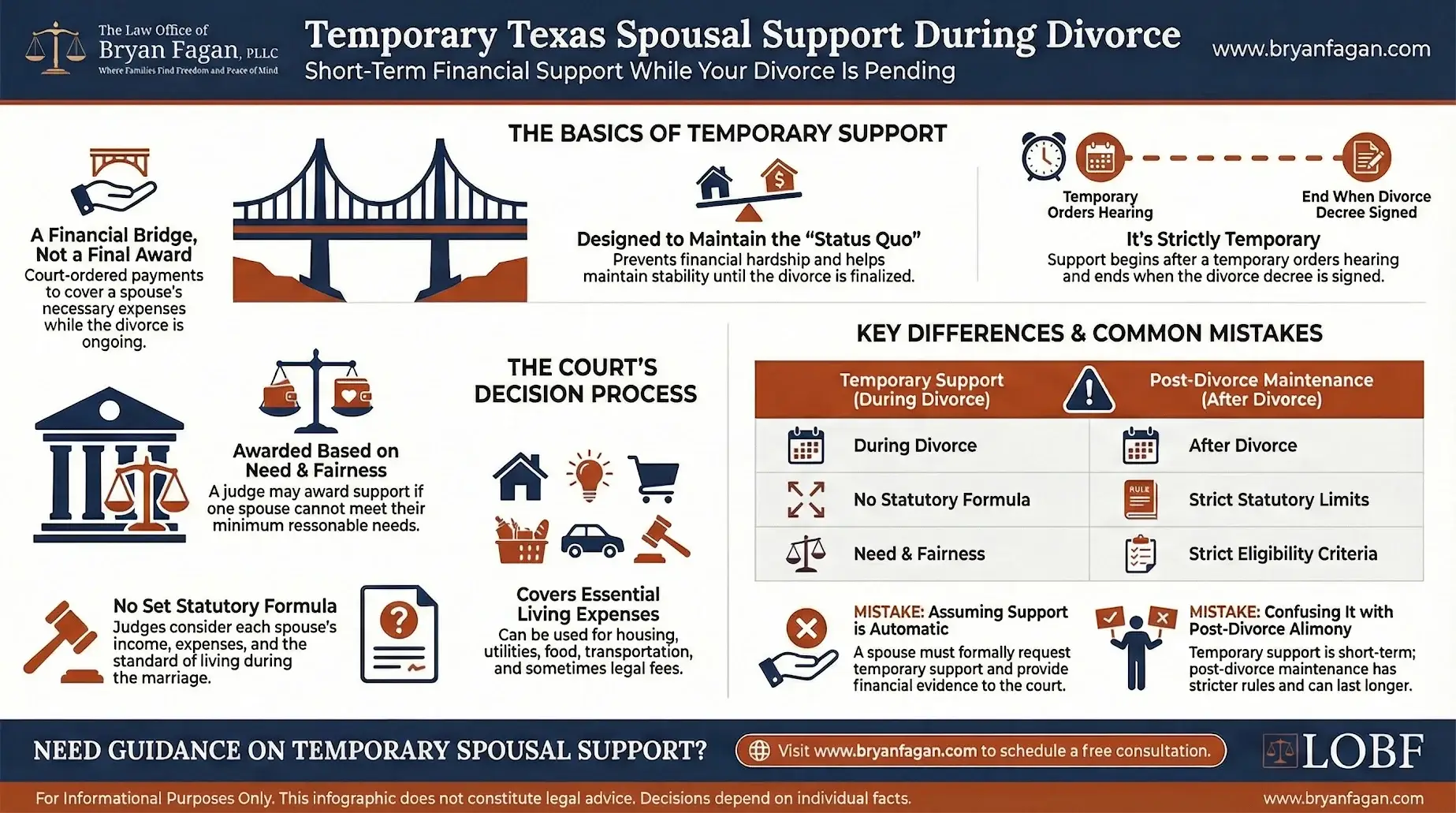
Unlike long-term spousal maintenance, temporary spousal support is governed exclusively by temporary orders rather than the final divorce decree. These orders apply during the period between filing for divorce and the entry of final judgment, which can last several months or longer in contested cases. During this time, courts focus on maintaining financial stability so both spouses can meet basic living expenses such as housing, utilities, food, and insurance. Many families benefit from negotiated solutions during this phase, including the use of Agreed Temporary Orders in Texas family law cases, which allow parties to reduce conflict while still complying with statutory requirements.
Texas courts treat temporary spousal support as a practical financial tool—not a punishment and not a reward. Judges evaluate whether the requesting spouse can meet minimum reasonable needs without assistance and whether the other spouse has the ability to contribute support without creating undue hardship. Consistent with Texas Family Code §§ 3.002 and 6.502, income earned during the marriage is presumed to be community property, and courts frequently rely on those community funds when ordering temporary support. This framework reflects the principle that both spouses contributed to the marital estate and both deserve financial security until property division and long-term obligations are determined.
At the Law Office of Bryan Fagan, PLLC, educating families is a core part of protecting their futures. Our attorneys regularly help clients understand how temporary orders fit into the broader divorce process and what courts expect when determining short-term financial support. For additional guidance, families may find it helpful to review our detailed resource on temporary orders in a Texas divorce, which explains how judges apply the Texas Family Code to real-world situations. By combining compassionate client communication with precise legal strategy, our firm remains committed to helping Texas families move forward with clarity and confidence.

How Temporary Spousal Support Differs From Post-Divorce Spousal Maintenance
Many people confuse temporary spousal support with post-divorce spousal maintenance, but these are distinctly different legal concepts with different standards, purposes, and outcomes.
| Aspect | Temporary Spousal Support | Post-Divorce Spousal Maintenance |
|---|---|---|
| Governing Law | Texas Family Code §§6.501–6.502 | Texas Family Code Chapter 8 |
| Purpose | Immediate stability during divorce | Long-term financial support after divorce |
| Eligibility | Need-based, flexible standards | Strict statutory criteria required |
| Amount Limits | No statutory caps | Lesser of $5,000/month or 20% of gross income |
| Duration | Ends at final divorce decree | Capped based on marriage length |
| Calculation | Judicial discretion | Statutory formula applies |
Temporary support under Texas Family Code Section 6.502 focuses on preserving basic financial stability while the case proceeds. Texas courts have broad discretion to order whatever amount seems reasonable based on the couple’s financial situation and each party’s needs and abilities.
Post-divorce spousal maintenance under Chapter 8, by contrast, has much stricter eligibility gates. A spouse seeking maintenance must prove they lack sufficient property to provide for minimum reasonable needs AND meet one of several specific circumstances: the marriage lasted at least ten years and the spouse cannot earn sufficient income for self-support; the other spouse committed family violence within two years before filing or during the case; the requesting spouse has a physical or mental disability; or the requesting spouse cares for a disabled child of the marriage.
Here’s what this means practically: qualifying for temporary support during your divorce does not guarantee you’ll receive post-divorce spousal maintenance. Many spouses receive temporary support who would never meet Chapter 8’s strict eligibility requirements. Understanding this distinction helps you plan realistically for your financial future after the divorce finalizes.
Who Can Request Temporary Texas Spousal Support During Divorce?
Any spouse experiencing genuine financial hardship during a pending Texas divorce may request temporary spousal support. There’s no requirement that you be a stay-at-home parent or have zero income—the key question is whether you can meet your reasonable needs with available resources.
Texas courts look for financial imbalance between the parties. Common scenarios where temporary support may be appropriate include:
- One spouse controlled all household finances and the other lacks access to marital funds
- A spouse earning significantly less than the other cannot afford basic living expenses after separation
- One spouse left the workforce to care for children or a disabled family member
- Separation doubled household expenses while income remained the same
- One spouse’s employment skills or education limit immediate earning capacity
The requesting party bears the burden of proving both financial need and the other party’s ability to pay. Courts want to see documented evidence—not just claims—that you cannot cover necessary expenses like housing, utilities, food, transportation, and healthcare from your own resources.
Caregiving responsibilities strengthen temporary support requests. If you’re the primary caregiver for minor children or a disabled child of the marriage, courts recognize that your earning capacity is legitimately constrained by these duties. Unlike post-divorce spousal maintenance, temporary support doesn’t require formal disability documentation—demonstrated caregiving need is sufficient.
The paying spouse’s income and available resources matter equally. Courts won’t order support that leaves the payer unable to meet their own basic needs. The goal is reasonable allocation of community resources, not financial destruction of either party.
How Texas Courts Calculate Temporary Spousal Support
Unlike post-divorce spousal maintenance—which is capped under Texas Family Code § 8.055 at the lesser of $5,000 per month or 20% of the paying spouse’s average monthly gross income—Temporary Texas Spousal Support During Divorce is not governed by a rigid statutory formula. Instead, Texas Family Code § 6.502(a)(2) grants judges broad discretion to issue temporary orders that provide financial support tailored to the specific needs and realities of each family. This flexibility, reaffirmed in the most current version of the Texas Family Code, allows courts to stabilize households while a divorce is pending rather than forcing families into a one-size-fits-all outcome.
When determining temporary spousal support, Texas courts typically follow a practical, step-by-step analysis rooted in fairness and necessity. Judges first assess the requesting spouse’s documented monthly needs, including housing costs, utilities, groceries, transportation, health insurance, and other reasonable living expenses, with the focus squarely on meeting minimum reasonable needs rather than preserving a pre-divorce lifestyle. Courts then evaluate the requesting spouse’s available resources by subtracting any earned income or accessible assets from those documented expenses to identify a true financial shortfall. Next, judges examine the paying spouse’s ability to contribute support by reviewing income and necessary personal expenses, ensuring that any support ordered does not create undue hardship. Finally, based on this balanced review, courts order a reasonable support amount that addresses the shortfall while maintaining overall financial stability for both parties, consistent with the authority granted under Texas Family Code § 6.502.
A practical example helps illustrate how this analysis works in real life. Imagine a couple divorcing after a long-term marriage in which one spouse stepped away from a career to raise children while the other became the primary wage earner. If the stay-at-home spouse documents monthly needs of $4,500 and has no independent income or access to marital funds, and the working spouse nets $8,000 per month with $4,200 in necessary expenses, the court may order temporary support that covers most of the documented shortfall while still allowing the paying spouse to meet personal obligations. This balanced approach reflects the intent behind temporary orders—to prevent genuine hardship without unfairly burdening either party.
Attorneys at the Law Office of Bryan Fagan, PLLC routinely help families understand how these discretionary decisions are made and why temporary orders are often one of the most important stages of a Texas divorce. For readers seeking deeper insight, our firm’s educational resource on why temporary orders matter in Texas divorce cases explains how courts apply the Family Code to protect financial stability early in the process. By combining clear legal guidance with empathetic support, our Texas family law team remains committed to educating families, reducing uncertainty, and protecting futures during every phase of divorce.

Factors Judges Consider When Ordering Temporary Spousal Support
While Texas Family Code Section 6.502 doesn’t enumerate specific factors, Texas district courts consistently consider several factors when issuing temporary support orders:
Each spouse’s income and access to financial resources. Courts examine pay stubs, tax returns, bank statements, and access to community property. If one spouse controls joint accounts while the other lacks access, this weighs heavily in the requesting spouse’s favor.
Monthly living expenses and basic needs assessment. Documented expenses carry more weight than estimates. Utility bills, lease agreements, grocery receipts, and insurance premiums help courts understand actual financial needs.
Length of the marriage and established lifestyle. Longer marriages often justify higher baseline needs because spouses become accustomed to particular living standards. A 20-year marriage where the family lived comfortably creates different expectations than a 2-year marriage.
Whether one spouse controls most marital assets. Asset control is critical. If the higher-earning spouse closed joint accounts, transferred funds, or otherwise limited the other spouse’s access to community estate resources, courts may order higher temporary support to compensate.
Health conditions affecting earning capacity. Physical or mental disability limiting employment affects both need analysis and ability-to-pay determinations.
History of family violence within the relationship. A family violence offense or pattern affects credibility determinations and may trigger additional protective orders. Courts take domestic violence seriously in all temporary orders decisions.
Educational background and employment skills. The court considers whether a spouse seeking support has realistic prospects for becoming self-supporting during the divorce process. Limited employment history or outdated skills may justify temporary support.
How Long Temporary Spousal Support Lasts in Texas
Temporary spousal support lasts only during pending divorce proceedings. The temporary order automatically terminates when the court enters the final divorce decree. There is no automatic conversion to long-term spousal maintenance—that requires meeting separate eligibility criteria under Texas Family Code Chapter 8.
Texas divorce cases typically take 6-12 months from filing to final decree, though contested cases involving significant assets or custody disputes may take longer. Throughout this period, the temporary support order remains in effect unless modified.
What happens to unpaid temporary support after the divorce finalizes? Past-due amounts survive the final decree as enforceable judgments. If the paying spouse falls behind on support obligations during the case, those arrearages remain collectible even after the divorce is complete.
Can temporary support be modified during the case? Yes, but only upon showing a significant change in circumstances. If the paying spouse loses their job, or if the requesting spouse obtains substantial employment, either party may file a motion requesting modification. Courts require genuine material changes—not just minor fluctuations—to justify altering temporary orders.
Common Misconceptions About Temporary Texas Spousal Support During Divorce
Misunderstandings about temporary spousal support can lead to unrealistic expectations and unnecessary conflict during divorce, particularly when it comes to Temporary Texas Spousal Support During Divorce. One common myth is that receiving temporary support guarantees long-term alimony, but this is incorrect under Texas law. Temporary support is authorized by Texas Family Code § 6.502(a)(2) and applies only while a divorce is pending, whereas post-divorce spousal maintenance is governed by Texas Family Code Chapter 8, which includes strict eligibility requirements such as the ten-year marriage threshold and proof that the requesting spouse cannot meet minimum reasonable needs. Many spouses qualify for temporary support yet never meet the statutory standards for maintenance after the divorce is finalized.
Another frequent misconception is that temporary spousal support is automatic in every Texas divorce. In reality, courts have broad discretion and do not award temporary support as a matter of course. The requesting spouse must present evidence demonstrating genuine financial need, often at a contested temporary orders hearing, and courts routinely deny support when a spouse cannot show an inability to meet basic living expenses. This discretionary approach, rooted in Texas Family Code § 6.502, ensures that temporary support remains a targeted remedy rather than a blanket entitlement.
Some spouses also believe courts always order equal expense sharing during divorce, but Texas judges focus on need-based analysis rather than mathematical equality. When there is a significant income disparity, courts do not require a higher-earning spouse to split expenses evenly with a lower-earning spouse. Instead, temporary support is used to address genuine financial imbalance and prevent hardship, consistent with the Family Code’s emphasis on fairness and practicality. This approach reinforces that temporary orders are about stabilizing households, not enforcing rigid formulas.
Finally, it is a myth that only stay-at-home spouses qualify for temporary support. Working spouses may still be eligible if their income is insufficient to cover minimum reasonable needs after separation, particularly when childcare, housing, or medical costs are involved. Attorneys at the Law Office of Bryan Fagan, PLLC regularly counsel clients on how courts evaluate these factors and why negotiated solutions—such as agreed temporary orders in Texas family law cases—can provide clarity and reduce conflict. For additional education, families may also find our resource on temporary orders in a Texas divorce helpful in understanding how judges apply the Texas Family Code in real-world situations. By combining compassionate guidance with authoritative legal insight, our firm remains committed to educating Texas families and protecting their futures.

Enforcing or Modifying Temporary Spousal Support Orders
When a spouse fails to comply with court-ordered support, Texas law provides strong remedies to enforce Temporary Texas Spousal Support During Divorce and protect financial stability while a case is pending. Under Texas Family Code § 6.502(a)(2), temporary orders are fully enforceable, and a spouse who does not pay as ordered may face serious consequences. The requesting spouse can file a motion for contempt, asking the court to address the violation of its temporary order, and courts have authority to impose fines, order payment of arrears, award attorney’s fees, and in extreme cases, order confinement for willful noncompliance. These enforcement tools underscore the importance Texas law places on ensuring temporary support obligations are taken seriously.
Successful enforcement depends heavily on how clearly the temporary order is drafted. Orders must specify payment amounts, due dates, and payment methods with precision, because vague or ambiguous language makes enforcement far more difficult. This is why experienced guidance during temporary orders hearings is so valuable, as careful drafting reduces future disputes and enforcement delays. Families seeking to understand how these orders are structured can review the firm’s educational resource on Texas divorce temporary orders, which explains how courts apply the Family Code to real-world situations and why clarity at the outset matters.
Texas courts also permit wage withholding as an enforcement mechanism for temporary spousal support, similar to child support enforcement. A judge may order the paying spouse’s employer to deduct support payments directly from wages, ensuring consistency and reducing the risk of missed payments. This tool is particularly effective when voluntary compliance has failed and is authorized within the court’s broad temporary orders power under Texas Family Code § 6.502.
Modification of temporary spousal support while a divorce is pending is possible, but it requires proof of a material and substantial change in circumstances. Examples include job loss by the paying spouse, significant new employment for the requesting spouse, a major health crisis affecting either party, or a substantial increase in income. Courts expect parties to act promptly when circumstances change, as unnecessary delay may undermine a modification request. Attorneys at the Law Office of Bryan Fagan, PLLC regularly help clients evaluate whether a change justifies modification and guide them through the proper procedure. For additional insight, families may find it helpful to review our broader discussion of temporary orders in a Texas divorce, which further explains enforcement and modification under the Texas Family Code.
How a Texas Divorce Attorney Helps With Temporary Spousal Support
Working with an experienced Texas divorce attorney can make a decisive difference when seeking Temporary Texas Spousal Support During Divorce, particularly because temporary orders are fast-moving, evidence-driven, and governed by specific provisions of the Texas Family Code. Under Texas Family Code § 6.502(a)(2), courts have broad authority to issue temporary orders for spousal support while a divorce is pending, but that authority is exercised based on proof, preparation, and clear advocacy rather than emotion. Having knowledgeable counsel ensures your request is grounded in the most current statutory framework and presented in a way courts expect.
One of the primary advantages of experienced representation is thorough preparation for temporary orders hearings. Your attorney gathers and organizes key financial documents such as bank statements, pay stubs, tax returns, and detailed expense records, because Texas courts decide temporary support based on admissible evidence, not sympathy. Clear documentation allows the court to evaluate minimum reasonable needs and ability to pay, consistent with the standards applied under Texas Family Code § 6.502 and related community property provisions in Texas Family Code § 3.002.
Effective advocacy also means presenting financial information in a concise and persuasive manner. Temporary orders hearings are often brief, and judges expect attorneys to explain complex financial situations efficiently. A skilled lawyer knows how to frame income disparities, household expenses, and access to marital funds so the court can quickly assess whether temporary spousal support is necessary and, if so, in what amount. This level of clarity is especially important because temporary support is discretionary and not subject to the rigid caps that apply to post-divorce spousal maintenance under Texas Family Code Chapter 8.
Representation protects both requesting and paying spouses. If you are seeking support, your attorney argues for an amount that genuinely addresses your short-term needs while anticipating objections from the other side. If you are the paying spouse, counsel helps guard against excessive or unsupported demands that could leave you unable to meet your own obligations. Courts strive for balance during the divorce process, and experienced legal guidance helps ensure that balance is reflected in temporary orders.
Many disputes over temporary spousal support are resolved through negotiation rather than contested hearings, and seasoned attorneys often secure favorable agreed orders that reduce cost, stress, and uncertainty. Families who want to better understand how these negotiated outcomes work may find it helpful to review the firm’s resource on temporary orders in Texas divorce cases, which explains the process and practical considerations involved. Attorneys at the Law Office of Bryan Fagan, PLLC also encourage clients to explore educational materials such as our overview of temporary orders in a Texas divorce to gain clarity before hearings begin.
Understanding temporary spousal support during divorce requires both legal knowledge and real-world experience, and the right attorney brings both to your case. By blending precise statutory guidance with compassionate client communication, the team at The Law Office of Bryan Fagan, PLLC remains committed to educating families, protecting financial stability, and helping clients move forward with confidence during one of life’s most challenging transitions.
Why Choose The Law Office of Bryan Fagan, PLLC
With decades of experience guiding families through Texas divorce proceedings, the attorneys at The Law Office of Bryan Fagan, PLLC bring practical insight and steady advocacy to cases involving Temporary Texas Spousal Support During Divorce. Our team regularly appears in Texas district courts and understands how judges apply Texas Family Code § 6.502(a)(2) when issuing temporary orders for spousal support. That experience allows us to anticipate what evidence courts find persuasive, how to clearly document financial need, and how to protect clients whether they are requesting support or responding to a request.
Our approach is grounded in a deep understanding of the Texas Family Code and its distinctions between temporary spousal support and post-divorce spousal maintenance under Texas Family Code Chapter 8. Temporary support is designed to stabilize families while a case is pending, not to determine long-term financial obligations, and our courtroom-tested strategies reflect that reality. By focusing on minimum reasonable needs, access to community funds under Texas Family Code § 3.002, and each spouse’s ability to pay, we have helped hundreds of Texas families maintain financial stability during one of the most uncertain periods of their lives.
Clear, compassionate communication is central to how our firm serves clients. Divorce is not just a legal process—it affects children, finances, and long-term security—and we make a point of explaining each step in plain English. From the initial filing through temporary orders hearings and beyond, our attorneys keep clients informed and empowered, drawing on educational resources such as our overview of the Texas divorce process to help families understand what to expect and how temporary support fits into the larger picture.
Whether you live in a major metropolitan area or a smaller Texas community, our firm is equipped to help you navigate temporary spousal support and other critical divorce issues. Families looking for additional guidance may also benefit from reviewing our discussion of temporary orders in a Texas divorce, which explains how courts use temporary orders to protect financial stability early in a case. By combining authoritative legal knowledge with empathetic client care, the team at The Law Office of Bryan Fagan, PLLC remains committed to educating families and protecting futures across Texas.
Checklist: Temporary Texas Spousal Support During Divorce
- [ ] Gather complete income documentation for both spouses (pay stubs, tax returns, 1099s)
- [ ] Document monthly living expenses with bills, receipts, and bank statements
- [ ] Understand the difference between temporary support and long-term spousal maintenance
- [ ] Comply with all temporary orders to avoid contempt proceedings
- [ ] Monitor and document any changes in financial circumstances
- [ ] Consult with an experienced Texas divorce attorney early in the process
- [ ] Prepare thoroughly for temporary orders hearings with organized evidence
Conclusion
Divorce has a way of making everything feel uncertain at once, especially when finances are in flux and you’re trying to keep life steady for your family. Understanding how temporary spousal support works in Texas can replace that uncertainty with clarity. It gives you a framework, a plan, and—most importantly—a sense that there are legal tools designed to help families breathe while bigger decisions are being made.
At The Law Office of Bryan Fagan, PLLC, we believe knowledge creates calm. When you understand your rights, your options, and how Texas courts actually approach temporary spousal support, you’re no longer reacting—you’re making informed choices. Whether you’re worried about keeping up with household expenses, protecting stability for your children, or responding to a support request fairly, having the right guidance can change the entire tone of your divorce experience.
If you’re facing questions about temporary spousal support or other divorce-related concerns, speaking with an experienced Texas family law attorney can help you move forward with confidence instead of guesswork. Sometimes the most powerful step is simply getting clear answers from someone who understands both the law and the human side of what you’re going through. When you’re ready, our team is here to help you protect what matters most and start the next chapter with steadier footing.
Frequently Asked Questions
Temporary spousal support in Texas usually lasts only while the divorce case is pending. Once the judge signs the final divorce decree, the temporary order automatically ends. Depending on what happens during the case, the amount or duration can sometimes be modified if there is a major change in circumstances, such as job loss or a significant shift in household expenses.
In many Texas divorces, a spouse’s separate property generally cannot be awarded to the other spouse. This can include certain gifts, inheritances, and assets owned before marriage. However, “can’t be touched” doesn’t mean “can’t be examined.” Courts often look closely at how money was used, whether separate and community funds were mixed, and how finances affect temporary support decisions during the case.
Moving out without a plan can create unintended consequences. It may increase expenses, limit access to important property or documents, and sometimes establish a new status quo that becomes harder to undo once temporary orders are entered. While leaving the home is sometimes necessary, it’s usually best to speak with a Texas family law attorney first to understand how the move could affect finances, property rights, and overall strategy.
Avoid making emotional or impulsive decisions that could hurt you later. Draining bank accounts, hiding assets, ignoring court orders, or running up unusual debt are all actions that can backfire in Texas divorce courts. Staying organized, transparent, and legally compliant often protects your long-term interests far better than reacting out of fear or frustration.
Not exactly. Temporary spousal support is ordered while the divorce is ongoing to help one spouse meet basic needs. What many people call “alimony” after divorce is usually referred to in Texas as spousal maintenance, which follows stricter rules and eligibility requirements. A spouse may receive temporary spousal support and still not qualify for spousal maintenance once the divorce is final.
One of the biggest mistakes is relying on advice from friends, family, or the internet instead of getting guidance from someone who understands Texas family law. Divorce decisions have long-term financial and legal consequences, and short-term emotional reactions can create lasting problems. A steady, informed approach almost always leads to better outcomes.
The 10 10 10 rule is a personal decision-making tool, not a legal rule. It encourages people to ask how a choice will affect them in 10 days, 10 months, and 10 years. During divorce, it can be a helpful reminder to pause, breathe, and think beyond the immediate stress before making big financial or legal decisions.
Divorce often costs both spouses financially because one household becomes two. Who feels the impact more depends on income, debts, spending habits, and temporary court orders. In Texas, courts aim for a “just and right” division of property rather than an automatic 50/50 split. Thoughtful planning and experienced legal guidance can help reduce unnecessary financial damage on both sides.