
Divorce can be one of life’s most difficult transitions, and the uncertainty of the cost can add a significant layer of stress. When you're facing the dissolution of your marriage, one of the first and most pressing questions is often, "What will this cost?" Understanding your rights and the financial landscape under Texas law can make the path forward less overwhelming.
As of 2025, the median cost for a Texas divorce lands at roughly $15,600 for couples without children. If you have kids, that number jumps to about $23,500. While these figures can be jarring, knowing what factors contribute to them is the first step toward gaining control of your financial future.
Breaking Down Your Potential Divorce Costs in Texas
"How much is this going to cost me?" It's almost always the first question we hear, and for good reason. While there's no single price tag that fits every situation, we can provide a clear picture of the typical financial landscape. This guide is designed to be your financial roadmap, helping to replace anxiety with a solid understanding of what to expect as you move forward.
Divorce attorney fees in Texas have seen a steady increase. Most lawyers now bill between $200 and $500 per hour, with the average sitting right around $267. For a contested divorce—where you and your spouse disagree on key issues—total legal fees can range from $7,000 to $25,000, and sometimes more if the case is particularly complex. You can explore some of the data behind these numbers in this research on Texas divorce attorney expenses.
The infographic below highlights some of the key figures you may encounter.
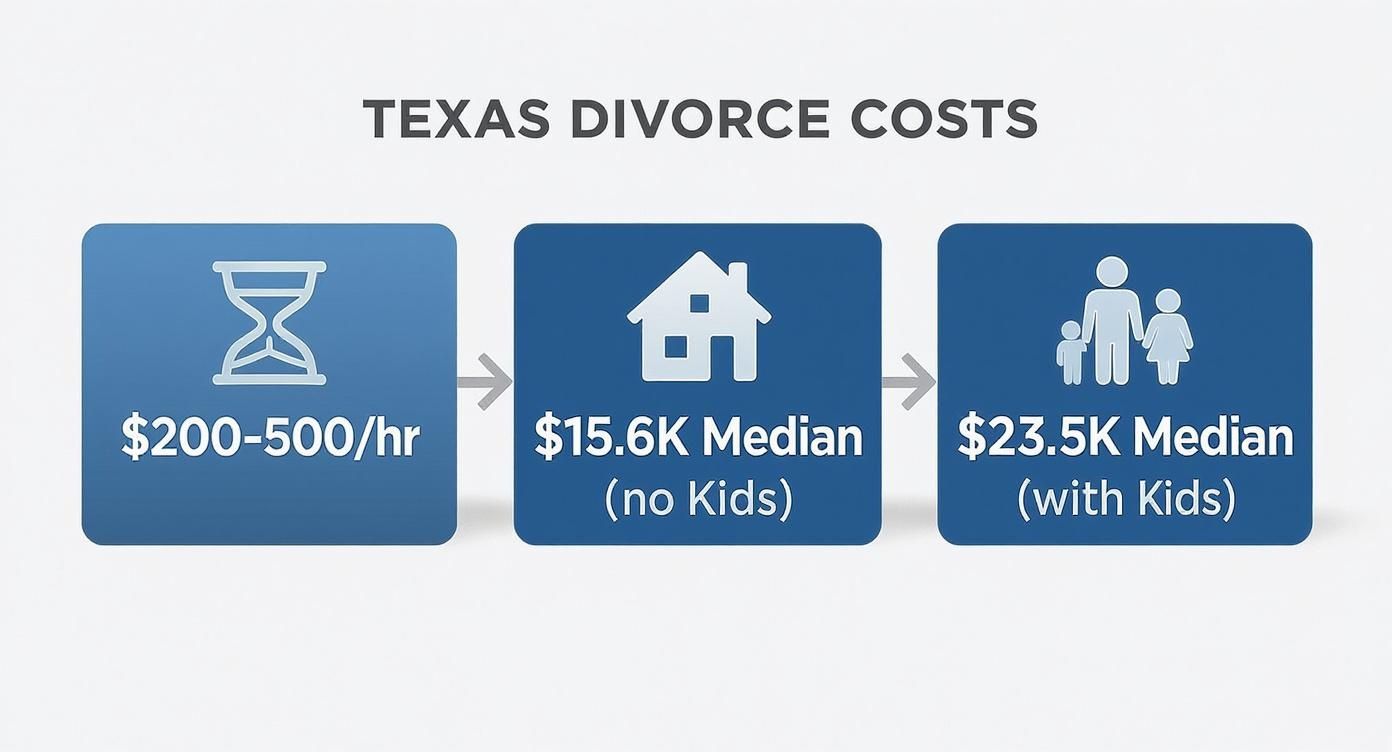
As you can see, the single biggest factor influencing the cost of a divorce is whether or not children are involved.
To give you a clearer starting point, here is a practical overview of what different types of divorces might cost in total. This is not a formal quote, but it provides a realistic snapshot of what many people in Texas experience.
Typical Texas Divorce Costs at a Glance
| Divorce Type | Typical Cost Range (Total Legal Fees) | Key Characteristics |
|---|---|---|
| Uncontested / Amicable | $3,000 – $7,000 | Spouses agree on all major issues; minimal attorney involvement. |
| Moderately Contested | $8,000 – $15,000 | Some disagreements on property or custody; requires negotiation. |
| Highly Contested (No Children) | $12,000 – $20,000 | Significant disputes over complex assets like businesses or investments. |
| Highly Contested (With Children) | $18,000 – $30,000+ | Major conflicts over custody, child support, and property; may go to trial. |
This table helps frame the conversation. Where your situation falls on this spectrum depends entirely on your unique circumstances.
Key Factors in Your Divorce Budget
Every divorce is different, but a few core issues almost always determine the final cost. It is helpful to consider these from the very beginning.
- Level of Conflict: This is the most significant factor. The more you and your spouse can agree on without lengthy legal battles, the lower your costs will be. Every protracted argument has a price tag.
- Complexity of Assets: Dividing a simple bank account is straightforward and inexpensive. However, valuing and dividing a family business, multiple real estate properties, or complex investments requires time, expert analysis, and higher legal fees.
- Child-Related Issues: When parents cannot agree on custody, visitation schedules, or child support, the legal process can become prolonged and costly. These disputes are often the most time-consuming—and therefore most expensive—part of a divorce.
By understanding these factors, you can begin to anticipate your own costs and make informed choices that protect your family, your finances, and your future.
How Texas Divorce Lawyers Bill for Their Time
Understanding how a lawyer's bill works should not be another source of stress. In Texas, divorce attorneys typically use a few standard methods to charge for their services. Familiarizing yourself with these billing structures will empower you to have a clear, upfront conversation about fees, ensuring you know exactly what you are paying for from day one.
Most family law firms, including The Law Office of Bryan Fagan, PLLC, primarily use an hourly billing model that begins with a retainer fee. Let's look at how this and other common fee arrangements function in practice.
The Retainer Fee: A Down Payment for Legal Services
A retainer fee is best understood as a down payment for your legal case. It is an upfront sum you pay to the law firm, which is then held in a special, protected trust account. This is not the total cost of your divorce; rather, it is a starting fund from which your attorney will draw as they dedicate hours to your case.
For example, if you pay a $5,000 retainer and your attorney works for four hours on your case at a rate of $300 per hour, they will bill $1,200 for that time. That amount is then transferred from your trust account to the firm's operating account. You will receive a detailed, itemized invoice showing precisely what services were performed and how your retainer was used.
It is important to know that the Texas Disciplinary Rules of Professional Conduct require attorneys to keep client funds in a separate trust account. This rule is designed to protect you, ensuring your money is held securely and is only used for work actually performed on your case. This transparency is key to your peace of mind.
Once the initial retainer is depleted, you will typically be asked to replenish it or begin paying monthly invoices for ongoing work. Understanding this process helps clarify how the divorce attorney cost in Texas is managed throughout your case.
Hourly Rates: The Most Common Approach
The hourly rate is the standard billing method for contested divorces for a simple reason: it is impossible to predict exactly how much time a case will require. Every phone call, email, court document, and negotiation session is tracked and billed, often in small increments like tenths of an hour (every six minutes).
Your attorney’s hourly rate reflects their experience, the complexity of your case, and the firm's reputation. While a higher hourly rate may seem intimidating at first, a seasoned attorney can often resolve issues more efficiently, which could save you money in the long run.
Flat Fees: Predictability for Simpler Cases
For straightforward, uncontested divorces where you and your spouse are in agreement on all major issues, some firms may offer a flat fee. This is a single, all-inclusive price for the entire divorce process. This approach provides cost certainty and is an excellent option if your situation involves minimal conflict and a simple marital estate. The key, however, is to get a crystal-clear understanding of what the flat fee covers—and what actions might lead to additional charges.
What Drives the Final Cost of Your Divorce
Determining the final cost of a divorce can feel like estimating the price of a major home renovation before seeing the blueprints. There is no fixed price because the total depends on the specific circumstances, the complexity of the issues, and any unexpected challenges that arise. Similarly, your total divorce bill is shaped by key variables unique to your family.
Understanding these factors is crucial. It helps you identify where costs are likely to increase and empowers you to make smarter decisions that can keep your legal expenses under control.

Conflict Versus Cooperation
The level of conflict between you and your spouse is the single biggest driver of divorce attorney costs. Every disagreement that requires your attorneys to negotiate, draft responses, or prepare for a hearing translates directly into billable hours.
Consider this scenario: a simple argument over a piece of furniture can lead to multiple emails and phone calls between lawyers, easily adding several hundred dollars to your bill. When you multiply that by every point of contention—from parenting schedules to bank accounts—you can see how quickly costs can escalate. Conversely, cooperation is the most powerful tool you have for keeping costs down.
Complexity of Your Marital Estate
The type and value of your assets play a significant role in the final cost. Dividing a shared checking account and vehicles is a relatively simple task. However, if your marital estate includes more complex assets, the process becomes more involved and, consequently, more expensive.
Here are a few common examples that add layers of complexity:
- A Family Business: You cannot simply guess a business's value. A proper valuation requires hiring a specialized financial expert, which can cost thousands of dollars.
- Multiple Real Estate Properties: Each property must be professionally appraised. Then, you must negotiate who retains each property, whether to sell, or if one spouse will buy out the other's interest.
- Retirement Accounts and Investments: Dividing 401(k)s, pensions, or other investment accounts requires a special court order known as a QDRO (Qualified Domestic Relations Order), which is an additional legal document your attorney must prepare.
Put simply, the more entangled your finances are, the more time and specialized expertise are needed to ensure everything is divided fairly and equitably according to the Texas Family Code.
Issues Involving Children
When children are part of the equation, the emotional and financial stakes are immediately higher. Disputes over child custody and support are often the most intense and costly aspects of any divorce.
If you and your spouse cannot agree on a parenting plan, a judge may order a child custody evaluation. This involves a neutral mental health professional who will interview you, your children, and other relevant individuals before making a recommendation to the court. These evaluations are incredibly thorough and can easily add $5,000 to $10,000 or more to your total bill.
Drawn-out custody battles can cause the cost of a divorce to skyrocket. A moderately contested divorce might cost between $7,000 and $15,000. However, if that case proceeds to trial over custody, those fees can easily double. For high-asset divorces with contentious custody disputes, it is not uncommon for costs to exceed $30,000 per person. You can find more details by exploring these key facts every Texan should know.
Your Attorney’s Experience and Approach
Finally, the lawyer you choose will influence your costs. It may seem counterintuitive, but while a seasoned attorney often has a higher hourly rate, their expertise can actually save you a significant amount of money in the long run.
An experienced lawyer has handled countless cases and can anticipate problems, navigate complex negotiations efficiently, and avoid costly mistakes that a less experienced attorney might make. Their guidance is invaluable in helping you pick your battles, preventing you from investing thousands into a fight you have little chance of winning.
Practical Strategies to Manage Your Legal Expenses
While you cannot control every aspect of your divorce, you have more power over the final cost than you might realize. Taking a proactive role in your own case is one of the most effective ways to keep your legal bill from spiraling. By being an organized and efficient partner to your attorney, you can help them reduce billable hours, which puts money back in your pocket.
This section provides actionable advice to help you manage the divorce attorney cost in Texas. Each strategy offers practical steps that can lead to significant savings.

Prepare and Organize Your Financial Paperwork
One of the most time-consuming—and therefore expensive—phases of any divorce is "discovery," when both sides must exchange all financial information. You can save your attorney significant time, and yourself a lot of money, by doing the organizational work yourself.
Before your first meeting, begin gathering and organizing every financial document you can find. The more prepared you are from day one, the less time your legal team will need to spend tracking down paperwork, which directly translates into lower fees for you.
Here are the essential documents you will want to collect:
- Income Information: Recent pay stubs, W-2s, and tax returns for both you and your spouse.
- Asset Statements: This includes bank account statements, retirement account statements (like 401(k)s and IRAs), and any investment portfolio reports.
- Debt Records: Collect mortgage statements, car loan details, credit card bills, and documents for any other outstanding loans.
- Property Deeds: Find the deeds to any real estate you own, along with recent property tax appraisals.
Presenting this information in a clear, organized format—such as a labeled binder or a neat digital folder—makes your attorney's job much easier and far more cost-effective.
Communicate Efficiently with Your Attorney
Every phone call and email to your lawyer is typically a billable event. While open communication is vital, how you communicate can have a major impact on your final bill. Making frequent, unscheduled calls for every small question that comes to mind can add up quickly.
A smart strategy is to bundle your non-urgent questions. Keep a running list and then address them all in a single, well-structured email or during one scheduled phone call. This approach is far more cost-effective than making five separate calls throughout the week.
This does not mean you should hesitate to reach out with truly urgent matters. However, for routine questions, batching your communication shows respect for your attorney's time and is an excellent way to save money. Being concise and clear helps your lawyer provide the answers you need without expensive back-and-forth communication.
Choose Your Battles Wisely
Emotions run high in a divorce, making it easy to get drawn into fights over seemingly small issues. It is crucial to remember that every argument comes with a price tag. Fighting over a piece of furniture worth $500 could easily end up costing you $1,000 in legal fees to resolve.
This is where your attorney's guidance is invaluable. A good lawyer will help you perform a cost-benefit analysis on each point of contention. Is this issue really worth the time, stress, and money it will take to fight over?
Exploring alternative dispute resolution methods like mediation can be a powerful tool for saving money. Mediation allows you and your spouse to work with a neutral third party to find common ground, often resolving disputes in a fraction of the time and at a fraction of the cost of going to court. Prioritizing what truly matters and learning to let go of smaller disagreements is one of the most effective ways to control your legal expenses.
Looking Beyond Attorney Fees to Other Divorce Expenses
When planning for a divorce, it is easy to focus solely on your lawyer’s bill. However, that is only one piece of the financial puzzle. To get a complete picture of what your divorce will cost, you must also consider the other common expenses that arise along the way.
Budgeting for these "hidden costs" is not about being pessimistic; it is about being prepared. It helps you avoid surprises and gives you a much-needed sense of control over your finances during a turbulent time.

Thinking of these additional expenses as a normal part of the legal process allows you to plan for them from the outset.
Common Ancillary Costs in a Texas Divorce
From filing the initial petition to gathering evidence, you will encounter several standard fees. Some are minor, but others can add up, especially in a complicated divorce.
Here are a few of the most common costs to have on your radar:
- Court Filing Fees: Every Texas divorce begins with an Original Petition for Divorce. The county court charges a fee to open your case, which typically ranges from $250 to $350.
- Process Server Fees: After filing, your spouse must be formally notified. This is called "service of process," and you will need a professional process server or a sheriff's deputy to deliver the legal papers. This service usually costs between $50 and $100.
- Mandatory Parent Education Courses: If you have minor children, Texas law generally requires both parents to complete a co-parenting class. The goal is to help you navigate parenting during and after the divorce, and these courses typically cost $25 to $50.
When Expert Witnesses Are Necessary
In a contested divorce, costs can increase significantly. If you and your spouse cannot agree on the value of complex assets or custody arrangements, you may need to hire expert witnesses to provide specialized testimony. These professionals can be crucial for protecting your rights, but they represent a notable added expense.
The need for expert testimony highlights a critical point: a fair divorce settlement is built on objective, credible evidence. Experts provide the court with the specialized information it needs to make an informed decision, especially when spouses disagree on key facts.
Here are some of the experts you might need to hire:
- Property Appraisers: To determine the fair market value of your home or other real estate.
- Business Valuation Experts: If you or your spouse owns a business, an expert will be needed to calculate its worth for property division.
- Forensic Accountants: These financial detectives can trace hidden assets or clarify complex financial records.
- Child Custody Evaluators: A mental health professional appointed to assess the family and recommend a custody arrangement that is in the children's best interest.
Beyond the legal process, divorcing parents often face costs related to managing the new family dynamic. For instance, engaging in co-parent counselling for separated couples can be vital for everyone’s well-being. Factoring in these varied costs from the start gives you a complete and realistic financial picture.
Time to Take the Next Step with Confidence
Navigating the financial aspects of a divorce can feel overwhelming. We have walked through the different fee structures, the factors that drive costs, and practical strategies to help you feel more in control. The most important takeaway is this: while the divorce attorney cost in Texas is not a single, fixed number, knowledge is your most powerful tool. You do not have to figure this out alone.
Professional guidance brings clarity to the chaos and is essential for protecting your family, your finances, and your future. An experienced attorney acts as your advocate and strategist, ensuring your rights are protected under the Texas Family Code while helping you make smart, informed decisions every step of the way.
This is your opportunity to move forward from a place of strength, not uncertainty. Understanding your options is the first step toward reclaiming your peace of mind and building a stable new beginning for you and your family.
If you are ready to discuss your specific situation, our team is here to listen. We invite you to schedule a free, no-obligation consultation. It is a straightforward way to receive personalized advice, understand potential costs, and see a clear path forward.
If you need help navigating divorce, custody, or estate planning in Texas, contact The Law Office of Bryan Fagan today for a free consultation.
Frequently Asked Questions About Divorce Costs in Texas
When you're facing a Texas divorce, it is natural for specific, practical questions to arise. Let's address some of the most common ones we hear from our clients about the financial side of the process.
Can I Make My Spouse Pay for My Attorney Fees in Texas?
In certain circumstances, yes. While the general rule in Texas is that each party pays their own legal fees, a judge has the discretion to order one spouse to cover some or all of the other's attorney fees. This typically occurs when there is a significant disparity in income or if one spouse has engaged in misconduct during the divorce process.
For example, if one spouse controls all the financial resources, leaving the other without the means to hire a lawyer, a judge may intervene to level the playing field. A court can also award attorney’s fees as a sanction if a party is found to be hiding assets or unnecessarily prolonging the case.
Is a Flat Fee Divorce a Good Option for My Situation?
A flat fee can be an excellent choice, but only if your divorce is truly uncontested. This means you and your spouse are in complete agreement on all issues—property division, child custody, support, and everything in between. The primary benefit is cost predictability, which provides significant peace of mind.
However, this model is not suitable for contested cases where the amount of work required is uncertain. If you begin with a flat fee and disagreements arise, you will likely need to transition to an hourly billing arrangement. Therefore, it is essential to be realistic about the level of cooperation you can expect from your spouse.
How Can I Keep Track of My Legal Costs?
A reputable family law firm will provide complete financial transparency. You should expect to receive regular, itemized invoices—usually monthly—that detail every task performed on your case and its associated cost. These statements show exactly how your retainer is being used and what your current balance is.
Never hesitate to review these statements carefully and ask your attorney questions. Maintaining an open dialogue about your budget and the billing process is a sign of a healthy and productive attorney-client relationship.
Does a Longer Marriage Automatically Mean a More Expensive Divorce?
Not necessarily. While it is true that longer marriages often involve more complex assets to divide (such as retirement accounts and real estate), the most significant factor driving up costs is conflict, not duration.
A couple married for 25 years who can amicably agree on how to divide their estate can have a much less expensive divorce than a couple married for three years who fights over every detail.
If you need help navigating divorce, custody, or estate planning in Texas, contact The Law Office of Bryan Fagan, PLLC today for a free consultation.