

Planning for the future of a loved one with a disability involves careful thought, especially when you want to protect their eligibility for government benefits while also providing supplementary support. Establishing a special needs trust can serve both goals. Let’s explore the key legal requirements you’ll need to consider under Texas law, offering a clear roadmap so you can move forward with confidence.
We’ll begin by outlining the legal foundations so you know exactly what the requirements are.
Legal Framework: What Texas Recognizes and Requires
Before you begin drafting your plan, it’s helpful to understand how state and federal law intersect to govern special needs trusts. Texas special needs trust requirements reflect both state-specific rules and the federal Medicaid/SSI eligibility overlay.
- Texas does not have a special statute exclusively for special needs trusts. Rather, legally sound special needs trusts in Texas must satisfy federal rules as applied by Texas agencies.
- For example, in Texas a properly drafted first-party trust must include a pay-back provision (to the state for Medicaid payments) and be irrevocable if assets belong to the beneficiary.
- The state’s handbook for exception trusts (for Medicaid purposes) explains that the trust must be created by a parent, grandparent, legal guardian or court on behalf of the individual.
- Because eligibility for programs like Supplemental Security Income (SSI) or Medicaid depends on asset and income limits, the trust must be structured so that the assets are not counted as the beneficiary’s personal resources.
Types of Trusts and Their Requirements
When including special needs planning in your estate plan, you’ll encounter three primary types of trusts. Each must meet certain Texas special needs trust requirements to function as intended.
First-Party (Self-Settled) Special Needs Trust
- Funded with assets belonging to the person with the disability (for example, from a settlement or inheritance).
- The trust must be established by a parent, grandparent, guardian or court (not the individual alone in most cases).
- The trust must be irrevocable and include language requiring reimbursement of Medicaid (or the state) for benefits provided after the beneficiary’s death or when the trust ends.
- Because these trust assets are originally the beneficiary’s, careful structuring is required so they are excluded from countable resources for SSI/Medicaid eligibility.
Third-Party Special Needs Trust
- Funded with assets from someone other than the beneficiary (e.g., parent, grandparent, friend).
- Typically may be revocable or irrevocable depending on how it’s drafted, but because the beneficiary did not contribute the funds, the pay-back requirement to the state may not apply.
- These allow more flexibility in how remaining assets are distributed after the beneficiary’s death (for example, to siblings or charities).
Pooled Trust
- Managed by a nonprofit organization that pools assets from many beneficiaries for investment and administrative efficiency, while maintaining separate accounts for each beneficiary.
- Often an option when the amounts to be placed in trust are modest or for individuals whose families prefer outsourcing administration.
- Must still respect the eligibility and trust-distribution requirements so as not to interfere with SSI/Medicaid participation.
When you compare these types, you’ll want to assess not only the legal requirements but also which trust best aligns with your loved one’s needs, funding sources and long-term goals.
Critical Drafting Elements and Compliance
Once you’ve selected the type of trust, the next step lies in the draft itself—this is where many of the Texas special needs trust requirements are embedded and must be carefully followed.
Trustee Selection and Powers
- The trustee must have the power to manage trust assets, invest appropriately and make distributions for the beneficiary’s supplemental needs.
- The trust document should provide for successor trustees so that if the initial trustee becomes incapacitated or unwilling, the trust administration continues smoothly.
- The trustee should be aware of the restrictions on distributions. Assets should not be treated as direct cash to the beneficiary (which could jeopardize benefits).
Funding and Timing Requirements
- For first-party trusts, the trust must be funded typically before the beneficiary reaches age 65 (for Medicaid/SSI exclusion) under federal rules.
- The document should clearly identify who the grantor is, how the funding will occur, and specify the beneficiary’s disability status.
- Assets transferred into the trust must be held for the beneficiary’s benefit and must follow wording that ensures they are not treated as the beneficiary’s personal asset.
Distribution Standards
- The trust should specify that distributions are at the trustee’s discretion and cannot be given outright as cash to the beneficiary unless carefully structured.
- It must articulate that distributions are for supplemental and extraordinary needs beyond what government benefits cover—not basic food or shelter if doing so will count as income/state-considered support.
Documentation and Record-Keeping
- It is essential the trust document contains all terms, defines allowable uses and clarifies remainder beneficiary provisions (especially relevant to pay-back or third-party trusts).
- Trustee must maintain accounting and keep records of how funds are used so as to satisfy both legal and benefit-eligibility oversight.
By ensuring these drafting elements are handled correctly, you create a trust that meets both the letter and spirit of the law, positioning the beneficiary to keep their public benefits intact while accessing supplemental support.
Funding Strategies, Asset Protection & Benefit Eligibility
Having explored how the trust must be created and drafted, you’ll also want to understand how to fund it, how it interacts with benefits and what measures to consider for asset protection.
Funding Sources and Timing
- For third-party trusts, funding comes from outside the beneficiary and can include life insurance policies, investment accounts, or direct contributions from relatives.
- For first-party trusts, the beneficiary’s own funds are used (inheritance, settlement proceeds) – these must be properly placed into the trust rather than the individual retaining them.
- It is advisable to fund early, especially if there is an inheritance or settlement expected, to avoid disqualifying the beneficiary from needs-based benefits.
Benefit Eligibility Considerations
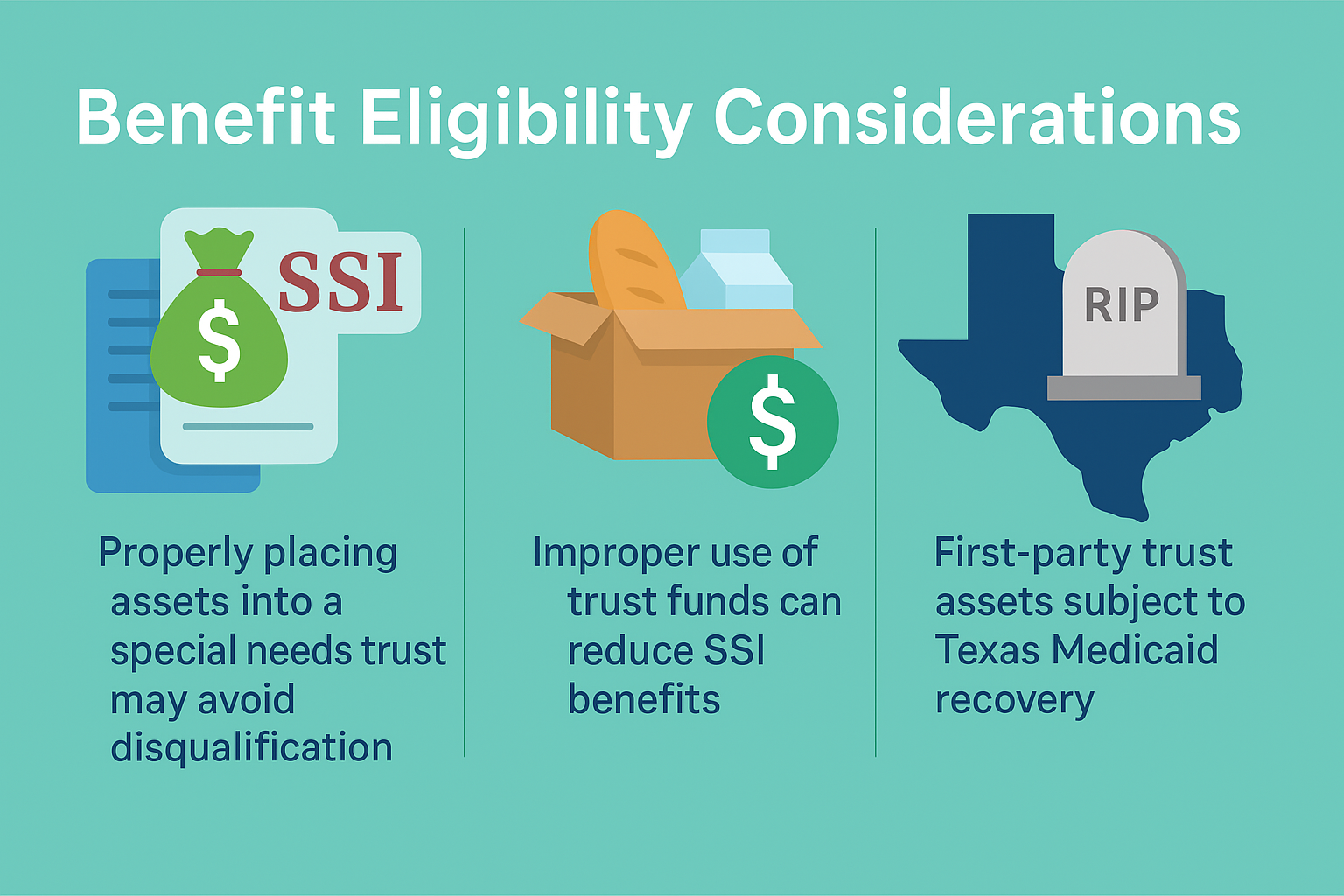
- Federal programs such as SSI set asset limits (for example the $2,000 countable asset cap for many SSI recipients) so properly placing assets into a special needs trust may avoid disqualification.
- Trust funds used improperly (for example basic food or shelter paid directly) may be treated as “in-kind support and maintenance” which can reduce SSI benefits by about one-third.
- The state of Texas, via its Medicaid Estate Recovery Program, can seek reimbursement from first-party trust assets after the beneficiary’s death; a third-party trust typically avoids this pay-back.
Asset Protection Benefits
- By keeping the trust assets separate from the beneficiary’s direct control, the funds are less vulnerable to creditors or mismanagement, provided the trust is properly drafted.
- The trustee’s discretionary power is key—excessive or uncontrolled distributions may raise the risk of eligibility audit or trust disqualification.
- A pooled trust allows economies of scale and oversight via the nonprofit structure, which may benefit beneficiaries whose families prefer less hands-on management.
Trustee Duties, Monitoring Trust Performance and Decision Factors
Choosing the right trustee and staying on top of the trust’s performance are essential to fulfilling the Texas special needs trust requirements and achieving your objective of supplemental support without jeopardizing benefits.
Trustee Competency and Guidance
- The trustee must understand their role in making distributions that enhance the beneficiary’s quality of life without crossing the line into countable income.
- They must keep detailed records of disbursements, investments and trust administration.
- The trust should provide for successor trustees and potential corporate or professional trustees if circumstances change.
Monitoring and Review
- Annual or periodic reviews of trust assets, investment performance and whether the trustee is complying with the trust document and law are recommended.
- If the beneficiary’s medical condition, living situation or government benefits change, the trust may need adjustment (via amendments if permitted) or at least review by an attorney familiar with special needs planning.
Decision Factors When Drafting
When deciding how to proceed, consider these factors:
- The beneficiary’s age, condition, level of independence and anticipated longevity.
- Availability of family resources or inheritance that will fund the trust.
- Whether you want remaining assets after the beneficiary’s death to flow to family members (third-party trust) or be subject to state pay-back (first-party trust).
- Trustee willingness, competency and relationship to the beneficiary.
- Whether a pooled trust makes sense given funding size and administrative complexity.

Next Steps and Practical Considerations
After understanding the legal and administrative requirements, your next focus should be practical implementation: drafting the document, funding the trust, selecting a trustee and integrating the trust into your overall estate plan.
- Consult with an attorney experienced in special needs trust planning in Texas.
- Prepare a Letter of Intent for the beneficiary outlining preferences, routines, living arrangements and any special care instructions.
- Coordinate the trust with other estate-planning documents: will, power of attorney, guardianship designation and life insurance beneficiary designations so that assets flow into the trust and not directly to the beneficiary.
- Ensure the funding mechanism is in place (for example naming the trust as beneficiary of insurance, transferring investment accounts, etc.).
- Educate the trustee (and successor) about allowable distributions, record-keeping and monitoring benefit eligibility.
- Periodically revisit and adjust the plan as laws change (federal or Texas), the beneficiary’s circumstances evolve or assets/investments change.
Conclusion
Creating a trust that properly supports a loved one with disabilities while preserving need-based government benefits requires thoughtful planning, correct drafting and careful administration. By following the relevant legal requirements, selecting the appropriate trust type, funding it appropriately and appointing a capable trustee, you can establish a structure that enhances your loved one’s life and secures their financial stability.
As you move ahead, remain mindful of changing laws, the beneficiary’s evolving needs and regular reviews of trust performance. Taking these steps sets a strong foundation for the future you intend for someone special.
Other Related Posts
- Why You Need an Attorney for Living Will Decisions and Planning
- Finding the Right Texas Special Needs Trust Lawyer for Your Family’s Future
- Is a Living Will Legally Binding and How It Works in Real Situations
- Key Benefits of Minor Guardianship in Texas: Legal Protection and Parental Support
- Creating a Living Will: A Clear Legal Framework for Your Future Care
- How to File for Temporary Guardianship the Right Way: What You Need to Know
- Understanding the Cost of Special Needs Trust for Long-Term Planning
- How to Set Up a Living Will: Step-by-Step Legal Planning Guide
- Texas Guardianship Attorney Services: Essential Legal Support for Families
- Special Needs Trust Medicaid Guide: Protecting Benefits Without Sacrificing Support
- dvance Directives vs Living Will: A Practical Comparison for Medical Planning
- Texas Court Guardianship Evaluation Process: How It Works and What to Expect
Frequently Asked Questions
A first-party trust must typically be established before the beneficiary reaches 65 in order to fully protect Medicaid/SSI eligibility under federal rules.
No. To protect benefits, the beneficiary generally cannot control the trust assets directly. The trustee must have discretion over distributions.
Yes, if the inheritance would otherwise exceed the asset limit for SSI/Medicaid. A first-party trust may be appropriate if the asset belongs to the beneficiary. The trust must be drafted properly to avoid losing benefits.
The trust can pay for certain enhancements or support services, but direct payment for basic food or shelter may count as income and reduce SSI. Distributions must be carefully structured.
It depends on the trust type. In a first-party trust, the state may seek repayment for Medicaid benefits before heirs receive any remainder. In a third-party trust, assets can be distributed to family or charities as designated.