Skip to content

A Texas family court can impose monetary sanctions, hold a party in contempt with fines of up to $500 or county-jail confinement of up to six months, restrict possession or visitation, order attorney's fees, require bonds, or refer extreme abuse-allegation misconduct to child-protective services. The specific remedy depends on whether the conduct violated an existing order, abused discovery, involved a false allegation, or justified statutory fee-shifting.
You may be dealing with this right now because the other parent withheld your court-ordered possession, your former spouse refuses to produce financial records, or someone made an abuse allegation that changed your child's schedule overnight. Sanctions can feel like another crisis layered on top of an already painful divorce or custody dispute. Texas courts don't treat every disagreement as sanctionable misconduct, however, and the path to relief depends on matching the evidence and procedure to the conduct.
What This Guide Covers For Texas Families
A parent who misses a possession exchange once may have an explanation. A parent who repeatedly refuses to follow a clear order, conceals evidence, or makes a knowingly false allegation presents a different problem. The court's response must account for the conduct, the harm it caused, and the safeguards that protect both families from unfair punishment.

The central distinction is between contempt, discovery sanctions, and statutory fee-shifting or civil sanctions. Contempt generally addresses disobedience of an existing court order. Discovery sanctions address misconduct in obtaining or exchanging evidence. Fee-shifting provisions, including Texas Family Code § 157.167, can require a person who violated possession or access orders to pay reasonable attorney's fees and court costs when the statutory requirements are met. The remedies overlap in practical effect, but the proof and procedure don't.
Why the distinction matters
A contempt proceeding may seek coercive compliance or punishment for a deliberate violation. A discovery motion may ask the judge to exclude evidence, establish facts, or strike pleadings because the opposing party obstructed the litigation. A statutory request may focus on reimbursing costs caused by enforcement or responding to a false abuse allegation.
Those differences affect what you should gather:
- Order violations: Keep the signed order, possession calendar, messages, exchange records, and evidence showing the other party knew the obligation.
- Discovery abuse: Preserve requests, responses, delivery confirmations, deposition notices, orders compelling discovery, and invoices showing expenses caused by the violation.
- False allegations: Organize contradictory records carefully, including communications, medical or school records, witness information, and prior sworn statements. A disagreement about parenting is not automatically a false allegation.
Practical rule: Sanctions work best when the request is narrow, documented, and tied directly to the harm the court can see in the record.
The court's purpose isn't just to declare one parent the winner. Sanctions can protect a child's relationship with both parents, preserve a fair process, compel compliance, and discourage conduct that makes litigation more expensive or unsafe. They can also affect possession, visitation, support enforcement, evidence, and the credibility of the person asking for relief.
The Three Legal Paths For Sanctions In Texas Family Court
Texas family courts don't use one general punishment for every kind of bad conduct. The available remedy depends on which legal path applies and whether the requested sanction fits the misconduct.
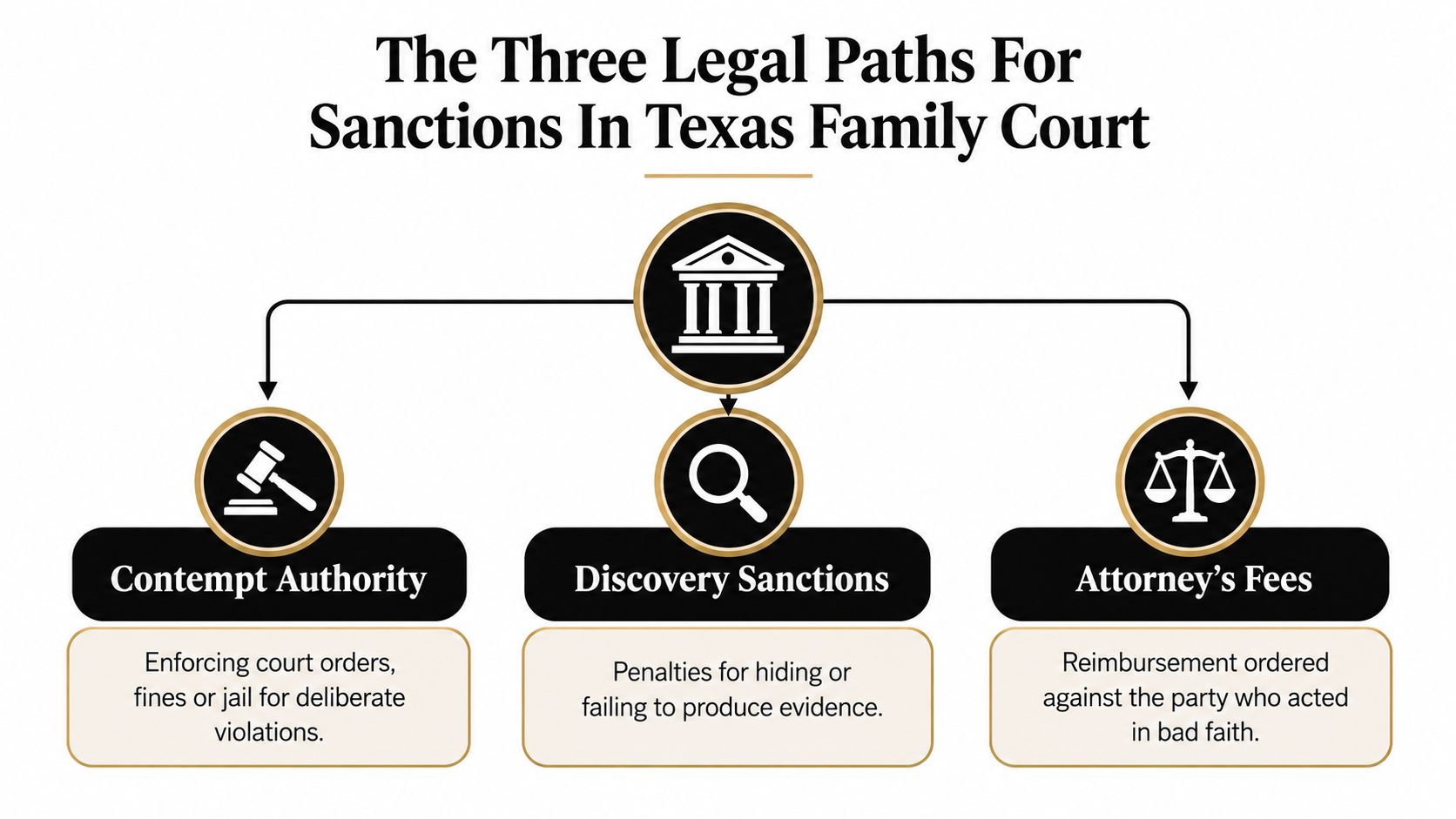
Contempt is usually connected to an existing order. A party seeking enforcement must identify the command, show that the respondent knew about it, and present evidence that the respondent violated it. In a custody case, that may involve refusing to surrender a child during ordered possession. In a support case, it may involve failing to pay an obligation as ordered.
Texas distinguishes between civil or coercive contempt and criminal or punitive contempt. A coercive order is designed to encourage compliance, often through a clearly stated condition that allows the respondent to avoid or end confinement by doing what the order requires. Punitive contempt addresses completed misconduct and must be imposed with appropriate procedural protections. The Texas State Law Library's explanation of contempt describes this distinction and the importance of treating the two forms differently.
Discovery sanctions
Discovery sanctions apply when a party abuses the process used to obtain evidence. Examples include withholding documents, violating a discovery order, obstructing a deposition, or refusing to provide information after a court has directed compliance. Under Texas Rule of Civil Procedure 215.2, the court may order expenses, exclude evidence, establish facts, restrict claims or defenses, stay the case, or impose more severe remedies in appropriate circumstances. The court must still connect the sanction to the discovery failure.
A party shouldn't be sanctioned for a response that was substantially justified or supported by a non-frivolous argument. That fairness limitation matters when the parties have a legitimate dispute about privilege, relevance, possession of a document, or the scope of a request.
Statutory fee-shifting and civil sanctions
Some Texas statutes provide targeted remedies instead of relying only on general contempt or discovery rules. Under Texas Family Code § 157.167, a respondent who fails to comply with a possession or access order may be ordered to pay the movant's reasonable attorney's fees and all court costs, in addition to other remedies. The statute also permits enforcement of those fees through mechanisms used for child support, including contempt, when the violation affected the child's physical or emotional health or welfare. Texas Family Code § 157.167 provides the statutory framework.
Texas Family Code § 105.006 separately authorizes any civil sanction permitted under law when a court finds that a party made a false allegation of child abuse or neglect. Potential relief can include attorney's fees, expert costs, and other expenses. That provision has been part of the Texas Family Code framework since 1995, giving judges a direct family-law tool when false allegations disrupt custody litigation. In a domestic-violence or family-safety matter, Protective Orders may also be relevant, but a protective-order proceeding and a sanctions request are not interchangeable.
How Contempt And Monetary Penalties Work In Practice
Contempt is often the remedy clients fear most because it can involve confinement. It isn't automatic. The judge must evaluate the order, the alleged violation, the respondent's ability to comply when relevant, the evidence of intentional conduct, and whether the proposed remedy is legally available.
For family-law enforcement proceedings, Texas authority generally caps punishment at a fine of not more than $500, county-jail confinement of not more than six months, or both. Total confinement from the same matter is capped at 18 months, and courts may suspend commitment and place a respondent on community supervision in many enforcement cases. The statutory limits appear in Texas Government Code § 21.002.
The court starts with the order
A strong enforcement case usually follows a clear sequence:
- Identify the exact command. The order should say what the party had to do, when the duty applied, and how compliance was supposed to occur.
- Show notice. The respondent must have had notice of the obligation. A vague conversation or informal parenting arrangement usually presents a different enforcement question from a signed order.
- Document the violation. Use calendars, messages, payment records, exchange-location evidence, school records, or witness testimony, depending on the issue.
- Address defenses. A parent may argue that compliance was impossible, the order was ambiguous, the child's immediate safety required a departure, or the alleged event didn't occur.
- Request a proportionate remedy. The requested sanction should address the actual violation rather than punish unrelated conduct.
A court may impose a monetary penalty, confinement, community supervision, corrective conditions, fee-shifting, or a change in possession-related relief when the facts and pleadings support it. A request to restrict visitation should focus on the child's welfare and the specific conduct, not serve as an opportunity to relitigate every disagreement in the relationship.
Civil and criminal contempt require care
Civil contempt typically uses a purge condition. The respondent can avoid or end the coercive consequence by taking a specified action, such as paying an amount, producing required information, or following an order. The condition must be clear enough that the respondent understands what compliance means.
Criminal contempt punishes completed conduct. The court must not casually combine punitive punishment with coercive language, and appellate decisions have continued to scrutinize orders that fail to state clear purge terms or mix civil and criminal contempt improperly. A judge's power is substantial, but due process and statutory ceilings still constrain it.
Attorney's fees and costs serve a different function from jail. Under § 157.167, fees and costs may accompany other enforcement remedies for possession or access violations, and the statute provides an especially important escalation rule for child-support contempt. When a parent is found in contempt for child-support nonpayment and owes $20,000 or more in arrears, the court generally can't waive attorney's fees and costs unless it makes an additional finding concerning the parent's inability to pay and inability to borrow money. The statute itself is the source for that $20,000 threshold and its limitation.
Discovery Sanctions And False-Allegation Penalties
Discovery misconduct often happens outside the courtroom, but it can shape the entire case. A spouse may refuse to produce business records, a parent may avoid a deposition, or a party may provide incomplete answers that prevent the other side from proving income, property ownership, or a child-related issue.
Texas Rule of Civil Procedure 215.2 provides a graduated set of tools. The court may deem facts established, prevent a party from supporting or opposing claims, exclude evidence, reopen a deposition, order reasonable expenses and attorney's fees, strike pleadings, dismiss a case, stay proceedings, or disallow further discovery. The remedy should secure compliance, deter repetition, and punish the violation, while remaining connected to the conduct.
What the judge is looking for
The court will usually focus on four questions:
- Was there a discovery duty or order? A party can't be sanctioned for violating a requirement that didn't apply or wasn't clear.
- Did the conduct interfere with the case? The stronger request identifies how the missing evidence or obstruction impaired preparation, settlement, or trial proof.
- Was the conduct justified? Rule 215 includes a fairness check for conduct that was substantially justified or supported by a non-frivolous argument.
- Does the remedy fit? A fee award should reflect actual expenses caused by the abuse, and a merits-affecting sanction should relate to the issue impaired by the misconduct.
A recent Texas appellate opinion illustrates how serious the consequences can become. In that appeal, the trial court struck a husband's pleadings and barred him from supplementing or offering further discovery at trial under Rule 215.2(b). The opinion described the purposes of Rule 215 sanctions as securing compliance, deterring similar misconduct, and punishing violators. The Fifth Court of Appeals opinion shows why discovery abuse can affect custody evidence, property claims, and trial strategy, not merely litigation expenses.
Discovery misconduct compared with false allegations
A false abuse allegation follows a different statutory track. Under Texas Family Code § 105.006, the court may impose a civil sanction on a party found to have made a false allegation of child abuse or neglect, including fees, expert expenses, and other costs. The finding must be based on the evidence, not merely on the fact that an investigation did not substantiate the accusation.
| Misconduct Type | Common Sanction Options | Key Limitation |
|---|---|---|
| Violating a possession or access order | Contempt, attorney's fees, court costs, and other enforcement remedies | The evidence must establish a violation of the order, and fee recovery follows statutory requirements |
| Hiding documents or obstructing discovery | Expense awards, evidence exclusion, established facts, pleading restrictions, or dismissal | The remedy must have a direct connection to the discovery abuse |
| False allegation of child abuse or neglect | Civil sanctions, attorney's fees, expert costs, and other expenses | The court must find that the allegation was false |
| Groundless pleading or motion | Directives, a penalty paid into court, or the opponent's reasonable expenses and attorney's fees | The remedy must be sufficient to deter repetition, not exceed what the statute supports |
Groundless pleadings and motions are governed separately under Texas Civil Practice and Remedies Code § 10.004. The statutory sanctions provision matters because a party or lawyer may face one framework for abusive filings and another for discovery abuse. Treating every problem as contempt can weaken an otherwise valid request.
How To Request Or Defend Against Sanctions In Texas
A sanctions request should tell the judge exactly what happened, what rule or order applies, what evidence proves the conduct, and why the requested remedy is proportionate. A short, precise motion is usually more persuasive than a pleading that repeats every grievance from the relationship.
If you're seeking sanctions
Start with the record, not the emotion. Attach the order, discovery request, response, correspondence, payment history, or other document that establishes the obligation. Then identify the specific event that violated it and explain the practical consequence.
For example, suppose a parent refuses three scheduled exchanges. The motion should identify the dates, quote the relevant possession language, attach communications showing the refusal, and request a remedy tied to those missed periods. If the parent also made unrelated insulting comments, those comments may be upsetting but they may not strengthen the enforcement request.
A discovery motion should be equally focused:
- Describe the request and deficiency.
- Show efforts to resolve the dispute.
- Identify any order compelling production.
- Explain how the missing material affected the case.
- Document actual fees or expenses caused by the conduct.
- Request only the restriction needed to address the problem.
Notice and a meaningful opportunity to be heard matter. Give the respondent a clear opportunity to answer the allegations, and ask the court for a hearing when the facts or requested remedy require testimony.
If you're defending against sanctions
Don't assume that denying everything is the best defense. Test the elements one by one. Was the order clear? Did you receive notice? Was compliance possible? Did you produce the requested material? Was the response substantially justified? Did the other side really incur the fees claimed?
Recent Texas appellate coverage in 2026 has emphasized that courts must show the required bad-faith basis and a direct nexus between misconduct and monetary sanctions. That means a fee request shouldn't rest on broad accusations alone. A party defending against sanctions should challenge unsupported causation, inflated or undocumented costs, defective notice, and a remedy that reaches issues untouched by the alleged misconduct.
A useful defense is often narrower than “I did nothing wrong.” Explain what happened, correct the record where possible, and show why the requested sanction exceeds the proven harm.
Credibility matters in both directions. Don't destroy messages, coach a child, send angry threats, or file a new accusation just to gain an advantage. Preserve the original records, communicate in a measured way, comply with valid orders while seeking clarification or modification when needed, and discuss the strategy with counsel. If the underlying problem is a changed circumstance rather than intentional disobedience, a request for custody and support modifications may be more appropriate than a sanctions motion.
Real Scenarios Showing Texas Family Sanctions In Action
Consider a parent who repeatedly keeps a child beyond the ordered return time and refuses the other parent's scheduled possession. The first legal question is what the order requires. If the evidence shows deliberate violations, the enforcement track may support contempt and statutory recovery of fees and costs. The court may also address future possession arrangements when the child's welfare requires a carefully crafted remedy.
Now consider a spouse who refuses to produce bank statements and business records after a discovery order. The focus isn't whether the spouse has behaved badly throughout the divorce. It's whether the missing records impaired proof of property or income and whether the proposed sanction addresses that impairment. The court may order expenses, restrict the use of evidence, establish facts, or impose a more serious Rule 215 remedy if lesser measures don't secure compliance.
A third example involves a party who makes a false allegation of child abuse or neglect. The allegation may affect temporary orders, possession, expert involvement, and litigation costs before the matter is fully examined. If the court finds the allegation false, Texas Family Code § 105.006 authorizes civil sanctions, including attorney's fees and expert costs, subject to the evidence and the court's authority.
These examples share an important lesson. Sanctions aren't a substitute for proof, and they aren't a shortcut around due process. The strongest case preserves the order or discovery history, identifies the precise misconduct, demonstrates the effect on the child or litigation, and requests a remedy that fits.
If you're worried that the other side's conduct may affect custody, support, property, or your ability to present evidence, get advice before filing an emergency or sanctions motion. A Texas family-law attorney can help distinguish an enforceable violation from a disagreement that calls for clarification, modification, mediation, or a different court procedure.
If you need help navigating divorce, custody, or estate planning in Texas, contact The Law Office of Bryan Fagan today for a free consultation. The firm can help evaluate enforcement evidence, discovery disputes, possession concerns, and statutory fee-shifting issues, then develop a practical response suited to your circumstances. Visit Law Office of Bryan Fagan, PLLC to learn more and request guidance.