Texas family courts have broad authority over property, children, and support, but that authority is limited by the Texas Family Code, the Constitution, and jurisdictional rules. For example, child support guidelines generally start at 20% of an obligor's net resources for one child and increase by 5% for each additional child, subject to the applicable statutory cap.
You may be facing a divorce, a custody dispute, or an urgent conflict over where your child should live. You may also be worried that a judge can take property you owned before marriage, change an agreement you already signed, or issue an order that lasts forever. Understanding what a Texas family court can and cannot order can make the process less frightening and help you focus on decisions that protect your family.
Understanding Texas Family Court Powers
Family courts can issue binding orders about several personal areas of life. In a divorce, a judge may address community property, community debt, temporary support, and the use of a marital residence. In a Suit Affecting the Parent-Child Relationship, commonly called a SAPCR, the court may address conservatorship, possession and access, child support, geographic restrictions, and other issues involving a child's safety and welfare.
That power has boundaries. A court must act under the Texas Family Code, follow due process, and have authority over the particular people, property, or child involved. A judge can't impose a result because it seems convenient or because one party wants it. The requested relief must fit the case, the evidence, and the law.

Start by identifying the type of order
The first question is whether you need a temporary order or a final judgment. Temporary orders manage immediate problems while a case is pending. They may address who lives in the home, how bills are paid, where a child stays, or whether someone may remove a child from a defined geographic area.
A final judgment resolves the issues before the court. A final divorce decree may divide community property and debt, establish conservatorship and possession, and order support. A final order doesn't mean every future dispute disappears, but it usually defines the parties' legal obligations going forward.
The court's power also depends on the case that was filed. A family court handling a divorce has authority connected to the marriage and marital estate. A court handling a SAPCR has authority connected to the parent-child relationship. A guardianship case follows a different jurisdictional path under the Texas Estates Code.
Practical rule: Before asking what a judge can order, identify the case type, the requested relief, and whether the request is temporary or final.
A court can protect a child during a pending case, but temporary relief isn't a shortcut to permanent custody. It can preserve property while a divorce is pending, but it generally can't use temporary authority to rewrite the final property rights of the parties. That distinction helps you evaluate both your options and the limits of the other side's requests.
What Courts Can Order Regarding Property and Support
Texas doesn't automatically divide every asset down the middle in divorce. Texas is a community-property state, but the court must divide the community estate in a “just and right” manner, not necessarily in equal shares. Property acquired during marriage is generally presumed to be community property, while property owned before marriage or received by gift or inheritance isn't automatically available for division. The foundational rules appear in the Texas divorce property guidance.
Community property and separate property
The court can divide community assets and debts. That may include a residence acquired during the marriage, retirement accounts earned during the marriage, bank accounts, vehicles, and business interests accumulated during the marriage. It must also address community debt in the decree. The fact that an asset is valuable doesn't place it outside the court's reach if the evidence shows it belongs to the community estate.
Separate property is different. A spouse claiming that property is separate generally needs evidence supporting that characterization. A judge cannot reclassify separate property as community property without proof. Records showing ownership before marriage, inheritance documents, gift records, account histories, and tracing evidence may become important.
For example, suppose one spouse owned a home before the marriage. The court doesn't automatically divide the entire home as community property. The analysis may require careful examination of ownership, payments, improvements, and any claims connected to community contributions. The result depends on the evidence and the governing law, not merely on the fact that the spouses lived there together.
Support and control during the case
A Texas court may issue temporary orders to preserve and protect marital property. Those orders can require sworn inventories, compel document production, award temporary spousal support, appoint a receiver, grant one spouse exclusive occupancy of the residence, limit spending to reasonable living expenses, or give one spouse exclusive control of a business or occupation while the case is pending. The court may also order temporary support for either spouse through an appeal in appropriate circumstances, as described in Texas Bar Practice's discussion of divorce temporary orders.
Spousal maintenance isn't an automatic consequence of divorce. Whether it may be ordered depends on statutory requirements, the parties' circumstances, and the evidence presented. A temporary order also doesn't guarantee that the same arrangement will appear in the final decree.
If you're considering Divorce, organize financial records early. Gather deeds, account statements, retirement information, business records, debt statements, tax documents, and documents showing gifts or inheritances. A clear inventory helps your attorney distinguish what the court can divide from what it cannot.
How Texas Courts Handle Child Custody and Support
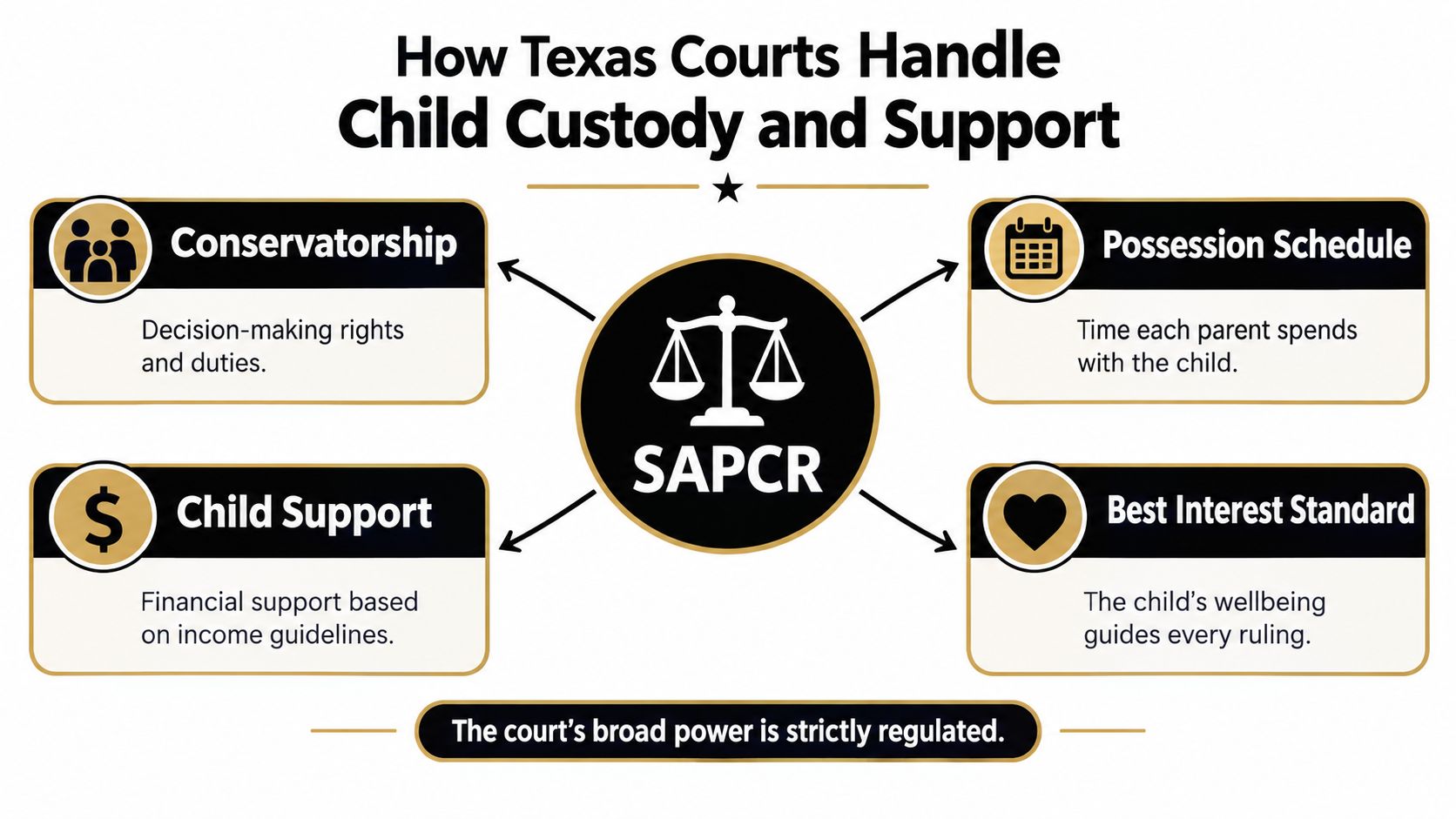
Consider a parent who files a SAPCR after the parents can no longer agree about where their child should live. The court may establish conservatorship, which addresses decision-making rights and duties, and possession and access, which addresses each parent's time with the child. It may also set child support and impose restrictions designed to protect the child.
The court's goal isn't to reward one parent or punish the other. Texas custody decisions are guided by the child's best interest, subject to statutory restrictions and jurisdictional requirements. A parent's preference matters, but it doesn't control the result by itself.
What a SAPCR order may address
A SAPCR can give the court a framework for making practical decisions. Depending on the facts, an order may address:
- Conservatorship: The order can allocate parental rights and duties, including how important decisions are made.
- Possession and access: The order can establish a schedule for the child's time with each parent.
- Child support: The order can require financial support under statutory guidelines and the evidence in the case.
- Safety restrictions: The order can restrict conduct, travel, or removal of the child when the child's welfare requires protection.
The statewide default child-support formula generally starts at 20% of the obligor's net resources for one child and increases by 5% for each additional child. The guideline cap was updated effective September 1, 2025, to $11,700 in net monthly resources, according to the Texas Attorney General's explanation of how child support works. The formula provides a starting point, but the court still applies the governing rules to the facts before it.
Child support usually ends when the child turns 18 or graduates from high school, whichever happens later, unless a disability or another statutory exception applies. That doesn't mean every dispute ends automatically on that date. Parents may still need to address arrears, enforcement, or an applicable exception.
A parent seeking Child Custody guidance should collect school records, medical information, communications, calendars, and evidence relevant to the child's routine and safety. Focus on concrete facts rather than broad accusations. Courts need usable evidence to create an order that works in daily life.
Temporary Orders vs Final Judgments
Temporary orders answer the question, “How will the family function while the case is pending?” A final judgment answers the question, “What legal arrangement will govern after the court resolves the case?” Confusing those two stages can cause unnecessary panic or lead a party to underestimate an urgent problem.

Temporary relief preserves safety and stability
In a pending SAPCR, the court can issue temporary orders covering temporary conservatorship, child support, restrictions against disturbing the child's peace, geographic limits on where a parent may take the child, and attorney's fees and court costs. The mechanism requires a pending SAPCR. It isn't available because someone wants advice or disagrees with the other parent.
Texas Family Code section 109.001 also allows temporary relief during an appeal when necessary to protect a child's safety and welfare. A court may appoint temporary conservators, set temporary support, prohibit a party from disturbing the child or another party, restrict removal beyond a defined geographic area, and order attorney's fees and expenses. The order must serve interim protection, not create permanent custody rights before final resolution. The statute's specific framework is available through this Texas Family Code section on temporary orders.
During a divorce, temporary orders may protect marital property and household stability. A judge may require inventories, limit spending, award temporary support, assign exclusive occupancy of the residence, appoint a receiver, or give one spouse temporary control of a business or occupation. These orders can be especially important when one spouse controls financial accounts or the parties cannot safely share a home.
What temporary orders cannot do
A temporary order generally isn't the final answer on ownership, custody, or support. It can establish a workable arrangement while evidence is gathered and hearings continue, but the court still must address final relief under the applicable legal standards.
If you receive temporary papers, read every requirement carefully. Note hearing dates, exchange locations, geographic limits, payment obligations, and prohibited conduct. Keep proof of compliance, and don't assume that an informal conversation changes a written order.
A protective order also has statutory limits. Texas protective orders generally last up to two years, unless a statute allows a different term. The Texas Family Code provision on temporary orders in divorce cases also illustrates an important jurisdictional boundary: custody authority under the UCCJEA depends on Texas having jurisdiction, with temporary emergency jurisdiction available only when the child is present in Texas and protection from abandonment, mistreatment, or abuse is necessary.
Common Misconceptions About Court Authority
A judge's authority is substantial, but it isn't unlimited. The most common mistake is treating a family court as if it can reach any result that seems fair. Texas courts must work within statutory classifications, procedural protections, constitutional due process, and jurisdictional rules.
A court cannot simply take separate property
People often say that a court can divide everything acquired or used during a marriage. That isn't accurate. The court can divide community property and community debt, but separate property remains outside the community estate unless the evidence supports a legally valid basis for a different characterization.
Mixing funds can create tracing and characterization disputes, but commingling doesn't give a judge permission to disregard the separate-property framework. A spouse who claims an inheritance, premarital account, or gifted asset is separate should preserve the records that support that claim.
A related misconception is that a court can always force a particular business outcome. The court may address a community business interest and may issue temporary orders concerning business control during a divorce. But the final division still must comply with Texas property law. The court's role is to divide the community estate in a just and right manner, not to grant unlimited power over every aspect of an owner's separate property or personal affairs.
Jurisdiction can stop a custody case
The UCCJEA creates a hard boundary around child-custody jurisdiction. Texas can't make a custody determination merely because one parent filed paperwork here. The court must have the required jurisdictional connection, and that authority is treated as exclusive under the statute. Emergency authority is narrower and depends on the child's presence in Texas and the need for protection.
Protective orders can create another layer of complexity when they overlap with a divorce or SAPCR. Recent legislative reporting describes a change to Texas Family Code section 85.064 under which the court that issued a protective order must transfer it into a pending family case if the transfer won't negatively affect safety, and the transfer order must state that finding. The discussion of Texas family-law changes affecting protective-order transfers explains why the controlling court and safety findings matter.
Deadlines can also be more nuanced than people expect. In termination cases, recent appellate reporting explains that Texas Family Code section 263.401 requires timely commencement of trial, not necessarily completion, and that merits evidence taken before the dismissal date preserved jurisdiction even though the case concluded later. The reported termination-deadline decision shows why a missed final-order date doesn't always answer the jurisdiction question by itself.
Next Steps for Texas Families
The safest way to evaluate court authority is to separate your concerns into categories: property, children, support, safety, jurisdiction, and deadlines. Then identify the evidence connected to each category. A concern such as “my spouse will take everything” becomes more manageable when translated into specific questions about community property, separate property, account access, temporary restraints, and documentation.
Build a focused case file
Start with a timeline. Record major financial events, moves, parenting exchanges, school or medical issues, threats, protective-order events, and court filings. Save original messages and identify the dates of important documents. Don't edit screenshots in a way that removes context.
For a divorce, collect financial records and a preliminary inventory. For a custody case, organize information around the child's routine, safety, school, health, and each parent's ability to follow an order. If you're seeking emergency relief, explain the immediate risk with specific facts and supporting evidence.
Estate planning and guardianship matters require a different court analysis. Texas guardianship cases must be filed and heard in a court with original probate jurisdiction. In a county with a statutory probate court, that court has exclusive jurisdiction over guardianship proceedings, while it may share jurisdiction with district courts in specified related matters. These jurisdictional rules are described in the Texas Estates Code provisions on probate jurisdiction.
A guardian may be appointed only after a written application is filed in the proper court. The proceeding may concern guardianship of the person, the estate, or both. A guardian of the estate may manage the ward's property, collect debts, and bring or defend suits involving the ward. Temporary guardianship may be available when there is substantial evidence of incapacity and probable cause that immediate appointment is required, as explained in this Texas courts guardianship resource.

Ask questions that match the court's limits
Before a consultation or hearing, ask:
- What case is pending? Confirm whether the matter is a divorce, SAPCR, protective-order case, termination case, guardianship, or another proceeding.
- What relief is needed now? Separate an urgent request for temporary protection from the final result you want.
- What proof supports the request? Gather documents, witnesses, records, and a clear explanation of how the evidence connects to the legal standard.
- Does the court have jurisdiction? Review the child's location, prior orders, related cases, and the proper probate court when guardianship is involved.
- What deadline controls? Calendar hearings, response dates, trial-commencement requirements, support obligations, and expiration dates.
A qualified Texas family-law attorney can help you distinguish a request the court may legally grant from one that sounds reasonable but exceeds judicial authority. The attorney can also help you negotiate an agreement, prepare for a temporary-orders hearing, respond to a proposed decree, or evaluate whether an existing order can be enforced or modified.
If you need help navigating divorce, custody, or estate planning in Texas, contact The Law Office of Bryan Fagan today for a free consultation.
The following video offers another way to think about the practical choices families face during a legal dispute.
The Law Office of Bryan Fagan, PLLC helps Texas families evaluate property division, temporary orders, custody, child support, guardianship, and related estate-planning concerns within the limits of state law. Visit Law Office of Bryan Fagan, PLLC to schedule a free consultation and discuss the facts, deadlines, and court authority involved in your situation.