 Skip to content

In Texas, a written agreement signed with the fertility clinic before treatment usually decides who receives frozen embryos after divorce. Without a clear agreement, the court must address the dispute case by case because Texas has no statute directly defining the legal status of frozen embryos stored outside the body.
You may be sorting through divorce papers when you remember the embryos still in storage, and the clinic forms you signed while hoping to build a family. Those documents can feel very different now. Understanding what happens to frozen embryos in a Texas divorce starts with finding that paperwork, then separating control of the embryos from permission to use them and responsibility for a future child.
How Texas Courts Decide Who Gets Frozen Embryos
A Texas court's starting point is generally the couple's written disposition agreement, meaning instructions about what happens to stored embryos. The question is whether the document addresses divorce and explains what either spouse may do afterward.
This question carries emotional weight that ordinary property disputes don't. One spouse may see the embryos as the remaining possibility of a biological family, while the other may feel strongly about avoiding reproduction after the marriage ends. Each concern deserves respect. An enforceable agreement still controls unless a court finds a reason not to enforce it.
Why the documents matter
Retrospective reviews of American frozen-embryo litigation describe recurring patterns rather than odds: many disputes reach court with no prior arrangement or no ownership term for divorce, and reported outcomes range from destruction orders to continued storage. Those findings describe American litigation, not Texas outcome probabilities; Texas's separate assisted-reproduction parentage rules appear in the Texas Family Code.
The practical lesson is that missing or incomplete instructions can leave spouses disputing decisions they thought they had already made.
Likely outcome by embryo agreement situation
| Situation | Likely court approach | What decides the outcome |
|---|---|---|
| Signed clinic agreement that addresses divorce | Court generally enforces the written instructions, as in Antoun | Terms, consent, and proper execution of the agreement |
| Clinic form silent on divorce | Outcome uncertain; court considers the form alongside other evidence | Clinic records, the couple's intent, and public-policy arguments |
| No agreement, spouses agree in writing | Court can consider incorporating the settlement into the divorce decree | Written decree terms and the clinic's ability to implement them |
| No agreement, spouses disagree | Court addresses the dispute case by case because no Texas statute sets out how frozen embryos are disposed of in divorce | Evidence of intent, each spouse's interests, and storage and parenthood issues |
An agreement that authorizes storage doesn't necessarily authorize implantation. A form addressing death may say nothing about divorce. Read each provision for the specific event it covers rather than assuming one selection answers every future question.
An award also has limits that surprise people. Receiving the embryos in a decree can settle control of the stored material without settling every later issue: whether the clinic will release them, what consent is required for transfer, and who Texas law treats as a legal parent if a child is born. The signed form often shapes the divorce outcome, while parenthood and permitted use still depend on the decree, clinic requirements, and separate parentage rules.
Start with the questions you can answer
Before predicting what a judge might do, establish:
- Which documents exist? Locate treatment consents, disposition elections, storage contracts, and later amendments.
- Does the clinic form mention divorce? Look for separation, dissolution, disagreement, and withdrawal language as well.
- Do both spouses still agree? Distinguish a shared preference from a genuine signed instruction the clinic can follow.
- What would an award allow? Separate possession of the embryos from permission to attempt pregnancy and from responsibility for a future child.
The firm's explanation of what a Texas family court can and cannot order can help you prepare realistic questions. A judge's authority, the agreement's meaning, and the clinic's implementation requirements need to be considered together.
The Antoun Case and Why Pre-IVF Agreements Matter
A form signed before fertility treatment ended up deciding the dispute in Antoun v. Antoun, years after anyone had last thought about it.
The case turned on a section many patients never read closely: the disposition election, where a clinic form asks what should happen to embryos after death, separation, or divorce. Signing that page while focused on starting treatment can lock in an outcome long before a marriage is in trouble.

According to the Antoun appellate decision and case history, the Denton County couple created three frozen embryos in 2019, began divorce proceedings in 2022, and received a trial-court ruling awarding the embryos to the husband on June 29, 2022. Their clinic agreement stated that the embryos would be placed at the husband's disposal if they divorced.
The wife argued that the embryos should be treated as children and that child-custody principles should govern. The appellate court instead enforced the agreement, finding no Texas statute directly defining the legal status of frozen, fertilized embryos preserved outside the body before implantation.
What the ruling establishes
The Second Court of Appeals affirmed in 2023. The Texas Supreme Court declined review on June 14, 2024, leaving the appellate ruling in place rather than issuing its own sweeping personhood decision.
A pre-IVF consent form can control what happens to embryos after divorce.
That holding carries real weight for couples with clear signed forms, and its limits matter just as much. Contract language, consent, proper execution, and public-policy arguments can still change the result. An agreement must be examined, not merely located.
Read the choices you made, not the choices you remember
Suppose you and your spouse signed treatment forms years ago, focused on medication schedules and the possibility of pregnancy. You remember agreeing to storage, but don't remember selecting what should happen after divorce.
Your lawyer needs the actual document, including completed selections and signatures. A blank sample from the clinic's website won't establish what you agreed to.
Check whether the signed paperwork addresses:
- Divorce or separation: What event activates the instructions?
- Storage: Who controls continuation and payment?
- Donation or destruction: What authorizations are required?
- Transfer: Does the language distinguish moving embryos to another facility from using them to attempt pregnancy?
That final distinction can prevent a serious misunderstanding about what an award permits. Being awarded the embryos answers who holds them. The signed form and any consent requirements still shape whether the recipient may transfer, donate, or use them to attempt pregnancy.
Property, Personhood, and Future Parenthood
“Are frozen embryos property or children?” is an understandable question. Neither label, standing alone, resolves what a divorcing couple faces.
Texas has not established a statutory classification for embryos stored outside the body. The Supreme Court's decision not to review Antoun left a contract-centered appellate result in place, and broader questions about personhood, disposition, and reproduction remain open.
Why ordinary property and custody rules don't finish the analysis
Under Texas Family Code section 3.003, property possessed by either spouse during or at dissolution of marriage is generally presumed community property. Under section 7.001, a court divides the marital estate in a manner it considers just and right.
Those principles describe how courts divide the marital estate. They do not settle what a spouse who receives embryos may do with them, because an award of control can still leave questions about consent and permissible disposition.
The competing personhood argument asks courts to apply child-custody principles, including the child's best interests. That was the wife's position in Antoun, and it did not displace the signed agreement in that case.
A Baylor legal analysis explains the gap: Texas's assisted-reproduction parentage provisions do not supply a clear process for disposing of frozen embryos. The practical concern is protecting each person's interests without assuming either spouse may unilaterally discard, implant, or transfer embryos.
Control and parenthood are different legal questions
Two distinct questions run through every embryo dispute, and keeping them separate prevents the most common misunderstanding:
- Disposition: Who has authority over the stored embryos, and what actions are permitted?
- Parentage: Who becomes a legal parent if assisted reproduction results in a child?
Texas Family Code section 160.706 addresses the second question when a marriage ends before placement. Generally, a former spouse is not a parent of the resulting child unless that person previously consented in a physician-maintained record that assisted reproduction after divorce would make that person a parent.
That consent may be withdrawn in a physician-maintained record before placement. Only the record counts; conversations between the spouses and unsigned drafts create no binding consent either way.
A husband receives control of the embryos under the decree, and his wife previously signed a qualifying post-divorce parentage consent. Her potential parental status still requires a separate review of that consent and any effective withdrawal. The award alone resolves none of it. Any proposed transfer also requires analysis of the reproductive arrangement and applicable parentage rules.
The American Society for Reproductive Medicine's ethics guidance emphasizes written disposition instructions and express written consent from each person with dispositional authority before embryo transfer in the circumstances it addresses. Medical consent and legal parentage need coordinated attention.
Practical rule: A decree awarding embryos does not by itself settle parenthood; the physician-maintained record controls.
The operational questions still need answers
A workable resolution should answer several questions in writing:
- Who pays storage charges while the divorce is pending?
- May the clinic act on either spouse's instructions before the case concludes?
- Is donation authorized, and by whom?
- What happens when an earlier agreement conflicts with later written instructions?
A decree that leaves these unanswered can hand a spouse nominal control without a usable path forward.
Your Options for Disposing of Frozen Embryos
Every path below runs through the same gatekeeper: the paperwork already on file with the clinic. The signed agreement defines which options exist, and the decree allocates authority between the spouses. This table shows what each option demands in practice.
Disposition options and what each requires
| Option | What It Requires | Who Must Agree | Main Risk |
|---|---|---|---|
| Continued storage | Storage contract with clear fee allocation | Both spouses, or an applicable court order | Charges continue without a defined endpoint |
| Transfer to one spouse | Written authority under the agreement or decree, coordinated with clinic requirements | Both spouses and the clinic, unless an enforceable agreement or order resolves authority | Confusing an award of control with permission for reproductive use |
| Donation to another couple or research | Written consent from each person with dispositional authority and acceptance by the appropriate program | Authorized decision-makers, the clinic, and the recipient or research program as applicable | Irreversibility and conflict with later wishes |
| Destruction | Effective written instructions or an applicable court order | Both spouses, or authority established through an enforceable agreement or court order | The decision cannot be undone |
| Use under specified conditions | Precise written conditions and required medical consents | People with relevant consent authority and the clinic | Ambiguous conditions or unresolved parentage consequences |
Storage preserves possibilities, but needs a plan
Continued storage works like a holding pattern: the embryos stay preserved while the spouses negotiate or wait for court guidance. The arrangement lives or dies by the storage contract, so the payment and termination terms in that contract control how long this option stays open.
The common oversight is failing to assign responsibility for ongoing fees. If each spouse assumes the other is paying, a billing lapse can turn into an urgent preservation problem.
Specify who receives notices, who pays, and who must alert the other person if a payment is missed. Set a review point as well, so storage ends by a deliberate decision instead of drifting on because neither spouse knew how to raise the issue.
Transfer, donation, and destruction require different decisions
"Transfer" can mean moving embryos to a different storage facility or placing an embryo for reproductive use. Ask the clinic and your attorney to use precise terms, because one word covering two very different acts invites confusion about what was authorized.
Donation to another couple and donation to research serve different purposes, carry different recipient requirements, and use different consent documents.
Destruction and completed donation close the door permanently. Where spouses disagree about an irreversible step, the safer course is to preserve the embryos and seek court direction before anyone signs.
Before authorizing an irreversible action, make sure the clinic and your attorney are working from the same complete set of documents.
Ask the clinic these questions for each proposed option:
- Required forms: What signed documents would you need to implement this choice?
- Court orders: Will you accept the proposed decree language, and are additional consents necessary?
- Storage duration: How long will storage continue, and what notice precedes termination or other action?
Request written responses. Written answers give your attorney concrete requirements to draft around instead of assumptions.
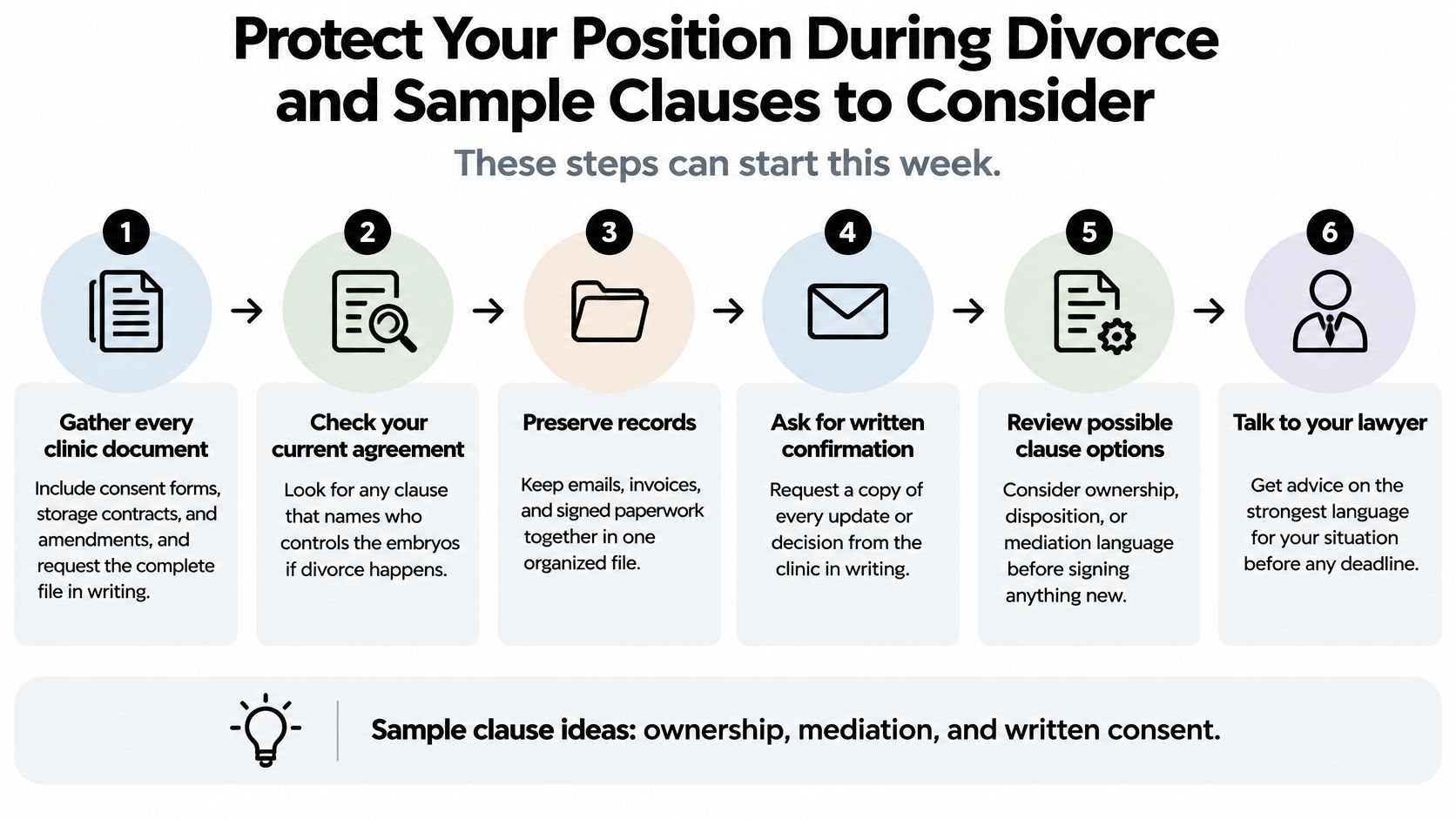
Protect Your Position During Divorce and Sample Clauses to Consider
The paperwork already sitting in the clinic's file will shape this dispute long before a judge rules on it. These steps can start this week, and you don't have to decide the embryos' ultimate disposition yet to protect your ability to make an informed decision later.
Use this guide to organize the paperwork and conversations that come first.
Build a complete record and preserve your options
Gather every clinic document. Request the complete file in writing, including consent forms, storage agreements, amendments, and disposition elections. The common mistake is bringing only the initial treatment consent when a later document changed the instructions.
Confirm the storage arrangement. Identify whose names appear on the contract, who receives invoices, and what happens after missed payments. Save invoices and notices alongside the agreement so your attorney can distinguish control disputes from billing problems.
Ask what the clinic will do during the divorce. Request written confirmation about whether it will act on one spouse's instructions and how it handles disputed authority. Filing for divorce does not, by itself, tell the clinic to suspend every action.
Discuss temporary protection with your attorney. If someone may move, use, donate, or destroy embryos, ask whether temporary orders under Texas Family Code section 6.502 are appropriate. Your attorney can evaluate a request to preserve the status quo while the court considers the dispute, and the judge decides whether to grant it based on the facts presented.
Coordinate the decree with medical records. Give your attorney the clinic's written requirements before finalizing settlement language. A decree that the clinic can't implement can create another dispute after the divorce.
Keep signed copies and track changes. Maintain one organized file containing executed documents, emails, notices, and later instructions. Revisit the plan when circumstances change rather than relying on an outdated draft.
The firm's guide to what to check before signing a Texas family law agreement can help you evaluate proposed language before making a commitment.
Clause options to discuss with your lawyer
These are drafting topics, not ready-to-sign provisions:
- Disposition clause: Identify the embryos and specify whether the authorized outcome is continued storage, control by one spouse, facility transfer, reproductive use, donation, or destruction. State what documents must be completed before implementation.
- Payment clause: Allocate storage charges, notice obligations, reimbursement, and the response to a payment lapse. Avoid language that authorizes irreversible disposition merely because someone misses a bill.
- Parentage and consent clause: Address whether either spouse consents to post-divorce assisted reproduction and potential parenthood, with any required physician-maintained records and withdrawal process.
- Dispute-resolution clause: Consider a notice-and-mediation procedure for later disagreements, while preserving access to urgent court relief when necessary.
Two questions sit inside every clause conversation, and they are easy to blur together. Being awarded the embryos settles who controls disposition. It does not settle whether either spouse may use them to become a parent, which is why the parentage and consent language deserves its own careful treatment rather than a single line inside the disposition clause.
Be careful about statutory references. Texas Family Code section 160.204 addresses presumed paternity, and post-divorce assisted reproduction is a separate subject. Counsel should distinguish those rules rather than using a general parentage citation for every embryo issue.
When a dispute reaches a temporary-orders hearing, the attorney presents the actual consent forms, the clinic agreement, relevant physician records, and any existing orders or proposed decree language. The wording and legal effect of each document matter more than either spouse's shorthand description of what was signed.
Our Divorce representation covers contested and uncontested cases. The purpose of early document review is to identify the disagreement accurately before anyone signs language that doesn't reflect the intended outcome.
Schedule a Free Consultation Before You Sign Anything
This is a lot to carry while your marriage is ending. A prepared conversation can help you replace uncertainty with specific questions and a practical plan, without requiring you to make an immediate decision.
Bring every clinic document, a written description of what each spouse wants, and the storage contract with its fee terms. Our guide to what to bring to your first Texas family law consultation can help you organize the rest.
Make the conversation useful
An attorney can:
- Evaluate the agreement: Review its language against Antoun and identify unresolved consent issues.
- Prepare workable terms: Coordinate proposed decree provisions with clinic requirements.
- Assess immediate protection: Determine whether temporary orders should be requested.
We match each client with an attorney based on the client's situation and represent clients statewide in every major family law and estate planning matter. Your consultation can also address local court practice and whether negotiation or litigation is appropriate.
If you need help navigating divorce, custody, or estate planning in Texas, contact The Law Office of Bryan Fagan today for a free consultation.
Law Office of Bryan Fagan, PLLC offers Texas divorce guidance to help you evaluate embryo agreements, address consent questions, and prepare clear settlement or court-order terms. Visit Law Office of Bryan Fagan, PLLC to schedule a free consultation, and bring your clinic paperwork so we can discuss the decisions specific to your situation.



