 Skip to content

You're gathering adoption paperwork when an old CPS investigation comes back to mind. Maybe the case closed years ago, you completed every requested service, or you never understood what the final letter meant. Now you're wondering whether that history could keep a child from joining your family.
Understanding how a Texas CPS finding affects a future adoption starts with the written outcome, not the fact that someone made a report. The finding's category, your registry status, and the timing of any challenge can affect different stages of the adoption process. You don't have to resolve every question at once, but you do need to identify the record before the agency does.
What Ruled Out, Reason to Believe and Substantiated Really Mean
An investigation is the process CPS uses to examine an allegation. A finding is the agency's conclusion. A Central Registry listing is a separate record that can affect screening.
Texas Family Code Chapter 261 requires DFPS to maintain a Central Registry of people found to have abused or neglected a child. A CPS finding can therefore matter even without a criminal conviction, while a criminal record does not by itself establish a CPS finding.
Families may hear reason to believe called substantiated. The written disposition and abuse category identify the actual result.
How each CPS disposition affects adoption screening
| Disposition | What it means | Central Registry | Effect on adoption screening |
|---|---|---|---|
| Reason to believe, physical or sexual abuse | Finding that the person caused physical or sexual abuse | Listed | Permanent disqualification from approval, subject to narrowly defined exceptions |
| Reason to believe, trafficking | Finding of labor or sex trafficking | Listed | Permanent disqualification from approval, subject to narrowly defined exceptions |
| Reason to believe, emotional abuse or neglect | Finding that the person caused emotional abuse or neglect | Listed | May allow a formal risk evaluation that could lead to approval |
| Reason to believe, older physical abuse or relative-linked case | Physical abuse finding where time has passed or the applicant is related to the child | Listed | Risk evaluation may be available after more than five years or where the applicant is related to or has a significant longstanding relationship with the child |
| Ruled out | Investigator did not find the person caused abuse or neglect | Not listed for that finding | Not a registry bar, though disclosed history can still be weighed in the suitability assessment |
| Pending administrative appeal | Finding is still under review | An existing listing is not automatically removed by an appeal | Unresolved status can delay the home study or placement |
| Overturned on review | Finding reversed in administrative review or appeal | Removed from the registry after DFPS receives notice | Proof of reversal should go to every screening entity that received the adverse information |
The serious-abuse rows describe screening eligibility, not a prediction that every private adoption petition will fail. Emotional abuse and neglect may allow an individualized risk evaluation; certain physical-abuse cases have limited routes to review.
A ruled-out case means CPS did not find that the person caused abuse or neglect. A pending appeal, by contrast, leaves the finding unresolved until the review is complete.
Practical rule: Check the written disposition and abuse category. The case-closure date alone does not identify the finding.
For example, a former caregiver seeking to adopt a relative may have a clear criminal record but an adverse neglect finding. The agency still needs to assess that child-protection record, so the category and registry status matter more than the fact that someone made a report.
Where a CPS Record Gets Checked During an Adoption
Think of the adoption file like a passport checked at successive border crossings, not a ticket examined only when you buy it. An issue identified early may remain important through placement and the court proceeding.
DFPS's CPS background-check policy requires initial criminal-history and IMPACT abuse-and-neglect checks before approval, generally covering applicants and household members age 14 or older who aren't under DFPS conservatorship; it also describes central-registry requirements under the Adam Walsh Child Protection and Safety Act of 2006.
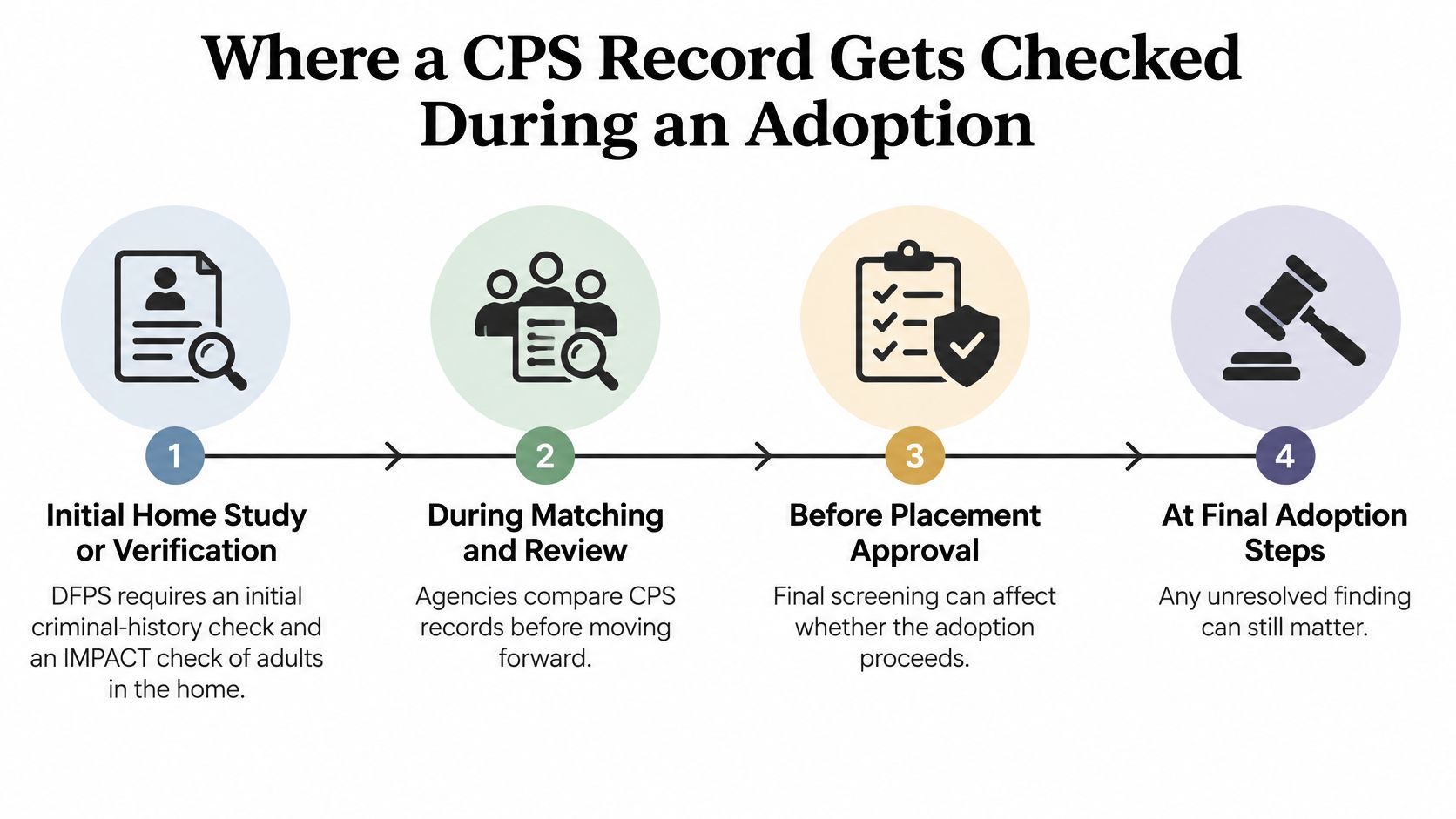
Screening checks at each adoption milestone
| Milestone | Who is checked | Check and timing rule |
|---|---|---|
| Initial home study and verification | Applicant and each household member age 14 or older not under DFPS conservatorship | IMPACT abuse-and-neglect history and criminal history before approval |
| Agency match for private placement | Approved adopters and other household members age 14 or older | Approved home study and applicable checks before a home is selected |
| Criminal-history currency | Each adoptive applicant | Current within 12 months of the adoption petition |
| Court-ordered criminal history | Each person seeking to adopt | DFPS or licensed-agency information accepted only if obtained no more than one year before the court order |
| Out-of-state registry check | Applicants or adult household members who lived outside Texas | Required where the preceding five years included residence in another state |
| Federal central-registry check | Prospective foster and adoptive parents | Required under the Adam Walsh Child Protection and Safety Act of 2006 |
The DFPS Foster and Adoptive Home Background Check Resource Guide explains agency selection requirements and the 12-month adoption-petition currency rule, distinct from the generally applicable 24-month recurring licensing cycle. Under Texas Family Code Chapter 162, each person seeking adoption must obtain criminal-history information, and agency-supplied information must meet the one-year court-order timing limit.
The DFPS Background Checks Handbook also addresses out-of-state registry checks involving residence during the preceding five years. Tell your agency about prior addresses early.
For broader context, Organic Fostering's explanation of background checks for foster carers illustrates why household screening matters, although it isn't Texas legal guidance. For Texas court preparation, review what an adoption court needs in petitions, consents, reports, and findings.
Adoption representation includes stepparent and agency adoptions. Whichever route you're considering, coordinate the registry, home-study, and criminal-history records rather than treating a clear criminal check as complete approval.
How the Impact Differs for Birth Parents, Applicants and Agency Adoptions
Your role determines which decision you need to address. A birth parent dealing with an open DFPS case faces different questions from an applicant seeking approval to adopt.
Impact and first move by role
| Role | What is checked | What decides the outcome | First move |
|---|---|---|---|
| Birth parent placing a child for adoption | Status of the child's existing DFPS case and the parent's compliance with the case plan | Current case status, court orders, and the child's permanency plan | Get the case plan and court orders in writing |
| Prospective adoptive parent with prior history | Registry and IMPACT checks for the applicant and household members 14 or older | Disposition category, recency, and availability of a risk evaluation | Obtain the written disposition and registry status |
| Agency or foster-care adopter | Registry, criminal history, and applicable out-of-state records during the home study | Home-study recommendation and any risk-evaluation outcome | Ask the caseworker for the screening decision in writing |

Start with the decision that applies to you
For a birth parent, the prospective-adopter screening rules aren't the same as the court's decisions in the child's existing case. Don't assume that arranging a private placement overrides DFPS involvement or existing orders. Your first task is to identify the current case plan, hearings, and restrictions before making commitments about placement.
For a prospective adoptive parent, the exact abuse category controls the available screening route. The Child Welfare Information Gateway's Texas screening summary describes permanent disqualification for sustained physical abuse, sexual abuse, labor trafficking, and sex trafficking, subject to narrow exceptions; emotional abuse or neglect may permit a formal risk evaluation. It also describes potential review for certain physical-abuse findings after more than five years, or where a qualifying family or longstanding relationship exists.
That doesn't mean completing counseling guarantees approval. Services can support a legally available evaluation, but they don't create an exception where none applies. Obtain the written finding before spending time preparing the wrong kind of application.
For an agency or foster-care adopter, ask which screening rule the agency is applying and what additional documents it needs. A favorable home study cannot ignore a disqualifying finding, and a ruled-out report may still prompt questions about household safety.
Relatives should also review Texas adoption requirements for grandparents and kin. A relationship to the child can be relevant, but it isn't blanket permission to bypass screening.
How to Request and Review Your CPS Records
You don't need to prepare a legal argument before requesting your records. Start by assembling the documents that establish what CPS decided, then compare them for accuracy.
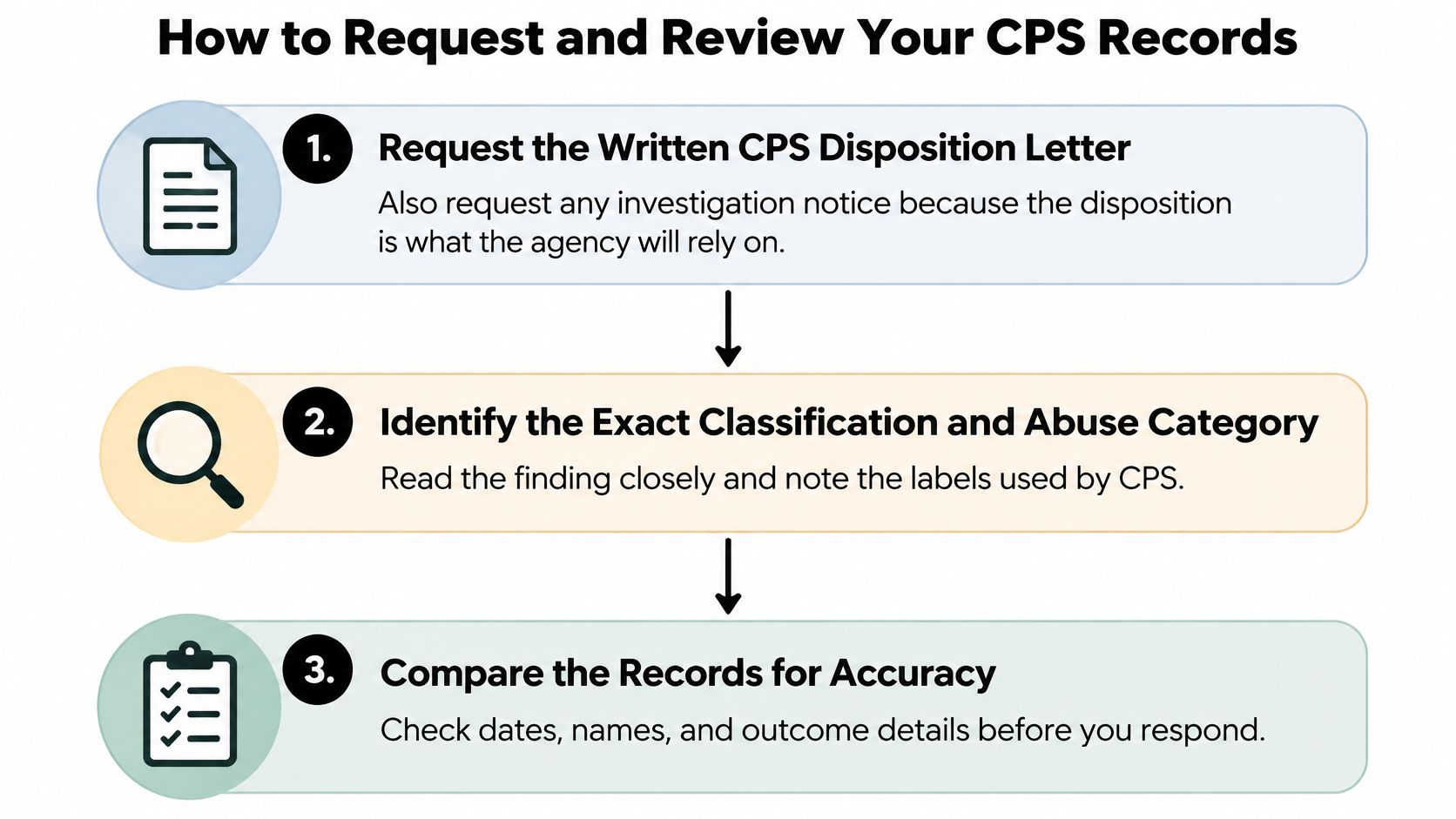
Build a file the agency can evaluate
Request the written disposition and investigation notices. Contact DFPS through its current records-request process and explain that you're seeking records concerning your own CPS history for adoption screening. Keep a copy of the request and any response identifying access restrictions or additional requirements.
Identify the exact classification and abuse category. Highlight the finding, the person identified as responsible, and the alleged conduct. Don't substitute your memory of a conversation for the language in the letter.
Confirm your Central Registry status. Ask how to verify whether the finding appears in the registry and whether any review remains unresolved. A closed case and an absent registry listing aren't interchangeable conclusions.
Locate review and appeal instructions immediately. Preserve the notice, envelope, and electronic delivery information, then ask counsel to determine the applicable deadline. Don't assume that requesting records extends your time to challenge a finding.
Gather completion records. Collect service certificates, counseling documentation, parenting-class records, treatment records where relevant, and court orders. Match each document to the concern it addresses rather than submitting an unexplained stack of paperwork.
Write a short factual timeline. Explain what happened, what the agency concluded, what changed, and how children would be protected now. Separate facts you can document from statements you dispute.
Share the organized file before the home study begins. Ask your attorney how to provide relevant documents securely and what the agency needs. Keep a record of what you submitted and who received it.
Check for errors without rewriting the history
Compare names, dates, household relationships, and disposition language across the documents. If a letter says one thing and a screening summary says another, flag the discrepancy specifically.
The common mistake is waiting until the home-study interview to locate the disposition. Another is assuming that a ruled-out letter eliminates every question about the underlying event.
File preparation tip: Put a document index at the front of your file. A reviewer should be able to locate the disposition, challenge status, and current safety evidence without guessing.
Keep originals and work from copies. Sensitive child-protection records deserve careful handling, especially when they contain information about children or other family members.
How Long Records Stay and When a Finding Can Be Cleared
A placement decision can arrive before an appeal does. If a finding is later reversed, the legal record may change, but the child's placement timeline may already have moved on.
Record and screening timelines
| Item | Timing or rule | Governing reference |
|---|---|---|
| Permanent disqualification for sustained physical, sexual, or trafficking findings | No time limit, subject to narrow exceptions | DFPS screening rules |
| Risk evaluation for certain physical-abuse findings | Eligible after more than five years, or where a qualifying relationship to the child applies | DFPS guidance |
| Registry removal after a finding is overturned | Within 10 business days of DFPS receiving notice | Texas Family Code Chapter 261 |
| Retention of underlying CPS case file | Depends on the record category | Confirm with DFPS |
Registry removal and case-file retention are separate questions. A reversed finding may change a person's registry status, while the investigation file may remain subject to its own retention schedule.
A reversal may come after the placement decision
An appeal can remain unresolved while an adoption agency reviews a home or a child's placement schedule advances. If the appeal is decided after a placement date, a later reversal may clear the registry obstacle without restoring that particular opportunity.
The age of a finding does not mean it has expired. Time may affect eligibility for a specific risk evaluation, but it does not erase the record or guarantee approval.
After a reversal, provide the final decision to any entity that received the adverse information. Ask for written confirmation that the corrected outcome will be used in renewed screening. Separately, ask DFPS which retention schedule applies to the underlying case file. A criminal-check renewal or the passage of time does not determine how long that file is kept.
Challenging a Finding and Building a Strong Rehabilitation File
Completing services and challenging a finding serve different purposes. A formal challenge seeks to change the finding; rehabilitation evidence addresses present safety and suitability. You may need to pursue both, depending on the available legal route.
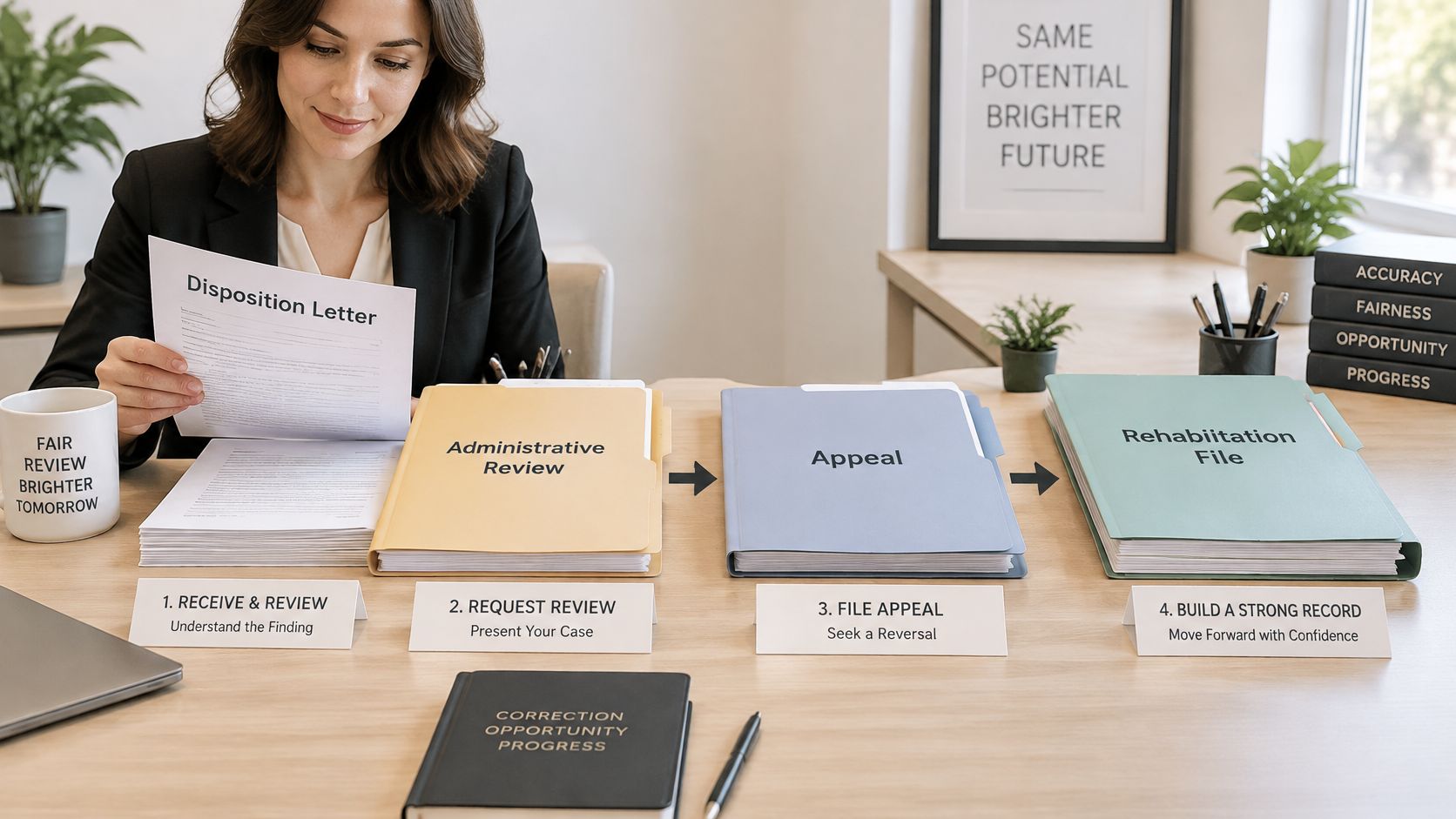
Choose the route that addresses the actual problem
- Administrative review or appeal. A successful challenge can reverse the finding and change its registry consequences. The trade-offs are time, uncertainty, and the possibility that an unresolved status prevents the agency from completing its review.
- Correction of inaccurate information. Request correction of specific errors, such as an incorrect identity or outcome summary. Correcting a clerical mistake isn't necessarily a reversal of the underlying finding.
- Risk evaluation where permitted. This can provide a path toward approval for eligible findings. It isn't available for every category, and favorable evidence doesn't require the agency to approve the home.
DFPS reported in its Sunset Review agency report that CPS-related appeals increased nearly 75% from fiscal year 2023 to fiscal year 2024, with more than 2,000 appeal cases backlogged by February 2025. Those figures explain why a legally available challenge may still create a practical placement problem.
The report also described proposed stronger review before certain serious findings, including sexual abuse or sex trafficking, are added to the registry. A proposed reform doesn't remove an existing finding, and you shouldn't assume it establishes your current review rights.
Show what protects a child today
Organize rehabilitation evidence around the concern identified in the finding:
- Completed services. Include certificates and documentation showing what you completed.
- Parenting skills. Provide relevant parenting education and evidence that you can apply it.
- Treatment progress. Obtain appropriate counseling or treatment summaries without unnecessarily disclosing unrelated sensitive information.
- Household stability. Document housing, employment, and dependable caregiving arrangements.
- Supervision safeguards. Explain who supervises, who provides backup care, and how unsafe contact will be prevented.
- Current safety. Identify concrete changes in the home and how you'll maintain them.
For interview preparation, review getting yourself ready for a home study. If the investigation remains open, seek CPS-defense advice before making statements or signing documents that may affect both the present case and a future adoption.
Three Scenarios That Show How a Finding Plays Out
These hypothetical families illustrate how to prepare, not guaranteed outcomes. Each faces a different question despite sharing the same concern about an old CPS record.
A grandmother with a neglect finding
A grandmother hopes to adopt her grandchild but has an older neglect finding. She assumes that being family will eliminate the problem.
Her attorney instead starts with the finding's category and determines whether a formal risk evaluation is available. The grandmother gathers service-completion records, explains the circumstances that led to the finding, and prepares a supervision plan addressing the child's needs.
Her family relationship provides context, not automatic approval. The useful change is that the reviewer receives evidence addressing the actual safety concern rather than a general statement that she loves her grandchild.
A couple whose investigation was ruled out
A married couple applies through an agency after a prior investigation was ruled out. They're embarrassed and consider leaving the event out of their explanation.
They bring the disposition letter and provide a concise account when the agency requests their history. They distinguish the original allegation from the investigator's conclusion and answer questions about their present household.
The letter allows the reviewer to assess the correct outcome instead of relying on an incomplete account. Their preparation doesn't guarantee a favorable home study, but it avoids treating a report as though it were a sustained finding.
An applicant with a record outside Texas
An applicant previously lived in another state and has a child-protection record there. They assume the Texas check will be the only relevant search.
Before the home study, they disclose the residence history and request the other state's disposition. If terminology differs, they obtain documentation explaining the outcome rather than trying to translate it themselves.
The reviewer can then evaluate the records together. If a challenge remains pending, the applicant asks whether screening can proceed, what additional proof is needed, and whether the anticipated placement schedule allows time for resolution.
Across these scenarios, a complete file changes the quality of the decision, not necessarily the decision itself. The category, current safeguards, available review route, and timing determine what the family should do next.
Confirm Your Record Before You File and Talk to a Lawyer
Before you file, check whether your adoption paperwork tells a consistent story about your CPS record. A case number alone is not enough: you need the written disposition and a clear account of any unresolved review.
- Disposition obtained. Keep the written outcome with your records.
- Status confirmed. Know the finding category, registry status, and whether a challenge is pending.
- Deadlines identified. Record any review deadlines and court dates.
- Evidence organized. Gather completion records and prepare a factual timeline.
- Disclosure documented. Keep a copy of relevant information provided to an agency or court.
Stop preparing the file on your own and contact an attorney if you have a serious sustained finding, an unresolved appeal, a reversal that screening recipients may not yet have received, an out-of-state record, an open birth-parent case, or a criminal-history timing issue. These situations can affect different stages of adoption review, and a delay in challenging a finding may put a placement at risk even if the finding is later reversed. Registry screening, criminal-record checks, and the home study are separate parts of the process.
Administrative help can include sorting records, creating an index, and tracking documents or deadlines. You can hire legal virtual assistants for those tasks, but an attorney should assess eligibility, interpret the finding, and advise on deadlines and legal strategy.
The Law Office of Bryan Fagan, PLLC handles stepparent and agency adoption matters and offers Child Protective Services Defense for families facing CPS investigations and allegations. Texas Family Code Chapters 261 and 162, along with DFPS adoption and background-check guidance, provide resources for understanding the rules that may apply. For help with your record, screening status, and next steps, contact The Law Office of Bryan Fagan today for a free consultation.



