
Imagine a little girl who reaches for her stepfather’s hand whenever she feels nervous. He has been there for bedtime stories, scraped knees, and quiet talks about her day. Now the family hopes to make that bond legally permanent, and one question feels especially important: What Will the Adoption Court Need in Texas before they can take that next step?
For a family like this, adoption carries both hope and uncertainty. A loving relationship matters deeply, but the court must also review the applicable legal requirements. Under Texas Family Code §162.016, the judge must find that those requirements are met and that adoption serves the child’s best interest. Knowing what needs to happen can make the process feel more manageable.
At the Law Office of Bryan Fagan, PLLC, we believe families deserve clear answers and compassionate guidance during life’s biggest transitions. Founded in Houston by Bryan Joseph Fagan, a South Texas College of Law graduate and Texas attorney since 2012, our firm helps families understand their options and prepare for what comes next. Our mission—educating families and protecting futures—starts with helping you move forward with clarity and peace of mind.
This guide walks through the petition, consents, evaluations, reports, and findings your adoption may require. Whether you are a stepparent, relative, or another prospective adoptive parent, understanding your next steps can help you approach this meaningful decision with greater confidence.
This guide addresses the adoption of a child under Texas Family Code Chapter 162; adult adoption follows different requirements.
Quick Answer
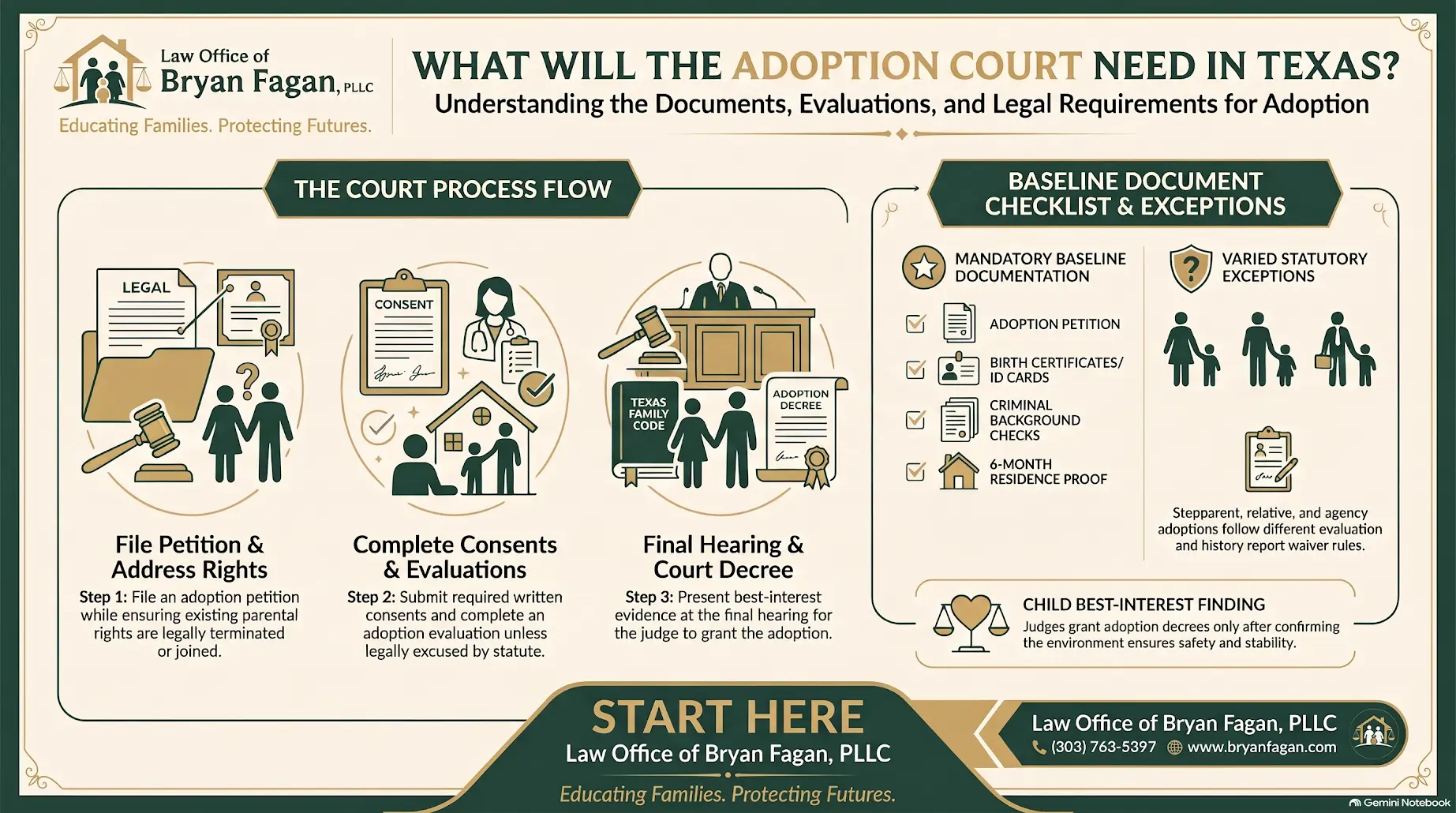
A Texas adoption court generally needs a proper petition, the required consents, an adoption evaluation, each adopting person’s criminal history, six months of residence with the child unless the court waives it, and findings that the adoption serves the child’s best interest. Several requirements have conditions or waivers, so the list depends on who is adopting.
Key Takeaways
- The court works from a statewide baseline. It reviews the petition, the required consents, the adoption evaluation and its reports, criminal history and, in many adoptions, the child’s history report, and a court may add nonconflicting local requirements.
- Many requirements have conditions or waivers. The six-month residence rule can be waived on the petitioner’s request when that serves the child’s best interest, and a child 12 or older must consent and attend the hearing unless the court waives either requirement.
- The stepparent evaluation waiver is narrow. The court may waive the adoption evaluation only in an uncontested stepparent adoption, after it reviews DFPS investigative records and DPS criminal-history information.
- The evaluation and the history report are separate. The adoption evaluation is a process with its own report or reports; the health, social, educational and genetic history report concerns the child and does not apply to grandparent, aunt or uncle, or stepparent adoptions.
- The court must make findings. It grants the adoption when it finds the requirements are met and the adoption serves the child’s best interest, with separate best-interest findings when termination is joined.
Plain-English Check
| Your situation | The direct answer |
|---|---|
| A stepparent is adopting | The parent married to the stepparent joins the petition. The court may waive the adoption evaluation only if the case is uncontested and the court has reviewed DFPS investigative records and DPS criminal-history information. |
| A grandparent, aunt or uncle is adopting | The health, social, educational and genetic history report does not apply to these relatives. Being a relative does not by itself waive the adoption evaluation. |
| The child is 12 or older | The child generally must consent in writing or in court and attend the hearing, but the court may waive either requirement if that serves the child’s best interest. |
| The managing conservator will not consent | The court may excuse that consent only if it finds the consent is being refused or has been revoked without good cause. Questions about ending a parent’s rights are a separate analysis. |
| An agency or DFPS placed the child | The agency or DFPS conducts the pre-placement and post-placement parts of the adoption evaluation under department rules and files its reports before the final order. |
What Will the Adoption Court Need in Texas? The Core Requirements

What Will the Adoption Court Need in Texas depends on who is adopting and the child’s legal circumstances. The table below outlines the main requirements, what the judge reviews, and when an exemption or waiver may apply.
Statewide law provides the starting point. Under Texas Family Code §107.158(b), a court may also impose requirements or adopt local rules for adoption evaluations or evaluators that do not conflict with that subchapter. For families considering adoption in Austin, preparation should include checking the applicable court’s requirements alongside this statewide overview.
| Requirement | What the court reviews | When the requirement may differ |
|---|---|---|
| Petition | Who is adopting, whether each living parent’s rights have been terminated or termination is joined, or another route in §162.001 applies; a married petitioner’s spouse joins | Routes differ by adoption type; the petition must also include a verified statement about interstate-placement compliance |
| Managing conservator’s consent | Written consent filed, unless the managing conservator is the petitioner | The court may waive it if consent is refused or revoked without good cause |
| Parent married to the petitioner | That parent joins the petition | No separate consent from that parent is required |
| Child 12 or older | Consent in writing or in court, and attendance at the hearing | The court may waive either in the child’s best interest |
| Adoption evaluation | The person adopting and the home, through a Chapter 107 evaluation | Waivable only in an uncontested stepparent adoption after the court reviews DFPS and DPS records; agency and DFPS cases follow department rules |
| Health, social, educational and genetic history report | A report signed by the adoptive parents, filed before the adoption is granted | Not required for grandparent, aunt or uncle, or stepparent adoptions; filing may be waived if the birth parents cannot be located and information is insufficient |
| Criminal history | Each person adopting obtains that person’s own criminal history record | A DFPS or agency record is accepted if obtained not more than one year before the court’s order |
| Residence | The child has lived with the petitioner for at least six months | The court may waive it on the petitioner’s request if the waiver is in the child’s best interest |
| Hearing attendance | The petitioners attend, and a child 12 or older attends | One spouse may be excused if attending would be unduly difficult and the other is present; the child’s attendance may be waived in the child’s best interest |
| Findings | The requirements are met and the adoption is in the child’s best interest | If termination is joined, the court makes separate best-interest findings and terminates at the same time it grants the adoption |
Texas Adoption Requirements: What the Court Reviews
The case starts with who may adopt and whether the child may be adopted. Under Texas Family Code §162.001, an adult may petition, subject to Chapter 102’s standing rules. A child may be adopted if each living parent’s rights have been terminated or a termination request is joined with the adoption; if the parent whose rights have not been terminated is married to the petitioner in a stepparent adoption; or through two narrower routes for a child at least two years old that require the listed periods of care and, in one, the nonterminated parent’s consent.
If the petitioner is married, both spouses must join the petition, and the petition must include a verified statement about compliance with the interstate-placement rules or the reasons they do not apply (§162.002). Texas law sets no minimum age difference between an adoptive parent and the child, and agencies that place children may not set a maximum age or age differential, although they may consider health and expected lifespan (§162.604).
Training courses an agency or DFPS requires of foster or adoptive families come from those placement programs, not from the Chapter 162 list of what the adoption court needs. DFPS and private agencies may impose program or placement requirements in addition to the statutory documents and findings the adoption court reviews.
Adoption Evaluations
Texas law calls this review an adoption evaluation; many families know it as a home study. Texas Family Code §107.151 defines it as a pre-placement or post-placement evaluative process through which information and recommendations about the adoption may be made to the court, the parties and their attorneys. In a suit for adoption, an adoption evaluation must be conducted as Chapter 107 provides unless the court waives it under the stepparent provision (§162.003), and the evaluation looks at the circumstances and condition of the home and social environment of the person seeking to adopt.
When a licensed child-placing agency or DFPS is involved, the agency or the department conducts the pre-placement and post-placement parts of the evaluation under rules adopted by the department’s commissioner and files reports on those parts with the court before it renders a final adoption order (§107.152).
In other cases, the evaluator must meet the qualifications Chapter 107 sets (§107.154). In a county with fewer than 500,000 residents, if a qualified evaluator is not available in a timely manner, the court may—after notice and a hearing or by agreement of the parties—appoint someone it determines is otherwise qualified (§107.155). Unless the child was already living in the home when the suit began, the evaluator files a pre-placement report; when the suit is filed after the child began living there, that report and the post-placement report may be combined. If termination is joined with the adoption, the pre-placement report must be filed before the court signs the final termination order. The post-placement report must be filed before the court renders the final adoption order, and copies of the reports must be made available to the prospective adoptive parents before that order (§§107.159–107.160). The report must identify each evaluator and license number, note the sources used to verify pertinent facts when possible, and state the basis for the evaluator’s conclusions or recommendations (§107.158(e)–(g)). The adoption evaluation is a process, and the evaluator’s report or reports are separate from the health, social, educational and genetic history report described below.
When a Stepparent Evaluation May Be Waived

A Texas court may waive the adoption evaluation in an uncontested stepparent adoption, but only after reviewing DFPS investigative records and any DPS criminal-history information about the prospective adoptive parent. Meeting these conditions allows the judge to consider a waiver; it does not guarantee one under Texas Family Code §107.153(a-1).
Grandparents and other relatives do not qualify for this waiver based on their relationship alone. The prospective adoptive parent pays for either the evaluation or the required record review, as applicable, under §107.153(e).
If you are asking, “What Will the Adoption Court Need in Texas?” confirm whether an evaluation or waiver request applies before preparing for finalization. Our A–Z guide to adoption in Texas provides broader context for the steps ahead.
Contested Adoptions and Evaluations
This contested-adoption evaluation framework does not apply to Interstate Compact services, a DFPS evaluation under §262.114, or a suit in which DFPS is a party (§107.201). Where it does apply, the court first decides what question the evaluation must answer. When the court is deciding whether ending a parent’s rights is in the child’s best interest, it orders a child custody evaluation that includes termination as an issue, and it may also have that evaluator address the adoption-evaluation requirements if the evaluator recommends termination; when the court is deciding only whether the people seeking to adopt would be suitable if termination is granted, it may order an adoption evaluation (§107.202). How termination and adoption fit together is covered in our separate guide on that subject.
Consents the Court Needs
Unless the managing conservator is the petitioner, the managing conservator’s written consent must be filed. The court may waive that consent if it finds the consent is being refused or has been revoked without good cause, after a hearing the court conducts without a jury (§162.010(a)).
A parent who is married to the petitioner joins the petition, and no further consent from that parent is required (§162.010(b)). A child 12 or older must consent in writing or in court, but the court may waive that requirement if it would serve the child’s best interest (§162.010(c)). A consent required by §162.010 may be revoked by filing a signed revocation at any time before the adoption order is rendered (§162.011).
Supporting case note: excusing a managing conservator’s refusal
In In the Interest of J.W. (Fort Worth Court of Appeals, memorandum opinion, delivered January 11, 2024), foster parents asked the court to excuse both the residence requirement and DFPS’s refusal to consent. The court affirmed the denial, explaining that the petitioners carried the burden to show the consent was withheld without good cause and treating residence and consent as separate requirements. The result was limited to that record; the court did not hold that DFPS always has good cause, and treatment was checked by search only, not a citator.
History Report and Criminal History

The child’s history report and each prospective adoptive parent’s criminal-history records serve different purposes. When asking, “What Will the Adoption Court Need in Texas?” check these requirements separately—an exemption from one does not remove the other.
The health, social, educational, and genetic history report is not required for adoption by a grandparent, aunt or uncle by birth, marriage, or prior adoption, or stepparent. Otherwise, Texas Family Code §162.008 requires filing the report signed by the adoptive parents and, when applicable, DFPS’s acknowledgment of receipt. The court may waive preparation and filing if the biological parents cannot be located and their absence leaves insufficient information to compile it.
Under §162.0085, the court must order each person seeking adoption to obtain their own criminal-history information. It must accept qualifying information supplied by DFPS or a licensed child-placing agency that received it from DFPS, provided it was obtained within the year before the court ordered the history obtained.
If you have a criminal record, discuss it with counsel early rather than assuming approval or denial. Families working with our San Antonio adoption attorneys can ask which records to gather and whether their placement program has additional standards.
Residence and the Hearing
The court may not grant an adoption until the child has lived with the petitioner for at least six months, but on the petitioner’s request the court may waive that requirement if the waiver is in the child’s best interest (§162.009).
Section 162.0045 provides that, if ‘the adoption evaluation has been filed’ and the adopting person’s criminal history has been obtained, the court must grant a motion for a preferential setting of the final hearing and give that hearing precedence over other civil cases not given preference by other law. That rule affects scheduling priority, not the outcome of the case or a specific hearing date.
If spouses petition together and it would be unduly difficult for one of them to appear, the court may waive that spouse’s attendance if the other spouse is present. A child 12 or older must attend the hearing, but the court may waive that requirement in the child’s best interest (§162.014).
If testimony is necessary to decide the case, the court may compel witnesses to attend, including a representative of an agency that conducts an adoption evaluation; that does not mean an evaluator or agency representative must testify in every adoption (§107.161).
The Findings the Court Must Make

The court must grant an adoption when it finds that the legal requirements are met and adoption serves the child’s best interest. Under Texas Family Code §162.016, when termination and adoption are requested together, the court terminates the parent-child relationship when it renders the adoption order. It must make separate findings that termination and adoption each serve the child’s best interest.
Section 162.015 prohibits denying or delaying adoption based on the child’s or prospective parents’ race or ethnicity. That section contains an exception for matters subject to the Indian Child Welfare Act, which require separate analysis.
When asking, “What Will the Adoption Court Need in Texas?” consider both the required documents and the evidence supporting these findings. Our adoption attorneys serving The Woodlands help families prepare petitions, consents, and reports and identify issues that need attention before the hearing.
What to Gather
Documents and Records to Review Before the Hearing
- The petition and any existing orders about the child, including conservatorship or termination orders
- Written consents the case requires, including the child’s consent if the child is 12 or older and the court has not waived it
- The adoption evaluation report or reports, or the records the court must review for a stepparent waiver
- The health, social, educational and genetic history report, if your adoption requires one
- Each adopting person’s criminal history record
- Records showing how long the child has lived with you
- The completed documentation the court clerk uses for the child’s birth record
Your court may require additional items under its local rules.
Questions About What Your Adoption Court Will Need?
A Texas family-law attorney at the Law Office of Bryan Fagan, PLLC can review your adoption type, the consents, the evaluation and the reports your case requires, then explain the next steps without promising a particular outcome.
Legal Resources
- Texas Family Code Chapter 162 (Adoption) — Official Texas law: who may adopt, petition, consents, history report, criminal history, residence, hearing and findings (§§162.001–162.017, 162.602, 162.604).
- Texas Family Code Chapter 107, Subchapter E (Adoption Evaluation) — Official Texas law: adoption evaluations, agency and DFPS evaluations, evaluator qualifications, reports, witness testimony and the stepparent waiver (§§107.151–107.163, including §107.161).
- Texas Family Code Chapter 107, Subchapter F (Evaluations in Contested Adoptions) — Official Texas law: when the contested-adoption framework applies and which evaluation the court orders (§§107.201–107.202).
- In the Interest of J.W., Nos. 02-23-00047-CV & 02-23-00048-CV (Tex. App.—Fort Worth Jan. 11, 2024) (mem. op.) — Fort Worth Court of Appeals, memorandum opinion: waiver of a managing conservator’s consent.
Research note: this article relies on official Texas statutes and an official opinion of a Texas court of appeals. Case treatment was checked by search only, not a citator. Authorities last checked October 22, 2026.
Lisa Kreider works with families in adoption, termination and related family transitions and can help identify which requirements, waivers and documents apply to your adoption.
Meet Lisa Kreider
Meet the Attorney
Lisa Kreider
Family Law Attorney | Rockwall Office
Lisa Kreider helps individuals and families navigate divorce, child custody, parentage, adoption, modifications, termination and other major family transitions. She works toward practical resolution when appropriate and prepares cases for hearings or trial when significant issues remain disputed.
Credentials: Texas attorney since 2017 · J.D., Texas Tech University School of Law, 2016
Conclusion
The question “What Will the Adoption Court Need in Texas?” becomes easier to approach when you know which requirements apply to your family. Start with the existing orders, identify any unresolved issues, and ask what must be completed before the hearing. A clear plan can help you move forward with greater confidence while keeping your child’s needs at the center.
In straightforward situations, preparation may focus on coordinating consents, required records, and reports. In more complex cases, disputed parental rights, a missing parent, or interstate placement may require additional investigation or contested hearings. If your family is considering stepparent adoption after a parent’s death, explain which parent has died and bring the available records so counsel can assess your circumstances.
At The Law Office of Bryan Fagan, PLLC, educating families and protecting futures means helping you understand your options and connecting you with legal support suited to your case. Gather any custody or termination orders, write down your concerns, and call 281-810-9760 or schedule a free consultation. Hiring an attorney involves fees, and no attorney can promise a faster result or a particular outcome.
About the Author and Reviewer
Bryan Joseph Fagan
Founder, Law Office of Bryan Fagan, PLLC
Texas Divorce & Family Law Attorney · Licensed in Texas Since 2012
Bryan Joseph Fagan founded the Law Office of Bryan Fagan, PLLC in 2012. His work includes Texas family-law strategy, firmwide leadership, team-based case planning, and client education designed to help families understand their legal options and make informed decisions.
Juris Doctor, South Texas College of Law, 2011 · Licensed by the State Bar of Texas May 4, 2012 · Bar No. 24080889
Read Bryan Joseph Fagan’s profile · Verify on the State Bar of Texas
About the Law Office of Bryan Fagan, PLLC
The Law Office of Bryan Fagan, PLLC helps Texas families understand and navigate family-law issues involving divorce, child custody, possession and access, and related matters. Founded by Bryan Fagan in 2012, the firm combines legal representation with education designed to give families clearer information about their options and the decisions ahead.
Frequently Asked Questions
Usually a petition, the required consents, an adoption evaluation, each adopting person’s criminal history, proof the child has lived with you for six months unless the court waives it and, for many adoptions, a health and social history report. Some items can be waived when the statute allows, so the exact list depends on who is adopting.
Usually yes, unless the court waives it. The court may waive the adoption evaluation only when the adoption is uncontested, the person adopting is the stepparent, and the court has reviewed DFPS investigative records and DPS criminal-history information. The waiver is discretionary, not automatic.
No. An adoption evaluation is a court-ordered process that examines the prospective adoptive parent and home, and the evaluator files the required report or reports. The health, social, educational and genetic history report concerns the child’s background. They follow different statutory exceptions and waiver rules.
Generally yes. Grandparent, aunt and uncle adoptions do not need the health, social, educational and genetic history report, but being a relative does not by itself waive the adoption evaluation. The statutory waiver is limited to uncontested stepparent adoptions after the required record review.
Usually yes. The court may not grant the adoption until the child has lived with the petitioner for at least six months, but it may waive that requirement on the petitioner’s request if the waiver is in the child’s best interest.
Attorney advertising. This page provides general information about Texas adoption requirements. It is not legal advice, and reading it does not create an attorney-client relationship. Requirements and results depend on the facts, the court and the governing law; no outcome is guaranteed.