Estate planning can feel abstract until a parent becomes unable to manage bills, or a family has to make decisions after a death. If you're sorting out who can act, and when, it helps to know that a power of attorney and an executor's role are not two versions of the same job. Texas families often need both, but the authority behind each works at a different stage.
Understanding the Two Roles in Your Estate Plan
Suppose a Texas parent names one adult child to handle finances if illness makes it difficult to pay bills, and names another child in a will to settle the estate after death. The family has made plans for two different situations: managing affairs while the parent is alive, and administering an estate afterward.

A power of attorney (POA) lets a person, called the principal, authorize an agent to act on the principal's behalf. The agent generally handles matters during the principal's lifetime, and the document controls what the agent may do. A durable POA can help keep financial decision-making in place if the principal becomes incapacitated. A nondurable POA ends if the principal becomes incapacitated, and a POA ends at the principal's death. The Uniform Power of Attorney Act, adopted in various U.S. jurisdictions, sets out these termination principles (Uniform Power of Attorney Act reference).
An executor, by contrast, is named in a will to carry out the testator's wishes after death. In Texas, that work includes addressing outstanding debts and taxes and distributing remaining assets. The person named in the will still has to qualify through probate and receive letters testamentary before acting as the estate's personal representative.
| Power of Attorney vs Executor at a Glance | Power of Attorney Agent | Executor of Will |
|---|---|---|
| When the role operates | During the principal's life, subject to the document's terms | After death, following appointment through probate |
| Source of authority | The POA document | The will and probate appointment |
| Main focus | Authorized management of the living principal's affairs | Estate administration and distribution |
| What happens at death | POA authority ends | Executor authority begins after qualification |
The key is timing. The agent's authority doesn't turn into executor authority when the principal dies, even if the same person is named in both documents. The documents address separate risks, so coordinating them can help families avoid confusion when circumstances change.
What a Power of Attorney Does in Texas
A POA is a tool for lifetime decision-making. The principal chooses an agent and defines the authority in the document. A durable POA can help a trusted person manage authorized financial or property matters if the principal later can't manage them independently. It doesn't, by itself, appoint an executor or give anyone the right to administer an estate after death.
The Texas Estates Code describes the fiduciary relationship that arises when an agent accepts a durable POA. The agent must act in good faith, stay within the authority granted, avoid conflicts of interest, keep records, and provide an accounting when required. Texas law allows a POA to authorize a range of financial actions, including collecting assets, entering contracts, executing deeds or mortgages, and managing investments (Texas Estates Code Section 752.051).
Match the document to the task
Broad authority isn't unlimited authority. Certain actions can significantly affect an estate plan or beneficiaries, so the document generally needs to authorize them expressly. Examples include making gifts, changing beneficiary designations, creating survivorship rights, or amending an inter vivos trust.
Think of the POA as a set of keys. The principal decides which doors the agent may open, and the agent can't treat the document as permission to do anything that seems useful. If a parent wants an agent to manage a home, business interest, investments, or digital assets, the document should address the intended powers clearly.
Practical rule: An agent manages the principal's affairs for the principal's benefit while the principal is alive. The role isn't a shortcut to deciding who inherits property.
A POA can therefore help prevent a gap in financial management during incapacity, but it doesn't replace a will. Families comparing their options can review a Houston Heights power of attorney lawyer resource and consider how Estate Planning documents can record a person's wishes and protect assets.
What an Executor of a Will Does in Texas
An executor's job is to administer the estate after death. The will names the person the testator wants to serve, but nomination alone doesn't give that person authority to act for the estate. The executor must qualify through probate, after which the clerk issues letters testamentary.
Texas Estates Code provisions place the person named as executor in the will first in the statutory order of preference for receiving letters testamentary. The same code sets a fiduciary standard for caring for estate property: an executor or administrator must take care of it as a prudent person would take care of their own property (Texas Estates Code Chapter 304).
The executor's work after appointment
An executor may need to identify and protect estate property, collect assets, address valid debts and taxes, handle claims, and distribute remaining property according to the will and applicable law. These responsibilities are different from an agent's authority to act for a living principal. The executor works for the estate and must meet fiduciary duties, rather than continuing under the former POA.
Texas independent administration can reduce routine court supervision after the required steps are completed. An independent executor may generally act without court approval unless the Estates Code specifically requires court involvement. That flexibility doesn't remove the executor's duties or accountability.
| Decision matrix | Power of Attorney Agent | Executor |
|---|---|---|
| Authority | Granted by the principal in the POA | Nominated in a will and activated through probate |
| Timing | During the principal's life | After death and qualification |
| Fiduciary responsibility | Follow the document, act in good faith, keep required records | Protect estate property and administer it under law and the will |
| Operational focus | Manage authorized affairs for the principal | Gather assets, resolve estate obligations, and distribute property |
If an estate includes a home that may need to be sold, a Cyber Homes probate selling guide can help readers understand the practical property-sale context. For questions about the legal process of settling an estate, see the firm's information on an estate administration lawyer. The firm also provides Divorce representation in Texas for contested, uncontested, and high-conflict cases, a separate area of law that may affect a family's broader planning needs.
Power of Attorney vs Executor Key Differences
The clearest way to understand power of attorney vs executor of will is to compare the source, timing, and purpose of each authority. A POA agent acts for a living person within the powers the principal granted. An executor administers a deceased person's estate through the probate process.
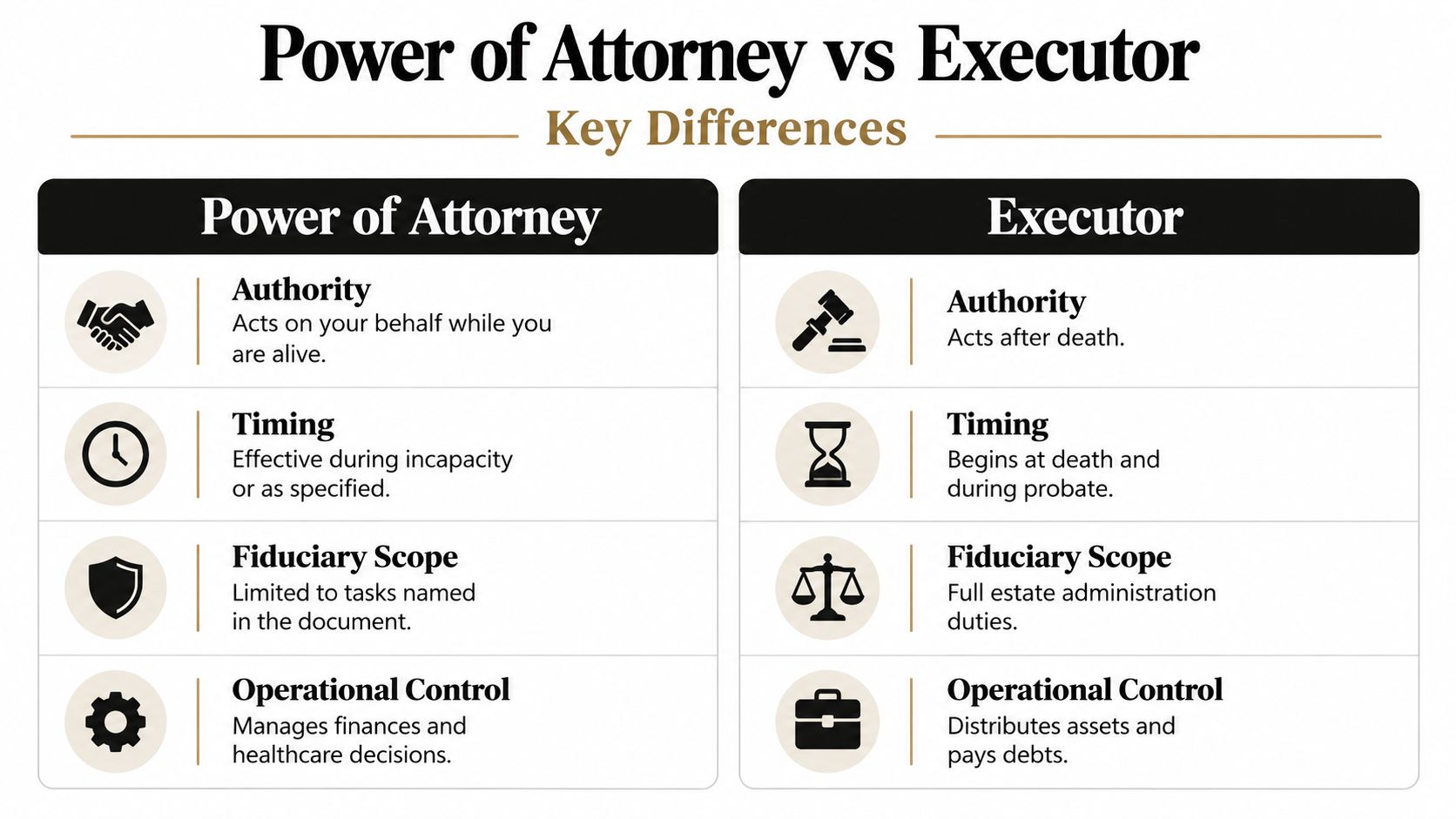
A POA's authority comes from the principal's document and is limited by its terms and legal restrictions. The agent may manage authorized financial matters, but doesn't gain the right to distribute inheritances or settle the estate after death.
An executor's authority arises from the will and probate appointment. The executor's focus is to gather and protect estate property, address creditor claims and expenses, and distribute what remains according to the will and law. Texas Estates Code Chapter 351 addresses administration responsibilities and the executor's relationship to estate property (Texas Estates Code Chapter 351).
One person can serve both roles, but the powers stay separate
A principal may name the same trusted person as POA agent and executor. That may help with continuity because the person already understands the principal's finances and wishes. But the two roles don't merge. The person acts under the POA during the principal's life and, after death, must qualify as executor before acting for the estate.
Separate records matter, especially if the agent later serves as executor. The agent's lifetime transactions should be documented as POA activity, while transactions after appointment belong to estate administration. A practical control plan can keep separate signing authority, account access, inventories, valuations, beneficiary information, and deadlines for each role.
The mental model is simple: the POA supports personal financial management during life; the executor handles estate administration after death. The legal handoff is not just a change in job title. It is a change in whose interests the person serves, what authority applies, and what records support each action.
What Happens to a Power of Attorney at Death
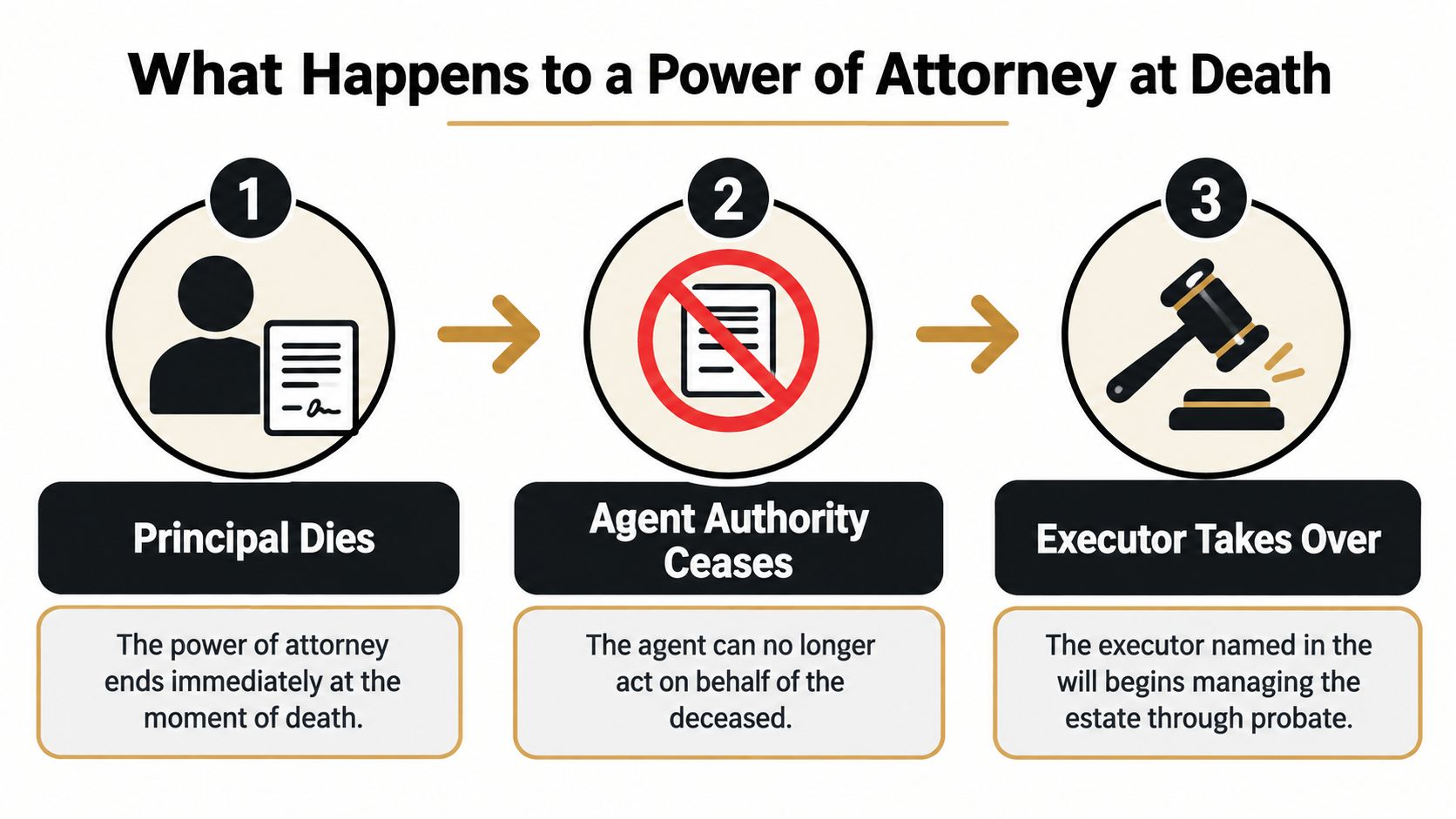
At death, the POA generally ends, even if the agent is also named executor in the will. The former agent's experience managing accounts or property doesn't carry over as legal authority to continue those tasks. The nominated executor must instead obtain authority through probate, typically by having the will admitted and receiving the court's appointment (Texas State Law Library guidance on powers of attorney).
Why the gap can cause trouble
The period between death and probate appointment can leave relatives uncertain about who may handle property. A bank may freeze an account or ask for proof of authority. Beneficiaries may want updates. A former agent may feel pressure to pay bills, sell property, or distribute belongings quickly, especially if they've managed those affairs for a long time.
That pressure doesn't extend POA authority. A person named as executor in the will is still only the nominee until appointed through probate. Acting as though the POA continues can create disputes over transactions and complicate the later accounting of estate assets.
The practical handoff is legal, not automatic: naming the same individual for both jobs may make the family transition more familiar, but it doesn't authorize that person to administer the estate before appointment.
Families can reduce confusion by discussing this handoff in advance. Make sure the proposed agent and executor understand that their roles have different start and end points, and that the family should confirm the proper authority before someone signs on behalf of the estate. If a transaction can wait for the executor's appointment, waiting is often safer than relying on the former POA.
When to Use Each Document in Your Plan
A durable POA and a will solve different planning problems. The POA can let a trusted agent manage authorized matters while the principal is alive and unable to act. The will names the person the testator wants to administer the estate after death. Having one document doesn't fill the gap left by the other.
Consider a parent experiencing early-stage dementia. The parent may still be able to express wishes, but may want a plan for who can manage authorized financial matters if independent bill-paying becomes difficult. A durable POA can address that lifetime concern. The parent's will serves a different purpose by naming an executor and directing how the estate should be handled after death.
A business owner with property in Texas and elsewhere may also need both roles coordinated. The agent's authority needs to cover the intended lifetime management tasks, while the will should name an executor prepared to handle estate administration. Keeping a clear record of access, signing authority, assets, and key documents can help the people in each role understand their responsibilities without assuming they have the same powers.
Consider the desired probate structure
Texas Estates Code Section 401.001 allows a testator to provide for independent administration in a will, or to state that independent administration isn't allowed. If the will names an executor but doesn't provide for independent administration, all distributees may agree that it's advisable, designate the named executor to serve independently, and request limited court involvement (Texas Estates Code Section 401.001).
That choice should reflect the estate and family circumstances. Some families may value less routine court involvement, while others may prefer greater court oversight when conflict or vulnerability is a concern. A Houston Heights trust attorney resource can help readers explore how trust planning fits alongside a will and POA.
The aim isn't to choose between the documents. It's to make sure the people you trust can act at the right time, under the right authority, and with a clear understanding of what you want.
Practical Scenarios and a Transition Checklist
If the same person is named as agent and executor, they may know the principal's accounts and preferences. After death, however, they need to stop treating the POA as authority to transact and wait until properly appointed as executor. If different people hold the roles, the former agent may have records the executor needs to understand the principal's lifetime finances.

An executor who finds unexplained transfers or gifts shouldn't assume a lifetime transaction can be reversed. The right next step is to preserve records and examine what authority the agent had, what the principal's circumstances were, and what the transaction documents and account statements show. Beneficiaries who suspect an agent favored one person should avoid informal accusations or self-help distributions and consider getting legal advice about the records and estate process.
A practical transition checklist
- Secure property: Take reasonable steps to protect the home and other property without treating the POA as continuing authority to sell or transfer assets.
- Preserve records: Keep POA documents, statements, receipts, contracts, deeds, tax materials, and a record of transactions made during the principal's life.
- Notify institutions: Contact relevant financial institutions about the death and ask what proof they require before releasing information or allowing estate transactions.
- Avoid distributing assets: Don't divide money or property among family members before the executor is appointed and the estate process is understood.
- Confirm the will and probate path: Find the original will and determine how the nominated executor can seek appointment and letters testamentary.
- Raise concerns with care: If records suggest possible misuse, preserve them and consult probate counsel before attempting to recover property or change distributions.
A Texas State Law Library resource discusses concerns about POA abuse and estate accountability. It reports that investigations rose 28% in one year, from 2,849 to 3,647 cases, while more than 8 million powers of attorney remained in place; those figures are not Texas-specific, but they underscore why careful records and oversight matter (Texas State Law Library guidance on estate executors).
Families can use the following video as another way to review the transition from lifetime authority to estate administration.
Getting Professional Help With Your Estate Plan
The right documents depend on your wishes, family relationships, assets, and the people you trust to serve. A Texas estate planning attorney can help you coordinate a POA with a will, clarify the agent's authority, name an appropriate executor, and consider whether the will should address independent administration. Careful planning can make the handoff clearer for the people who will manage your affairs.
The central distinction remains the same: a POA can't substitute for a will's post-death administration provisions, and a will doesn't ordinarily authorize someone to manage the testator's affairs during life. Keeping the documents aligned can reduce uncertainty when a family is already coping with illness, incapacity, or loss.
The Law Office of Bryan Fagan, PLLC helps Texas families with estate planning and probate, as well as family law matters. Its attorneys have more than 100 years of combined legal experience, and the firm serves clients across Houston, Dallas–Fort Worth, Austin, San Antonio, and surrounding Texas communities.
If you're deciding who should manage your affairs during life or administer your estate after death, the Law Office of Bryan Fagan, PLLC offers estate planning and probate guidance for Texas families. Contact the firm to schedule a free consultation and discuss how your documents can work together.