 Skip to content
A loved one has died, and your family is suddenly trying to locate a will, protect a house, identify bank accounts, respond to creditors, and understand what a Texas court expects. You may also be grieving while relatives disagree about who should take charge. That combination can make even a straightforward estate feel unmanageable.
An estate administration lawyer helps turn those responsibilities into an organized legal process. The right guidance can help your family identify the appropriate Texas probate track early, meet deadlines, preserve estate property, and reduce the chance that an executor becomes personally responsible for an avoidable mistake.
Introduction When You Are Facing Estate Administration for the First Time
Consider a family in Houston after a parent passes away. One child has the original will, another has access to the home, and a third believes the bank account should pass directly to the person listed on it. Meanwhile, the mortgage, utilities, medical bills, and insurance notices continue arriving. Nobody wants to make the wrong decision, but someone still needs legal authority to act.
That person may eventually serve as an independent executor, dependent administrator, or another court-authorized representative. The role isn't just a matter of collecting property and handing it to beneficiaries. The representative must follow Texas law, protect estate assets, address valid debts, communicate with interested parties, and keep records showing how each decision was made.
The timing can also be confusing immediately after death. Families may be waiting for certified documents before a probate filing can move forward. A resource explaining the timeline for Texas pending certificates can help you understand why those documents may not be available right away and what information you should begin gathering in the meantime.
This guide focuses on the decisions that matter early:
- Which probate path fits the estate
- What an executor or administrator must do
- Why Texas deadlines and claim sequencing matter
- How missing documents, family conflict, and title problems create delay
- What to ask before hiring an estate administration lawyer
Texas families in Houston, Dallas-Fort Worth, Austin, San Antonio, and surrounding communities don't have to solve every issue alone. A careful first conversation with counsel can clarify what needs immediate attention, what can wait, and which route may avoid unnecessary court supervision.
What an Estate Administration Lawyer Does in Texas
An estate administration lawyer acts much like a project manager for a legally sensitive financial process. The representative remains responsible for the estate, but counsel helps sequence the work so that one step doesn't undermine the next. That sequence generally begins with probate filings and court compliance, then moves through property identification, valuation, debt review, tax administration, and final distribution. (Justia explains the probate administration workflow and fiduciary responsibilities.)

The fiduciary workflow
The first question is authority. The lawyer reviews the will, determines whether the person named can serve, identifies the proper county, and prepares the filing needed to open the estate or pursue another available procedure. Until the court issues the appropriate authority, family members shouldn't assume they can sell property, close accounts, or distribute assets just because they expect to inherit.
Next comes the estate inventory. This may include real estate, vehicles, financial accounts, business interests, personal property, insurance-related rights, and potential claims owed to the estate. The lawyer helps distinguish property owned individually from assets that may pass through beneficiary designations, survivorship rights, or another legal arrangement.
Valuation and debt review follow. The representative should preserve property from avoidable loss, identify secured and unsecured obligations, review creditor claims, and determine which expenses the estate can properly pay. Tax administration may require gathering records and coordinating with tax professionals when appropriate.
Final distribution comes only after the representative has addressed the estate's obligations and confirmed the beneficiaries' rights. The lawyer can help prepare receipts, releases, accountings, deeds, and other closing documents.
Practical rule: An executor's job isn't merely to divide property. The executor must be able to show that the estate was handled in the beneficiaries' and creditors' lawful interests.
What the representative must document
The executor or administrator generally needs to:
- Protect property: Secure the home, maintain insurance, prevent waste, and safeguard valuable personal items.
- Keep beneficiaries informed: Provide appropriate updates and respond to reasonable questions without promising distributions too early.
- Maintain records: Preserve statements, invoices, appraisals, correspondence, receipts, and filing confirmations.
- Act impartially: Follow the will or Texas intestacy rules rather than favoring one family member.
- Follow court requirements: Meet filing obligations and respond accurately to notices, orders, and requests.
Families looking for a broader explanation of the role can review what an executor of an estate does. For a Texas overview of Probate, see Probate administration and estate settlement.
The value of counsel often appears in the transitions between tasks. For example, paying a bill may be appropriate, but paying the wrong claim before reviewing creditor rights can create a problem. Likewise, distributing a bank account may seem simple until ownership, beneficiary designations, or estate debts have been confirmed.
A lawyer's role is to help the representative make those decisions in the correct order, while keeping the family informed about what is happening and why.
How Texas Probate and Estate Administration Works
A family may have a valid will, a home, bank accounts, and unpaid bills, yet still face several possible probate routes. Texas does not use one procedure for every estate. The will, property, debts, heirs, and level of family agreement determine which path fits. Choosing that path early matters. A process suited to a clear will and cooperative beneficiaries may be inappropriate for disputed heirs or difficult assets.
Independent administration
Independent administration gives an executor authority to handle estate work with less routine court supervision. The will may authorize it, or Texas law may permit it when the required conditions exist. This can reduce court involvement, but it does not remove the executor's fiduciary duties.
The executor must still protect estate property, address valid claims, maintain accurate records, complete required filings, and distribute assets according to the will or Texas law. Independent administration is often a practical fit when the documents are clear and beneficiaries can cooperate. It is not permission to treat estate property as personal property or skip legal requirements.
Dependent administration
Dependent administration places the estate under closer court supervision. An administrator may need court approval before taking actions that an independent executor could handle with greater discretion. The added oversight can require more time and paperwork, but it also supplies structure when heirs disagree, the will is unclear, assets are difficult to manage, or the court determines that closer control is appropriate.
The simpler-sounding route is not always the safer choice. Counsel should examine family cooperation, possible creditor objections, disputed ownership, and assets that require careful handling before recommending a procedure.
Muniment of title
A muniment of title can provide a narrower route when a valid will is available and the main goal is transferring title without a full administration. Texas Estates Code Chapter 257 requires the court to find that the testator has died, that the court has jurisdiction and venue, and that the application was filed fewer than four years after the date of death. Texas Estates Code Chapter 257 provides the muniment-of-title requirements.
That deadline can control the family's options. Waiting too long may prevent use of this procedure for a house or another asset named in the will. A muniment proceeding also may not address every debt or administration issue, so the family should review the estate as a whole before assuming title transfer is the only task.
Small estate affidavit
A small estate affidavit is a limited alternative for some intestate estates. The estate must generally have no will, and the value of estate assets, excluding homestead and exempt property, must be $75,000 or less. At least 30 days must have passed since death. All distributees must sign, and two disinterested witnesses must verify the family relationship and stated facts. A Texas probate resource describes the small estate affidavit requirements.
A missing signature, disputed heir, or asset value above the applicable limit can make the affidavit unavailable. A modest estate does not automatically qualify. The facts must fit each statutory condition.
| Probate Path | When It Applies | Court Oversight | Best For |
|---|---|---|---|
| Independent administration | The will or applicable law permits an independent process | More limited routine supervision | Clear estates with an available representative and manageable cooperation |
| Dependent administration | Greater court control is needed or required | More active supervision | Estates with complexity, disagreement, or heightened risk |
| Muniment of title | A valid will supports title transfer and the Chapter 257 requirements are met | Focused court proceeding | Transferring property without a full administration when appropriate |
| Small estate affidavit | A qualifying intestate estate meets the value, timing, signature, and witness requirements | Affidavit-based process | Modest estates that fit the narrow statutory conditions |
Before meeting counsel, gather the will, death certificate, recent account statements, deeds, vehicle titles, creditor notices, and a list of possible heirs. These documents help the lawyer compare the available routes instead of selecting a procedure from one fact alone. Families can also review how to probate a will in Texas while preparing those materials.
Timelines Fees and What to Expect With a Texas Estate
Estate administration doesn't follow one fixed calendar. The time and expense depend on the probate route, the number and type of assets, creditor issues, tax work, title questions, beneficiary cooperation, and whether someone challenges the will or the representative's conduct.
Texas imposes an important early duty on an independent executor. The executor must generally file the estate's inventory, appraisement, and list of claims within 90 days of qualification, unless the court grants an extension. If the estate has no unpaid debts other than secured debts, taxes, and administration expenses, the executor may be able to file an affidavit in lieu of the full inventory package. (TexasLawHelp explains the inventory and affidavit alternatives.)
A practical sequence
A representative should generally think in this order:
- Confirm authority and secure property. Obtain the court documents needed to act and protect the home, vehicles, accounts, and personal property.
- Identify and value assets. Gather statements, deeds, titles, account information, and appraisals where appropriate.
- Review claims and obligations. Separate valid estate expenses from disputed or unsupported demands.
- Complete required filings. Prepare inventory materials, tax-related documents, accountings, and court filings that apply.
- Resolve and document distributions. Transfer property only after the estate's obligations and beneficiary rights have been addressed.
The sequence protects the representative. An executor who distributes money before confirming what the estate owes may have to recover funds from beneficiaries personally. An estate administration lawyer can create a document list and calendar so the representative knows which deadline applies and what proof belongs in the file.
Keep a separate estate file: Mixing personal spending with estate funds makes it harder to explain transactions and can fuel beneficiary objections.
Understanding fees
Legal fees may be structured in different ways, including hourly billing, a flat fee for a defined task, or another arrangement permitted by the engagement agreement and applicable law. The total cost can be affected by the amount of court work, property valuation, creditor disputes, tax coordination, title corrections, family conflict, and whether litigation becomes necessary.
Ask for a written explanation of what the proposed fee covers. You should know whether the engagement includes the initial probate filing, routine communications, inventory preparation, distribution documents, contested matters, and additional court hearings. A clear agreement helps the family compare options without relying on a vague estimate.
Digital probate systems can also affect practical expectations. Official UK data provide an illustration of how filing method may matter in another major probate system, with digital applications representing about 80% of filings, average digital grant times around 4.9 to 5 weeks, and paper cases taking roughly 12 to 13 weeks. (The UK government discusses digital and paper probate processing times.) Texas procedures are different, but the broader lesson applies: complete documents and the correct filing method can influence progress.
For a document-focused starting point, see this Texas probate checklist.
Common Challenges That Delay or Complicate Administration
Many estate problems begin with an understandable assumption. A family member assumes the oldest child should control the estate. Someone believes a joint account automatically belongs to the surviving account holder. An executor pays a bill immediately because it appears legitimate. These decisions may be reasonable in ordinary life, but probate requires legal verification.
Disputes that need early attention
A will contest may involve questions about capacity, undue influence, execution, or the meaning of a provision. A caveat or objection can interrupt an otherwise routine filing. Recent UK data reported 11,589 caveat applications in the 12 months to 31 July 2025, a 12% increase, illustrating the importance of addressing contentious probate risk early rather than treating every estate as purely administrative. (MoneyWeek reports the UK caveat figures and probate dispute trend.)
In Texas, similar warning signs include a beneficiary who says the decedent lacked capacity, a relative who questions a late change to the will, or an interested person who believes the executor is favoring one heir. Early legal review can help preserve records and identify whether communication, mediation, or formal litigation is appropriate.
Other frequent complications include:
- Title problems: The house may be recorded under an outdated name, a prior deed may be missing, or the property may not be titled as the family expected.
- Unverified creditor claims: A creditor may demand payment without providing enough support, or a valid obligation may be overlooked.
- Tax and record gaps: Missing returns, account statements, or business records can prevent accurate valuation and reporting.
- Beneficiary breakdowns: Siblings may disagree about personal belongings, repairs, sale timing, or the fairness of a proposed distribution.
Do not distribute first and investigate later. Premature payment or distribution can expose the representative to personal liability and may require transactions to be unwound. (Executor instructions emphasize creditor review, asset protection, and proper sequencing.)
A house is a useful example. One sibling wants to sell immediately, another wants to live there, and a third claims the will gave the property to a particular person. The executor should first confirm title, the will's language, the estate's debts, insurance needs, and each beneficiary's legal position. Selling without that review can turn a manageable disagreement into a title dispute or fiduciary complaint.
The firm's Child Custody practice addresses custody and conservatorship representation, including high-conflict disputes. That work is distinct from probate, but the same principle applies: early legal structure can prevent emotional conflict from controlling important decisions.
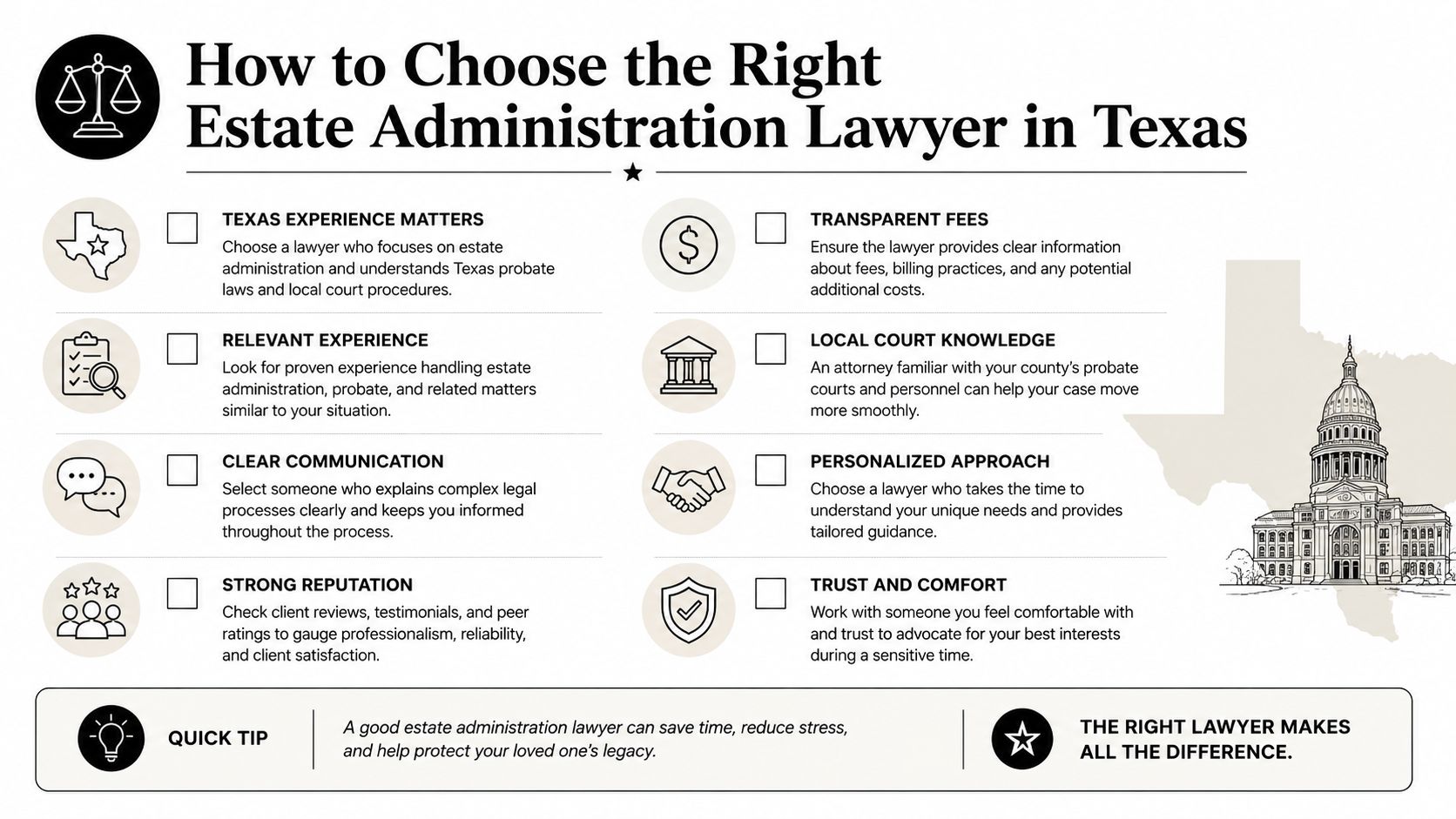
How to Choose the Right Estate Administration Lawyer in Texas
The right lawyer should do more than recite probate vocabulary. You need someone who can explain your likely Texas procedure, identify immediate deadlines, and tell you what could change the strategy.
Questions to ask during the consultation
Ask direct questions such as:
- Which track appears appropriate? Ask whether the facts point toward independent administration, dependent administration, muniment of title, a small estate affidavit, or another procedure.
- What must happen first? The lawyer should identify urgent steps involving property, documents, creditors, and court filings.
- Who will communicate with the family? Confirm how updates are delivered and who answers routine questions.
- How are fees calculated? Request a written explanation of the initial work, ongoing administration, and contested matters.
- What could create personal exposure? A thoughtful answer should address records, claims, distributions, and conflicts of interest.
- What documents are missing? The lawyer should explain how missing wills, deeds, account records, or death certificates affect the plan.
Bring the original will if available, certified death certificates, deeds, account statements, insurance information, vehicle titles, business documents, recent tax records, a list of known debts, and the names and contact details of potential beneficiaries and heirs. Don't worry if your file is incomplete. An initial consultation can identify what needs to be requested next.
Look for Texas-specific judgment
Experience with independent and dependent administration matters because the choice affects supervision, paperwork, and decision-making. Familiarity with Texas Estates Code provisions matters just as much when the family is considering a muniment of title or a small estate affidavit.
Local court familiarity may help counsel anticipate filing practices in Houston, Dallas-Fort Worth, Austin, or San Antonio, although no lawyer can promise a particular outcome or timeline. The lawyer should also be comfortable explaining when an estate that appears simple has become contentious.
A small estate affidavit is a good test of precision. The estate must generally be intestate, qualifying assets must be within the statutory limit, the waiting period must have passed, all distributees must sign, and two disinterested witnesses must verify the facts. A lawyer who treats those requirements casually may also overlook more serious filing details. (The Texas small-estate requirements are summarized in this probate resource.)
Warning signs
Be cautious if a lawyer offers a fee without asking about the will, assets, debts, or family relationships. Be equally cautious if someone promises that probate will be quick, says creditors can be paid immediately, or refuses to explain what happens if a beneficiary objects.
The Law Office of Bryan Fagan, PLLC provides Texas families with estate planning and probate guidance alongside its family-law services. Its Estate Planning resources address wills, trusts, and estate strategies for protecting assets and carrying out a person's wishes.
Next Steps for Texas Families Ready for Guidance
Start by gathering what you have, not by waiting until the file is perfect. Locate the will, request certified death certificates, collect deeds and account statements, list known debts, and preserve recent tax records. Secure the residence and valuable property, but avoid selling, transferring, or distributing assets before a lawyer reviews the estate's authority and obligations.
The first strategic question is often the probate track. An estate with a valid will and a house that needs title transfer may call for a different procedure than an intestate estate with modest assets. A family that delays may lose a simplified option, miss an inventory deadline, or allow a disagreement to harden before anyone has evaluated the legal issues.
Whether you're in Houston, Dallas-Fort Worth, Austin, San Antonio, or another Texas community, an estate administration lawyer can help you build a practical plan around the facts of your loved one's estate. Early advice can be useful even when the estate appears small because the consequences of an incorrect distribution, missed filing, or unresolved title issue can reach the representative personally.
Bring your questions to a consultation. You don't need to know the correct legal terminology, and you don't need to decide every issue before speaking with counsel. You need a clear explanation of what happens next and what your family should avoid doing in the meantime.
If you need help identifying the right Texas probate path, meeting the 90-day inventory requirement, protecting estate assets, or addressing beneficiary and creditor concerns, The Law Office of Bryan Fagan, PLLC can provide individualized probate and estate planning guidance. Visit Law Office of Bryan Fagan, PLLC to request a free consultation and discuss your estate with a Texas legal team.


