
Texas Standard Possession Order Calendar: Take Control Before It Controls You
When it comes to co-parenting after divorce, the Texas Standard Possession Order Calendar can either give you clarity — or create constant confusion. Without a clear, written custody order, verbal agreements often fall apart. And when that happens, your parenting time, decision-making rights, and even your relationship with your child can suffer.
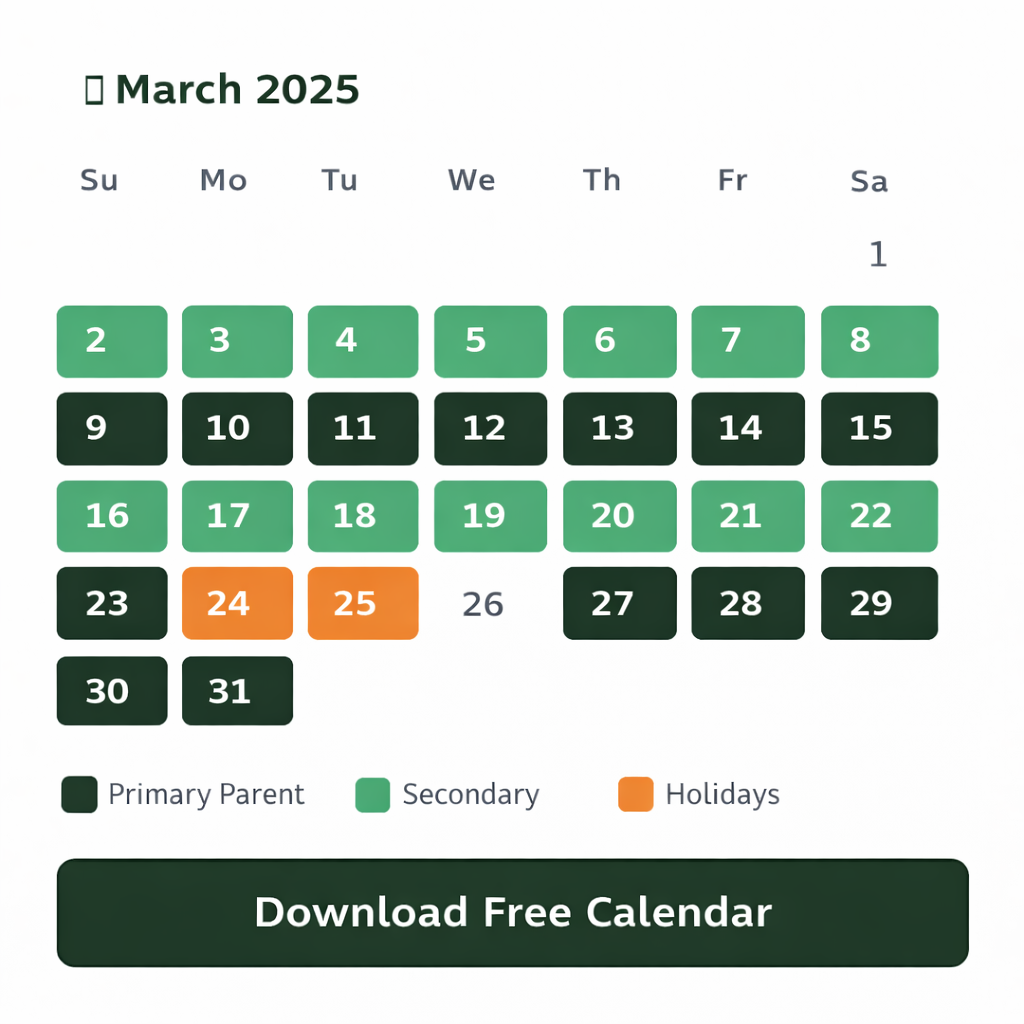
A properly organized Texas Standard Possession Order Calendar helps eliminate uncertainty. It clearly outlines first, third, and fifth weekends, holiday rotations, and summer possession so you know exactly when exchanges occur. No guesswork. No missed weekends. No unnecessary arguments.
That’s why The Law Office of Bryan Fagan, PLLC created a Free Texas Standard Possession Order Calendar for 2025 and 2026. This easy-to-use tool is designed specifically for Texas parents who want to stay organized, reduce conflict, and protect their time with their children.
Instead of reacting to scheduling disputes, you can plan ahead with confidence and stability — exactly what Texas courts intend when issuing a Standard Possession Order.
👉 Download your free Texas Standard Possession Order Calendar today and protect your parenting time before confusion takes control.
What Is a Standard Possession Order (SPO)?
A Standard Possession Order (often called an SPO) is a Texas court order that outlines when each parent has physical possession of the child. It sets the foundation for your child custody schedule, including weekends, holidays, and summer visitation.
Without it, you’re relying on “he said, she said” arrangements that can’t be enforced or modified by a judge. And when one parent stops cooperating, there’s little you can do to protect your time or your child’s stability.
Our 2025 and 2026 Standard Possession Order calendars align with Texas law, giving you a practical visual tool that mirrors the legal order you should have in place.
Why You Need a Written Legal Order—Not Just a Verbal Agreement
A verbal agreement might work… until it doesn’t.
When one parent refuses to cooperate, you can’t enforce a handshake deal. Without a written court order:
- You can lose valuable visitation time because the other parent changes plans.
- Your child could move further away, limiting your access.
- You can’t modify or enforce anything in court.
- You risk confusion, stress, and emotional strain for your child.
Don’t take chances with your child’s future. A written Standard Possession Order is the only way to protect your rights and secure a reliable parenting schedule.
Understanding Child Custody and Conservatorship in Texas
In Texas, the term “conservatorship” refers to a parent’s legal rights and duties toward their child. The two main types are:
-
- Joint Managing Conservatorship – Both parents share decision-making authority.
-
- Sole Managing Conservatorship – One parent has the exclusive right to make certain major decisions (often what people mean when they ask about “ full custody as a mother ” or father).
Your possession schedule (the time spent with your child) may vary depending on your conservatorship arrangement.
If you need clarity on what kind of conservatorship or schedule fits your family best, contact our legal experts to discuss your options and get a customized plan in place.
Examples of Common Child Custody Schedules
Every family is different—and Texas law allows flexibility in setting schedules that work for your child’s best interests. Here are a few common options:
1. Standard Possession Order (SPO)
The most common court-ordered plan. Typically, one parent has the child on:
- The 1st, 3rd, and 5th weekends of each month.
- Thursday evenings during the school year.
- Extended time in the summer and alternating holidays.
This usually resembles a 60/40 custody schedule—where one parent has the child about 60% of the time, and the other has 40%.
2. 50/50 Custody Schedule
Parents share nearly equal time—great for cooperative co-parents who live close to each other. Common patterns include:
- Week-on / Week-off
- 2-2-3 schedule
- 3-4-4-3 schedule
3. 2-2-3 Custody Schedule
Wondering, “What is a 2-2-3 custody schedule?”
It means one parent has the child Monday–Tuesday, the other Wednesday–Thursday, and weekends alternate. It’s a balanced, predictable way to share parenting time while keeping both parents actively involved.
If you need help determining which schedule suits your child’s routine—or need a judge to approve a customized version—speak to one of our legal experts today.
How Our Free Texas Standard Possession Order Calendar Helps You
Our downloadable 2025 and 2026 Texas Standard Possession Order Calendar makes it easy to track parenting time and avoid confusion.
Each calendar includes:
-
Clearly marked first, third, and fifth weekends
-
Pre-labeled holiday rotations (odd/even years)
-
Color-coded possession days for each parent
-
Space for 50/50 or 2-2-3 custom schedules
-
Notes for school events and exchanges
This Texas Standard Possession Order Calendar reduces conflict, improves organization, and helps protect your parenting time with clarity and confidence.
Don’t Wait Until It’s Too Late
If you’re co-parenting without a written legal order, you’re vulnerable. Life changes—new jobs, new relationships, new cities—and without restrictions or enforceable terms, your child could move further away or your visitation time could shrink overnight.
Protect your child and your parenting rights.
Download your free Standard Possession Order calendar now, then speak to one of our legal experts about creating or modifying your own enforceable court order.
Texas Standard Possession Order (SPO) Frequently Asked Questions
This FAQ is written for Texas families following a Standard Possession Order. Always follow your court order first. When in doubt, your SPO calendar controls the exact dates.
What counts as the 1st, 3rd, and 5th weekend?
Look at the Fridays in each month. The weekends that begin on the 1st and 3rd Fridays are always in the SPO. If a month has a 5th Friday, that weekend is also included.
When does the weekend start and end?
Unless your order says otherwise, weekend possession typically runs from Friday at school dismissal (or 6:00 p.m. if school’s not in session) until Monday at school return (or 8:00 a.m. Monday/6:00 p.m. Sunday if specified differently in your order). Check your order and the calendar notes for your exact start/end times.
How do 5th weekends work—do they stack with the next month’s 1st weekend?
Yes. When a month has a 5th weekend, it’s common for the same parent to have back‑to‑back weekends (the 5th weekend of one month and the 1st weekend of the next month). Your calendar will show this clearly.
What if the month starts on a Saturday or Sunday—does that change which weekend is the 1st?
No. We count by Fridays. The first Friday of the month begins the 1st weekend, regardless of which day the month starts.
Do Monday school or federal holidays extend the weekend?
Often, yes. If Monday is a student holiday/teacher in‑service day (or a federal holiday when school is out), the weekend usually extends through Monday at 6:00 p.m. or to school return on Tuesday. Follow your order and the notations on your calendar for the exact rule in your case.
Do I get a weekday visit during the school term?
Standard SPOs include a Thursday period during the school year—either 6:00–8:00 p.m. or from school dismissal to Friday school return if your order has the “expanded” schedule. Your order controls which version you have.
Do Thursday visits continue during summer break?
Typically no—weekday periods apply during the school term and usually do not apply in summer unless your order says otherwise.
How much summer time does the non‑primary parent receive?
Under a standard SPO, the non‑primary parent typically receives extended summer possession (commonly 30 days when parents live within 50 miles; often longer—e.g., 42 days—if over 100 miles). Your specific length and start/end times are controlled by your order.
How do I choose my summer dates, and what if I miss the deadline?
Your order sets a notice deadline (commonly April 1). If you give timely written notice, you can select your summer dates (often allowed to be split into multiple blocks with limits). If you don’t give timely notice, a default summer period applies—your calendar shows that default.
Do regular 1st/3rd/5th weekends still happen during the other parent’s summer time?
Usually no—extended summer possession supersedes regular weekends during that block, except for specific carve‑outs (e.g., Father’s Day). Your order or calendar will show any exceptions.
How are the major holidays split?
SPOs alternate Thanksgiving, Christmas/Winter Break (divided into two parts), and Spring Break by even/odd years between the parents. Your calendar indicates who has which holiday in the current year.
How is Christmas/Winter Break divided?
It’s typically split into Part A (from school dismissal at winter break to midday on December 28) and Part B (from December 28 to the day before school resumes/return to school). Parents alternate these parts by even/odd years. Follow your order and the calendar for exact times.
Who gets Thanksgiving this year?
Thanksgiving alternates each year. Your calendar labels the current year’s Thanksgiving parent. If you’re unsure, check the year indicator on the calendar.
What about Spring Break?
Spring Break is typically one parent in even‑numbered years and the other in odd‑numbered years. Your calendar marks the current year’s assignment.
Do Mother’s Day and Father’s Day override the regular schedule?
Yes. Each parent is entitled to possession on their respective day every year, which overrides the normal weekend/holiday pattern.
How is the child’s birthday handled?
Many SPOs give the non‑possessory parent a birthday visit period, even if it falls during the other parent’s time. See your order for the length and time window.
Where do exchanges happen?
During the school year, exchanges commonly occur at school (pickup at dismissal/return at start of school). If school isn’t in session, your order will specify a time and location (often 6:00 p.m. at a designated place).
What if our schools/closures or bell times change?
The SPO ties many periods to “school dismissal/return”. If your district changes schedules or there are unexpected closures, default to the times listed in your order or any fallback time (e.g., 6:00 p.m./8:00 a.m.) stated in your order.
Which wins if dates conflict—holidays, summer, or regular weekends?
Priority is generally: Holiday possession → Extended Summer possession → Regular weekends/ Thursdays. Your order controls, but this is the usual hierarchy.
What if the other parent and I agree to swap?
The SPO ties many periods to “school dismissal/return”. If your district changes schedules or there are unexpected closures, default to the times listed in your order or any fallback time (e.g., 6:00 p.m./8:00 a.m.) stated in your order.
What is a Standard Possession Order?
A Standard Possession Order (SPO) is a Texas court order that defines each parent’s right to spend time with their child. It outlines weekends, holidays, vacations, and other possession times.
What is the difference between a Standard Possession Order and a customized schedule?
The SPO follows a state-approved structure, while customized schedules—such as 50/50 custody, 60/40 custody, or a 2-2-3 custody schedule—can be agreed upon when it better fits the child’s routine and both parents’ availability.
What is a 2-2-3 custody schedule?
A 2-2-3 schedule means one parent has the child for two days, the other parent for the next two, and weekends alternate. It’s often used in 50/50 custody situations because it keeps both parents equally involved during the school week.
Can I get full custody as a mother in Texas?
In Texas, “full custody” usually refers to sole managing conservatorship—where one parent makes major decisions for the child. This is typically granted only when it’s in the child’s best interest, such as in cases involving neglect, abuse, or severe conflict.
What happens if the other parent takes the child and does not return the child?
If the other parent refuses to return your child after their visitation period, it’s a serious legal issue.
- You can call local law enforcement to request a welfare check or enforcement of your court order.
- Your attorney can file an enforcement action or writ of habeas corpus to compel the child’s return.
- If no written court order exists (only a verbal agreement), law enforcement may not intervene, leaving you powerless to act.
This is why having a court-signed Standard Possession Order is essential—it’s your only enforceable protection if the other parent violates custody terms.
👉 Contact our legal expert immediately if your child has not been returned on time or if you need to establish an enforceable order.
What happens if we only have a verbal custody agreement?
Verbal agreements are not enforceable in Texas. If the other parent refuses to follow your agreed-upon schedule, there’s nothing the court or police can do. Only a written, signed child custody order allows you to enforce or modify your rights.
Can I modify an existing order if my situation has changed?
Yes. If there’s been a material and substantial change—like relocation, new jobs, or changes in your child’s needs—you can file for a Modification of Court Orders to update your schedule.
👉 Learn more about Modification of Court Orders.
How do I download the Standard Possession Order calendar?
Simply click the download link on this page to access your free 2025 or 2026 Standard Possession Order calendar. The calendar reflects Texas law and helps you track your child custody schedule clearly and easily.
Where can I verify my exact dates and times?
Use your SPO calendar and court order. If anything is unclear or your situation is unique (distance between homes, non‑standard provisions), contact our office and we’ll review your order and calendar with you.
How Our Free Texas Standard Possession Order Calendar Helps You
Our downloadable 2025 and 2026 Texas Standard Possession Order Calendar makes it simple to see your parenting time at a glance and stay organized all year long.
Each calendar includes:
-
Clearly marked weekends and holidays under Texas SPO guidelines
-
A color-coded layout showing each parent’s possession days
-
Space to customize for 50/50 or 2-2-3 custody schedules
-
A notes section for school events, pickups, and exchanges
This Texas Standard Possession Order Calendar isn’t just convenient — it’s a practical first step toward creating or enforcing a custody order that protects your parental rights and your time with your child.
SPO Calendar Video for August
Family & Custody Law Experts – Free Initial Consultation
Fill out this short form and a member of our experienced family law team will contact you to discuss your situation.
FREE 2025 & 2026 CALENDARS
Your Free Texas Standard Possession Order Calendar
Stop the confusion over custody weekends, holidays, and summer schedules. Download your color-coded SPO calendar and stay on top of every exchange — built for Texas parents.
- Color-coded for primary & secondary parent days
- Texas holidays included
- Both 2025 & 2026 available
- Free — no strings attached
500+ 5-Star Reviews
15,000+ Downloaded
Always Free
Texas Court-Ready
UNDERSTANDING YOUR RIGHTS
What Is a Texas Standard Possession Order — and Why Does It Matter?
A Standard Possession Order (SPO) is a Texas court order that establishes exactly when each parent has the right to physical possession of their child. It is the default schedule Texas courts apply to children aged 3 and older.
Knowing your schedule in advance prevents conflict, protects your parental rights, and helps your child maintain a stable routine. Our free calendar pre-populates your entire year based on the Texas SPO framework.
The SPO is designed to keep both parents deeply involved in their child’s life — but only if both parents know and track their schedule correctly.
Standard SPO at a Glance
Regular Weekends (1st, 3rd, 5th)
Non-primary: Fri 6pm → Sun 6pm
Monthly
Thursday Overnight
Non-primary: Thu 6pm → Fri school
Weekly
Extended Summer Possesion
30-42 days depending on distance
Annual
Holiday Schedule
Alternating holidays per Texas SPO
Annual
SIMPLE 4-STEP SETUP
How to Use Your SPO Calendar

Download the Calendar
Fill out the quick form below to receive both 2025 and 2026 PDFs by email.

Print or Save Digitally
Print and post it on your fridge, or save to Google Drive/iCloud for on-the-go access.

Identify Your Days
Use the color-coding to instantly see which days belong to which parent — no more confusion.

Share With Co-Parent
Send a copy to your co-parent to get everyone on the same page and reduce scheduling conflicts.
GET YOUR CALENDAR
Choose Your Year & Download Instantly
Both years are available. We recommend downloading both so you always have the complete schedule at your fingertips — especially around the end of the year.
2025 Calendar
Full 12-month SPO schedule
2026 Calendar
Full 12-month SPO schedule
Both Years ★
Best value pick
Free Instant Download
Email your calendar directly to your inbox.
No spam. 100% private. Unsubscribe anytime.
SPO Calendar Video for August
WHAT PARENTS SAY
Real Feedback from Texas Families
This calendar saved us so many arguments. My ex and I finally have the same reference point — it’s been a game changer for our kids.
Ashley K. — Katy, TX
I didn’t fully understand my SPO until I saw it laid out visually. Bryan Fagan’s calendar made everything so clear. Highly recommend to any co-parent.
Daniel P. — Cypress, TX
My attorney told me to print this and keep it on my fridge. It’s become my go-to reference every single month. Free and incredibly useful.
Maria S. — Pearland, TX
FREQUENTLY ASKED QUESTIONS
Common Questions About the Texas SPO
What is the Texas Standard Possession Order?
The SPO is the default custody schedule Texas courts apply when parents can’t agree. It governs weekends, holidays, and summer possession.
Does the schedule change over 100 miles apart?
Yes. Extended-distance SPO rules differ — the non-primary parent typically gets longer summer possession and fewer but longer weekend visits.
Does the SPO apply to my case automatically?
It applies to most children aged 3 and older unless a court has deviated based on the child’s best interest or an agreed alternative schedule.
What if my co-parent violates the possession order?
Document every violation and consult an attorney. Texas courts take possession order violations seriously — you may have grounds for enforcement or modification.
Can I modify the Standard Possession Order?
Yes. Parents can agree to a different schedule, or you can petition the court for a modification if there’s been a material change in circumstances.
Is this calendar legally binding?
The calendar is a visual reference tool. Your actual legal obligations are set by your court order. Always refer to your official order in disputes.
KEEP LEARNING
More Free Resources for Texas Parents
Custody Guide
Texas Child Custody Laws Guide
Understand conservatorship, possession rights, and how Texas courts make custody decisions.
Cost Resource
Texas Family Law Case Cost Pamphlet
Get our free cost pamphlet and understand attorney fees, court costs, and payment options.
Free Consult
Free Consultation Booking
Have questions about your order? Talk directly with an experienced Texas family law attorney.
Stay Organized. Protect Your Time With Your Kids.
Download the free Texas SPO Calendar now and take the guesswork out of your custody schedule — for the whole year.