 Skip to content
A Houston business owner sits at the kitchen table after everyone else has gone to bed. The company supports the family, employs people who have been there for years, and carries the owner's identity along with its balance sheet. The question is difficult because it isn't only about retirement. It's about what happens to the business, the employees, and the family if the owner becomes ill, dies, divorces, or can't lead anymore.
Family business succession is where money, control, marriage, and grief meet. A plan that looks orderly in a binder can fall apart when a spouse, sibling, or child discovers that the documents don't answer the practical questions. Who votes? Who manages? Who gets bought out? Who has enough cash to pay taxes or redeem an ownership interest?
This guide gives you a working vocabulary, a Texas-specific framework, and a practical checklist for turning stated intentions into an operating process. The hard conversations won't become easy, but they can become more structured and less destructive.
The Conversation Every Texas Business Family Eventually Has
The owner at that kitchen table may have a will, a trust, and an operating agreement. That can create a comforting sense of completion. Then a child asks a simple question: “What happens to my sister's ownership if she stops working here?” The documents may not answer it, or they may answer it in conflicting ways.
That silence is common because succession planning feels personal. A founder may worry that naming one child as successor insults another. A child working in the company may fear that a non-working sibling will receive equal control. A surviving spouse may need income without wanting to run the business. These aren't merely legal issues. They involve loyalty, recognition, resentment, and fear of losing the family's center of gravity.
The transition also affects people outside the family. Employees need stable leadership. Customers need confidence that decisions won't freeze. Lenders and vendors may need to know who has authority to sign. A succession plan that ignores these relationships can leave a company technically transferred but practically ungovernable.
Deloitte's 2026 family business succession report describes the urgency. Leadership succession within the next 10 years is expected by 27% of families and 40% of family businesses, while 89% of families and 82% of family businesses report having some form of plan. Only about half report having a thorough, well-developed plan. Deloitte's 2026 report shows why “we have documents” isn't the same as “we're ready.”
Your first task isn't choosing a trust or drafting a buy-sell agreement. It's getting the family to describe the future in the same room, with the same definitions, before a crisis chooses the terms for you.
What Family Business Succession Actually Means
Family business succession is the planned transfer of responsibility and economic interests from one generation or leadership group to another. It has three separate layers:
- Ownership, the equity interest recorded in company documents and estate instruments.
- Control, the authority to vote, appoint managers, approve transactions, and make strategic decisions.
- Management, the daily responsibility for employees, customers, operations, and finances.
These layers may move at different times. A parent can transfer economic ownership while retaining limited control. A child can manage the company before receiving a controlling interest. A trust can own shares while a designated manager exercises voting authority. The plan must explain how those stages connect.

Paperwork is only the starting point
A plan on paper identifies a preferred successor. A living plan identifies what that successor can do now, what authority transfers later, how performance is evaluated, and what happens if the successor dies, divorces, becomes disabled, or refuses the role.
The distinction matters in financially complex families, including those facing High-Net-Worth Divorce, where businesses, investments, and other valuable assets may require careful characterization and division.
Central rule: Succession is a multi-year transfer system, not a one-day signing.
A practical plan should include a transition calendar, family meeting procedures, leadership training, updated valuations, signing authority, emergency authority, and a written response to disputes. A document that stays in a safe deposit box without rehearsals is an intention, not an operating plan.
Choosing the Right Texas Legal Structure
The legal structure should serve the transition. It shouldn't become a collection of complex documents that nobody understands when the founder is unavailable.
Match the structure to the transfer problem
A Texas limited liability company can separate ownership units from management authority through its certificate of formation and operating agreement. The agreement can address voting thresholds, transfer restrictions, manager succession, redemption rights, and what happens when an owner's interest becomes subject to a divorce, creditor claim, or estate administration.
A family limited partnership can separate general management authority from limited economic interests. It may help a family centralize control while gradually transferring economic participation, but its restrictions and tax treatment require careful drafting and administration. The family must understand who controls the entity, who receives distributions, and which decisions require consent.
Revocable trusts can organize assets during life and provide continuity if the owner becomes incapacitated. They generally don't create the same transfer-tax effect as an irrevocable structure. Irrevocable trusts, grantor trusts, and dynasty-style trusts may serve different estate, gift, creditor, and multigenerational objectives, subject to the specific facts and applicable law.
An S corporation election, when available and appropriate, affects tax treatment and imposes eligibility and ownership rules. Trust ownership must be reviewed carefully because an otherwise useful trust may create an S-corporation qualification problem if drafted or administered incorrectly.

Put the tax filings beside the legal documents
A multi-member LLC often receives partnership tax treatment, though classification can vary. The family's accountant should confirm the filing position and ownership records, including whether Form 1065 for multi-member LLCs applies. Legal ownership, capital accounts, distributions, and tax reporting need to tell the same story.
Consider a third-generation construction company. An LLC may be the cleaner choice if the family wants flexible management and direct operating control. An FLP may be considered if the family wants a holding structure that separates management from economic interests. Neither structure solves an unprepared successor, a stale valuation, or a family that refuses to decide who has authority.
Valuation and Why the Number on Paper Matters
A succession plan can't allocate what nobody has measured. The business value drives purchase prices, equalization between children, estate reporting, insurance needs, and the amount a company may need to borrow or reserve.
A valuation professional may use an income approach, which examines expected cash flow and earnings. A market approach compares the company with relevant transactions or comparable businesses. An asset approach focuses on the value of tangible and identifiable assets, often with adjustments for liabilities and business circumstances.
| Method | What It Measures | Best Used When |
|---|---|---|
| Income approach | Earning capacity and anticipated cash flow | The company has reliable operating results |
| Market approach | Pricing evidence from comparable businesses or transactions | Comparable market information is available |
| Asset approach | Net value of business assets after liabilities | Assets drive value or earnings are difficult to normalize |
The method matters because different approaches can produce different conclusions. A professional also needs to examine owner compensation, related-party transactions, customer concentration, debt, intellectual property, goodwill, and the company's dependence on the founder.
Character determines where the interest goes
Texas Estates Code Chapter 201 governs descent and distribution for intestate estates and distinguishes community property from separate property. That distinction can affect whether a surviving spouse, children, or other heirs receive a decedent's business interest when there isn't a controlling will or coordinated transfer plan. Texas Estates Code Chapter 201 should be reviewed alongside formation records, purchase documents, tracing evidence, marital agreements, and later contributions.
Suppose a Dallas shop owner's company has doubled in value, but the buy-sell formula still uses a five-year-old figure. The family may believe it has a fair process, yet the formula can underpay one owner, overburden the company, or provoke a dispute at the moment trust is weakest. Guidance on deal structuring strategies for buyers can provide useful commercial context, but Texas counsel and a qualified valuation professional must apply the facts to the family's documents.
For a related discussion of business value in a marital dispute, review valuing a business for divorce. The same discipline matters in succession, even though the legal questions differ.
How Buy-Sell Agreements Hold Everything Together
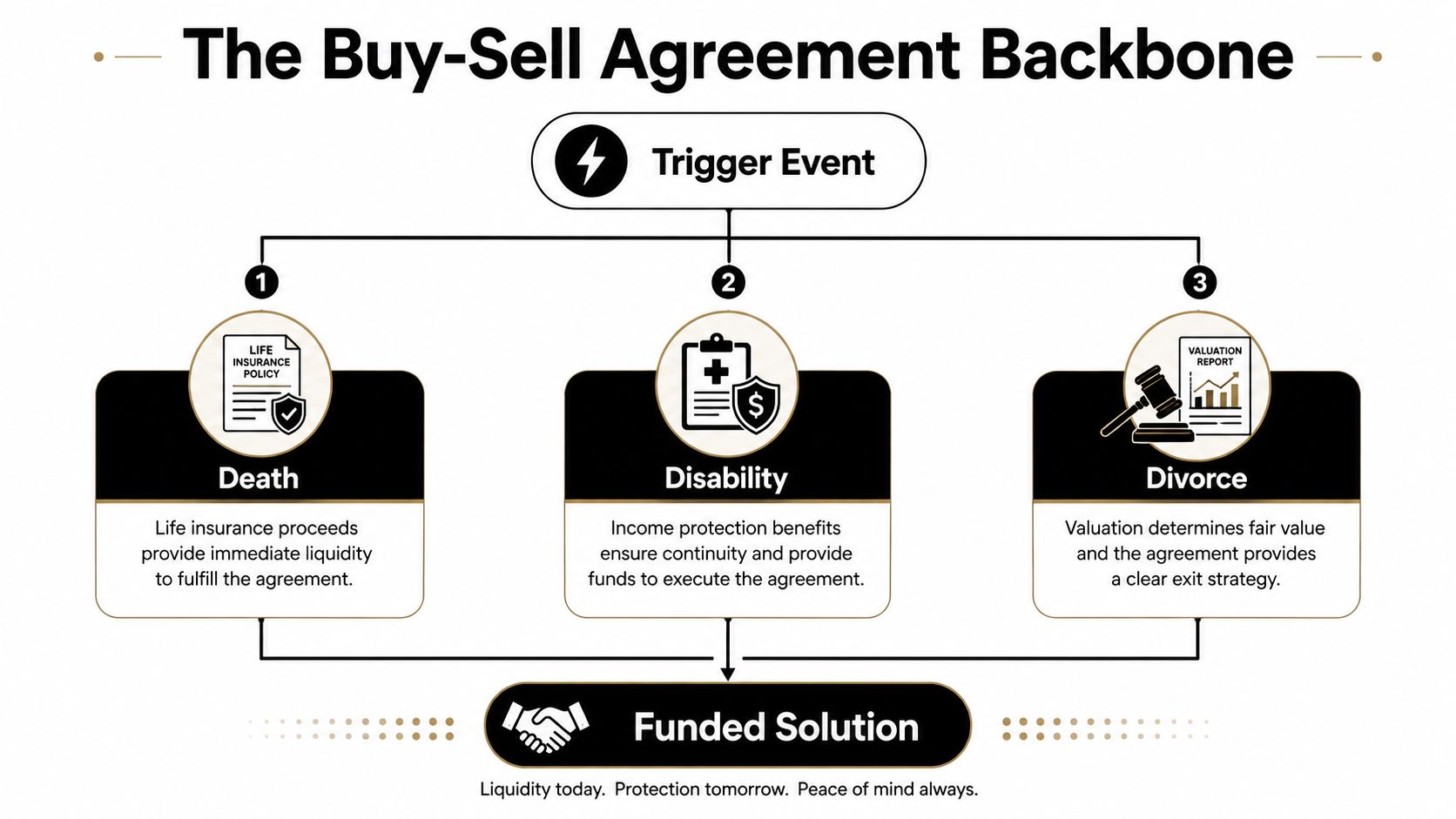
A buy-sell agreement is the operating backbone of succession. It explains who may buy an ownership interest, who must sell, how the interest is valued, when payment occurs, and what restrictions apply to an outsider receiving the interest.
The agreement should address at least three distinct triggers:
- Death: Life insurance may provide liquidity for a redemption or cross-purchase, but the policy owner, beneficiary, premium obligations, and coverage amount must match the agreement.
- Disability: A disability policy or another reserve may support a purchase after a defined period, but the agreement must define disability, evidence, notice, and payment terms.
- Divorce: The company may need a valuation and structured buyout to prevent a former spouse or a court-ordered transfer from introducing an unwanted co-owner.
A San Antonio founder dies without a funded buy-sell agreement. The surviving spouse inherits an interest under the applicable estate plan or intestacy rules, while the founder's sibling continues running the company. The spouse may need income and may want a sale. The sibling may lack the cash to buy the interest. Suddenly, two people with different goals own part of the same operating business.
Texas law permits a successor independent administrator to be appointed when a will's named independent executor and named successor executors cannot or won't serve. Under Texas Estates Code Section 404.005, distributees may apply for continuation of independent administration and appointment of a qualified successor administrator in the described circumstances. That authority can make administration more workable, but it doesn't replace a clear company agreement or funded purchase mechanism.
Before signing, test the agreement against a real event. Ask whether it has a single-trigger or double-trigger transfer rule, when the valuation updates, who pays for the valuation, and whether insurance proceeds arrive when the purchase price is due. Review the agreement after major changes in ownership, debt, family relationships, or business value.
The key-person insurance discussion can help families understand why coverage needs to be coordinated with the company's actual continuity risks, not treated as a generic insurance purchase.
Wiring the Business into Your Texas Estate Plan
The business interest can't sit apart from the rest of the estate plan. A will, revocable trust, pour-over provision, durable power of attorney, medical power of attorney, and beneficiary designation each has a different job. If they point in different directions, the family may spend time litigating instead of leading.
A will controls property that passes through probate. A revocable trust may provide management continuity for assets properly transferred to it. A durable power of attorney can authorize an agent to handle business and financial matters during incapacity, but the agent's authority should be coordinated with the entity agreement and any lender requirements. A medical power of attorney addresses health decisions, not company management.
Beneficiary designations can control insurance, retirement accounts, and other assets outside probate. They don't automatically transfer an LLC interest correctly, and they may create an unequal result if the owner used insurance to equalize children without updating the wider plan.
A blended family needs more than default documents
Consider a Fort Worth owner with a child from a first marriage working in the company and two younger children from the current marriage. The working child may be the right manager, but the other children may still need fair economic treatment. The current spouse may need housing, income, or control over other assets. A default will and default beneficiary form may leave the family with competing expectations and no practical funding plan.
The estate plan should answer four questions in writing:
- Who owns the business interest after death?
- Who votes and manages during incapacity and after death?
- How are non-business heirs compensated?
- What prevents an unprepared or unwilling person from controlling the company?
The estate planning for business owners resource offers related context, but each family still needs documents coordinated around its ownership records, marital property, tax exposure, and operating agreement.
Empirical literature reviewing more than 400 articles associates smoother transitions with heir preparation, trust-based family relationships, and more extensive tax and wealth-transfer planning. The succession planning evidence review supports a practical conclusion: one document rarely solves a multi-layer transfer.
Governance Tools That Prevent the Family Fights
Families often assume conflict will disappear once the taxes are funded and the insurance is purchased. It won't. Money can solve a liquidity problem while leaving a control problem untouched.
The most common friction starts with different expectations. A working heir may expect authority to follow responsibility. A non-working heir may expect an equal vote because ownership is equal. A spouse of an heir may become a de facto stakeholder through household finances, even though the company documents never gave that person a formal role. The founder may also remain involved long after announcing retirement, undermining the successor in front of employees.
Give the family a structure for disagreement
A family constitution can state the family's mission, employment expectations, ownership principles, and conduct standards. It isn't a substitute for an operating agreement, but it gives relatives a shared reference point.
A family council creates a regular setting for questions about ownership, distributions, education, and family participation. An advisory board can bring outside perspective without immediately transferring legal control. A documented decision-rights matrix should identify which matters belong to management, the board, owners, or the family council.
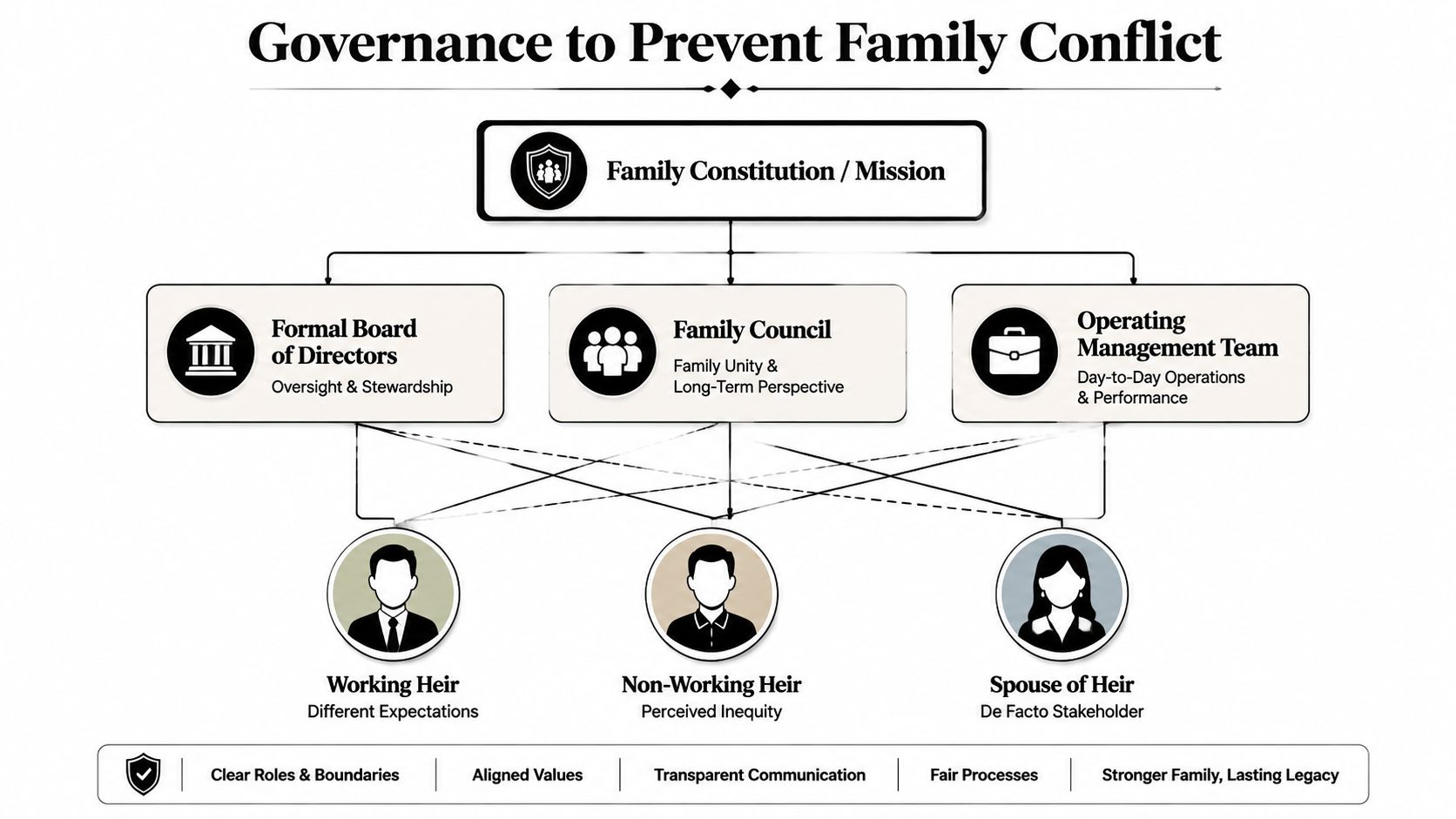
Write down the rules before the conflict:
- Employment: Define qualifications, reporting lines, compensation review, and removal procedures for relatives working in the company.
- Ownership: Explain whether ownership requires active employment and how a non-working owner receives information and distributions.
- Spouses: Address transfer restrictions, marital agreements, confidentiality, and the effect of divorce on ownership.
- Deadlock: Establish voting thresholds, mediation, appraisal procedures, and a buyout path.
Texas families should pay particular attention to the LLC operating agreement. If it lacks a clear buyout mechanism, a divorce, death, or ownership disagreement can force the family to negotiate under pressure, with the business itself exposed to the dispute. The goal isn't to eliminate every disagreement. It's to prevent one disagreement from becoming a fight over the company's existence.
A Practical Timeline and Common Pitfalls to Avoid
Succession planning works best when the family treats it as a process with accountable steps. The timeline below is adaptable, but postponing every decision until the founder is ready to leave creates avoidable pressure.
Five to ten years before the handoff
Use the long horizon to prepare people, not just paperwork. Identify potential successors, give them progressively meaningful responsibility, expose them to financial information, and evaluate whether they can lead employees and make unpopular decisions. Create a written development plan with specific responsibilities and a way to review progress.
Start family meetings before anyone is asking for a transfer. Discuss whether the company will remain family-owned, whether all children are candidates, and how non-working heirs may participate economically without controlling operations.
Two to five years before the handoff
This is the structuring phase. Confirm entity ownership, review the operating agreement, obtain a current valuation, analyze community and separate property, and coordinate the will, trust, powers of attorney, and beneficiary forms. Draft or revise the buy-sell agreement and match its triggers to realistic funding.
Tax design can change whether the company survives intact. A comparative European tax-monitoring study found that succession tax on a €10 million family business ranged from €0 to just over €4.2 million depending on jurisdiction, with standard gift and inheritance tax rates ranging from 0% to 45% across the surveyed countries. The KPMG European Family Business Tax Monitor illustrates the core discipline, model liquidity before transfer, identify available reliefs, and avoid a forced sale of operating assets.
For an additional planning perspective, review the Synopsix succession planning guide, then have Texas legal and tax professionals apply the concepts to your documents and family structure.
Twelve to twenty-four months before execution
Move from design to rehearsal. Hold a transition meeting, clarify signing authority, notify key advisors, test insurance and payment mechanics, and document who acts if the founder becomes incapacitated before the scheduled handoff.
Run this checklist:
- Update valuations: Replace formulas based on stale assumptions.
- Fund the buy-sell: Verify policy ownership, beneficiaries, coverage, reserves, and payment timing.
- Review beneficiary forms: Confirm they match the will, trust, ownership records, and intended equalization.
- Check Texas property character: Apply the community and separate property framework rather than assuming every asset passes alike.
- Address intestacy: Texas law can produce different results for a surviving spouse depending on whether the deceased spouse leaves children or descendants from outside the marriage. Texas intestacy guidance for surviving spouses explains why a valid will and coordinated beneficiary planning matter.
- Have the conversation: Tell the family who will lead, who will own, who will be bought out, and what happens if the preferred successor cannot serve.
Deloitte's separate 2026 survey of 300 family business executives found that 78% expected a CEO transition within the next decade, 42% expected one within three to five years, and only 23% were actively implementing a plan. The Deloitte succession paradox findings make the operational gap difficult to dismiss.
If you need help navigating divorce, custody, or estate planning in Texas, contact The Law Office of Bryan Fagan today for a free consultation.
The Law Office of Bryan Fagan, PLLC helps Texas families coordinate estate plans, probate strategy, business ownership concerns, and related family-law issues before a transition becomes a crisis. Visit Law Office of Bryan Fagan, PLLC to request a free consultation and discuss your family business succession plan with counsel who can help align ownership, control, and continuity.


