
Building a successful business is one of life’s most significant achievements. You’ve poured countless hours, immense effort, and your heart into creating something that provides for your family and contributes to our Texas community. But have you thought about what happens to that legacy when you're no longer at the helm? This transition can be one of the most difficult to consider—but understanding your rights and options under Texas law can make it feel far less overwhelming.
Estate planning for business owners is more than just a legal formality. It is the thoughtful process of creating a clear roadmap for your company’s future, ensuring the business you built continues to thrive long after you've stepped away. By using legal tools like wills, trusts, and buy-sell agreements, you can sidestep family feuds, minimize tax burdens, and ultimately, secure your financial legacy. For any Texas entrepreneur, this is your final, most crucial act of leadership.
Your Business Is More Than an Asset—It Is Your Legacy
As a Texas business owner, you know the grit it took to get here. Your company isn't just an entry on a balance sheet; it's a source of pride, a way to provide for your family, and the cornerstone of the legacy you'll one day leave behind.
But what happens to it all when you’re no longer there to lead?

It’s a heavy question, and we understand why it's difficult to face. We've sat with countless entrepreneurs who share the same fears:
- Family Disputes: Will my children fight over who gets control?
- Forced Sales: Could my family be forced to sell the company for pennies on the dollar to pay off taxes or debts?
- Operational Chaos: Who will manage daily operations if I’m suddenly incapacitated?
- Crushing Taxes: Will a significant portion of my life's work be lost to estate taxes?
These concerns are entirely valid, but they don't have to become your reality. A well-designed estate plan is the key to preventing these outcomes and giving you and your loved ones true peace of mind.
The Financial Stakes of Inaction
Putting off this planning means gambling with everything you’ve built. The Trusts & Estates sector in the U.S. is massive, with revenues projected to hit $290.1 billion in 2025. But without a solid succession strategy, many business legacies could crumble under financial and legal pressures.
Estate planning for your business isn't just about preparing for death; it's about planning for life. It ensures your company can thrive even if you are unexpectedly unable to lead, protecting your employees, partners, and family from uncertainty.
To truly protect your legacy, it helps to first understand the general principles of estate planning. This foundational knowledge provides the right frame for the specific, tailored strategies your business needs.
At The Law Office of Bryan Fagan, PLLC, we see you as more than a client—you're a fellow Texas entrepreneur. We understand the complexities of preserving a business because we live it, too. We’re here to be your trusted partner in navigating this vital process.
Why Do So Many Business Owners Put Off Succession Planning?
If you’ve been pushing succession planning down your to-do list, you are not alone. For most Texas entrepreneurs we meet, the idea of stepping away from the business they’ve poured their life into feels abstract and uncomfortable. It's a task that often falls to the bottom of the list—not because it isn't important, but because the hurdles feel immense.
We get it. Contemplating your own mortality or picturing your company without you is heavy. It's natural to feel a mix of pride, anxiety, and perhaps denial. This isn’t just another business transaction; it’s a deeply personal journey that touches your family, your employees, and the core of your identity.
The Real Reasons We Procrastinate
Over the years, we've heard business owners share the same deeply personal reasons for pausing their estate plan. These aren’t just excuses; they are valid feelings that deserve to be handled with care.
Here are some of the most common emotional roadblocks:
- The Struggle to Let Go: For many, the business is their identity. The thought of handing over the reins can feel like giving up a piece of yourself.
- Fear of Stirring Up Family Drama: Money and control have a way of straining even the tightest family bonds. Many owners delay planning because they fear it will spark fights among their children or other relatives.
- The "No One's Ready" Belief: You might look at your chosen successor—whether it's a child or a key employee—and think they just don't have the experience or vision to take over.
- Feeling Completely Overwhelmed: The process itself can seem daunting. Legal jargon, tax rules, and business valuations can feel like learning a foreign language, making inaction seem easier.
These feelings are a normal part of the process. The key is to see them not as stop signs, but as signals that it’s time to put a clear, solid legal framework in place to guide you through these challenges.
The Hard Numbers Behind Inaction
While the emotional reasons for delay are understandable, the statistics paint a sobering picture. A lack of planning is one of the biggest threats to the survival of a private business.
A recent survey found that just 46% of private business owners have a formal succession plan in the works. Even more shocking, a full 30% have no plan at all. This hesitation is often tied to worries about the next generation's readiness, with nearly half of owners saying their successors are only 'somewhat prepared' to manage the company's wealth. You can dig into more of these findings in the Brown Brothers Harriman business owner survey.
This data reveals a significant gap between knowing you should plan and actually doing it. It also shows you’re not alone in worrying about whether your successor is ready. But that’s precisely why a structured plan is so critical. A good plan provides a roadmap to mentor, train, and legally empower your successor, turning uncertainty into a confident transition. By tackling these common fears with a smart legal strategy, you can turn passive worry into active leadership and ensure your legacy is protected.
Essential Tools for Your Business Estate Plan
Now that we’ve addressed the common reasons for delay, let's shift from the ‘why’ to the ‘how.’ Protecting your business requires a specific set of legal tools designed to manage ownership, control, and succession. Think of these as the essential instruments in your toolbox, each with a distinct role in building a secure legacy.

A solid estate plan is about layering several key components that work together to prevent chaos and ensure a smooth, predictable transition. Let's break down the most critical tools every Texas business owner should consider.
The Power of a Buy-Sell Agreement
For any company with more than one owner, a Buy-Sell Agreement is non-negotiable. This is a legally binding contract that outlines exactly what happens to a business owner's interest if a "triggering event" occurs—such as death, disability, divorce, or retirement. It predetermines who can buy a departing owner's share, at what price, and on what terms.
Think of it as a "business prenuptial agreement." It ensures remaining owners aren't suddenly forced into business with a former partner's spouse or an heir who knows nothing about the company. It also creates a guaranteed market for the departing owner's shares, ensuring their family receives fair value. Before you do anything else, you need to understand how a buy-sell agreement impacts business valuation.
There are two main ways to structure these agreements:
- Cross-Purchase Agreement: The individual owners agree to buy the shares of any owner who exits. In this setup, each owner typically holds a life insurance policy on the other owners to fund the purchase.
- Redemption Agreement: The business entity itself agrees to buy back the shares of the departing owner. Here, the company usually owns the life insurance policies needed to fund the buyout.
Choosing the right structure is a strategic decision that depends on the number of owners, your business entity type, and tax considerations.
Comparing Buy-Sell Agreement Structures
Deciding between a cross-purchase and a redemption agreement can feel complicated, but it often comes down to administrative simplicity and tax implications. This table breaks down the core differences.
| Feature | Cross-Purchase Agreement | Redemption (or Entity-Purchase) Agreement |
|---|---|---|
| Who buys the shares? | The remaining individual owners. | The business entity itself. |
| Who owns the insurance? | Each owner holds a policy on every other owner. | The company owns one policy on each owner. |
| Tax Basis for Buyers | The surviving owners receive a "step-up" in basis on the shares they purchase. | No step-up in basis for the remaining owners' original shares. |
| Best For | Companies with a small number of owners due to policy management. | Companies with multiple owners, as it simplifies policy management. |
The goal is to create a smooth, funded transition. A cross-purchase agreement can be great for two or three partners, but it becomes difficult to manage with more. A redemption agreement streamlines the process for larger groups, but the tax implications for the remaining owners must be carefully considered.
Using Trusts to Protect Your Business Assets
Trusts are powerful tools for avoiding probate and maintaining control over your assets. For a business owner, they are indispensable. Under the Texas Estates Code, assets held in a trust bypass the public, time-consuming, and often expensive probate process.
A Revocable Living Trust is a popular choice. While you’re alive, you can transfer your business ownership into the trust and act as the trustee, maintaining complete control. The key is naming a successor trustee in the trust document. That person can seamlessly step in to manage the business assets if you become incapacitated or pass away—without court intervention.
Another important tool is the Irrevocable Life Insurance Trust (ILIT). This specialized trust is designed to own a life insurance policy. When the policy is inside an ILIT, the death benefit is kept out of your taxable estate. That money can then be used by the trust to buy your business shares from your estate, providing instant cash for your family and helping fulfill the terms of your buy-sell agreement.
By placing your business interests in a trust, you create a private and efficient pathway for succession. This ensures your hand-picked successor can take control immediately, keeping operations stable and avoiding the delays of the Texas probate court system.
The Vital Role of a Business Power of Attorney
Most people have a durable power of attorney that allows someone to manage their personal finances. However, that document often stops short when it comes to your business. A Business Power of Attorney is a separate document that grants an agent the authority to handle decisions for the company.
This document can empower your chosen agent to:
- Manage payroll and pay company bills
- Access business bank accounts
- Negotiate and sign contracts on behalf of the business
- Make day-to-day operational decisions
Without this specific authority, your personal agent could find their hands tied, lacking the legal standing to keep the business running. This could lead to operational paralysis at the worst possible time. A well-drafted business power of attorney is a simple but profound step toward ensuring your company can survive a personal emergency.
Getting Real About Your Business’s Value and Taxes
For most entrepreneurs, their business isn’t just an asset; it’s the asset. It is likely the most valuable thing you own. When it comes to estate planning, you need a precise, formal business valuation. Think of it as the bedrock for every other strategic decision you’ll make.
Without a real number, how can you plan for estate taxes, structure a fair buy-sell agreement, or ensure your heirs inherit assets equitably? This is especially true in Texas, where a proper valuation can be critical evidence in probate court or during a divorce.
Why You Can’t Afford to Skip a Formal Valuation
A professional business valuation provides a defensible, objective assessment of your company’s fair market value. It’s not just about the final price tag; it’s about the detailed analysis that gets you there.
This formal process is crucial for several reasons:
- Tax Planning: It establishes the value of your business for federal estate tax purposes, which is the starting point for determining what you might owe.
- Succession Planning: It sets a fair price for buy-sell agreements, preventing conflict whether you’re selling to a partner, a key employee, or a family member.
- Divorce Proceedings: If a divorce is possible, Texas law requires a formal valuation to properly divide community property under the Texas Family Code.
- Securing Funding: It gives your heirs the documentation needed to obtain a loan to buy out other beneficiaries or keep the business running.
Navigating these situations without a professional valuation is like trying to sail across the Gulf without a compass—it invites trouble with the IRS, family disputes, and major financial losses.
The Clock is Ticking on the Federal Estate Tax Exemption
One of the biggest reasons to act now is the changing landscape of federal estate tax law. We are currently in a period with a historically high federal estate tax exemption, allowing you to pass a significant amount of wealth to your heirs tax-free. But this window is closing.
This high exemption is set to “sunset” at the end of 2025. Unless Congress acts, the exemption amount will be cut by roughly half. For many successful Texas business owners, this change could suddenly expose a large portion of their estate to a crippling tax bill.
The upcoming drop in the federal estate tax exemption isn’t just a future problem—it’s an urgent call to action. Smart planning today, using tools like strategic gifting and specialized trusts, can lock in the benefits of the current high exemption and potentially save your family millions in taxes.
This isn’t a far-off concern. The 2025 federal exemption is $13.99 million per person, but it’s projected to drop to around $7 million in 2026. This sharp decline highlights the importance of timely action. Yet, recent data shows a surprising number of people are unprepared. While most high-net-worth individuals feel financially secure, more than half do not have a formal estate plan. As you can learn more about wealth transfer preparedness trends, it’s clear we need to move from feeling secure to taking concrete action.
By strategically gifting or moving assets into certain types of irrevocable trusts before the deadline, you can use the current, larger exemption to its full potential. This is a powerful move in estate planning for business owners that can dramatically reduce the tax burden on your loved ones.
Real-World Scenarios for Texas Business Owners
Legal tools can sound abstract. To show you what they actually accomplish, let’s walk through a couple of relatable scenarios that bring these concepts to life for Texas entrepreneurs. These examples reflect the kinds of challenges we help business owners solve every day.
The Houston Restaurant and the Divided Heirs
Imagine Maria, the owner of a beloved family restaurant in Houston. She has three adult children. Her son is the head chef and has poured his heart into the business. Another child is a teacher with no interest in the industry, and the third is a CPA who helps with the books part-time. Maria wants to retire but is stuck.
How can she be fair to all three children while ensuring the restaurant continues to thrive under her chef son’s leadership?
Without a plan, this is a recipe for disaster. If Maria simply leaves the business to all three in her will, they become equal partners. The teacher and CPA could outvote the chef on critical decisions or demand a buyout the business can’t afford, forcing a sale.
Instead, Maria works with her attorney to create a smart plan:
- A Buy-Sell Agreement: This legal agreement states that upon Maria’s retirement or death, her chef son has the first right to purchase the business shares from his siblings.
- A Revocable Living Trust: Maria transfers ownership of the restaurant into a trust. The trust’s instructions are clear: the restaurant is for the son who runs it, while other assets can be divided among the others.
- Life Insurance Funding: The trust owns a life insurance policy on Maria. When she passes away, the tax-free payout provides the cash her chef son needs to buy his siblings’ shares at a pre-agreed price determined by a formal valuation.
The result? Her chef son gets the business he helped build. Her other two children receive a fair and liquid inheritance. The family is protected from the kind of conflict that can tear families and businesses apart.
The Dallas Startup and the Unexpected Disability
Now consider Ben and Sarah, co-founders of a successful Dallas tech startup. They’re young, focused on growth, and estate planning is the last thing on their minds. Then, Ben is in a serious accident that leaves him permanently disabled and unable to work.
Suddenly, their company is in limbo. Ben still owns 50% of the business but can’t contribute. His family, facing immense medical bills, pressures Sarah to buy them out, but the company doesn’t have the cash.
Here’s how a proactive plan would have saved their company:
- A Funded Buy-Sell Agreement: A solid agreement would include disability as a triggering event, outlining the terms for Sarah to purchase Ben’s shares.
- Disability Insurance: The buy-sell agreement would have been backed by a disability buyout insurance policy. This policy would pay a lump sum to Sarah, giving her the capital to buy Ben’s stake without draining company funds.
- Business Power of Attorney: As part of their planning, both Ben and Sarah would have appointed each other as their agent for business decisions. This would have given Sarah the legal authority to make critical choices on Ben’s behalf, ensuring the business could continue to operate smoothly.
These stories show that estate planning for business owners isn’t just about what happens when you die. It’s about planning for all of life’s unexpected turns. A well-crafted plan is your best defense against chaos, ensuring your legacy is one of stability and success.
Your Step-by-Step Estate Planning Checklist
Getting started is often the hardest part, but you don’t have to do it all at once. We’ve created this practical checklist to break down estate planning for business owners into clear, manageable steps.
This flowchart maps out a common journey for a Texas business owner—from running a local Houston restaurant to eventually securing their family’s future.
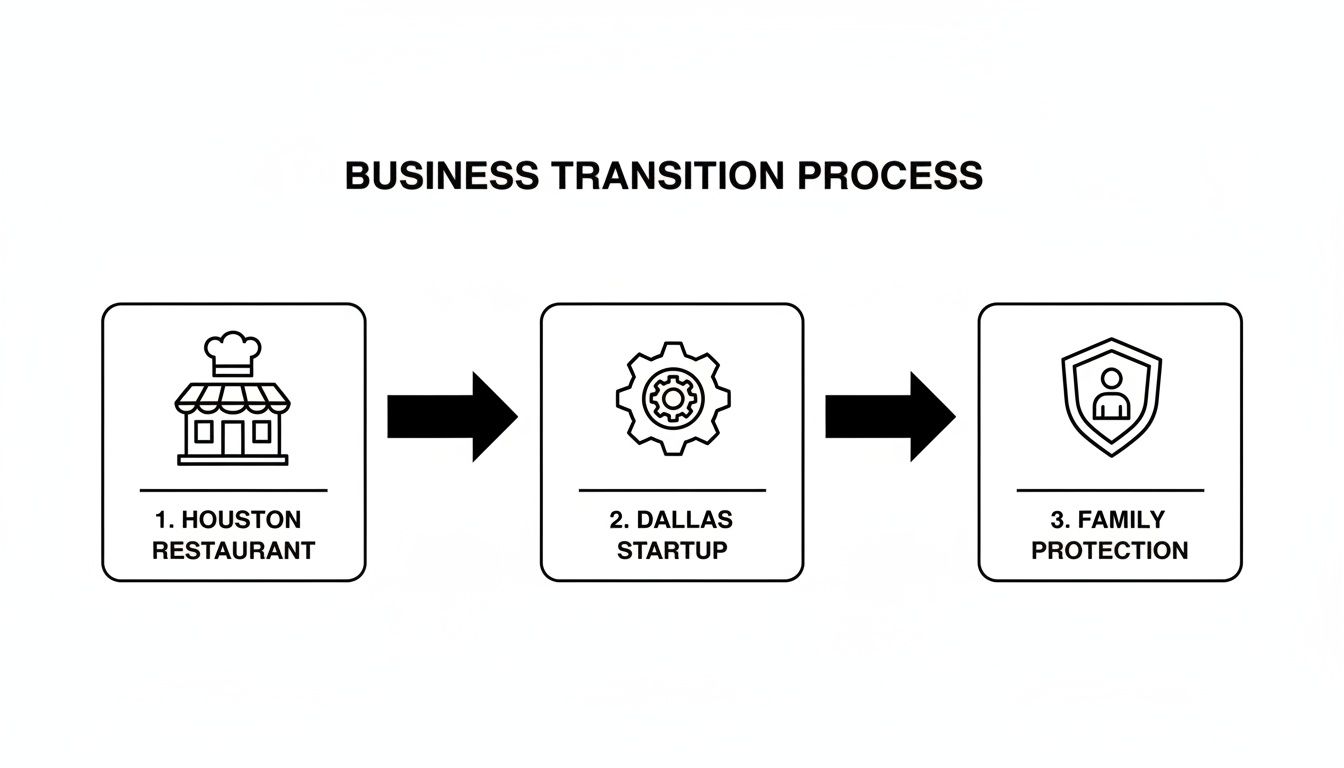
Whether you’re at the helm of a longtime family business or a high-growth startup, the end goal is the same: creating a solid shield for the people you care about.
1. Gather Your Key Documents
Before you can build a plan, you need to know what you’re working with. Pull together all the essential paperwork for your business and personal finances.
- Business Documents: This includes your articles of incorporation or LLC formation documents, partnership agreements, company bylaws, and any existing buy-sell agreements.
- Financial Statements: You’ll need recent profit and loss statements, balance sheets, and business tax returns from the past three to five years.
- Personal Estate Documents: Gather your current will, any existing trusts, and powers of attorney.
2. Define Your Succession Goals
This step is personal. Think hard about what you want for the future of your business and your family. Who do you envision running the company when you’re no longer there?
Your vision might include:
- Keeping the business in the family.
- Selling the company to key employees.
- Positioning the business for a sale to an outside buyer.
- Ensuring your spouse and children are financially secure, even if they aren’t involved in the business.
3. Assemble Your Professional Team
This is not a solo mission. An effective business estate plan requires a team of advisors working together to protect your interests.
This team typically includes:
- An Estate Planning Attorney: To draft the core legal documents like trusts, wills, and buy-sell agreements.
- A Certified Public Accountant (CPA): To provide crucial advice on making your plan as tax-efficient as possible.
- A Financial Advisor: To help manage investments and align your succession plan with your broader financial goals.
4. Start the Conversation
Once you have a clearer vision, it’s time to talk. This means sitting down with your family, business partners, and potential successors. We know these conversations can be difficult, but they are essential for preventing confusion and hurt feelings later.
A little transparency now can prevent a lot of conflict. As you finalize your plan, it’s also important to think about the logistics of storing your estate planning documents so they are safe and accessible.
If you need help navigating divorce, custody, or estate planning in Texas, contact The Law Office of Bryan Fagan today for a free consultation.
Common Questions About Business Estate Planning
As you begin this process, questions will naturally arise. We’ve heard them all from Texas business owners just like you, so let’s tackle some of the most common ones to provide clarity and confidence.
Does My Business Structure Affect My Estate Plan?
Yes, absolutely. Your business structure—whether it’s an LLC, S-Corp, or sole proprietorship—directly impacts how ownership can be transferred.
For example, an LLC is governed by an operating agreement, which can specify rules for transferring membership interests. An S-Corp has strict IRS rules about who can be a shareholder, which must be factored into any trust or succession plan.
A sole proprietorship is the simplest structure but also the riskiest from an estate planning perspective because the business is legally tied to you. This makes a solid plan using trusts and other tools critical to keep business assets from getting tangled in probate.
What Happens Without a Buy-Sell Agreement?
Imagine your business partner passes away suddenly with no buy-sell agreement in place. The deceased owner’s shares will likely pass to their heirs. This means you could be forced into business with their spouse or children, who may have no experience or interest in the company.
Without a pre-agreed method for valuing the business and terms for a buyout, you could face lengthy, expensive negotiations or even a lawsuit. It creates a cloud of uncertainty that can paralyze a business.
Is a Simple Will Enough to Transfer My Business?
A will is a good start, but for a business owner, it is rarely enough. A will must go through the Texas probate process, which is public, can be expensive, and often takes a long time. You can learn more in our guide on what in a will goes to probate in Texas.
While your will is in probate, your business operations could stall as the court works to validate the will and appoint an executor. A much smarter strategy is to use tools like a revocable living trust, which allows for a private and immediate transfer of control to your chosen successor without court involvement.
How Often Should I Review My Plan?
Your business estate plan is a living document that should evolve with your business and your life. We recommend reviewing it with your attorney at least every three to five years, or whenever a major life event occurs.
Major events include:
- A significant change in your business’s valuation
- The birth of a child or grandchild
- Getting married or divorced
- Changes in federal or Texas tax laws
To properly plan, it’s also important to understand the nuances of post-mortem taxation, such as the difference between Death Tax Vs Estate Tax. Regular check-ins ensure your plan remains effective and reflects your goals.
If you need help navigating divorce, custody, or estate planning in Texas, contact The Law Office of Bryan Fagan, PLLC today for a free consultation.