
Can CPS take my kids in Texas? That was the question a father asked after a heated exchange on his front porch ended with flashing lights and a neighbor recording on a cell phone. The divorce had been tense for months. Voices were raised. Accusations flew. Someone mentioned calling Child Protective Services. As the patrol car pulled away, the only thing running through his mind was this: can cps take my kids in texas because one argument spiraled out of control?
If you are going through a divorce in Texas, you may recognize that feeling. Conflict has a way of escalating when emotions are raw and futures feel uncertain. It does not take much for fear to enter the picture—especially when one parent threatens CPS involvement. In those moments, anxiety can overshadow logic.
Here is what the law actually says. Under Texas Family Code Chapter 262, CPS cannot remove a child simply because parents argue, divorce, or experience stress. Removal requires credible evidence of immediate danger to a child’s physical health or safety. The legal threshold is intentionally high because parents have a fundamental liberty interest in raising their children, protected by the Fourteenth Amendment and reinforced by United States Supreme Court decisions like Santosky v. Kramer. Texas courts do not treat divorce conflict as automatic grounds for state intervention.
At The Law Office of Bryan Fagan, PLLC, we have guided thousands of families through divorce and custody disputes across Houston and throughout Texas. Bryan Joseph Fagan, a South Texas College of Law graduate and recognized authority on Texas divorce and custody law, founded this firm with a clear purpose: to empower people to reclaim freedom and peace of mind during life’s hardest transitions. We understand that when someone mentions CPS, it feels like the ground shifts beneath you. Our job is to steady that ground with clarity, strategy, and compassionate counsel.
Texas judges decide custody matters based on the “best interest of the child” standard found in Texas Family Code §153.002. That standard focuses on safety, stability, and long-term well-being—not punishing parents for marital breakdown. In fact, courts expect some emotional tension during divorce. What they look for is whether a parent can provide a safe environment moving forward.
Fear grows in silence and uncertainty. Confidence grows when you understand your rights. In the sections ahead, we will explain when CPS can legally intervene, how divorce-related conflict is evaluated in Texas courts, and what practical steps you can take to protect both your parental rights and your peace of mind.
Key Takeaways
- CPS can only remove children when there is credible evidence of immediate danger to the child’s physical health or safety under Texas Family Code Chapter 262—not based on mere suspicion or a single report.
- Emergency removal without a court order requires exigent circumstances and must be followed by prompt court review, including an adversary hearing within approximately 14 days.
- Parents retain constitutional rights during CPS investigations, including the right to legal representation, the right to attend hearings, and the right to challenge evidence.
- Court-ordered removal requires a sworn affidavit and judicial oversight, with the burden of proof resting on CPS to demonstrate immediate danger.
- Early consultation with experienced legal counsel significantly improves outcomes and helps protect parental rights throughout the entire process.

Your Family’s Future Starts Here
Don’t navigate your legal journey alone. Schedule a consultation now and get the clarity and support you deserve.
Can CPS Take My Kids in Texas? The Short Answer
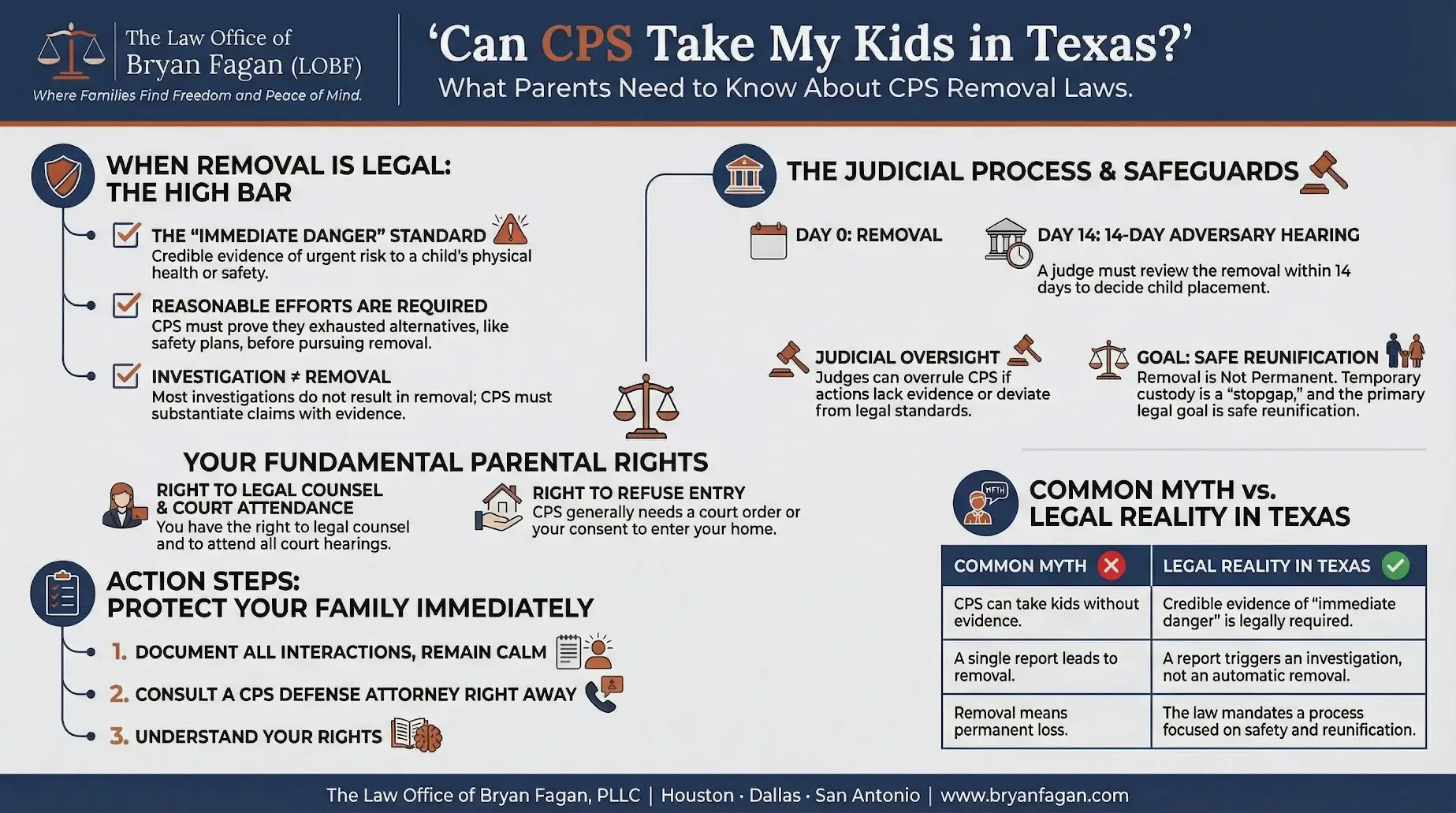
When parents quietly type “can cps take my kids in texas” into a search bar, it usually follows a moment of fear—an argument, a report, or a knock at the door. The reassuring truth is that Texas law sets a high legal threshold before the government can remove a child from a parent’s care. Under Texas Family Code Chapter 262, CPS may remove a child only if there is credible evidence of immediate danger to the child’s physical health or safety. Removal is considered an extraordinary remedy, not a routine step in an investigation.
Specifically, Texas Family Code §262.101 requires CPS to obtain a court order before removal unless there are exigent circumstances under §262.104 that make waiting unsafe. Even in emergency situations, parents are entitled to prompt judicial review through an adversary hearing under §262.201, typically held within 14 days. At that hearing, the Texas Department of Family and Protective Services must prove that immediate danger existed and that reasonable efforts were made to prevent removal when possible. The burden of proof is on the agency—not the parent.
This means CPS cannot legally remove children simply because someone made a report, because a caseworker suspects a problem, or because divorce tensions have escalated. Allegations must be supported by sworn affidavits and reviewed by a judge. Courts are required to evaluate whether less intrusive alternatives—such as safety plans, monitored services, or relative placement—could protect the child while preserving the family unit. Recent legislative updates to the Texas Family Code continue to emphasize due process safeguards and timely court oversight, reinforcing that removal is a last resort.
Parents also retain strong constitutional protections grounded in the Fourteenth Amendment, as recognized by the U.S. Supreme Court in cases like Santosky v. Kramer. You have the right to legal counsel, the right to notice of allegations, the right to challenge evidence, and the right to present your case before a judge. Parental rights do not disappear simply because an investigation begins.
For a deeper explanation of the statutory framework and how courts apply these standards in real cases, we encourage you to review our detailed resource, When Can CPS Remove Your Child From Your Home in Texas?. The attorneys at The Law Office of Bryan Fagan, PLLC remain committed to educating families, protecting futures, and helping parents replace fear with clarity. When you understand the law, you are better equipped to protect both your children and your peace of mind.

When Can CPS Remove a Child in Texas?
Texas Family Code Chapter 262 sets the legal boundaries for when Child Protective Services can remove a child from a parent’s home. For families asking, “can cps take my kids in texas,” the answer depends on whether the strict statutory requirements have been met. Removal is not based on suspicion, conflict, or anonymous accusations alone. It requires legally sufficient evidence, judicial oversight, and compliance with procedural safeguards that protect parental rights.
First, there must be credible evidence of immediate danger to the child’s physical health or safety. Under Texas Family Code §§262.101 and 262.104, CPS must show that the child faces a substantial risk of serious harm if intervention does not occur. Examples may include documented physical abuse, severe neglect that endangers medical or physical well-being, or exposure to dangerous criminal activity in the home. The “immediate danger” standard—reinforced in §§262.105(b) and 262.107(b)—creates a high legal bar. The risk must be real, specific, and supported by sworn evidence.
Second, CPS must demonstrate that reasonable efforts were made to prevent removal when possible. The Texas Department of Family and Protective Services is required to document in its affidavit the steps taken to preserve the family unit while ensuring safety. This may include safety plans, in-home services, relative placements, or other less intrusive alternatives. Recent updates to the Texas Family Code continue to emphasize accountability and documentation requirements, reinforcing that removal is intended to be a last resort rather than a first response.
Third, removal must be authorized by a court unless exigent circumstances exist. Under §262.101, CPS typically must obtain a court order before removing a child. In emergency situations under §262.104, removal without a prior court order may occur—but only if waiting would place the child in immediate danger. Even then, prompt judicial review is mandatory, including an adversary hearing under §262.201, usually held within 14 days. Parents have the right to legal representation and the opportunity to challenge the agency’s evidence at that hearing.
For a deeper explanation of how emergency removals work and what due process protections apply, we encourage you to review our detailed resource on Can CPS Remove Your Child Without a Court Order in Texas?. Our family law team has also created additional guidance in our Texas CPS Resource Center to help parents understand their rights and responsibilities.
At The Law Office of Bryan Fagan, PLLC, our mission is to educate families and protect futures. We combine precise knowledge of Chapters 261 and 262 of the Texas Family Code with compassionate, client-focused advocacy. When parents understand the legal standards governing removal, fear gives way to clarity—and clarity allows families to move forward with confidence.

Emergency Removal Without a Court Order
In rare situations involving exigent circumstances, CPS may remove a child without first obtaining a court order. Emergency removal occurs when waiting for judicial approval would place the child in immediate danger of serious harm.
Under Texas law, emergency removal requires multiple levels of approval within DFPS, including supervisor authorization, program director review, and often consultation with an attorney. This process ensures that emergency removals are not made hastily or without proper evaluation.
When emergency removal occurs, CPS must:
- Immediately inform parents of the reasons for removal
- Provide the “While Your Child Is in Our Care” brochure
- Deliver Form 2231 Notice of Removal as required by Texas Family Code §262.109
- File a Suit Affecting the Parent-Child Relationship (SAPCR) by the next business day
- Attend an ex parte hearing no later than the first working day after removal (but within three days maximum)
The adversary hearing must then occur within 14 calendar days of removal, giving parents the opportunity to challenge the removal before a judge.
Court-Ordered Removal Process
When CPS believes a child faces immediate danger but exigent circumstances do not exist, the agency must seek a court order authorizing removal before taking possession of the child.
This process begins when CPS files a SAPCR petition along with a detailed sworn affidavit. The affidavit must contain specific allegations supported by evidence—not vague concerns or unsubstantiated claims. A judge then reviews this affidavit during an ex parte hearing to determine whether removal is legally justified.
If the court grants the order, removal proceeds under judicial oversight from the beginning. This court order CPS obtains provides legal authority for the removal while simultaneously triggering the timeline for the adversary hearing.
The burden of proof rests entirely on CPS. The agency must convince the court that the child faces immediate danger to their physical health or safety and that reasonable efforts to prevent removal have been made.
What Happens at the Adversary Hearing?
The adversary hearing represents your most important opportunity to challenge CPS’s removal decision. Under Texas law, this hearing must occur within 14 calendar days after your child is removed.
At the adversary hearing:
You have the right to legal representation. If you cannot afford an attorney, the court will appoint one to represent you. You also have the right to hire private legal counsel who specializes in CPS cases and Texas family law.
CPS must present evidence. The burden of proof falls on DFPS to demonstrate that the child faced immediate danger and that removal was necessary. You and your attorney can cross-examine witnesses and challenge the evidence presented.
The judge reviews the removal decision. The court evaluates whether CPS met its legal burden and whether continued removal serves the child’s best interest. The judge may order the child returned home, continued temporary custody with DFPS, or placement with relatives.
Service plans may be ordered. If the court upholds the removal, you will likely receive a family service plan outlining steps toward reunification—such as parenting classes, counseling, or substance abuse treatment.
The adversary hearing shapes the trajectory of your entire case. Strong legal representation at this stage can make a decisive difference in protecting your parental rights.
Parents’ Rights During a CPS Investigation
When families begin asking, “can cps take my kids in texas,” it is often because an investigation has already started. What many parents do not realize is that even during a CPS investigation, you retain fundamental constitutional and statutory protections. Texas law does not allow government intrusion without safeguards, and understanding your rights under the Texas Family Code can prevent costly mistakes.
First, you have the right to legal counsel. While Texas Family Code §262.201 guarantees the right to appointed counsel once a case is filed in court and removal is sought, you may consult with a private attorney at any stage of an investigation. Early legal guidance can shape how you respond to CPS requests, protect you from unnecessary admissions, and ensure that your rights are preserved if the case moves toward litigation. At our firm, we often advise families before a petition is even filed, helping them respond strategically rather than react emotionally.
Second, you have the right to refuse entry into your home without a court order. Under Texas Family Code §§262.101 and 262.104, CPS generally must obtain judicial authorization before removing a child or conducting intrusive actions unless exigent circumstances exist. If you voluntarily consent to entry, however, you may waive certain protections. Exercising your right to request a court order is lawful, but it should be done thoughtfully and with counsel because CPS may then seek judicial approval. Knowing when and how to assert this right is critical.
Third, you have the right to attend and participate in all court hearings involving your child. This includes the adversary hearing under §262.201, as well as status hearings and permanency hearings governed by Chapter 263 of the Texas Family Code. These proceedings are not formalities; they are opportunities to challenge evidence, present witnesses, and demonstrate your commitment to your child’s safety and stability. The burden of proof rests on the Texas Department of Family and Protective Services—not on you.
Fourth, you have the right to challenge the evidence presented against you. CPS must support removal or continued conservatorship with sworn affidavits and legally sufficient proof. You and your attorney may cross-examine witnesses, dispute factual inaccuracies, and introduce your own documentation. Recent legislative updates to the Texas Family Code continue to reinforce due process protections, including clearer timelines and evidentiary requirements designed to protect parental rights.
Finally, you have the right to be informed of the allegations against you. Transparency is required so that you can meaningfully respond. Parents are entitled to know the nature of the claims, the safety concerns identified, and the legal basis for any action taken. These safeguards exist because parental rights are recognized as fundamental under both Texas law and the United States Constitution.
For a deeper look at how removal decisions are evaluated and what procedural safeguards apply, we recommend reviewing our detailed resource on Child Removal in Child Protective Services Cases. You may also find helpful guidance in our Texas CPS investigation overview, which explains how investigations typically unfold.
At The Law Office of Bryan Fagan, PLLC, our commitment is to educate families and protect futures. We believe that informed parents make stronger decisions. When you understand your rights, the question “can cps take my kids in texas” becomes less about fear and more about strategy. With experienced legal guidance, you can navigate the process confidently and safeguard what matters most—your family.

Can CPS Take My Kids for Drug Use Alone?
A common fear among parents involves whether substance use alone can result in removal. Under Texas law, CPS cannot remove children solely because a parent uses drugs or alcohol. The key question is whether that substance use creates immediate danger for the child’s safety.
Texas courts focus on the impact of drug use on parenting ability and child safety. Situations that may justify concern include:
- Children exposed to drug manufacturing or distribution activities
- Parents whose intoxication impairs their ability to supervise children safely
- Substance use that leads to neglect of basic needs like food, shelter, or medical care
When substance use is identified but does not rise to immediate danger, CPS typically develops a family service plan requiring drug testing, treatment programs, and compliance monitoring. Removal becomes appropriate only when substance use creates a substantial risk of harm that cannot be addressed through less intrusive measures.
The court’s focus remains on protecting children—not punishing parents. Treatment and family preservation efforts take priority over removal whenever safely possible.
How to Reduce the Risk of Removal
If CPS becomes involved with your family, your response matters. Lawful cooperation and proactive engagement can significantly reduce the risk of removal while demonstrating your commitment to your child’s safety.
Stay calm during interactions with CPS. Emotional reactions, hostility, or confrontational behavior can escalate situations unnecessarily. Remaining calm demonstrates stability.
Follow voluntary safety plans. If CPS offers a safety plan as an alternative to removal, comply fully with its terms. This shows good faith and may prevent court involvement.
Attend all required services. Parenting classes, counseling sessions, mental health evaluations, and other services demonstrate your willingness to address concerns.
Avoid actions that escalate situations. Do not flee, hide children, or interfere with investigations. These actions typically result in worse outcomes.
Consult legal counsel early. An experienced CPS attorney can guide you through the process, protect your rights, and help you avoid common mistakes that harm your case.
DFPS must show that no reasonable alternatives to removal exist. Your cooperation creates those alternatives.
What Happens If CPS Removes Your Child?
If removal occurs, understanding the process helps you work effectively toward reunification.
DFPS becomes Temporary Managing Conservator. This legal status gives the agency decision-making authority regarding your child’s placement, medical care, and education during the case.
A family service plan is developed. This plan outlines specific steps you must complete to work toward reunification—addressing the root issues that led to removal.
Placement follows a priority order. Texas law prioritizes kinship care, meaning relatives or close family friends are preferred over foster care. This helps maintain family connections during separation.
Permanency hearings occur at scheduled intervals. Under Texas law, permanency hearings take place at 180 days post-removal and continue at regular intervals. The court reviews progress and determines next steps.
Reunification remains the primary goal. Unless circumstances warrant termination of the parent child relationship, DFPS and the courts focus on safely returning children to their families. Federal law requires consideration of termination after a child has been in foster care for 15 of the preceding 22 months, making timely compliance with service plans critical.
Common Myths About CPS Removal
Fear spreads quickly when CPS becomes involved, especially when parents begin asking, “can cps take my kids in texas.” Misinformation often makes the situation feel far more hopeless than it truly is. At The Law Office of Bryan Fagan, PLLC, we believe that replacing myths with accurate legal guidance empowers families to respond calmly and strategically rather than react out of panic.
One common myth is that CPS can remove your children without proof. In reality, Texas Family Code Chapter 262 requires credible evidence of immediate danger to a child’s physical health or safety before removal can occur. Sections 262.101 and 262.104 outline when a court order is required and when emergency circumstances may justify temporary removal. Even then, sworn affidavits must be submitted under penalty of perjury, and a judge must review the agency’s claims. Recent legislative updates continue to emphasize due process protections, prompt adversary hearings under §262.201, and judicial oversight designed to prevent arbitrary removals.
Another widespread misconception is that a single report automatically results in removal. Under Texas Family Code Chapter 261, a report triggers an investigation—not immediate loss of custody. CPS must evaluate the credibility of the allegations, assess risk factors, and determine whether evidence supports intervention. The vast majority of investigations do not result in removal because the legal standard is intentionally high. Courts require substantiated evidence, not speculation.
Some parents also fear that once CPS is involved, their parental rights disappear overnight. That is simply not how Texas law works. Parental rights remain intact unless and until a court terminates them under Texas Family Code §161.001, which requires clear and convincing evidence and a finding that termination is in the child’s best interest. Even during an ongoing case, parents have the right to attend hearings, challenge testimony, present evidence, and work toward reunification through service plan compliance under Chapter 263. The law is structured to preserve families whenever safely possible.
There is also the belief that removal, once it happens, is permanent. In truth, reunification is the primary goal in most CPS cases. Texas courts conduct regular permanency hearings to evaluate progress and determine whether children can safely return home. Parents who actively participate in court-ordered services and address identified concerns frequently regain custody. Understanding timelines, expectations, and compliance requirements is critical to protecting your family’s future.
Finally, some parents panic and react emotionally during investigations, which can unintentionally complicate matters. Interfering with an investigation or refusing lawful court orders can create additional legal risks. We encourage families to understand the boundaries of their rights and responsibilities by reviewing our detailed guidance on How Interfering with a Child Protective Services Investigation Can Affect Your Case. You may also find valuable insight in our Texas CPS Investigation Resource, which explains what typically happens after a report is made.
The attorneys at our Houston-based firm are committed to educating families and protecting futures. When myths are replaced with legal clarity, fear begins to lose its power. The question “can cps take my kids in texas” deserves an answer grounded in statute, court procedure, and constitutional protections—not rumor or worst-case scenarios. With experienced guidance and a steady approach, parents can move from uncertainty to informed action and focus on what matters most: the well-being of their children.

How a Texas CPS Attorney Can Help
When facing a CPS investigation or removal, experienced legal representation provides critical protection for your family.
A skilled CPS attorney can:
- Challenge improper or illegal removals by scrutinizing affidavits for insufficient evidence and procedural violations
- Prepare comprehensive defenses for adversary hearings and subsequent court proceedings
- Ensure CPS meets its legal burden of proving immediate danger and reasonable efforts
- Protect your constitutional and statutory rights throughout the investigation and court process
- Develop strategic approaches to service plan compliance and reunification
When parents ask “can CPS take my kids in Texas,” the answer often depends on how effectively their rights are protected. Expert guidance makes a measurable difference.
Why Choose The Law Office of Bryan Fagan, PLLC
When families find themselves asking, “can cps take my kids in texas,” they need more than general advice—they need experienced, strategic legal advocacy grounded in the Texas Family Code. The attorneys at The Law Office of Bryan Fagan, PLLC represent parents across Texas in CPS investigations and litigation, with a deep working knowledge of Chapters 261, 262, and 263 of the Texas Family Code. These statutes govern everything from initial investigations and emergency removals to adversary hearings, permanency reviews, and reunification timelines. Because removal under §262.101 or §262.104 requires strict judicial oversight and evidentiary support, understanding how courts apply these provisions can make a measurable difference in a case’s outcome.
Our legal team provides focused courtroom advocacy designed to protect parental rights at every stage of the process. From the adversary hearing required under §262.201 to permanency hearings under Chapter 263, we prepare clients thoroughly so they understand what the court will evaluate and how to demonstrate compliance and stability. Recent updates to the Texas Family Code continue to emphasize due process protections, documentation requirements, and timely review of cases to prevent unnecessary delays. We use those statutory safeguards to our clients’ advantage, ensuring that CPS meets its burden of proof and that parents are treated fairly under the law.
Equally important, we recognize that CPS cases are not just legal disputes—they are deeply personal crises. Our firm combines legal precision with compassionate communication, helping parents understand service plans, evidentiary standards, and court expectations without overwhelming them. We guide families through compliance requirements, help them document progress, and advocate for safe reunification whenever possible. For those seeking representation in the Humble area, our CPS defense team is available here: Humble CPS Defense Lawyer.
If you would like to better understand how removal decisions are evaluated under Texas law, we also recommend reviewing our in-depth article on When Can CPS Remove Your Child From Your Home in Texas?. Education is a powerful first step. At our Houston-based firm, our mission remains clear: to educate families and protect futures. By combining statutory knowledge, courtroom experience, and genuine empathy, we help parents move from fear to informed action—and toward restoring stability for their children.

Checklist: Can CPS Take My Kids in Texas — Preparation Steps
If CPS contacts your family, these lawful preparation steps help protect your rights:
- Remain calm and courteous during all interactions with caseworkers and law enforcement
- Request identification and document the caseworker’s name, badge number, and contact information
- Contact an experienced CPS attorney immediately before providing detailed statements
- Do not consent to home entry without legal advice or a court order
- Document everything—dates, times, conversations, and any evidence supporting your position
- Gather important records including medical records, school records, and character references
- Follow any safety plan requirements while your case proceeds
- Attend all scheduled hearings and appointments without exception
Conclusion and Next Steps
Divorce has a way of magnifying every fear, especially when someone utters the words “CPS” in the middle of an already painful conflict. But fear and facts are not the same thing. Texas law sets clear boundaries on when the state can step in, and those boundaries exist to protect families—not to punish parents navigating difficult transitions. When you understand how the law works, the unknown becomes manageable, and manageable problems can be solved.
The most important takeaway is this: conflict during divorce does not automatically equal danger in the eyes of the law. Judges focus on safety, stability, and your child’s long-term well-being. When you approach the situation calmly, document responsibly, and seek experienced legal guidance early, you shift from reacting emotionally to responding strategically. That shift makes all the difference.
If you are feeling uncertain, that is completely normal. What matters is what you do next. Ask questions. Gather reliable information. Speak with a legal team that handles Texas divorce and CPS-related matters every day. Working with an experienced Texas Family Law Attorney can help you separate real legal risks from exaggerated fears and build a plan that protects both your parental rights and your peace of mind.
At The Law Office of Bryan Fagan, PLLC, our purpose is to educate families and protect futures. We are here to provide clarity when emotions are high and to help you move forward with confidence instead of confusion. If you are facing divorce, custody concerns, or worries about CPS involvement, we invite you to schedule a consultation and have a real conversation about your situation. Sometimes the most powerful step you can take is simply deciding that fear will not make your decisions for you.
Frequently Asked Questions About CPS in Texas
In Texas, CPS can remove a child only if there is credible evidence that the child is in immediate danger of physical harm or severe neglect. This standard is outlined in Texas Family Code Chapter 262. Examples may include documented physical abuse, sexual abuse, serious medical neglect, or exposure to dangerous environments such as drug manufacturing. Removal cannot be based on suspicion alone, parenting style differences, or ordinary family stress. The law requires specific evidence and court oversight.
An unstable home is one where ongoing conditions place a child’s safety or well-being at risk. This may include repeated exposure to domestic violence without protective measures, chronic lack of supervision, or living conditions that are unsafe or hazardous. Temporary financial hardship, a recent move, or a divorce does not automatically make a home unstable. Courts look for patterns that create real risk—not short-term challenges.
Parents have significant legal rights during a CPS investigation. These include the right to be informed of allegations, the right to legal representation, the right to attend court hearings, and the right to challenge evidence. CPS generally cannot enter your home without consent or a court order unless there are emergency circumstances. If removal occurs, parents are entitled to a prompt adversary hearing to contest the decision.
CPS can remove a child without a court order only in true emergency situations where waiting would place the child in immediate danger. Even then, the agency must seek judicial review quickly. Texas law requires a hearing—typically within about 14 days—so a judge can determine whether the removal was justified. Emergency removal is meant to be rare and must meet strict legal standards.
An unfit home is one where caregivers are unable or unwilling to provide for a child’s basic needs or where the environment creates a substantial risk of harm. Examples may include severe neglect, ongoing substance abuse that impairs parenting, unsafe living conditions, or repeated exposure to violence. Courts evaluate the full circumstances, including whether the issues can be corrected with support or services.
The length of time a child remains in CPS custody depends on the circumstances of the case. After removal, CPS must file a lawsuit and follow court deadlines. Texas law includes a one-year dismissal deadline for most cases, with limited extensions. During that time, the court reviews progress toward reunification through regular hearings. The goal in most cases is safe reunification whenever possible.
An unfit parent may be someone who consistently fails to provide food, shelter, medical care, or supervision; engages in behavior that endangers the child; or refuses to address serious substance abuse or mental health issues that impact parenting. Courts focus on patterns of behavior and the child’s safety rather than isolated mistakes. A single argument or temporary setback does not automatically make someone unfit.
While CPS does not publish a simple checklist, investigations generally consider several key factors: the nature and seriousness of the allegation, the immediacy of the risk, the child’s age and vulnerability, the caregiver’s ability to protect the child, and whether supportive services could resolve the issue without removal. These factors help determine whether a report leads to further investigation or court action.
A messy house by itself is not typically considered neglect. Clutter or disorganization does not justify removal unless it creates actual safety hazards—such as blocked exits, exposed wiring, dangerous debris, lack of food, or unsanitary conditions that threaten health. CPS looks at whether the environment presents a genuine risk to the child, not whether the home meets a certain standard of neatness.