Planning for the future can feel overwhelming, but creating a will in Texas is one of the most compassionate and important things you can do for your family. It's a common misconception that wills are only for the wealthy or the elderly. The truth is, a will is a fundamental legal tool for any Texan who wants to protect their family, secure their assets, and ensure their final wishes are honored.
Why Every Texan Needs a Will to Protect Their Family

Thinking about what happens after you’re gone is never easy, but failing to plan can leave your family in a difficult and painful position. A will is far more than just a legal document—it’s your voice, speaking for you when you no longer can, making sure your loved ones are cared for exactly as you intend.
If you pass away without one, Texas law—not you—decides how your property is divided and who will care for your minor children. This default legal process, called intestacy, often creates confusion, conflict, and financial burdens for families when they are most vulnerable. A well-drafted will eliminates that uncertainty and provides stability when your family needs it most.
Secure Your Family's Future in a Growing State
The need for smart estate planning is more urgent than ever as Texas continues to grow at a breakneck pace. With a population that is constantly expanding, the complexities of family life and asset management also increase. You can read more about Texas's demographic shifts and what they mean for families.
A will is the primary tool that gives you direct control over your legacy. It puts you in the driver's seat and empowers you to:
- Appoint a Guardian for Your Children: You get to decide who raises your minor children, not a judge who doesn't know your family or your values.
- Determine Asset Distribution: You specify exactly who gets what, from your home and savings to sentimental family heirlooms. This helps prevent ugly disputes down the road.
- Select an Executor: You can hand-pick a trusted person to manage your estate, settle any debts, and make sure your instructions are followed to the letter.
- Minimize Family Conflict: A clear, legally sound will leaves no room for guessing games, dramatically reducing the chance of painful and expensive legal fights between relatives.
When you create a will, you’re giving your family the gift of clarity and peace of mind. You’re lifting the burden of uncertainty from their shoulders and ensuring they are supported according to your final wishes. It’s one of the most responsible and loving actions you can take.
Understanding the Legal Requirements for a Valid Texas Will

Creating a will is one of the most important steps you can take to protect your family. But for that will to be legally binding, it must follow the specific rules laid out in the Texas Estates Code. Think of these requirements as the blueprint for your will—if any part is missing or incorrect, the entire document could fail when your family needs it most.
These rules aren't just legal red tape. They exist to ensure the document is a true reflection of your wishes and to guard against fraud or undue influence. For a Texas court to honor your will, every one of these legal boxes must be checked.
You Must Be of "Sound Mind"
The process starts with what the law calls testamentary capacity. This is a formal way of saying you must be of "sound mind" when you sign your will. Under Section 251.001 of the Texas Estates Code, a person must be at least 18 years old, married, or a member of the armed forces to make a will.
But what does "sound mind" actually mean in practice? At the exact moment you are signing the document, you must understand a few key things:
- The Act of Making a Will: You know you're signing a document that will dictate who gets your property after you pass away.
- The Nature of Your Property: You have a general idea of your assets—your house, bank accounts, investments, and other property. You don’t need a perfect inventory, just a basic awareness.
- Your Relationships: You know who your close family members are (your "natural objects of your bounty") and are clear about who you are choosing to be your beneficiaries.
- The Overall Plan: You can hold all these thoughts in your head at once to form a clear plan for distributing your property.
Meeting this standard is fundamental. It ensures the will is genuinely yours, created without confusion or outside manipulation.
The Formalities of a Proper Signing
Beyond having a sound mind, a standard Texas will—often called an attested will—must be signed with specific formalities. This process is like a ceremony, and every step is crucial for the will's validity.
Imagine a young couple, Sarah and Tom, who just had their first baby. They know they need wills to name a guardian and ensure their child is provided for. Here’s what the Texas Estates Code demands they do to make their wills legally binding:
- It Must Be in Writing: An oral promise is not enough. The will must be a physical, written document.
- It Must Be Signed by You (the Testator): Sarah and Tom must each sign their own will. They could also have someone else sign for them, but only if it's done in their presence and under their direction.
- It Must Be Witnessed Correctly: This is a critical step. The will must be signed by two credible witnesses who are at least 14 years old. These witnesses must sign the will in the testator's presence, and they cannot be people who will inherit anything in the will.
The witnesses are not there to read your will or approve your choices. Their only job is to watch you sign and confirm that you appeared to be of sound mind and were acting voluntarily. This simple act provides powerful proof to a court that your will is authentic.
By following these strict signing rules, you transform a simple piece of paper into a legally enforceable directive. It gives you peace of mind now and saves your family from potential legal challenges later.
To help you keep track, here is a quick summary of the core requirements for a valid will in Texas.
Key Requirements for a Valid Texas Will
| Requirement | Description | Texas Estates Code Reference |
|---|---|---|
| In Writing | The will must be a written document. Oral wills are not recognized except in very narrow circumstances. | §251.051 |
| Signed by Testator | The will must be signed by the person making it (the testator) or by another person signing on their behalf, in their presence, and under their direction. | §251.051 |
| Attested by Witnesses | The will must be signed by two credible witnesses, each at least 14 years old, who sign the will in the testator’s presence. | §251.051 |
| Testamentary Capacity | The testator must be of "sound mind" at the time of signing—at least 18 years old (or married/in the military) and understanding the nature of the act. | §251.001 |
Following these elements is the minimum for creating a will that will hold up in court. However, there's one more highly recommended step you should almost always take.
Speed Up Probate with a Self-Proving Affidavit
One of the smartest and simplest additions you can make to your will is a self-proving affidavit. This isn't technically part of the will itself but is a separate statement attached to it. In this affidavit, you and your two witnesses sign in front of a notary public, swearing under oath that all the legal formalities were followed correctly during the signing.
While a will is still valid without this affidavit, having one can make the probate process dramatically smoother and faster. Without it, your executor might have to track down the original witnesses—who could have moved, passed away, or be impossible to find years later—and bring them to court to testify.
A self-proving affidavit allows the court to accept the will at face value, proving its validity on its own. It's a small, inexpensive step that saves your loved ones a massive amount of time, money, and stress down the road.
The Different Types of Wills Recognized in Texas
When you imagine creating a will in Texas, you probably picture a formal document, signed and witnessed in a lawyer's office. That is the most common and secure way to create a will, but it's not the only type Texas law recognizes.
It's crucial to understand that not all wills are created equal. Your will is the legal document that speaks for you when you're gone, and choosing the wrong format can put your family’s future at risk. Let's walk through the types of wills Texas courts will consider and why one stands head and shoulders above the rest.
The Attested Will: The Gold Standard
The most reliable and legally powerful will you can create is an attested will. This is the formal, typed document most people think of, usually prepared with an attorney's guidance to make sure your wishes are clear and legally binding.
For an attested will to be valid, it must follow the strict rules laid out in the Texas Estates Code:
- It must be in writing.
- It must be signed by you (the "testator").
- It must be signed by two credible witnesses, in your presence, who watch you sign it.
These formalities aren't just for show. They create a powerful legal presumption that your will is valid. The witnesses serve to confirm that you signed the document willingly and appeared to be of sound mind, which makes it much harder for someone to challenge your will in court later on. This is why, at The Law Office of Bryan Fagan, PLLC, the attested will is the only type we prepare for our clients. It offers the highest level of protection possible.
The Holographic Will: A Risky Alternative
Texas law also makes an exception for something called a holographic will. This is a will written entirely in your own handwriting. Unlike an attested will, a holographic will doesn't need any witnesses. While that might sound simple and convenient, it is a path loaded with serious risks.
The "entirely in your handwriting" rule is absolute. If even a single word is typed, pre-printed, or written by someone else, a court can invalidate the entire document.
For example: Imagine a father writes a letter to his son saying, "When I pass, the farm is yours." He signs it and tucks it away. Since it's all in his own hand, a court might accept it as a holographic will. But this creates immediate problems. What about the mortgage on the farm? What about his other children? What about his bank accounts? This kind of ambiguity is a recipe for a family legal battle.
Holographic wills are notorious for causing heartbreaking and expensive court fights. The common pitfalls include:
- Ambiguous Language: People often use casual language that can be interpreted in multiple ways, leading to disputes over what they truly intended.
- Authenticity Fights: A disgruntled relative might claim the handwriting isn't genuine, forcing the estate to hire expensive handwriting experts to prove it in court.
- Critical Omissions: Without legal advice, people often forget to name an executor to manage the estate, fail to account for all their property, or neglect to name guardians for their children.
While the history of these documents is interesting, relying on one today is a dangerous gamble with your family's future. You can learn more about why these wills were once common but are now a risky choice by reading our post about the historical significance of handwritten wills.
What About Oral Wills?
You've probably seen it in a movie: a character on their deathbed whispers their last wishes to someone in the room. This is called a nuncupative, or oral, will.
In Texas, these are practically non-existent. They are only considered valid in extremely limited and specific situations, such as for a soldier in active military service or a sailor at sea during their final illness. For virtually every Texan, an oral will is not a valid way to leave property to loved ones.
Ultimately, while options like a holographic will exist on paper, they invite uncertainty, conflict, and expense. A professionally drafted and executed attested will is the only way to ensure your wishes are crystal clear, legally enforceable, and that you're truly protecting the people you care about most.
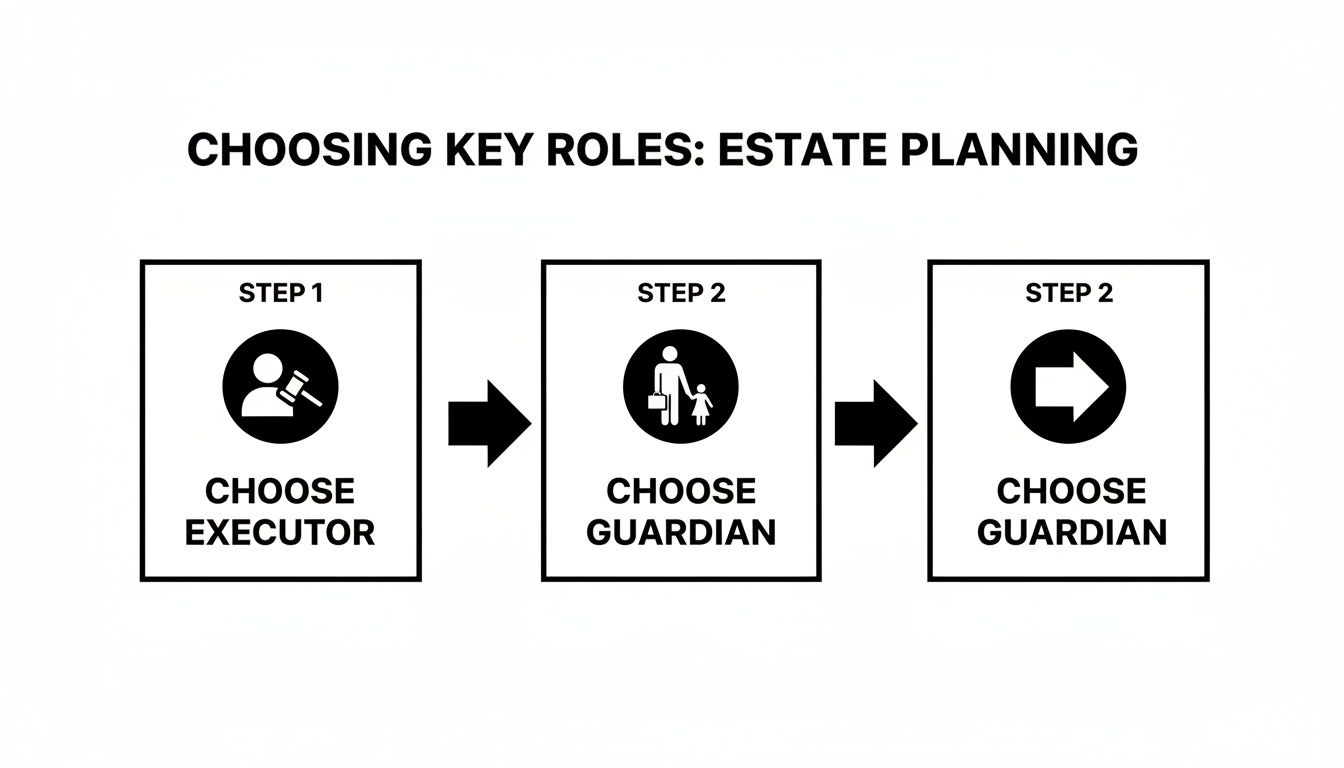
Choosing Your Executor and Guardians
A will in Texas does far more than just map out who gets your property. It’s where you appoint trusted individuals to carry out your wishes and, most importantly, protect your family. This is where your estate plan gets deeply personal. Two of the most critical decisions you will make are choosing your Executor and, if you have minor children, their Guardian.
These aren't roles you should assign lightly. The people you select will be handed immense responsibility during what will already be a difficult time for your family. Taking the time now to pick the right individuals is one of the most powerful things you can do to ensure your legacy is managed with integrity and your children are raised with love and stability.
What an Executor Does
Think of your Executor as the captain of a ship, responsible for steering your estate safely through the probate process. This person takes on the legal and financial duties of settling all your affairs after you’re gone. It’s a significant job that demands diligence, honesty, and a great deal of organization.
An Executor's key responsibilities include:
- Filing the Will: They are the one who submits your will to the probate court to get the process officially started.
- Managing Estate Assets: This means gathering all your property, from bank accounts and real estate to personal belongings and heirlooms.
- Paying Debts and Taxes: The Executor must use funds from the estate to settle any outstanding debts, final bills, and taxes owed.
- Distributing Property: After all debts and expenses are paid, the Executor is responsible for distributing the remaining assets to the beneficiaries you named in your will.
Choosing an Executor is about more than just trust. While integrity is absolutely non-negotiable, you also need to consider their financial sense, their ability to handle paperwork and deadlines, and their willingness to accept the role. It can be a demanding job, so it's vital to pick someone who is up to the task. To get a better handle on what this role involves, you can read our detailed guide on the duties of an executor of a will in Texas.
Selecting the Best Person for the Job
When picking your Executor, it’s always wise to name a primary choice and at least one alternate. This backup plan is crucial in case your first choice is unable or unwilling to serve when the time comes.
Consider these factors when you're making your decision:
- Trustworthiness: Is this someone you trust implicitly to act in your family's best interests, no matter what?
- Responsibility: Do they have a good track record of managing their own finances and responsibilities? Are they organized and detail-oriented?
- Location: While not a requirement, having an Executor who lives nearby can make managing the practical aspects of the estate much easier.
- Willingness: Always have an open conversation with your potential Executor. Make sure they understand what the duties entail and that they agree to take on the role.
Your Executor acts as your personal representative after you're gone. Choosing someone who is both trustworthy and capable ensures your final wishes are executed precisely as you intended, providing a final layer of protection for your loved ones.
The Monumental Decision of Naming a Guardian
For parents with minor children, no part of making a will is more important than naming a Guardian. This is the person you entrust to raise your children if both you and your spouse are no longer here. It's a decision that weighs heavily on every parent's heart, but it is one you absolutely must make.
If you don't name a Guardian in your will, a court will make this decision for you. A judge, who doesn't know you, your children, or your values, will decide who gets to raise them. By naming a Guardian yourself, you ensure this deeply personal choice remains yours.
When thinking about who to name, look beyond just who loves your children the most. You have to consider their parenting style, values, financial stability, and even their physical ability to care for a growing child. Most importantly, have a candid and heartfelt conversation with the person you want to choose. Confirm they are truly willing and able to accept this profound responsibility. Just as with your Executor, always name an alternate Guardian—it’s a vital safeguard for your children’s future.
How to Create, Update, or Revoke Your Texas Will
Your life is a journey of constant change—you get married, welcome new children, see your career grow, and sometimes, face a divorce. Just as your life evolves, your will needs to evolve right along with it. Creating a will in Texas isn't a one-and-done task. Think of it as a living document that needs regular check-ups to make sure it always reflects your true intentions.
Keeping your will current is a genuine act of love for your family. An outdated will can cause just as much confusion and conflict as having no will at all. Because major life events can fundamentally alter your wishes, periodic reviews aren't just a good idea—they're a critical part of responsible estate planning.
When to Update Your Will
Imagine your will is a snapshot of your life and your wishes. When that picture changes, you need a new snapshot. While it's wise to review your will every few years anyway, certain major life events should trigger an immediate update.
Consider updating your will after:
- Marriage or Divorce: Under Texas law, a divorce automatically voids any provisions for an ex-spouse. On the other hand, a new marriage gives a spouse certain inheritance rights. In either situation, a new will is needed to clarify your wishes.
- Birth or Adoption of a Child: This is a crucial time to update your will. You'll want to include the new child and, just as importantly, name a legal guardian for them.
- Significant Financial Changes: A major inheritance, selling a business, or any substantial shift in your assets might make you want to rethink how your property is distributed.
- Death of a Beneficiary or Executor: If a person named in your will passes away, you absolutely need to update the document to name a replacement.
These are just a few examples. Any significant life change is a good reason to sit down and review your estate plan with an attorney.
How to Make Changes: A Codicil vs. a New Will
When you need to make changes, you have two primary options. The first is to create a codicil, which is a formal, legal amendment to your existing will. A codicil must be executed with the exact same legal formalities as the original will—it must be in writing, signed by you, and witnessed by two credible witnesses.
Codicils are really only best for very minor, simple changes, like swapping out your named executor. For anything more substantial, however, codicils can create a mess. They can get lost, create confusion, or lead to interpretation issues, leaving a legal puzzle for your family to solve.
The cleanest and safest approach is almost always to create an entirely new will. A new will revokes all previous wills and codicils, ensuring there is only one clear, authoritative document that expresses your final wishes.
How to Revoke a Will in Texas
What if you want to scrap your old will entirely? Texas law provides two clear ways to revoke a will:
- By a Subsequent Will: This is the most common and effective method. You simply create a new will that includes a specific statement like, "I hereby revoke all prior wills and codicils made by me." This language leaves no doubt that the new document replaces all the old ones.
- By Physical Act: You can also revoke a will by destroying it with the intent to revoke. This might mean burning it, tearing it up, or otherwise physically destroying the document. The key word here is intent. Accidentally losing your will doesn't revoke it; you must destroy it deliberately for the purpose of revoking it.
Properly managing your will is an ongoing responsibility. To ensure your documents are not only current but also secure, you can learn more about the best practices for storing your estate planning documents to keep them safe from damage or loss.
Common Mistakes That Can Invalidate Your Will

You’ve taken the important step of planning for your family's future by creating a will. But a simple, avoidable mistake can unravel all of that hard work. If your will is invalidated, your loved ones could be thrown into the exact legal chaos you were trying to prevent.
At The Law Office of Bryan Fagan, PLLC, we have seen firsthand how minor oversights can lead to major heartbreak. Understanding these common pitfalls is the best way to create a will in Texas that is clear, legally sound, and dispute-proof, ensuring your wishes are honored without a fight.
Improper Execution and Witnessing
One of the most common and devastating errors happens during the signing itself. As we've covered, Texas law has very strict rules for how a will must be signed and witnessed. If you don't follow these instructions to the letter, the entire document can be thrown out.
Imagine this scenario: an elderly father signs his will at home, and his two adult children—who are also his main heirs—sign as witnesses. They thought they were helping, but they actually compromised the entire will. Under Texas law, a beneficiary should never be a witness. This creates a conflict of interest and opens the door for other family members to claim the children pressured him. A judge could easily invalidate the will, pushing the estate into the cold, impersonal intestacy process.
To ensure your will is executed correctly, it must be:
- Signed in the physical presence of two credible witnesses.
- Witnessed by people who are at least 14 years old and are not named as beneficiaries.
- Signed by the witnesses in your presence, confirming you appeared to be of sound mind.
Vague or Ambiguous Language
Do-it-yourself will kits and online templates are everywhere, but they are notorious for using vague language that creates more problems than it solves. A will needs to be crystal clear. Phrases like, "I leave my personal belongings to my children to divide amongst themselves," are a recipe for family drama. One child’s idea of a fair split can look very different from another's, sparking arguments and legal battles.
Handwritten changes are just as dangerous. We once saw a case where a father crossed out a beneficiary’s name on his formal will and just penciled in someone else’s. He thought it was a simple update. In reality, he created a legal nightmare. The scribbled change didn't count as a valid codicil, and it cast doubt on his true intentions, forcing the family into a costly court fight over which version of the will was legally binding.
A will is no place for ambiguity. Every instruction, from who gets what property to who you name as executor, must be precise and legally sound to prevent conflict.
Failing to Update After Life Changes
Think of your will as a snapshot of your life at the moment you sign it. But life doesn’t stand still, and neither should your will. Failing to update your will in Texas after a major life event is one of the most common and damaging mistakes you can make.
For example, getting divorced in Texas automatically voids any part of your will that leaves property to your ex-spouse. But what if you also named your ex as the executor? The law voids their inheritance, but it might not automatically remove them as the executor. This oversight can lead to a profoundly awkward and hostile situation where your ex is in charge of your estate, managing it for your other beneficiaries.
By knowing what these common mistakes are, you can take proactive steps to protect your legacy. The most reliable way to sidestep these pitfalls is to work with an experienced estate planning attorney who can help ensure your will is not just a piece of paper, but a fortress that protects your family’s future.
Frequently Asked Questions About Texas Wills
When it comes to creating a will in Texas, it's natural for practical questions to pop up. To help you feel more confident about planning your estate, we’ve put together some straightforward answers to the most common concerns we hear from our clients.
What Happens If I Die Without a Will in Texas?
If you pass away without a will, your property doesn't just go to the state (unless you have no living relatives at all). Instead, the state’s "intestacy" laws step in to decide who gets what. A court will follow a rigid, one-size-fits-all formula based on your family tree. For instance, your surviving spouse could be forced to split your shared community property with children from a previous marriage. This all happens in a public court process that can be expensive, drag on for months, and often spark painful family fights. A will is the only way to make sure you are the one who decides who inherits your property.
Do I Need a Lawyer to Make a Will in Texas?
While Texas law doesn't force you to hire an attorney, trying to draft a will on your own is a huge gamble. Estate planning, especially with the unique complexities of Texas community property laws, is full of legal traps. DIY will kits and online templates are notorious for containing critical errors or ambiguous phrases that can get the entire document thrown out. These mistakes can unleash costly and emotionally draining legal battles for your family down the road. An experienced attorney ensures your will is legally solid, says exactly what you mean it to say, and minimizes the risk of future challenges. It's about getting true peace of mind.
How Does Divorce Affect My Will in Texas?
Under the Texas Estates Code, the moment your divorce is finalized, any part of your will that leaves something to your ex-spouse is automatically voided. The law effectively treats your ex-spouse as if they had passed away before you. However, the rest of your will stays in effect. While this built-in protection is helpful, it's absolutely critical to create a new will right after a divorce. This is your chance to name new beneficiaries, choose a new executor, and make sure your will fully reflects your new life and your current wishes.
If you need help navigating divorce, custody, or estate planning in Texas, contact The Law Office of Bryan Fagan today for a free consultation.