 Skip to content
You're in Collin County, trying to keep your business running while dealing with an estranged spouse and a newly entered protective order. You may be asking whether your existing Texas License to Carry still protects you, whether your firearms must be surrendered, and whether you'll ever be able to carry again. Those questions have separate answers, and confusing firearm possession with LTC status can create serious legal trouble.
A Texas protective order can affect your home firearms, your handgun license, federal firearm eligibility, and later renewal applications. The safest approach is to treat the order as an immediate legal event, preserve proof of every compliance step, and get advice before transferring, surrendering, or attempting to use any firearm.
When a Protective Order Changes Your Gun Rights
Under Texas law, a final protective order can create an immediate firearm possession disability, even if your Texas License to Carry appears active in the state's records. The restriction may apply to firearms kept at home, carried in public, or stored elsewhere. Its effect depends on the order, the governing Texas statutes, and any applicable federal prohibition.
The order's duration matters. Texas guidance generally treats the restriction as lasting while the order remains effective, unless a court modifies or rescinds it. A final protective order can generally last up to two years under the applicable legal framework. Texas State Law Library guidance explains how possession restrictions relate to license consequences.
An LTC authorizes certain carrying activity but does not override a separate prohibition on firearm possession. The license may be restricted or suspended while the underlying disability remains active, so possession and license status must be reviewed separately.
Practical rule: Read the order immediately, stop handling firearms, and ask a lawyer how to document compliance.
Address these questions first:
- What type of order was entered, and did you receive the required notice?
- Does the order direct surrender, transfer, storage, or another specific step?
- What is the current LTC status, and must the physical license be surrendered?
- What must occur after the order ends before possession or carrying can resume?
Do not wait for a letter from the Texas Department of Public Safety. The protective order and applicable law may restrict possession before an administrative notice arrives.
Preserve the signed order, any surrender or transfer receipt, communications with law enforcement or the court, and proof showing where each firearm went. Those records can matter when the order expires, when an LTC application or renewal is reviewed, and if anyone later questions whether you complied. Follow the order's instructions precisely, and obtain legal advice before moving, transferring, or attempting to retrieve a firearm.
What Counts as a Protective Order Under Texas Law
The order's title is only the starting point. Texas protective-order types differ in duration, notice, hearing rights, and possible firearm consequences, so review the signed order itself before deciding what you may possess or carry.
A magistrate's emergency protective order may follow an arrest in a family-violence matter. A temporary ex parte protective order may be entered without the respondent present when the court finds an immediate and serious danger. Under Texas protective-order guidance, it generally lasts up to 20 days. A final protective order follows a hearing or an approved agreement and can generally last up to two years, although particular cases may involve different periods. Texas Legal Services guidance on protective orders explains the basic process and common forms.
These orders can involve spouses, family members, household members, or dating partners. Texas Family Code Chapter 71 provides important family-violence definitions. Other Texas laws address dating violence and protective orders involving stalking, sexual assault, or trafficking.
The federal firearm question turns on whether the order is a qualifying protective order. Relevant factors include the required relationship, notice, an opportunity to be heard, and findings or restraints involving credible threats or intimate-partner conduct. A no-contact bail condition or ordinary civil restraining order may not trigger the federal firearms prohibition, though it can still create separate legal risks.
For a plain-language explanation of the difference between protective orders and restraining orders, review this Bada Bing Bail Bonds legal guide.
Texas Protective Order Types at a Glance
| Order Type | Maximum Duration | Notice Required | Federal Firearm Ban Triggered? |
|---|---|---|---|
| Magistrate's emergency protective order | Depends on the order and governing law | Criminal-process notice rules apply | Depends on whether the order satisfies federal requirements |
| Temporary ex parte protective order | Generally up to 20 days | May be issued before the respondent is heard | Depends on notice, hearing, relationship, and order terms |
| Final protective order | Generally up to two years in family-violence matters | Notice and an opportunity to be heard are generally central | May be triggered if the order qualifies under federal law |
Do not decide the firearm issue from the title alone. Have counsel review the actual order, service information, findings, relationship allegations, and restrictions. That review also helps separate the immediate firearm-possession question from any separate effect on your LTC.
How State and Federal Law Restrict Firearm Possession
A protective order can affect two separate questions: whether a person may possess a firearm and whether an LTC remains usable. Possession means having control of a firearm at home, in a vehicle, or elsewhere. Carrying concerns transporting or having a handgun in public under authorization such as an LTC. The two restrictions must be reviewed separately.
Texas unlawful-possession rules apply to people subject to qualifying protective orders. An unexpired order can prohibit the respondent from possessing a firearm, with a narrow exception for peace officers actively performing official duties. The restriction may apply even if the order lacks a detailed firearms paragraph. As noted earlier, the order's active period generally controls the state disability.
Federal law creates a separate possession restriction. A person subject to a qualifying domestic-violence protective order may be barred from possessing a firearm while the order remains in effect. That rule can apply to a firearm registered to, purchased by, or primarily owned by the respondent. It does not turn on whether the protected person personally asked law enforcement to remove the weapons.
Texas courts may suspend the respondent's handgun carry license during a protective-order case. The consequence extends beyond restricting public carry. The underlying firearm-possession ban can make possession unlawful, while the LTC carries its own status consequence.
A protective order controls firearm access even when an LTC is active.
State and federal timelines require separate review. The end of a Texas order may address the state restriction, while federal eligibility still requires its own analysis before the person buys, possesses, or carries a firearm again. That timing matters in cases involving court-appointed decision-making. Review this Texas guardianship guide for family-law context, but obtain firearm-specific advice before acting.
Review Protective Orders alongside any criminal case, bond condition, custody dispute, or divorce proceeding. Those related matters can create separate restrictions and affect how the order is enforced.
Surrender, Reporting, and Court-Ordered Compliance Steps
Once an order is entered, don't improvise. First, identify every firearm and every item covered by the order's surrender language. Typical instructions may reach beyond a handgun and can include rifles, ammunition, receivers, and curio or relic firearms.
Next, follow the order's stated deadline and transfer method. Depending on the order and local procedure, options may include placing firearms with law enforcement, transferring them through a licensed dealer, or making another legally permitted transfer to a qualified third party. A friend's house isn't automatically a safe solution. If you retain access or control, law enforcement may view that arrangement as continued possession.

Keep the record clean
Ask the receiving agency or dealer for written documentation identifying what was surrendered or transferred, when, and to whom. File that proof with the court when the order requires it, and keep copies in a secure location. If the court order separately requires surrender or disabling of the LTC, follow that instruction as well.
The difference between a possession ban and an affirmative surrender clause matters, but neither is an invitation to wait. Ignoring a surrender requirement can create contempt exposure, and possessing a firearm during a prohibition can create a separate criminal case.
If you're also dealing with enforcement of another family-court order, preserve every receipt and filing. A Houston Heights enforcement lawyer can address enforcement mechanics, but firearm transfers require careful attention to the protective order and applicable firearm laws.
The Special Protective-Order LTC Designation for Young Adults
Texas law provides a narrow LTC pathway for certain protected young adults. Under Texas Government Code § 411.1735, a person who qualifies because of an eligible protective order may receive a license carrying a special protective-order designation. The Texas State Law Library LTC guidance explains that the 2021 change, HB 918, permits Texans aged 18 to 20 who are protected by certain protective orders or magistrate's emergency protective orders to seek an LTC under defined conditions.
The designation ends on whichever comes first, the protective order's expiration date or the holder's 22nd birthday. While carrying and asked to identify themselves, the holder must present the designated LTC together with a copy of the applicable court order, as stated in Texas Government Code § 411.1735.
Read the exception narrowly. It does not override a federal firearm disability, nor does it authorize possession when a qualifying active protective order independently prohibits it. The applicant's age, the exact order, the statutory licensing route, and the order's end date all control the analysis.
Standard LTC vs. Protective-Order LTC Designation
| Eligibility Factor | Standard LTC | Protective-Order LTC Designation |
|---|---|---|
| Typical age pathway | Texas generally allows LTC issuance beginning at age 21 | Narrow pathway for certain eligible protected persons aged 18 to 20 |
| Application route | Ordinary LTC application and eligibility review | Special statutory pathway tied to an eligible protective order |
| License marking | Ordinary license | License bears a protective-order designation |
| Expiration | Governed by ordinary license rules | Earlier of the order's end date or the holder's 22nd birthday |
| Carry documentation | Ordinary required identification | Designated LTC plus a copy of the applicable court order when required |
| Federal effect | Does not override federal prohibitions | Does not override federal firearm disabilities |
Firearm possession and LTC status remain separate questions. A designated license addresses the licensing pathway for an eligible young adult. It does not erase restrictions that independently prohibit firearm possession.
If you are between 18 and 20, have the protective order and your eligibility reviewed before applying or carrying. A renewal or replacement application also requires attention to whether the order remains active and whether you still meet the designation's conditions.
Real-World Scenarios That Show How the Rules Apply
A firearm left with a friend
A respondent owns handguns and a rifle. The order requires surrender within 48 hours, and he leaves everything at a friend's home without documenting a transfer or confirming that he has no access. That may not satisfy the order. The key question is control, not merely whose address contains the firearms.
He should follow the stated process, use a documented law-enforcement or dealer transfer when appropriate, and preserve the receipt. A casual handoff can leave him exposed to claims that he still possesses the weapons.
An 18-year-old applicant
An 18-year-old is subject to a two-year protective order and asks whether any LTC pathway exists. Texas Government Code § 411.1735 creates a narrow route for certain eligible protected persons aged 18 to 20, but the person must satisfy the statute's conditions and receive the designated license.
The designation ends when the order ends or the holder turns 22, whichever occurs first. The applicant should not treat the license as permission to possess firearms if state or federal law independently prohibits possession.
A former respondent seeking to carry again
A protective order expires, and the former respondent wants to carry. Expiration changes the order-based disability, but it doesn't automatically restore every legal right or reactivate a suspended license.
Before carrying, the person should obtain a certified copy showing expiration or dismissal, confirm the LTC's status with DPS, review federal eligibility, and determine whether a new application or renewal is required. Carrying first and checking later is the wrong order.
When the Order Ends and How Gun Rights Can Be Restored
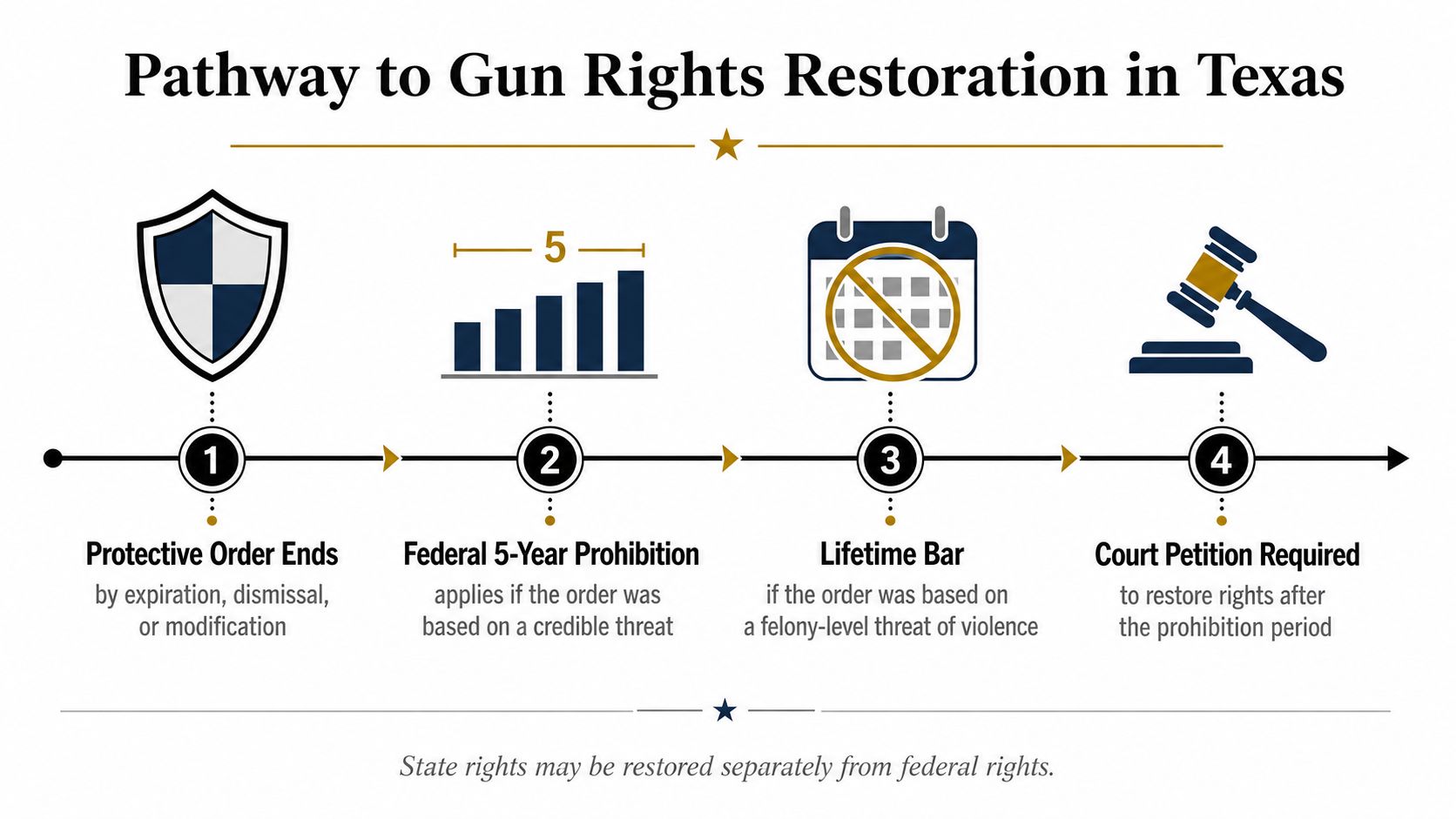
Expiration, dismissal, and modification are separate court events. Obtain a certified order or docket record for the event that ended or changed the restriction. That document becomes the starting point for every restoration request.
Check the Texas record first. Confirm whether the order expired on its stated date, was dismissed, or was modified to remove the firearm restriction. If law enforcement holds surrendered firearms, ask that agency about its written request, identification, court documentation, and property-release procedures. Do not wait for automatic notice. An unclaimed firearm may not remain available indefinitely.
Federal eligibility needs its own review. A qualifying protective-order prohibition may apply during the order and can involve a federal five-year prohibition under the applicable framework, as described in the ATF's Texas firearms materials. Review the ATF guidance on Texas firearms statutes with counsel. A qualifying domestic-violence conviction can create a separate federal disability that may last for life.
Build a practical restoration file
Gather these records before requesting restoration or applying to renew:
- Certified order: The complete protective order, including findings and information about expiration, dismissal, or modification.
- Surrender proof: Receipts, transfer documents, law-enforcement property records, and any court filing confirming compliance.
- License records: The LTC, DPS correspondence, suspension notices, and prior applications.
- Criminal records: Certified dispositions for any related arrest or conviction.
- Federal review materials: Documents needed to determine whether a federal prohibitor remains active.
For an LTC, contact DPS and use the proper renewal or application process after confirming eligibility. Expiration changes the order-based disability, but restoring every legal right or reactivating a suspended license requires separate steps. An expired protective order does not guarantee immediate approval, and a prior dismissal may not resolve every record or federal issue on its own. If the order was modified or vacated before expiration, have counsel examine exactly what the court changed and what remains in the record.
Common Mistakes and Getting Help in Texas
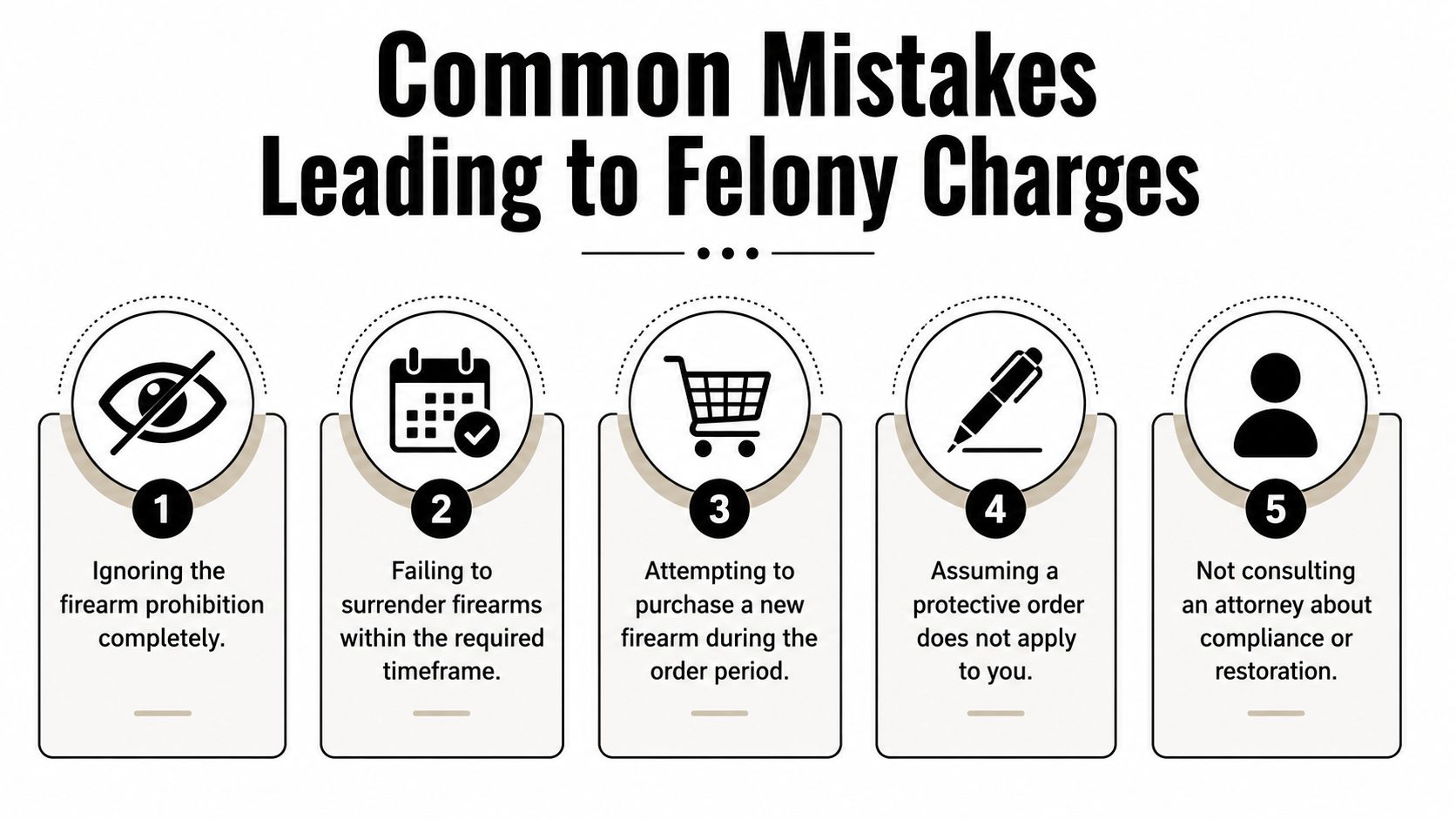
The most damaging mistake is treating an LTC as a shield. It isn't. A license may authorize carrying under ordinary circumstances, but it doesn't override a protective-order possession ban or federal restriction.
Other mistakes are more practical:
- Ignoring the firearm prohibition: Keeping a gun in a nightstand, truck, or workplace can create possession problems.
- Missing the surrender deadline: A late transfer can violate an express court instruction even if you never intended harm.
- Buying another firearm: Purchasing a new firearm during an active prohibition can create a fresh legal problem.
- Using a relative's firearm: Borrowing a spouse's, parent's, or friend's gun may still involve possession or control.
- Assuming records clear automatically: Expiration may end the order-based restriction, but it doesn't automatically resolve DPS records, federal eligibility, or surrendered-property procedures.
- Failing to disclose relevant information: An inaccurate LTC application can create additional licensing consequences.
Don't rely on an online forum to decide whether your order qualifies under federal law. The exact wording, service history, hearing opportunity, relationship between the parties, and any related conviction can change the analysis.
What you should do now
If you've been served, take these steps:
- Stop possessing or carrying firearms until counsel confirms what the order allows.
- Read every page, including attachments, surrender provisions, and expiration dates.
- Inventory firearms and ammunition without moving them unnecessarily.
- Ask law enforcement or a licensed dealer about a documented transfer that complies with the order.
- Obtain written proof and file it when required.
- Preserve certified court records and DPS correspondence.
- Get separate firearm advice if a federal prohibition or criminal conviction may apply.
A Texas family-law lawyer can address the protective-order hearing, modifications, custody consequences, and compliance strategy. A firearms attorney may be needed for federal restoration questions. If you need a narrowly defined service arrangement, review information about limited-scope representation and ask what work the lawyer will and won't handle.
Your safest next move is not guessing. It's matching the exact order to the exact compliance step before you touch a firearm or submit an LTC application.
If you need help responding to a protective order, documenting firearm surrender, reviewing LTC consequences, or planning for restoration, The Law Office of Bryan Fagan, PLLC can help you evaluate the Texas family-law issues and coordinate the next steps with appropriate counsel. Visit Law Office of Bryan Fagan, PLLC to schedule a free consultation and discuss your situation with a Texas family-law professional.


