 Skip to content

Divorce, custody, and support disputes can create an impossible-feeling choice. You may need legal guidance, but a full retainer may be beyond your budget, and handling every filing, deadline, and hearing alone can feel overwhelming. Limited scope representation can provide a practical middle path, especially when you need a lawyer for the parts of your case where a mistake could have serious consequences.
When Full Representation Is Not the Only Option
A Texas parent facing a child support modification or enforcement action may know exactly what's at stake. The parent may want help correcting support, protecting a possession schedule, or responding to allegations that payments were missed. At the same time, a full retainer may not fit the household budget. The alternative, handling the entire case without legal advice, can feel risky when court rules and evidence requirements are unfamiliar.
That tension is common in family law. A person may be comfortable gathering pay records and completing routine forms but have no idea how to frame the legal request, organize evidence, or respond to an objection. Limited scope representation lets the client hire an attorney for defined, high-impact work while retaining responsibility for agreed tasks.
The arrangement might include reviewing a proposed modification, drafting pleadings, preparing discovery responses, or coaching the client before a hearing. The client may still file documents, communicate with the other side, and appear in court personally. This isn't about pretending a complicated case is simple. It's about allocating professional help where it can provide the most value.
Practical rule: A limited engagement works only when both sides understand exactly what the lawyer will do and what the client must do.
Limited scope representation is a legitimate legal-service model, not an informal favor or a sign that the client's case doesn't matter. Texas law permits lawyers to limit representation after consultation and client consent. Nationally, the model has moved beyond theory. In England and Wales, the 2025 Legal Services Consumer Panel tracker survey reported that 21% of consumers used unbundled legal services, compared with 18% in 2024, the highest level recorded there since tracking began in 2014. If you're weighing self-representation, understanding whether you can get divorced without a lawyer can help you identify which responsibilities you can realistically handle.
What Limited Scope Representation Means Under Texas Law
Texas Disciplinary Rule of Professional Conduct 1.02(b) permits a lawyer to limit the scope, objectives, and general methods of representation when the client consents after consultation. The engagement still creates an attorney-client relationship, but only for the work the agreement covers.
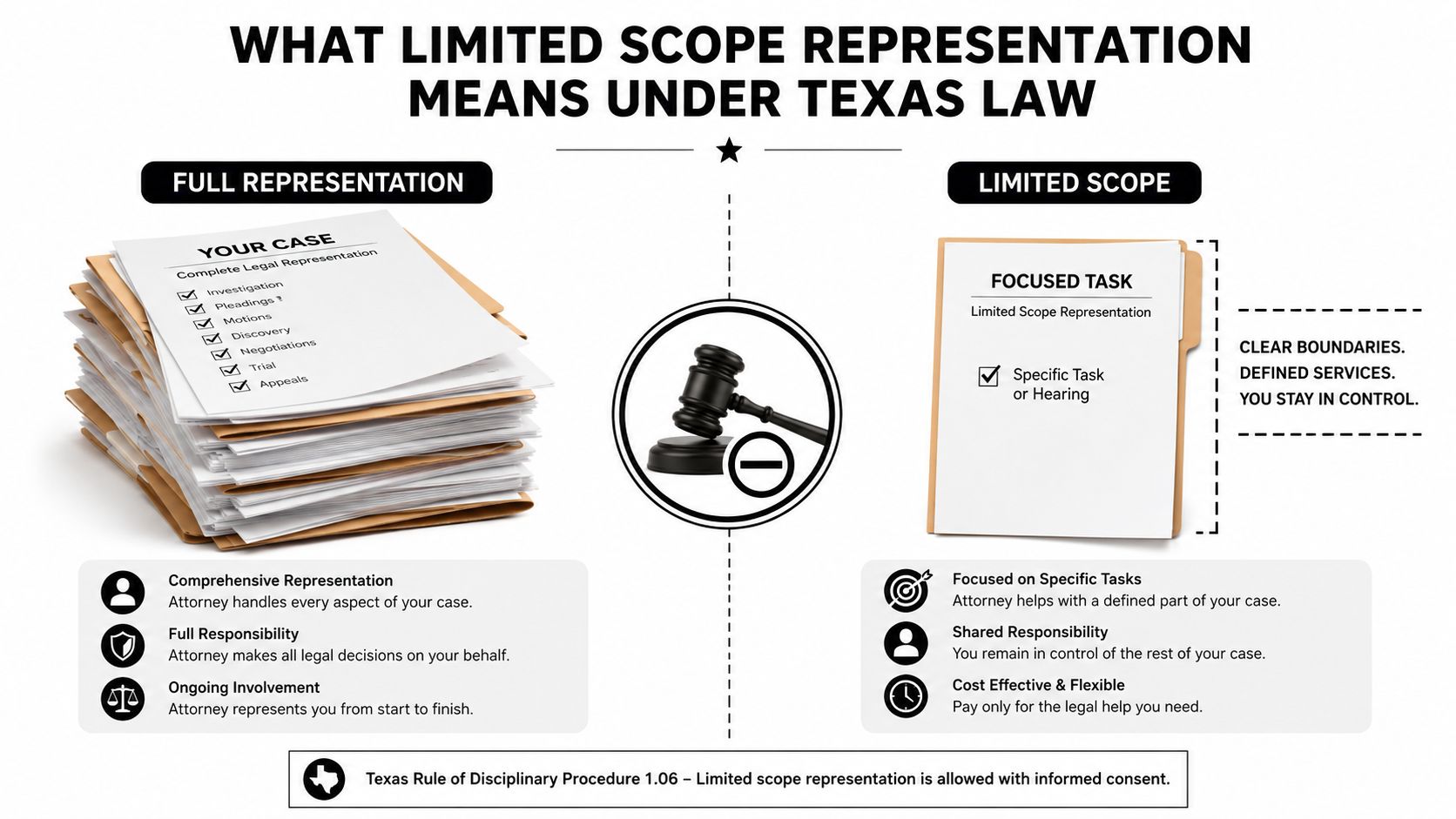
The distinction becomes clearer when you compare three arrangements:
- Full representation: The lawyer generally handles the case from initial pleadings through negotiations, discovery, hearings, and trial, subject to the written agreement and later decisions.
- Limited scope representation: The lawyer handles selected tasks, such as reviewing a decree, drafting a motion, advising on strategy, or appearing for a defined hearing.
- Pro se representation: The client acts without an attorney and remains responsible for all filings, communications, deadlines, preparation, and appearances.
“Unbundled legal services” is another term for the limited model. You aren't buying less professional responsibility within the agreed assignment. If a lawyer agrees to draft a motion, the lawyer still owes duties of competence, confidentiality, diligence, and communication concerning that motion. The boundary is the assignment itself.
For example, a lawyer may agree to prepare an original petition for divorce and explain the filing process, while excluding service, temporary orders, discovery, mediation, and trial. Another engagement may cover settlement review but not negotiation. The written agreement should identify those differences in plain language.
Clients sometimes need targeted assistance in related areas, including Child Protective Services Defense for families facing CPS investigations and allegations. The right scope depends on the legal problem, procedural posture, urgency, and client's ability to complete the remaining work. A practical guide to what Texas family law attorneys do can also help you decide which professional functions you need.
Benefits and Risks of Unbundled Legal Services
The strongest benefit is control. A client can reserve legal spending for a petition, settlement review, evidence plan, or hearing preparation instead of paying for tasks the client can complete independently. The arrangement can also preserve the client's direct knowledge of the case, which may matter in day-to-day parenting disputes and document collection.
Limited scope help can be particularly useful when the legal issue is defined. A lawyer who reviews a proposed enforcement motion may identify missing elements, unclear requested relief, or evidence that needs authentication. A lawyer who reviews a settlement agreement may spot language affecting support, possession, retirement benefits, or future enforcement.
The model also carries meaningful risks. A lawyer drafting a petition may not know about a protective order, prior allegation, or pending case that changes the custody analysis unless the client discloses it. A client who receives hearing coaching may still struggle to introduce evidence, answer objections, or follow courtroom procedure under pressure.
Where the model helps
A limited engagement often works better when:
- The issue is contained: One motion, agreement, pleading, or procedural question can be separated from the rest of the case.
- The client is organized: The client can provide accurate facts, preserve records, track deadlines, and communicate promptly.
- The remaining tasks are manageable: Filing, service, scheduling, and routine exchanges don't exceed the client's ability.
- The hearing is predictable: Advice may be useful for a straightforward uncontested matter, but less reliable when witnesses and objections are expected.
The evidence supports targeted assistance in appropriate settings. A Yale Law Journal study reported that homeowners with in-court limited-scope counsel kept their homes in 51.8% of cases, compared with 28.6% for similar homeowners proceeding without that limited counsel. The study is not family-law evidence, but it illustrates why partial assistance can matter when it reaches a critical procedural moment. The study is available through the Yale Law Journal discussion of limited-scope housing representation.
Where it can fail
Consider a contested divorce. A lawyer may efficiently prepare pleadings and review a settlement proposal, but the case can change at trial when a witness offers unexpected testimony or the opposing attorney raises an evidentiary objection. The client may then need immediate advocacy that the original agreement excluded.
Communication failures create another danger. If the client believes the lawyer is monitoring every deadline while the lawyer believes the client is responsible for scheduling, a missed hearing can result. Before accepting limited scope representation, ask who will file, serve, calendar, communicate with opposing counsel, prepare exhibits, and respond to new developments.
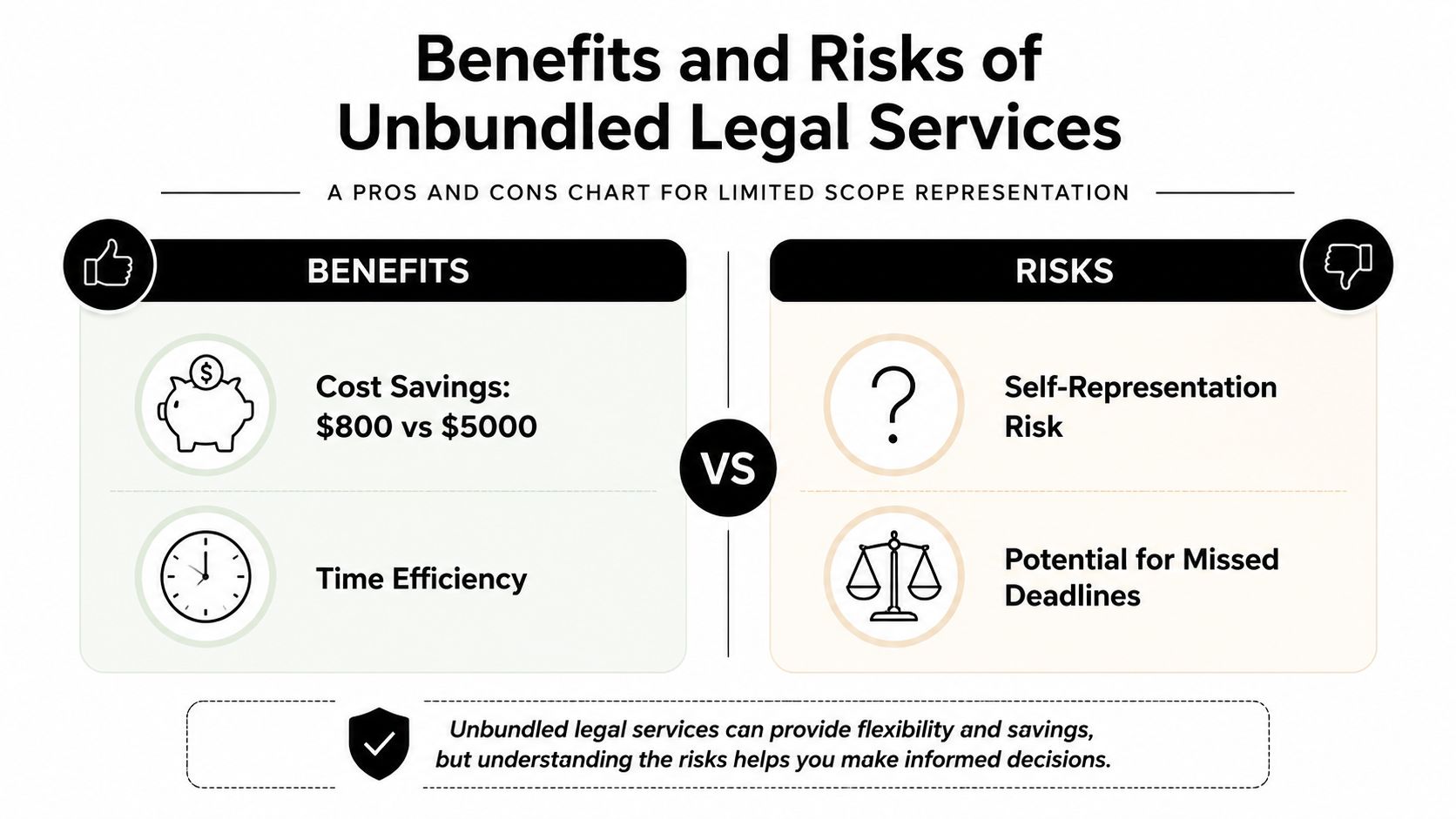
Targeted legal assistance has also been evaluated in eviction proceedings. The ABA guide to limited-scope rules discusses a randomized trial in Quincy District Court in which limited legal assistance was evaluated against full representation, with representation improving tenant possession outcomes, financial judgments, and court burden. The lesson for family cases is practical. Limited scope representation can be valuable, but only when the selected task matches the legal risk.
Texas Court Rules and Ethical Requirements
Texas lawyers must design limited engagements around both ethics rules and court procedure. Rule 1.02(b) requires consultation and client consent. The limitation also must be appropriate for the circumstances. A lawyer shouldn't accept a scope so narrow that competent handling of the agreed assignment is impossible.
The process should begin with a written agreement. It should identify the matter, the exact task, excluded work, communication expectations, and the event that ends the engagement. The lawyer and client then need to make sure the court and opposing party understand the lawyer's role when a court appearance or filing is involved.
Notice and appearance
Texas court materials describe an initial notice at the beginning of the limited representation. That notice states that the representation is subject to a written limited scope agreement and doesn't disclose the agreement's terms. If an issue arises outside the agreed scope, the attorney should promptly file a notice of limited appearance identifying the limited issue and providing the unrepresented client with applicable response deadlines and the date, place, and time of a hearing. The Texas court materials concerning limited scope procedure should be reviewed with counsel because filing practices can depend on the proceeding and court.
Do not assume that telling opposing counsel about the agreement is enough. The court record needs to accurately reflect whether the lawyer is appearing for the whole case, a particular issue, or a specific event. Service and notice also matter. A client who files a document without understanding the attorney's role may create confusion about who is responsible for the next step.
Completion and withdrawal
When the defined work ends, the lawyer must follow the applicable procedure for ending the representation. Timing is critical in family law. A lawyer shouldn't withdraw in a way that leaves a client unprepared for a hearing already within the engagement, and the client needs written confirmation of remaining deadlines and responsibilities.
Texas family-law materials caution against limiting representation so narrowly that the lawyer cannot handle all tasks necessary for a pretrial hearing for temporary relief or a final trial on joined Texas Family Code claims. Those materials also describe a proposed rule requiring withdrawal from a limited engagement 30 days before trial when the representation doesn't include trial, reinforcing the need to address trial timing at the beginning. The Texas Supreme Court family-law rule materials provide important context.
Courtroom reality: A limited appearance isn't a license to treat a temporary-orders hearing or trial as a collection of unrelated tasks. The lawyer must be able to perform the agreed assignment competently, and the client must know who handles everything else.
Communication duties continue within the agreed scope. If new facts make the assignment unsafe or materially different, the lawyer may need to explain the problem, recommend expanding the engagement, or decline further work. Clients should also ask whether a proposed Rule 11 agreement is included in the engagement or requires a separate assignment.
Which Family Law Tasks Work Best Unbundled
Some family-law tasks are naturally discrete. Others depend on ongoing factual development, witness preparation, and rapid courtroom decisions. The table below offers a starting point, not a substitute for reviewing the actual case.
| Family Law Tasks: Unbundled vs. Full Representation | Best Suited For | Why |
|---|---|---|
| Drafting an original divorce petition | Limited scope in a relatively straightforward case | A lawyer can frame the requested relief and identify necessary allegations while the client handles filing and service if agreed |
| Preparing a final decree | Limited scope when the parties have reached a complete agreement | Careful drafting can prevent inconsistent or missing provisions |
| Reviewing a settlement agreement | Limited scope | The lawyer can explain legal effects and identify provisions that don't match the client's goals |
| Preparing for a temporary-orders hearing | Limited scope for coaching, full representation for contested relief | Coaching may organize testimony, exhibits, and requested orders, but live advocacy carries greater risk |
| Child support modification paperwork | Limited scope when facts and requested relief are focused | The lawyer can assess the legal theory and help present supporting records |
| Enforcement involving disputed compliance | Often full representation | Contested evidence, credibility issues, and possible remedies can expand quickly |
| Custody trial | Usually full representation | Witnesses, exhibits, objections, and best-interest arguments require coordinated advocacy |
| Complex property division with business interests | Usually full representation | Valuation, tracing, characterization, and discovery may involve interconnected issues |
High-value assignments
Document review and strategic preparation often deliver strong value because they improve work the client must otherwise complete alone. A parent preparing a modification petition may know the family history but not the legal elements or requested relief. A lawyer can help turn a collection of facts into a coherent pleading and preparation plan.
Settlement review can also be efficient. Before signing, the client should understand possession terms, child support, medical expenses, tax provisions, retirement interests, property transfers, and enforcement language. That review is different from representing the client through negotiation, mediation, or trial.
Assignments that deserve caution
A parent may use limited help to prepare a petition and then appear alone at the hearing. If the other parent introduces new evidence or contests material facts, the client may discover that drafting skill doesn't translate into live advocacy.
Domestic violence, high-conflict custody disputes, relocation, complex assets, and allegations affecting conservatorship generally deserve careful consideration of full representation. A consultation can identify whether a discrete task is separable or whether the case's issues are too connected.
What Your Engagement Agreement Should Include
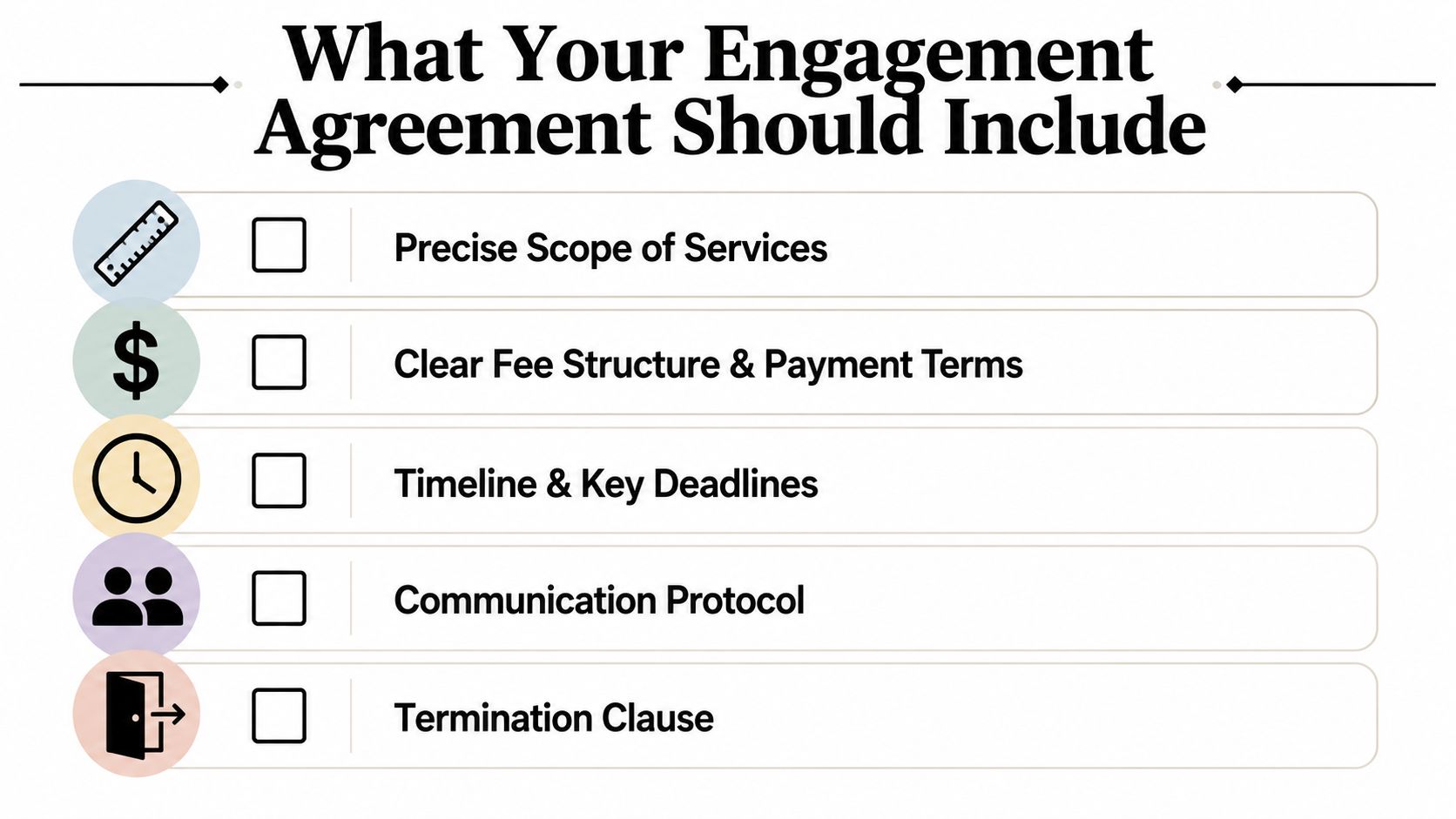
The agreement should be specific enough that a person unfamiliar with legal billing could identify the lawyer's responsibilities and the client's responsibilities. “Assist with divorce” is too vague. “Review the proposed mediated settlement agreement and provide written comments on property, conservatorship, possession, and support provisions” is much clearer.
Essential provisions
- Defined services: State whether the lawyer will advise, draft, review, negotiate, appear, or perform another identified task.
- Express exclusions: List what the lawyer won't handle, such as service, discovery, mediation, trial, post-decree enforcement, or communications with the other side.
- Fee terms: Explain whether payment is flat, hourly, or hybrid, when payment is due, and how additional work is approved.
- Client duties: Identify who gathers records, files pleadings, serves documents, calendars deadlines, prepares witnesses, and appears in court.
- Completion and withdrawal: Describe when the engagement ends and what notice or filing will confirm completion.
The agreement should also address communication. Ask how you'll send documents, who reviews urgent messages, whether the lawyer will monitor court notices, and what happens if the opposing party files something unexpected. A client should never assume that sending a copy of a filing automatically expands the attorney's role.
A clearer clause
A useful provision might state: “The attorney will review the proposed final decree and provide written comments regarding the issues listed in this agreement. The attorney will not negotiate, file the decree, attend a prove-up hearing, monitor deadlines, or handle post-decree enforcement unless the parties sign a further agreement.”
That language gives both sides a reference point. Before signing, read every exclusion and ask what happens if the case becomes more complicated. Informed consent means understanding the advantages and risks of the limitation, not merely signing a fee document.
Understanding the True Cost of Limited Scope Help
Limited scope representation should be treated as strategic cost management, not as a promise that legal services will always be inexpensive. The financial result depends on the task selected, the quality of the client's preparation, the urgency of the issue, and whether the case remains within the original boundaries.
A flat fee may provide predictability for a defined document review or drafting assignment. Hourly billing may make more sense when the facts are incomplete or the client needs advice that could expand. A hybrid arrangement can combine a set amount for drafting with hourly charges for approved follow-up work.
The hidden cost appears when a client chooses the wrong task to unbundle. A poorly prepared petition may require correction, delay relief, or force new counsel to rebuild the case. A client who attempts a contested custody trial without adequate courtroom support may face consequences that later legal work can't easily undo.
Compare value, not just price
| Cost Comparison: Full vs. Limited Scope Representation | Full Representation | Limited Scope | Potential Savings |
|---|---|---|---|
| Complete case management | Covers the broader case under a comprehensive agreement | Client retains responsibility for excluded work | Depends on the scope and work remaining |
| Pleading preparation | Lawyer prepares and manages pleadings as part of the case | Lawyer drafts or reviews a defined pleading | May reduce fees when the client can handle filing and follow-up |
| Settlement review | Review may occur within broader negotiation or representation | Lawyer reviews specified terms without taking over negotiations | May preserve funds for a targeted legal question |
| Court appearance | Lawyer prepares and advocates at the hearing or trial | Client may appear personally unless appearance is included | Savings come with greater courtroom responsibility |
| Unexpected complexity | Existing counsel may already be positioned to respond | New work may require a new agreement or expanded scope | Any savings can disappear if the case expands |
The right question isn't “How can I spend the least?” It's “Which legal task is most likely to prevent an avoidable mistake?” For one client, that may be reviewing a property settlement. For another, it may be preparing a temporary-orders strategy or determining whether an enforcement action is properly pleaded.
Scope creep must be handled in writing. If the client asks the lawyer to contact opposing counsel, prepare exhibits, or attend a hearing outside the agreement, the lawyer should confirm whether the request is accepted and how it will be billed. The client should never rely on an informal assumption that additional work is included.
Deciding If Limited Scope Representation Is Right for You
Start with an honest assessment. Can you track deadlines, gather records, complete forms, communicate calmly, and appear in court? Do you understand which issues are agreed and which are disputed? Do you have enough time and emotional capacity to manage the parts the lawyer won't handle?
Limited scope representation may fit an uncontested divorce, agreed custody arrangement, straightforward support issue, or focused settlement review. Full representation deserves serious consideration when the case involves high-conflict custody, domestic violence, relocation, complex property, business interests, contested temporary orders, or a trial.
Texas family-law rules also matter. A lawyer must be able to handle the agreed assignment competently, and the agreement must account for notices, deadlines, hearings, and completion. A consultation doesn't commit you to full representation. It can help you identify the specific task that deserves legal attention and the responsibilities you can safely retain.
Limited scope representation isn't automatically second-best. For a prepared client with a contained legal issue, it can be a thoughtful way to control spending while obtaining professional guidance. For a rapidly changing or high-risk case, full representation may provide the continuity and courtroom advocacy that partial help can't replace.
If you need help navigating divorce, custody, or estate planning in Texas, contact The Law Office of Bryan Fagan today for a free consultation. The Law Office of Bryan Fagan, PLLC can help you evaluate whether limited scope representation, full representation, or another strategy fits your case, budget, and immediate legal needs.


