Navigating a divorce or custody battle can be one of life's most difficult transitions, often feeling like you're losing control over the most important parts of your life. The uncertainty can be overwhelming, but understanding your rights under Texas law can make it less overwhelming. You don't have to leave every single decision in a judge's hands.
This is where a Rule 11 Agreement becomes one of the most powerful tools for Texas families. As defined by Rule 11 of the Texas Rules of Civil Procedure, it’s a way to find common ground and create certainty, allowing you and the other party to decide on key issues together instead of waiting for a judge to rule.
Regaining Control in Your Case with a Rule 11 Agreement
Think of a Rule 11 Agreement as a formal, written handshake that turns informal understandings into legally enforceable commitments. It's a way for you to take back the reins during a chaotic and emotional time.

Building a More Stable Path Forward
These agreements are incredibly versatile and can be used to resolve almost any temporary or permanent issue that comes up in a family law case. Instead of fighting over every little thing in court, you and your former partner can craft your own practical solutions.
For example, a Rule 11 Agreement can help you and your family by:
- Establishing a temporary custody schedule for your kids while the divorce is pending.
- Deciding who will live in the marital home and pay the mortgage.
- Agreeing on how to handle joint credit card debt or the use of a shared car.
- Setting clear rules for communication to keep discussions productive and less hostile.
Rule 11 Agreements are a cornerstone of modern Texas family law, reflecting a shift toward resolving disputes outside of a formal trial. With the high emotional and financial costs of litigation, negotiated outcomes are more valuable than ever. Courts actively encourage these agreements because they reduce the judicial workload and empower families to craft their own solutions.
By using a Rule 11 Agreement, you aren't just settling a dispute—you are actively designing your family's future on your own terms. It offers a structured path to cooperation that can dramatically reduce conflict.
These agreements are often the result of successful negotiations, whether handled directly between attorneys or through a more formal process like mediation. In fact, many parents find tremendous success when they explore mediation before going to court, as it provides the perfect structured environment for hammering out these exact kinds of agreements.
What a Rule 11 Agreement Is and How It Works
So, what exactly is this powerful legal tool? At its heart, a Rule 11 Agreement is a formal, legally binding contract between people involved in a Texas lawsuit. It gets its name from Rule 11 of the Texas Rules of Civil Procedure, the law that spells out how these agreements must be made and enforced.
Think of it as a “written handshake” that the court can officially recognize and uphold. It’s the bridge between informal conversations and concrete, enforceable commitments that provide stability and clarity.

Without one, verbal understandings—like who will pay a certain bill or what the holiday schedule will be—can easily fall apart. A Rule 11 Agreement puts those terms in black and white, leaving no room for future arguments or "selective memory." This protects you and ensures everyone is held accountable.
Making Your Agreement Legally Binding
For an agreement to have any teeth in court, it has to meet specific legal requirements. Simply telling your spouse, "Don't worry, I'll handle the car payment," won't be enough for a judge to enforce. Rule 11 provides two official ways to make an agreement binding.
Understanding these two paths is a critical first step. If you don't follow one of them, your "agreement" is just a conversation, not a contract a judge can act on.
Per Rule 11 of the Texas Rules of Civil Procedure, an agreement must be either:
- In writing, signed, and filed with the court as part of the case record, OR
- Made in open court and read into the record, meaning it is stated before a judge while a court reporter transcribes every word.
Both methods create a clear, undeniable record of what was agreed to. This is how you shut down the "he said, she said" drama that can derail a family law case and run up thousands in legal fees.
The Two Ways to Make a Rule 11 Agreement Enforceable
Choosing between a written document and an oral one made "on the record" usually comes down to timing and convenience. A written agreement is perfect for complex issues ironed out over time, while an on-the-record agreement is ideal for finalizing terms at the courthouse right before a hearing.
Here is a step-by-step breakdown of these two essential methods for creating a legally sound Rule 11 Agreement in Texas:
| Method | Key Requirements | Ideal For |
|---|---|---|
| Written & Signed | The agreement must be written down, signed by both parties (or their attorneys), and officially filed with the court clerk. | Complex agreements negotiated over time, such as detailed property division lists or temporary custody schedules settled outside of court. |
| Made "On the Record" | The terms of the agreement must be spoken aloud in a formal court proceeding, with all parties affirming their consent to the judge. A court reporter must be present to create an official transcript. | Settling last-minute issues at the courthouse before a hearing, or finalizing a full settlement reached during mediation on the day of court. |
The reason for these strict requirements is to guarantee absolute clarity and prevent future disputes over what was actually decided. As a Texas appellate court case showed, a simple handwritten agreement signed by the parties and the judge, then filed with the clerk, was powerful enough to be considered a final judgment. This proves how definitive a properly executed Rule 11 Agreement can be—offering the same certainty as a final court order.
How to Use Rule 11 Agreements in Your Divorce or Custody Case
This is where the true power of a Rule 11 Agreement comes to life in a family law case. When you’re facing a divorce or custody dispute, the list of things to decide can feel overwhelming. Instead of fighting over every single point in court, these agreements let you and the other party create your own practical, enforceable solutions.
For example, in the early stages of a divorce, emotions are raw. You and your spouse need to figure out who stays in the house and who pays the mortgage until the case is final. A big court fight over temporary orders could drag on for weeks and cost thousands in attorney’s fees. A far better alternative is to craft a Rule 11 Agreement that lays out a temporary plan you can both live with right now.
Practical Guidance for Solving Problems Big and Small
The greatest strength of a Rule 11 Agreement is its flexibility. It lets you build highly specific solutions tailored to your family’s unique situation—a level of detail a judge’s standard order often can’t match.
You can use these agreements to settle a huge range of issues, including:
- Temporary Living Arrangements: Deciding who stays in the family home during the divorce and who is responsible for the mortgage, utilities, and upkeep.
- Property Use: Agreeing on who gets to drive a specific car and who will cover the insurance and loan payments.
- Temporary Child Custody Schedules: Creating a clear, temporary possession schedule for holidays, birthdays, or school breaks while the case is pending. This gives your children much-needed stability.
- Rules for Communication: Setting firm boundaries for how and when you’ll communicate. For example, you might agree to only use a co-parenting app and limit discussions strictly to child-related topics.
- Financial Responsibilities: Outlining who will pay certain debts, like credit cards or personal loans, until the divorce is final. This helps protect both of your credit scores.
This ability to resolve matters quickly and privately is what keeps your case moving forward. By agreeing on things like discovery deadlines or when to exchange financial documents, you sidestep needless delays and keep legal costs down.
A Rule 11 Agreement allows you to be the architect of your own temporary orders. It transforms potential conflicts into settled issues, giving you and your family immediate stability and peace of mind.
Ultimately, these smaller agreements can become the building blocks for your final settlement. The terms you hammer out and agree to on a temporary basis can often be rolled directly into your final divorce decree, making the end of your case much smoother and more predictable.
Creating an Essential Paper Trail
In the heat of a family law battle, verbal promises are easily forgotten or “misremembered.” A Rule 11 Agreement cuts through the noise by creating a formal paper trail that holds both parties accountable. This is incredibly important in counties with massive family law dockets, where these agreements provide a lifeline to avoid drawn-out litigation. As you can learn more from this analysis of Texas family law trends, having documented proof is essential for enforcement.
Let’s look at a relatable scenario in a custody case:
Scenario: A father verbally agrees to let the mother have the kids for the entire week of Thanksgiving this year. But as the holiday gets closer, he changes his mind and claims their conversation was just a casual discussion, not a firm deal.
Without a Rule 11 Agreement, the mother has almost no recourse. But with a signed agreement filed with the court, she holds a legally enforceable contract. Her attorney can file a motion to enforce the agreement, and a judge will almost certainly order the father to stick to the schedule he agreed to. This example shows why these agreements are so valuable—they erase ambiguity and give you a clear path to a solution if the other person fails to hold up their end of the bargain.
Creating a Strong and Enforceable Agreement
When it comes to a Rule 11 Agreement, the devil is absolutely in the details. While these agreements are a fantastic tool for finding common ground, their power rests entirely on how they’re written. To build a document that a judge will enforce, you have to be crystal clear, specific, and leave zero room for future arguments.
A vaguely worded agreement is often worse than no agreement at all. It gives you a false sense of security while leaving the door wide open for future conflict, which costs more time, money, and emotional energy down the line. Drafting isn’t just a formality—it’s the most important step in protecting yourself.
This flowchart shows how a Rule 11 agreement fits into a Texas family law case, from handling temporary issues all the way through to finalizing the terms of your divorce or custody order.
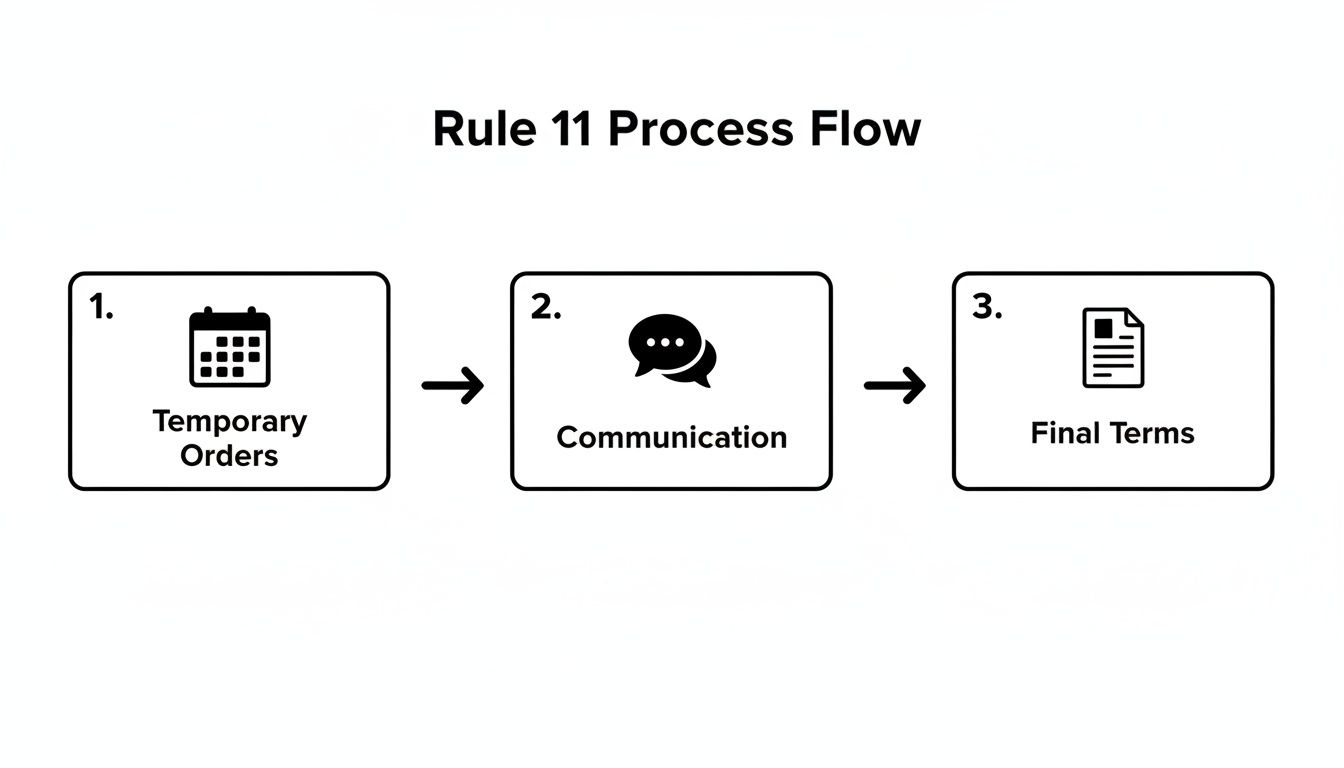
As you can see, these agreements are versatile, providing much-needed stability at every stage of your case.
From Vague Promises to Concrete Terms
One of the most common pitfalls we see is people using ambiguous language. Terms like “reasonable visitation” or “timely communication” might sound agreeable, but they are subjective and completely unenforceable. What you think is “reasonable” might be completely different from your ex-spouse’s definition, leading to endless bickering.
A strong Rule 11 Agreement swaps those fuzzy concepts for explicit, measurable terms.
- Instead of “reasonable visitation,” you should lock down exact dates and times. For example: “The non-primary parent shall have possession of the child on the first, third, and fifth weekends of each month, beginning Friday at 6:00 PM and ending Sunday at 6:00 PM.”
- Instead of “sharing costs,” you must define financial responsibilities with precision. For example: “The parties will split the cost of the child’s extracurricular activities 50/50. The parent who incurs the expense must provide a receipt to the other parent within 15 days, and the other parent must provide reimbursement within 15 days of receiving the receipt.”
- Instead of “timely communication,” you set firm boundaries. For example: “All non-emergency communication between the parties shall be conducted exclusively through the OurFamilyWizard app, with a required response time of 48 hours.”
Specificity is your best defense against future fights. The goal is to draft an agreement so clear that a total stranger could read it and know exactly what each person is supposed to do and when.
Essential Checklist for an Enforceable Agreement
While every case is different, a legally sound Rule 11 Agreement must include several core elements to be considered valid by a Texas court. Think of this as your pre-flight checklist before you sign.
Key Elements to Include:
- Proper Case Information: The document must clearly state the full names of both parties, the case number, and the specific court hearing the case (e.g., “the 308th District Court of Harris County, Texas”).
- Clear Statement of Agreement: It needs to state outright that it is a “Rule 11 Agreement” and that both parties intend for it to be legally binding and irrevocable.
- Unambiguous Terms: This is the heart of the agreement. Every single point—responsibilities, deadlines, dollar amounts, and actions—must be spelled out with no room for guesswork.
- Required Signatures: The agreement has to be signed by both parties or their attorneys. A written agreement without signatures is useless under Rule 11.
- Filing with the Court: The signed document must be filed with the court clerk to become an official, enforceable part of the case record.
A cautionary tale from a Texas appellate court drives this home. A couple jotted down a handwritten agreement, which they, their lawyers, and the judge all signed. It was then filed with the clerk. Later, one spouse tried to back out, but the court said no—the simple, properly executed document was a final, binding judgment. This proves that getting the formalities right is everything.
Having an experienced attorney draft or at least review your Rule 11 Agreement is the best protection against making a costly mistake. A lawyer will make sure every “i” is dotted, every term is airtight, and the document will hold up if challenged. As you get closer to finalizing your case, understanding how these terms work is critical for preparing a final order in a divorce that truly reflects the settlement you reached.
What Happens When an Agreement Is Broken
An agreement is only as good as its enforceability. When you sign a Rule 11 Agreement, you’re trusting the other person to hold up their end of the bargain. But what happens if they don’t? The good news is that a properly executed agreement isn’t just a piece of paper—it’s a powerful legal instrument with real teeth.
When one party violates the terms, it’s not just a broken promise. It’s a breach of a court-recognized contract. This gives you and your attorney a direct path to take legal action and force compliance.
The Path to Enforcement: A Step-by-Step Guide
Let’s walk through a common scenario. You and your spouse sign a Rule 11 Agreement stating that he will keep making the monthly payments on the car you drive until the divorce is final. A couple of months later, you get a late notice and discover he’s stopped paying.
This is a clear violation. The sense of panic and betrayal is completely understandable, but you are not without options. Here is a practical, step-by-step guide on what to do:
Step 1: Contact Your Attorney Immediately
The moment you find out about the breach, get in touch with your family law attorney. Provide them with any evidence you have, such as the late notice or bank statements.
Step 2: File a Motion to Enforce
Your attorney will draft and file a Motion to Enforce the Rule 11 Agreement. This is a formal legal document that tells the court the other party has broken the agreement and asks the judge to step in and fix the problem. This motion works like a breach of contract claim, but it’s handled right inside your existing family law case, making it an efficient way to get a resolution.
Step 3: Attend the Enforcement Hearing
The court will set a hearing where both sides can present their case. Your attorney will present the signed agreement and evidence of the violation.
Potential Outcomes in Court
If the judge agrees that the agreement was clear and that your ex-spouse knowingly violated it, several outcomes are on the table. A judge has the authority to issue orders that not only fix the immediate problem but also penalize the person who broke the rules.
The court’s main job here is to uphold the integrity of agreements made under its watch. A judge can compel the other party to follow the original terms and may even order them to pay you back for the trouble they caused.
Potential remedies a judge can order include:
- Compelling Performance: The most common outcome is an order forcing the other party to do exactly what they promised. In our car payment example, the judge would order your spouse to immediately make the missed payments and continue making all future payments on time.
- Awarding Attorney’s Fees: The judge can order the violating party to pay for the attorney’s fees and court costs you had to spend to file the motion and attend the hearing. This ensures you aren’t financially punished for someone else’s failure to follow the rules.
- Imposing Other Sanctions: For repeated or blatant violations, a judge can impose even more penalties. This might include fines or other sanctions designed to discourage them from breaking the rules again.
This enforcement process is what gives a Rule 11 Agreement its strength. It gives you the confidence that the terms you carefully negotiated will be upheld. For a deeper look, you can learn more about preparing for an enforcement case in Texas in our detailed guide.
Understanding the Limits of a Rule 11 Agreement
While a Rule 11 Agreement is an incredibly useful tool for regaining control in your family law case, it’s not all-powerful. It’s just as important to understand what this agreement cannot do. Knowing the boundaries helps set realistic expectations and prevents you from putting your faith in an agreement that a judge might later reject.
The biggest limitation comes into play when children are involved. In Texas, every single decision regarding children—from custody and visitation to child support—is governed by one single, overriding principle: the best interest of the child.
The Court’s Ultimate Authority Over Child-Related Issues
This legal standard, found throughout the Texas Family Code, gives a judge the final say on all matters concerning your kids. It means that even if you and the other parent create a perfect, detailed, and signed Rule 11 Agreement covering conservatorship (custody), possession schedules, and child support, a judge has the authority and the duty to review it.
If the court believes any part of your agreement is not in your child’s best interest, it can and will reject or modify it.
Relatable Scenario: You and your co-parent might agree on a possession schedule that seems fair to you both but gives one parent very little time with the children without a solid reason. A judge might look at that and decide it’s not in the children’s best interest to have such limited contact, then modify the schedule to ensure a more meaningful relationship with both parents.
When Agreed-Upon Child Support Deviates from Guidelines
Another common area where judges step in is child support. Texas has specific guidelines for calculating child support, primarily based on the non-primary parent’s net monthly income and the number of children. While you and the other parent can agree to an amount that is different, the court will scrutinize it.
You must provide the judge with clear and convincing reasons why deviating from the state guidelines is in the child’s best interest. Simply agreeing to pay less support to save money, or agreeing to no support at all, will almost certainly be rejected by a court.
This judicial oversight acts as a crucial safety net. It ensures that the needs of children are always the top priority, even when parents agree otherwise. The court’s role is to protect the children, and that authority supersedes any private contract between parents—including a Rule 11 Agreement. This is why having an attorney who understands these limits is so critical to crafting an agreement that is not only fair but also likely to be approved.
Common Questions About Rule 11 Agreements
When you’re in the middle of a Texas family law case, legal terms can feel overwhelming. A Rule 11 Agreement is one of the most powerful tools you have, but knowing how and when to use it is everything. We get a lot of the same questions from clients, and getting clear answers can help you feel much more in control.
Here are the answers to some of the most common questions we hear about Rule 11 Agreements.
Can We Make a Rule 11 Agreement Without Lawyers?
Technically, yes. But it’s an incredibly risky move. An experienced family law attorney does a lot more than just fill in a blank; they make sure every word is precise, every right is protected, and the entire agreement is legally airtight.
A small mistake or a single vague phrase in a DIY agreement can have devastating results. At best, a judge might find the agreement unenforceable. At worst, you could accidentally sign away crucial rights or agree to something that harms your case down the road. The peace of mind that comes with professional guidance is invaluable.
Is a Rule 11 Agreement the Same as My Final Divorce Decree?
No, and this is a critical distinction. Think of a Rule 11 Agreement as the detailed blueprint for a house, while the Final Decree of Divorce is the actual, finished house itself.
Your agreement will spell out all the terms you’ve settled on—how property gets divided, what the custody schedule looks like, and so on. But that agreement doesn’t finalize your divorce. Those terms must be formally drafted into a Final Decree, which is the official document a judge signs to legally end your marriage and turn your agreement into a court order.
A Rule 11 Agreement is a crucial step toward your final orders, but it is not the final order itself. It is the binding contract that dictates what will go into that final order.
The decree becomes the official, public judgment. The Rule 11 is the private contract that got you there.
What If We Agreed Verbally But My Spouse Won’t Sign?
This is a frustrating and unfortunately common scenario. It’s also the exact reason Rule 11 exists. In Texas, verbal agreements made outside of a formal court proceeding are almost never enforceable. A casual phone call, a conversation in the hallway, or even a series of text messages where you both seemed to agree on everything holds no legal weight if one person changes their mind.
This is why the rule is so strict. To be binding, an agreement must be one of two things:
- A written document signed by both parties (or their attorneys).
- An official statement made “on the record” in open court, in front of a judge and a court reporter.
If you don’t have one of those two things, you don’t have a contract—just an understanding. This highlights why it is absolutely essential to get any settlement terms formally written down and signed as soon as possible. It protects you from a sudden change of heart and turns your handshake deal into a binding commitment.
If you need help navigating divorce, custody, or estate planning in Texas, contact The Law Office of Bryan Fagan today for a free consultation.