 Skip to content

Your parent can no longer manage bills, an assisted-living payment is due, and you've discovered that a sibling is on the checking account. The bank says your sibling can withdraw money, but you've been appointed guardian. It's understandable to worry about who can act and whether the money will still be there when your parent needs it.
Who controls the money when a Texas ward has a joint account turns on separate questions: who can transact at the bank, who owns the funds, and what authority the guardianship court has granted. Don't move money because someone's name appears on the account. Start with the court order and the account records.
Who Really Controls a Texas Ward's Money
A guardian of the estate generally manages the ward's property, but a joint account doesn't make every dollar the ward's property or give every signer unrestricted authority.
| Role | Authority over ward's money | Court order before access? | Governing authority |
|---|---|---|---|
| Guardian of the estate | Manages and controls the ward's property under court supervision | Guardianship order is the source of authority; additional approvals may apply | Tex. Est. Code §1151.101 |
| Guardian of the person only | Makes care decisions; funds accessible through a court application when no estate guardian exists | Yes, with an annual statutory limit and required bond | Tex. Est. Code §1151.0525 |
| Joint co-owner with no guardianship | Bank access under the account agreement; ownership generally follows net contributions | Not ordinarily needed for contractual bank access; the ward's share remains protected | Tex. Est. Code §113.102 |
| Agent under a power of attorney | Authority limited to what the signed document grants | Usually not solely to exercise document-granted powers; review any guardianship restrictions | Signed power of attorney and applicable guardianship order |
Under Texas Estates Code Chapter 1151, an estate guardian manages the ward's property under court supervision, while §1151.0525 permits a person-only guardian, when no estate guardian exists, to obtain an order to manage and spend ward funds for the ward's benefit up to $20,000 per year, with a qualifying bond.
The same chapter expressly addresses survivorship assets. A survivorship designation doesn't prevent the estate guardian from taking possession and control of the ward's asset or closing the account, subject to applicable court direction. That authority protects the ward's property; it doesn't establish that money contributed by another owner belongs to the ward.
Read the appointment before approaching the bank
Start by confirming whether the appointment covers the person, the estate, or both. Then review the order's restrictions and confirm that the appointed guardian has qualified. A family member's understanding of their role isn't a substitute for the actual documents.
The Texas State Law Library's guardianship guidance distinguishes responsibility for the ward's property from responsibility for personal care. For example, a daughter may arrange medical appointments while a separate estate guardian handles payment.
Take these documents to your attorney and the bank:
- Court authority: The appointment order and current guardianship credentials.
- Account authority: The agreement identifying owners, signers, and account designations.
- Ownership evidence: Deposit histories showing whose money funded the balance.
If a relative also claims ownership, identify that claim before transferring the entire account. Ask the court for instructions when the evidence or scope of authority is disputed.
Core rule: Bank access isn't ownership, and guardianship authority comes from the court order and applicable law.
Joint Tenancy and Convenience Accounts Compared
Under Texas Estates Code §113.102, multiple names don't establish equal ownership: during the parties' lifetimes, ownership generally follows net contributions, unless clear and convincing evidence establishes a different intent.
Think of a shared household refrigerator. Everyone may be able to open the door, but that doesn't mean everyone owns all the groceries. An account can similarly give someone practical access without giving them beneficial ownership of the funds.
| Feature | Joint account with survivorship | Convenience account |
|---|---|---|
| Lifetime ownership | Follows each party's net contributions unless clear and convincing evidence shows another intent | Usually stays with the depositor who funded it; confirm the account agreement |
| Bank access | Each named party can usually transact under the agreement | Added party can usually transact, often for bill paying |
| Balance at death | Passes to the survivor only under a qualifying written survivorship agreement signed by the deceased | Generally doesn't pass to the added person merely because they could transact |
| Effect of a label such as JT TEN | Not enough on its own to establish survivorship | Not enough on its own to establish ownership or inheritance rights |
Follow the deposits, not the family assumption
Consider the contribution example described in Texas Estates Code Chapter 113's ownership framework: if the ward contributed 80% of the balance and an adult child contributed 20%, those contributions provide the starting point for the ownership analysis. The account title alone doesn't turn the child's withdrawal access into ownership of the ward's contribution.
Net contributions require more than checking who made the latest deposit. Review the account history, withdrawals, written agreements, and evidence of the parties' intentions. Don't assume a current balance can always be divided using a simple historical percentage.
A convenience arrangement commonly serves a narrower purpose: helping someone pay bills. A parent may add a child so the child can pay utilities during an illness, without intending a gift or inheritance.
Separate lifetime ownership from inheritance
Survivorship concerns what happens after death, not who owns the money during life. A valid written agreement matters; shorthand account labels don't settle the question by themselves.
Before anyone announces that the money is theirs, request:
- The account-opening agreement: Obtain all ownership and beneficiary elections.
- The signature card: Check who signed and in what capacity.
- Account amendments: Look for later changes to ownership or survivorship terms.
Get the documents before drawing conclusions. A bank statement showing names rarely answers every ownership question.
Which Withdrawals Need a Court Order
A daughter is guardian of her father's person and manages his doctor visits and assisted-living decisions. Her brother is listed on their father's joint account and has a debit card. Neither role alone settles whether the father's money may be spent. Bank access, legal ownership, and a guardian's authority are separate questions, and the records and court order determine what the family may do.
A guardian of the person who is not also guardian of the estate may apply for authority to access and spend ward funds for the ward's benefit, up to $20,000 per year, when no estate guardian has been appointed under Texas Estates Code §1151.0525. The court order requires a qualifying bond or bond rider, and the guardian must report authorized expenditures.
Texas Estates Code §113.151 addresses written survivorship agreements. A claimed right to inherit later does not give someone present authority to spend the ward's money.
Make the application specific enough for the court to assess both ownership and need:
- Establish the ward's interest. Provide statements and deposit records showing the amount attributable to the ward.
- Explain each expense. Name the provider, describe the service, and explain how it benefits the ward.
- State the requested amount. Include expected recurring costs and avoid asking for broad access without a defined purpose.
- Address the bond and reporting. Arrange the required protection and explain how authorized payments will be tracked.
A guardian of the person also has financial reporting responsibilities for support and maintenance under Texas Estates Code §1163.101. Keep receipts and payment records even when another person pays the provider.
| Situation | Who may act | Court approval needed? | Records to keep |
|---|---|---|---|
| Ward's care or housing bill paid from the ward's share, with an estate guardian in place | Guardian of the estate | No separate transaction order if the payment is within existing authority; otherwise seek approval | Invoice, bank statement, annual account entry |
| Same bill, with a guardian of the person only, within the annual statutory limit | Guardian of the person | Yes, obtain a court order and bond first | Court order, bond, receipts, annual report entry |
| Same type of spending above the annual statutory limit | Guardian of the person must seek further authority | Seek estate guardianship or court instructions | Court filings and instructions |
| Co-owner withdraws the full balance after the ward becomes incapacitated | Joint co-owner may have contractual access to the account | The bank may honor the withdrawal, but ownership may remain disputed; seek court instructions | Contribution records, deposit history, account agreement |
| Cash withdrawal from guardianship funds | Person acting within lawful authority | Generally prohibited under applicable court instructions, except for a rare court-ordered allowance | Court order establishing the allowance and spending records |
Apply the rule to the actual transaction
For an estate guardian paying housing costs, review the appointment order and existing spending authority before making payment. Match the invoice to the permitted purpose and retain the bank record for the annual account.
For a guardian of the person paying the same bill, obtain the court order and required bond before spending. Keep the approval with the receipt so the report connects the authorized payment to its purpose.
For spending beyond the limited statutory authority, seek further legal authority. Do not split payments between relatives or accounts to evade the limit. Ask whether an estate guardianship or other court direction is required.
For a co-owner who empties the account, preserve transfer details and account records promptly. A bank's decision to honor a withdrawal confirms access to the account, not the co-owner's right to keep the ward's share.
For cash withdrawals, follow the appointing court's instructions. Travis County guardianship instructions illustrate the strict court-level controls families should review before assuming ordinary ATM access is allowed.
A worthy purpose does not replace legal authority. Secure approval before spending and keep records that show who authorized each payment, whose funds paid it, and how it benefited the ward.
For future planning, Estate Planning includes wills, trusts, and estate plans intended to protect assets and wishes. Coordinate those documents with account arrangements, but do not treat them as substitutes for a guardian's court authority.
Documenting Ownership and Reporting to the Court
A joint account can show $18,000 in the bank while the records show that $12,000 came from the ward's benefits and $6,000 from the co-owner. Keep those sources distinct in the ledger. The accounting rules in Texas Estates Code Chapter 1163 require a report that makes the estate's transactions and balance understandable, not just a statement of the account's total.
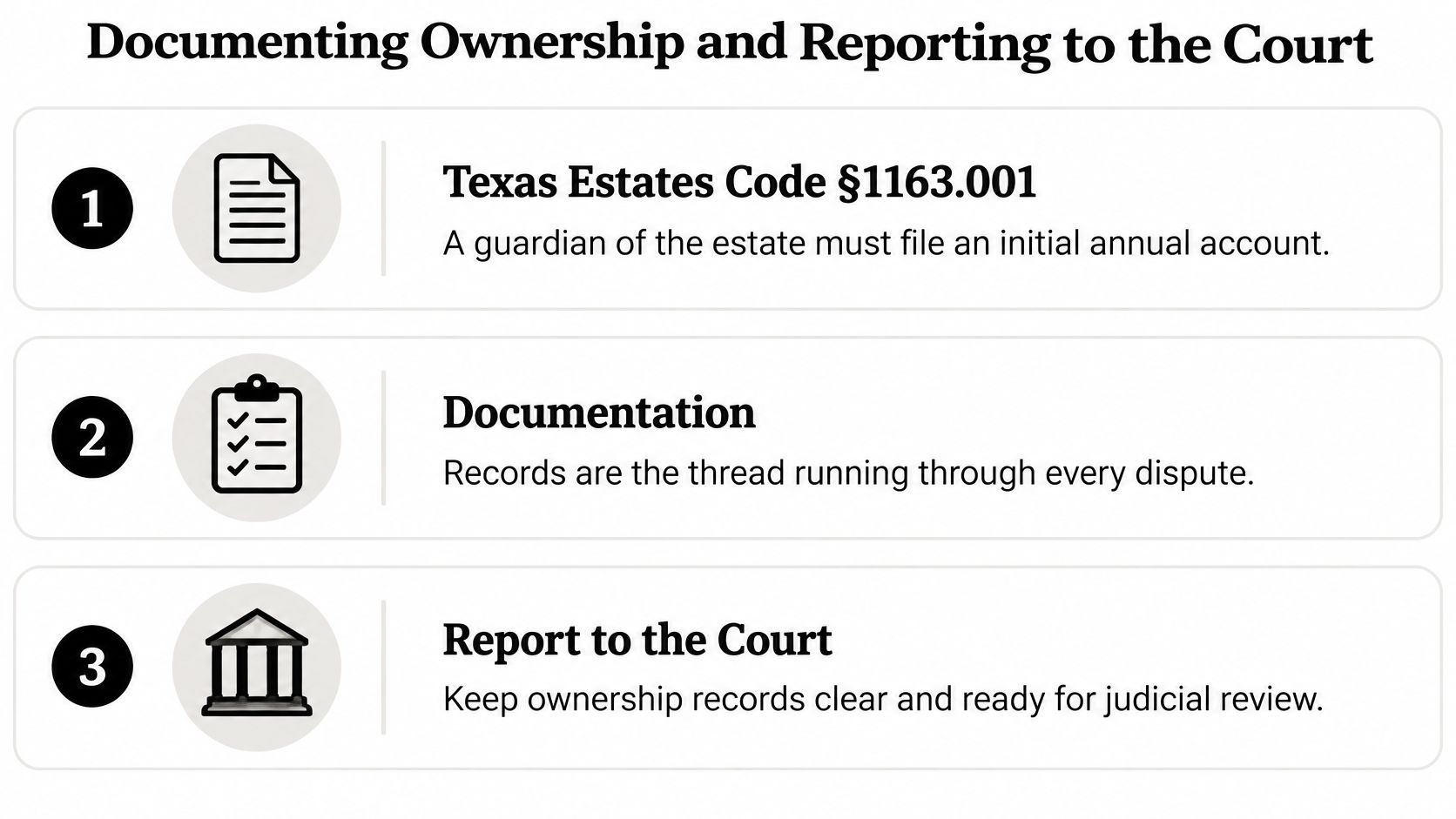
Use this checklist to organize the accounting.
Build an accounting someone else can verify
The initial annual account is due no later than the 60th day after the first anniversary of qualification, unless the court extends the deadline. Texas Estates Code §1163.001 requires the sworn account to identify property, changes in assets, receipts and disbursements, their source and nature, separate principal and income totals, and the cash balance with the depository's name and location.
Build the ledger so another person can follow each entry:
- Reconcile monthly: Compare the ledger with the complete bank statement and resolve unexplained differences.
- Identify ownership: Label deposits by source and retain the calculation showing how you determined the ward's share.
- Track transactions: Enter the date, amount, payee or source, and purpose for each receipt and disbursement.
- Carry forward the balance: Begin each accounting period with the prior balance, then add receipts and subtract disbursements.
Carry the balance forward accurately
Texas Estates Code §1163.002 requires continuing accounts to show the estate's true condition through that balance-forward calculation. For example, record a $1,200 assisted-living payment as a specific disbursement, not as an unexplained reduction in the account balance. The ledger should make the math clear from opening balance to closing balance.
The Senate Bill 2903 analysis describes requirements for official statements covering the accounting-period end date and documentation supporting claimed expenses. Keep the complete statement and supporting records together so the figures can be checked against the ledger. Download account records before an account closes or online access changes.
For additional context on these responsibilities, watch the following video.
Common Disputes and How Courts Resolve Them
A son begins writing checks after his mother's stroke. He buys groceries for her, then uses the same account to make his car payment, believing joint ownership gives him access to the entire balance.
The source of the money and the purpose of each payment guide the ownership analysis. Grocery receipts may support the claim that those purchases paid the ward's expenses. The car payment needs its own explanation, supported by evidence showing the son's ownership share or other lawful authority. The bank's acceptance of a check establishes access to the account, but it does not resolve who owned the money.
Preserve check images, account statements, and merchant details. Review each transaction separately. Some spending may have benefited the ward even if other payments are disputed, so a broad accusation can obscure what the records show.
A surviving co-owner keeps the balance
After the ward dies, a relative transfers the remaining money into a personal account. Other family members say the funds should pass through the estate.
The signed account agreement governs whether the balance passes to a surviving co-owner. Obtain the complete bank documents, including the account agreement and any related signature cards. A relative's memory of why the account was opened cannot establish its legal terms. The transfer itself also does not settle the family's competing claims.
A completed withdrawal is not a court's decision about ownership.
A divorce involves an account holding the ward's deposits
An adult child is divorcing, and the child's spouse claims the joint account as marital property. The account also holds the ward's Social Security deposits and transfers used for the ward's care.
Tracing deposits and withdrawals helps identify the ward's claimed share of a mixed account. Gather records showing where money came from and how it was used. The presence of marital funds may affect the analysis of the child's interest, while the ward's deposits and care-related transfers require separate consideration.
If a divorce proceeding is pending, coordinate the account analysis with the lawyers handling it. Property Division addresses community property, debts, and complex assets. The ward's claimed interest should be identified in the records and presented as part of the dispute.
Give counsel an organized evidence packet:
- Deposit sources: Benefit statements, payroll records, and transfer confirmations.
- Transaction chronology: Dates, recipients, purposes, and supporting documents.
- Authority documents: Account agreements and relevant court orders.
The strength of each position depends on the records supporting it. Specific transactions, account terms, and authority documents give the court a clearer basis to assess claims than general statements about who usually handled the money.
Talk to a Texas Attorney Before Money Moves
When a co-owner is draining an account, waiting can feel unbearable. Act promptly, but don't respond by moving the remaining balance into your own account without authority. Protecting the ward requires a defensible process, not a competing withdrawal.
Confirm the court file first
Before contacting anyone as guardian, check the county probate court records. Confirm whether a guardianship exists, which court holds the case, who was appointed, and whether the appointment covers the person, the estate, or both.
Request the actual order rather than relying on a sibling's description. If someone claims authority under a power of attorney, obtain that document too and have counsel evaluate it alongside the guardianship.
Then follow a focused response plan:
- Notify the bank in writing. Describe the disputed activity, provide available authority documents, request preservation of records, and ask what protective restrictions are available. Notification alone doesn't guarantee a freeze.
- Document each disputed transaction. Save statements, check images, transfer confirmations, and relevant messages. Record what happened without guessing at motives.
- Ask counsel about urgent court protection. Seek instructions from the guardianship court and discuss whether a restraining order or other protective relief is appropriate.
- File the necessary application or accounting. A person-only guardian needing financial access should obtain authority before spending. Larger or ongoing financial needs may require an estate guardianship.
Bring a usable file to the consultation
Prepare a short chronology identifying the ward, account holders, appointed guardian, disputed transfers, and unpaid care expenses. Bring the account-opening documents, current statements, appointment order, and any correspondence with the bank.
Be candid about payments you've already made. Your attorney needs the complete picture to address unauthorized transactions, missing receipts, or reimbursement questions.
The firm's Probate page describes probate administration and estate settlement services. When arranging a consultation, explain that your immediate concern involves a living ward's joint account so the appointment addresses the correct guardianship issues.
Families in Houston, Dallas-Fort Worth, Austin, San Antonio, and surrounding communities don't have to sort out these overlapping responsibilities alone. The immediate goal is straightforward: preserve the money, establish the proper authority, and keep the ward's care funded through a process the court can review.
The Law Office of Bryan Fagan, PLLC helps Texas families with guardianship, estate planning, and related family law concerns, including questions about authority over a ward's joint account. Bring your court order and bank records so an attorney can help you identify the appropriate next steps. If you need help navigating divorce, custody, or estate planning in Texas, contact The Law Office of Bryan Fagan today for a free consultation.


