Skip to content

A Texas spouse-agent's authority ends when the court signs a divorce, annulment, or void-marriage decree unless the power of attorney expressly says that authority survives. Filing for divorce alone doesn't end it.
You may already have filed papers, moved into another home, and separated your finances, yet your spouse's name still appears on the bank's authorization records. That can feel unsettling, especially if you no longer trust your spouse to handle your money. You can address the risk, but the solution involves more than waiting for the judge: you need to review the document, arrange replacement authority, and notify the people who might accept the old paperwork.
What Ends and What Continues After Divorce
Suppose you check your bank records after filing and discover that your spouse is still listed as your agent. Under Texas Estates Code §751.132, the court decree ends a spouse-agent's authority unless the document expressly preserves it, as reflected in the Texas Estates Code durable-power-of-attorney provisions.
The principal is the person who granted authority. The agent, sometimes called an attorney-in-fact, is the person authorized to act. Divorce affects the spouse's appointment, not necessarily every appointment or provision in the document.
Under §751.131, death, revocation, a termination condition in the document, or termination of the agent's authority can end the arrangement; the Texas State Law Library's durable-power-of-attorney guide explains this broader framework. A nonspouse agent, such as an adult child, business partner, or professional fiduciary, isn't removed by the spouse-specific divorce rule.
What a Texas divorce does to agent authority
| Your situation | What happens to authority | What triggers it |
|---|---|---|
| Spouse is the agent and the POA is silent | Spouse-agent's authority ends | Court decree of divorce, annulment, or void marriage |
| Spouse is the agent and the POA says authority survives | Former spouse may keep authority | Express survival language in the document |
| Agent is an adult child, partner, or other nonspouse | That agent isn't removed by the divorce | The spouse-only rule doesn't apply |
| Case is filed or spouses are separated, no decree yet | Spouse-agent retains authority unless revoked, otherwise terminated, or limited by a court | Filing, separation, and temporary orders aren't themselves the statutory termination trigger |
| Principal dies | The power of attorney ends | Principal's death |
| A successor agent is named | Successor may act in the listed order when eligible | Death, incapacity, resignation, refusal, court removal, or divorce of a spouse-agent |
Read the appointment, not just the title
A document labeled “Durable Power of Attorney” may contain customized exceptions. Don't assume that a standard-looking cover page means the language inside follows the default rule.
Look separately at who serves now, who serves next, and whether the document preserves authority after divorce. Your spouse may lose authority while your sister's successor appointment remains usable. Alternatively, a customized survival provision may leave the former spouse authorized until you take additional action.
Practical rule: Removing someone you no longer trust and appointing someone who can actually help are separate decisions.
Families with connections outside Texas should also separate Texas advice from another state's rules. For example, Olson & Sons' resource on understanding Hawaii family law rights provides context for Hawaii-related family issues, not a substitute for reviewing a Texas instrument under Texas law.
Pull your signed original now, and review it again when the decree is signed. Mark any sentence preserving authority after divorce and every successor-agent paragraph. If a survival clause exists, the decree alone hasn't erased it.
Keep your will in the same review folder. The rules for how a Texas divorce affects an existing will address a different document and shouldn't be confused with your agent's authority.
Financial Powers Medical Directives and Court Orders
Your planning documents are different keys for different doors. A financial agent may be authorized to pay a mortgage, but that doesn't make the agent your medical decision-maker.
A durable financial power of attorney concerns money, property, and business matters while you're alive. “Durable” means the authority can continue through incapacity; it doesn't mean the agent keeps serving forever or after your death.
Identify which document does which job
Which Texas document divorce changes
| Document | What the agent can do | Effect of divorce on a spouse |
|---|---|---|
| Durable financial power of attorney | Handle authorized money, property, and business matters while the principal is alive | Spouse-agent's authority ends at the decree unless the document preserves it |
| Medical power of attorney | Make authorized health-care decisions when the principal cannot decide | Review under its own terms and applicable health-care law; replace it if it no longer reflects your wishes |
| Directive to physicians | Communicate end-of-life treatment wishes | Not a financial agency and not updated by the financial POA rule |
| HIPAA release | Permit access to medical information | Doesn't itself authorize spending or treatment decisions |
| Temporary injunction in the divorce | Restrict conduct involving spending, transfers, and potentially beneficiary changes | Doesn't itself revoke the POA, although its specific terms may limit conduct |
| Guardianship of the estate | Provide a court-supervised substitute decision-maker | Can suspend agent authority; divorce doesn't automatically create a guardianship |
A hospital shouldn't treat your financial document as blanket permission to consent to treatment. Likewise, a bank shouldn't treat a medical appointment as authority to sell your house. A HIPAA release opens access to information, not a general right to make decisions.
Court restrictions aren't replacement appointments
Read the actual standing order, temporary restraining order, or injunction in your divorce case. It may prohibit a transaction that an agent could otherwise carry out under the document. Don't assume that changing an agent also gives you permission to move disputed marital assets.
Guardianship raises another issue. If you can no longer make decisions and no usable agent is available, your family may need court involvement rather than asking you to sign replacement paperwork.
Your agent also isn't your executor. Understanding the distinction between a power of attorney and an executor of a will helps family members avoid using the wrong document after a death.
The firm's Divorce representation includes contested, uncontested, and high-conflict Texas cases, where document changes should be coordinated with property-related orders.
Before changing anything, list every document by its exact name. Include beneficiary forms and medical releases, not just the financial power.
How to Revoke and Replace the Power of Attorney
A written replacement plan is usually clearer than relying on assumptions about what the divorce accomplished. Start with your ability to sign, then work through the old authority, the new appointment, and delivery.
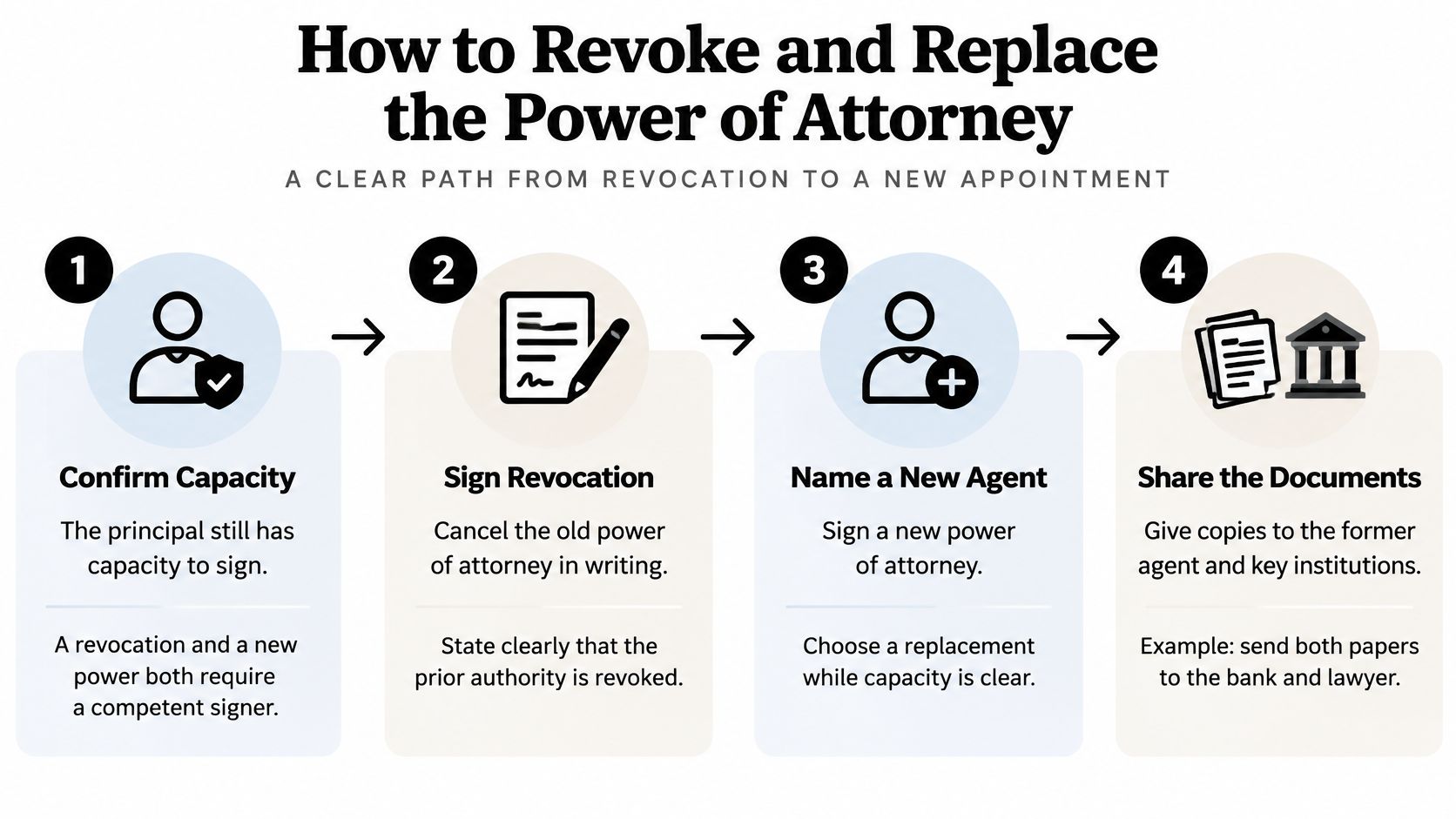
Follow a documented replacement path
Confirm capacity before signing. You must be legally capable of making the relevant decision. If memory loss, illness, medication, or another condition creates uncertainty, have counsel assess the situation rather than arranging a hurried signature.
Read the existing appointment. Identify the current agent, successor agents, survival language, and any restrictions. This prevents you from canceling useful backup authority without replacing it.
Execute a written revocation. Identify the old document by date and name the agent being removed. Illustrative wording for discussion with counsel is: I, [name], revoke the durable power of attorney dated [date] naming [spouse] as my agent, including any authority that might otherwise continue after divorce. This isn't a complete form, and counsel should clarify whether you're revoking the entire instrument or a particular appointment.
Choose a primary agent and a willing successor. Ask each person before naming them. The Texas statutory durable-power-of-attorney form allows successor agents to act alone and successively in the listed order when an earlier agent cannot serve, including when a spouse-agent's marriage ends. Someone who won't return calls or provide identification may be a poor practical choice, even if you trust them.
Execute the replacement correctly. Have counsel confirm Texas signing and acknowledgment requirements, arrange notarization, and check any real-property recording needs. Keep the original somewhere your new agent can access without depending on the former spouse.
Deliver both documents. Send the revocation and replacement to the former agent and institutions holding the old power. Ask for written confirmation that their records have been updated.
Stop if capacity has already been lost. Don't use a do-it-yourself signature to work around incapacity. Counsel should evaluate existing successor authority, guardianship, or other court relief.
Make the replacement fit your family situation
A reliable successor needs more than a name on paper. They need to know they've been appointed, where the document is, and how to use it.
Coordinate divorce counsel and estate-planning counsel so the replacement doesn't conflict with property orders. A free consultation with The Law Office of Bryan Fagan can help you identify which documents and divorce orders need to be reviewed together.
Parents should also keep financial agency separate from custody rights. If your family has a Georgia custody connection, custody guidance from Miles Hansford Law Firm offers jurisdiction-specific context; a financial-agent appointment doesn't replace a parenting order.
The Gap Between Filing and Notice
The most preventable problems often occur while everyone assumes someone else has handled the paperwork. Your lawyer may know you want your spouse removed, but your bank's authorization department may still have the old document.
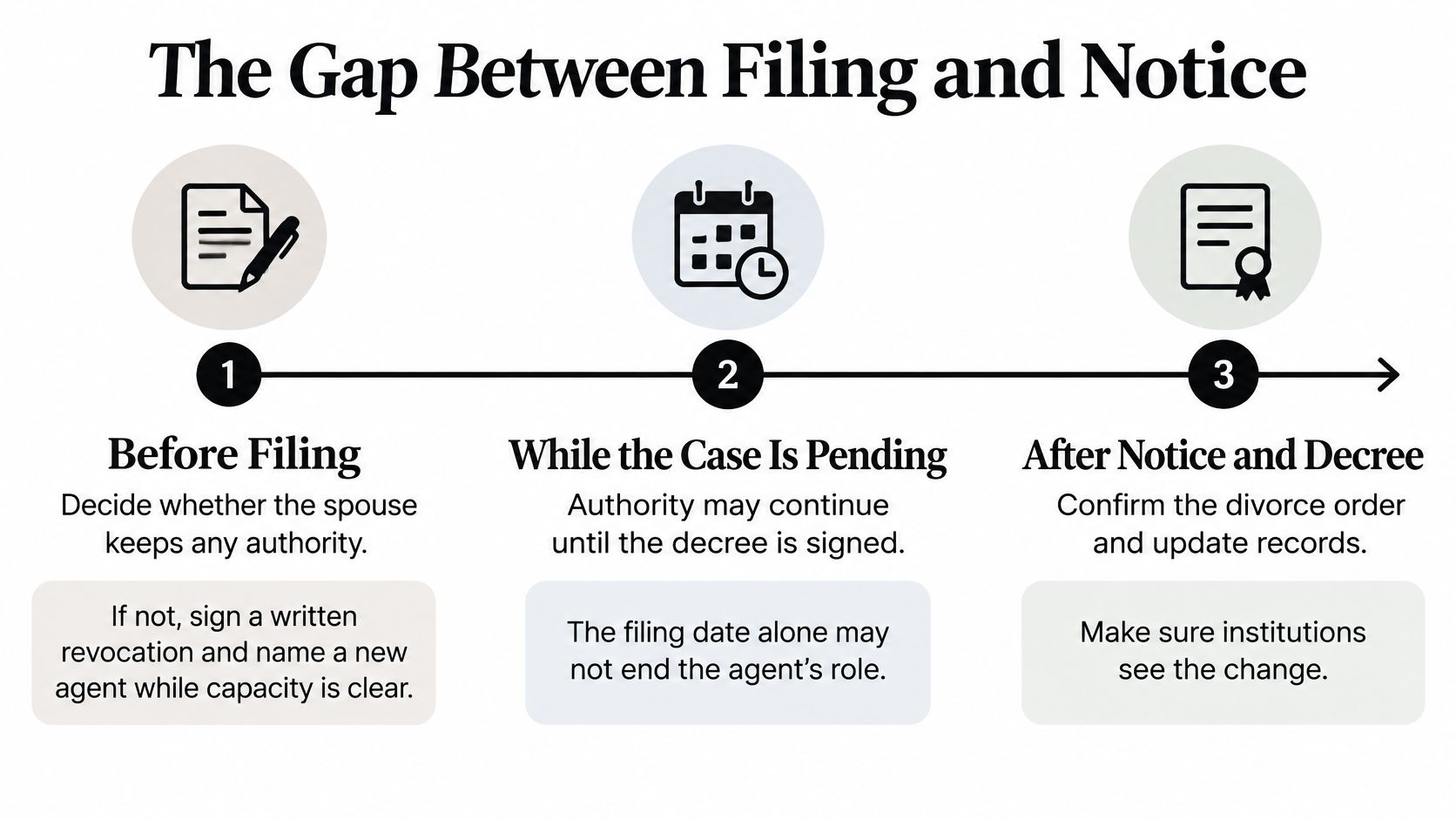
Before filing and while the case is pending
Before filing, decide whether your spouse should retain any financial agency. If not, arrange revocation and replacement while you have capacity, subject to any applicable restrictions.
During the pending case, don't confuse a restriction on conduct with cancellation of the instrument. A spouse-agent may remain named and authorized even though a court order prohibits particular transfers. Opposing counsel's knowledge isn't a reliable substitute for notice to a bank.
This is especially important if you rely on someone else for daily bill payment, manage a business, own out-of-state property, or have military deployment obligations. Removing an agent without arranging a workable replacement can interrupt necessary transactions.
The decree date and institutional notice
The decree changes the former spouse's legal authority, but institutions need information before they can update their systems. The Texas Estates Code good-faith reliance provisions protect certain actions taken without actual knowledge of termination.
Section 751.132 also addresses good-faith reliance by others without legally sufficient notice, as shown in the Texas Estates Code provisions reproduced by Justia. That protection doesn't restore the former spouse's authority, but it can affect whether a transaction binds other parties.
Build a notice packet containing the relevant decree or dissolution documentation, written revocation, and new power. Ask how to submit sensitive court documents securely and whether the institution needs a certified copy or only relevant portions.
Who to notify and what to request
| Institution | What to send | What to request |
|---|---|---|
| Bank or credit union | Decree or dissolution statement, written revocation, new power | Removal from signature cards, online access, and wire permissions, consistent with account ownership |
| Brokerage or investment firm | Same packet plus the firm's agent form | Confirmation of successor and removal of former spouse's trading authority |
| Insurer or retirement plan | Revocation and new power | Review of authority and beneficiary records |
| Mortgage servicer | Decree notice and new power | Confirmation of who may act on the loan |
| Title company with an open sale | Decree and new power before closing | Written confirmation of authorized signer and appearance requirements |
| Business registered agent or co-owner | Decree notice and new power | Review of signing authority and vendor contracts |
| Clinic or hospital with a records release | Revised medical power and release | Update of health-care agent and information-access records |
Verify completion rather than assuming receipt
Ask each institution whether it needs an agent certification, a particular form, a medallion signature guarantee for a relevant transaction, or an in-person appearance. Also ask about safe-deposit access. These aren't interchangeable procedures.
Keep delivery receipts, upload confirmations, and the name of the employee who processed the change. Revoking agency doesn't automatically remove someone's independent rights as a joint owner, borrower, or business officer.
If money has already moved, preserve statements, transfer details, messages, and signature records. Seek prompt legal advice about available court relief without assuming every transfer can be reversed.
Revocation, replacement, and notice solve different problems. Completing only one can leave your planning unfinished.
How These Rules Play Out in Real Cases
These hypothetical situations show what happens to a Texas power of attorney when the principal divorces. Each depends on a different missing document or decision, not just whether the marriage has become unhappy.

A Houston filing doesn't update a brokerage account
Say a Houston wife files in January, her husband presents an existing power at her individual brokerage in March, and the decree isn't signed until June. Assuming the instrument remains valid and no court restriction prevents the transaction, filing hasn't removed him as agent.
Her decision is whether to revoke his authority during the case rather than wait for the judge. She should have counsel review the existing orders and notify the brokerage through its authorization process.
A San Antonio successor prevents a planning gap
A San Antonio wife's statutory form names her sister as successor. Her sister is willing to serve and has the documents needed to establish authority.
A neighbor's document names only the spouse. If that neighbor suffers a stroke shortly after divorce, relatives can't add a replacement signature. The decision before finalizing the divorce is whether a willing, usable successor is in place.
An Austin survival clause changes the outcome
An Austin business owner discovers that a custom power preserves the spouse-agent's authority after divorce. The former spouse has used that document for vendor contracts.
The owner needs a deliberate revocation and replacement, not an informal handwritten deletion from a copy. Counsel should also distinguish agency authority from any separate authority the former spouse holds under company documents.
A military family needs separate property and medical reviews
A military family stationed away from Texas has named a nonspouse agent to manage a Texas rental home. That appointment doesn't disappear merely because the owners divorce.
Their medical paperwork still names the former spouse, however. The decision is to review that health-care appointment under its own rules instead of assuming the rental-property arrangement answers the medical question.
For high-conflict cases and estates involving businesses or substantial property, ask the lawyers handling your divorce to review these documents before entry of the decree. That gives you time to address signing authority without disrupting necessary operations.
Frequently Asked Questions for Texas Residents
No. Under Estates Code §751.132, filing and separation aren't the marital-dissolution trigger. A temporary order may restrict conduct, but you shouldn't treat it as an automatic revocation. Today, locate your signed power and ask counsel whether revocation is appropriate during the case.
Does the decree end the appointment automatically?
Generally, yes, unless the document expressly preserves it. Section 751.132 addresses the spouse-agent's authority when the court dissolves the marriage, grants an annulment, or declares the marriage void. Read the exact survival language today, then confirm whether your successor can establish authority without delay.
Does a temporary injunction cancel my power of attorney?
Not merely because it restricts spending or transfers. Divorce orders and the Estates Code's financial-agency rules perform different jobs. A particular order may limit an agent's actions, so its wording matters. Give your lawyer both the injunction and the power today, rather than interpreting either in isolation.
Does divorce end my spouse's medical power?
Don't assume the financial rule answers that question. Medical appointments are governed separately from the Estates Code financial-power provisions, and their terms and applicable health-care law require review. If your spouse shouldn't make care decisions, address that document directly. Today, obtain the copy held by your doctor and arrange an updated appointment.
Can a former spouse's signature still bind a bank after the decree?
A good-faith transaction may receive statutory protection. The Estates Code's reliance protections can matter when an institution lacks legally sufficient notice or actual knowledge of termination. That doesn't give the former spouse permission to keep acting. Send written notice today and preserve records if you suspect an unauthorized transaction.
Update the Rest of the Plan and Get Help
A corrected power of attorney won't resolve every estate-planning mismatch. Your will may no longer benefit your former spouse while an insurance or retirement beneficiary form still lists that person.
Under Texas Estates Code Chapter 123, divorce generally causes will provisions involving a former spouse, or certain relatives of the former spouse who aren't related to you, to operate as though that person failed to survive you, unless the will provides otherwise. The chapter also addresses revocable-trust provisions benefiting or appointing a former spouse, subject to exceptions involving court orders, trust terms, or marital-property agreements.
Don't rely on automatic cleanup
Those rules don't rewrite every beneficiary form. Retirement benefits and insurance can involve separate governing law, and you shouldn't assume the will controls them.
Review the following with the applicable account or document in hand:
- Beneficiary designations: Confirm life-insurance and retirement-plan records.
- Ownership and transfer documents: Review deeds, transfer-on-death arrangements, and payable-on-death accounts.
- Fiduciary appointments: Check trustees, executors, financial agents, and medical decision-makers.
The guide to documents to update after a Texas divorce decree can help you organize that review. If someone has already died, ask about probate administration before anyone tries to act under the deceased person's power of attorney.
Make the documents match your present wishes
If a spouse remains on a financial or medical appointment you no longer want, arrange the appropriate revocation and replacement while capacity is clear, then notify the relevant institutions. Have counsel check property-division orders before changing ownership or beneficiaries. You don't have to solve every document at once, but you do need a coordinated plan rather than treating the decree as a complete estate cleanup.
The firm offers Texas divorce representation and estate-planning guidance to help coordinate agent appointments, successor authority, and post-divorce document updates. Visit Law Office of Bryan Fagan, PLLC to discuss how your existing power of attorney fits your current situation. If you need help navigating divorce, custody, or estate planning in Texas, contact The Law Office of Bryan Fagan today for a free consultation.