 Skip to content
A Texas post-divorce document review typically spans roughly 15 to 25 separate documents, and the final decree is only the starting point. Promptly review beneficiary forms, deeds, insurance policies, powers of attorney, estate documents, and financial accounts, while checking the decree before changing any court-ordered obligation.
You may be holding a signed final decree and still have your former spouse listed on a retirement account, life insurance policy, bank account, deed, or medical authorization. That doesn't mean the decree has no legal effect. Texas law can revoke or limit certain rights after divorce, but institutions often rely on their own records and forms, and a court order may require you to preserve an obligation rather than cancel it.
The most reliable approach is an eight-part review organized around the documents and institutions that control ownership, authority, beneficiary rights, insurance obligations, and medical or guardianship decisions. Start by preserving the decree and obtaining multiple certified copies. Then update authority and ownership records, confirm insurance compliance, and create written proof of every change.
Texas Family Code and Estates Code rules can be fact-specific, particularly when children, retirement plans, real estate, trusts, business interests, or a QDRO are involved. The examples below explain what the decree may address, what you must separately update, and when legal review is prudent. You'll also find practical language for contacting institutions and links to Texas divorce, custody, estate planning, and probate resources.
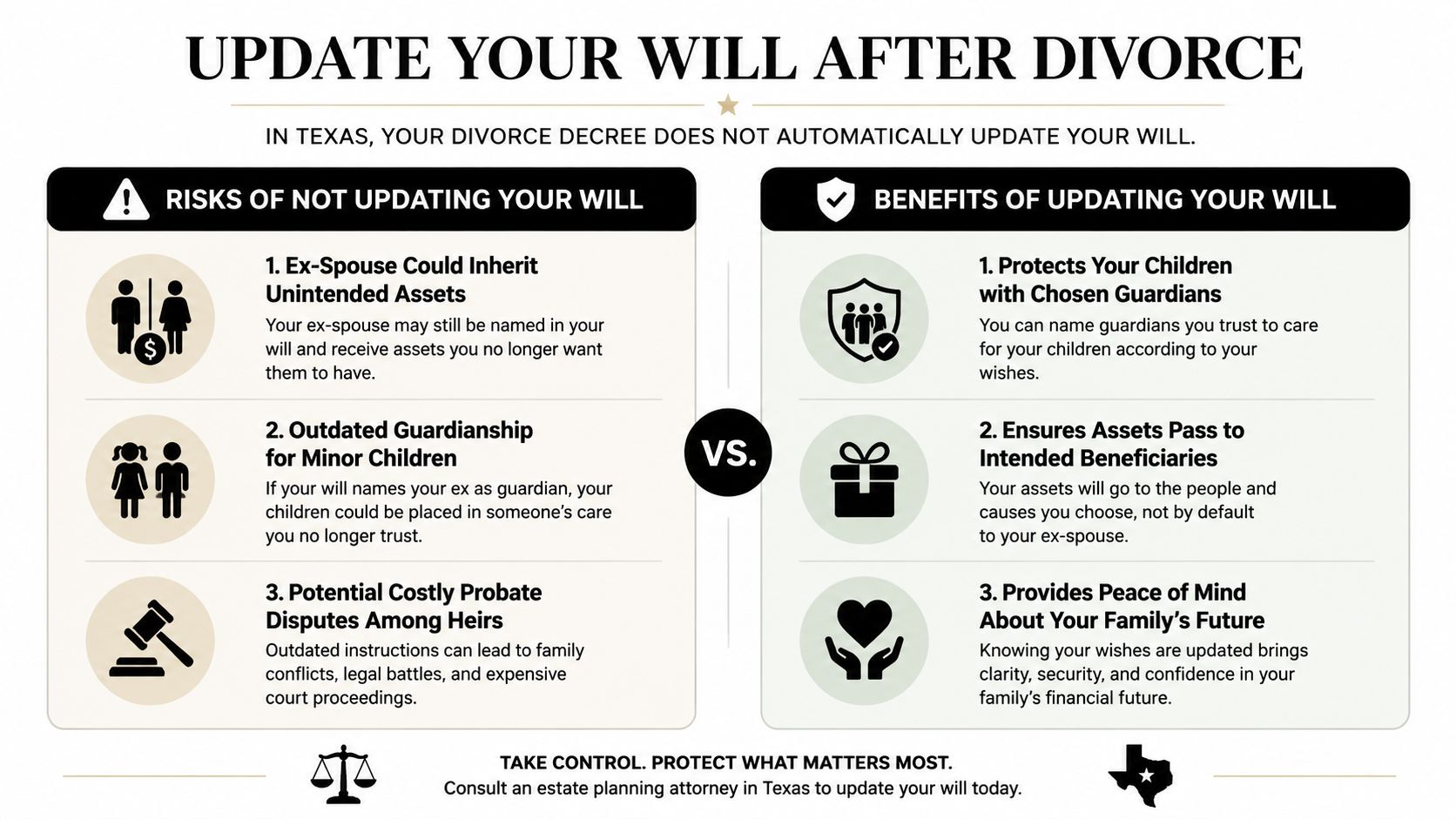
1. Update Your Will and Testament
Divorce changes the people you trust with your estate, even when the final decree addresses property division. Texas Family Code § 2.609 may revoke certain provisions benefiting a former spouse, but automatic protections aren't a substitute for a new estate plan. A revised will can name the executor, trustee, guardian, and beneficiaries who reflect your present wishes.
Begin by reading the decree alongside your current will. If your former spouse is named as executor, beneficiary, trustee, or guardian, decide who should replace that person and whether your children should inherit directly or through a trust. A parent with minor children may want a carefully selected guardian and successor guardian, while a business owner may need provisions that protect continuity rather than leave ownership decisions unclear.
Texas Estates Code § 2.001 addresses the basic execution requirements for a written will, including signing and witnessing. Your new document should be prepared and executed with those requirements in mind, and the original should remain in a secure location. A revocable living trust may supplement or, in some circumstances, replace parts of a will, but it must be coordinated with account titles and beneficiary designations.
Practical rule: A will controls assets that pass through probate. It generally doesn't control an account that passes under a beneficiary form, so update both documents.
A sound post-divorce file should include the original will, a copy for the chosen executor, and notes identifying related trusts, insurance policies, and retirement accounts. You can also review the firm's pour-over will guidance for Texas when deciding how a trust and will should work together. If the divorce itself still involves unresolved issues, Divorce representation may be relevant for contested, uncontested, or high-conflict cases.
2. Revise Beneficiary Designations on Life Insurance and Retirement Accounts
A will may say one thing while a retirement plan or life insurance policy says another. These accounts commonly pass outside probate, and the provider generally looks first to the beneficiary designation it has on file. That makes beneficiary forms one of the highest-priority documents to review after the decree is signed.
Texas Family Code § 9.302 generally addresses certain pre-divorce designations naming a former spouse on an IRA, employee stock option plan, or other savings, bonus, profit-sharing, or employer plan. The designation may remain effective if the decree names the former spouse, the account holder redesignates that person after divorce, or the designation benefits a child or dependent. Otherwise, the benefit may pass to an alternate beneficiary or back to the designating former spouse, depending on the circumstances.
Federal rules add an important limitation. For retirement plans governed by ERISA, including many employer-sponsored plans, a fresh beneficiary form submitted directly to the plan administrator is generally necessary. The IRS explains that a divorced participant may need to contact the employer or administrator, complete the required forms, and provide a divorce decree if requested. The IRS also states that, for required minimum distribution purposes, a beneficiary change is effective in the year following the year of death or divorce. See the IRS divorce and retirement plan guidance for the administrative process.
Contact each provider separately and request written confirmation. Include 401(k), 403(b), IRA, Roth IRA, SEP IRA, SIMPLE IRA, pension, employer stock, ESOP, deferred compensation, and life insurance records. A trust may be appropriate when minor children need controlled distributions, but that decision should be coordinated with the estate plan.
For insurance-specific background, review this explanation of spouse life insurance and voluntary coverage. Don't assume the decree alone will update a plan administrator's records.
3. Update Deed and Property Titles
A divorce decree can award a home, rental property, or land, but the decree usually isn't the document that changes the county's real-property title record. Texas guidance explains that a separate deed generally must be prepared and recorded with the county clerk where the property is located. This distinction matters when you sell, refinance, insure, or later transfer the property.
Texas Family Code § 3.002 provides the community-property framework for property acquired during marriage, while the decree determines the division in the particular case. If the decree awards the residence to you, review whether it also requires a deed, assumption, refinance, or payment to the other spouse. A title company or Texas-licensed attorney can prepare language that matches the decree and the existing title history.
A homeowner in Harris County may receive the family home in the decree but still need a deed removing the former spouse from title. A rental-property owner in Bexar County may need a separate recorded instrument before managing, refinancing, or selling the property without title confusion. The correct county is the county where the real estate is located, not necessarily the county where you live.

The decree may establish who was awarded the property. The recorded deed helps establish what the public title record says.
Before contacting a lender, obtain a certified decree, have the deed prepared, record it, and request a certified copy of the recorded instrument. Notify the mortgage lender and update homeowners or landlord coverage. For related estate planning, review the firm's Texas transfer-on-death deed resource. A transfer involving a divorce may also require title, mortgage, and tax review, so avoid signing an unfamiliar deed without professional guidance.
4. Modify Guardianship and Healthcare Decision-Making Documents
Parents often focus on custody orders and overlook the documents that operate if a parent dies or becomes incapacitated. The divorce decree controls the custody and possession arrangement during the parents' lives, but wills, guardianship nominations, healthcare powers of attorney, directives, and HIPAA authorizations still need to reflect the people you trust now.
Texas Family Code § 153.132 addresses a parent's rights and duties in conservatorship matters. Your decree may establish the current parenting arrangement, but a guardianship nomination in a will should identify a preferred guardian and successor guardian consistent with that arrangement. It can also explain your wishes without attempting to override the court's custody order.
Healthcare authority is separate from custody. If your former spouse was named as your healthcare agent, execute a new healthcare power of attorney and deliver it to the new agent and relevant providers. Texas Health and Safety Code § 166.152 governs medical powers of attorney, and healthcare directives should be executed using the formalities applicable to the document. A separate HIPAA authorization may also be needed because providers maintain their own access records.
Consider this scenario. A parent names a trusted sister as successor guardian, designates an adult daughter as healthcare agent, and separately tells the children's providers which relatives may receive medical information. That coordinated approach is more reliable than assuming the divorce decree will update every medical file.
Your review should include:
- Custody alignment: Read the decree before drafting guardianship language so the documents don't conflict with current conservatorship terms.
- Agent replacement: Remove the former spouse from healthcare authority and name someone willing and able to serve.
- Provider delivery: Give updated documents to agents, physicians, hospitals, and children's healthcare providers.
- Privacy review: Update HIPAA authorizations separately when a provider requires its own form.
The firm's health directives and living wills guidance can help you identify which healthcare documents should be reviewed together.
5. Update Financial Powers of Attorney and Agents
A financial power of attorney gives another person authority to act for you. Depending on its wording, the agent may handle bank transactions, sign documents, manage investments, deal with real estate, and perform other financial tasks. If your former spouse remains listed, don't rely solely on the divorce decree to protect you from every institutional or practical problem.
Texas law addresses powers of attorney through the Estates Code, including provisions governing execution, acceptance, and revocation. The document must be reviewed on its own terms. Some spousal authority may end after divorce, but banks, investment firms, and other institutions may still request a revocation notice or a replacement document before changing their records.
Prepare a written revocation of prior powers of attorney and send notice to institutions that received the old document. Then execute a new power of attorney naming a trusted agent and, preferably, a successor agent. The new document should answer a practical question: does the agent have broad authority, or should major transactions and business decisions be limited?
A business owner might replace a former spouse with a chief financial officer for routine business transactions while limiting authority to sell company assets. A single parent might select a close friend to manage household funds for the children if incapacity occurs. Those choices require more precision than writing “my agent may handle everything.”
A replacement power of attorney is only useful if the institutions that hold your accounts know it exists.
Give copies to banks, brokerages, employers, and the new agent. Keep the original securely and tell the agent where it can be found. If you're uncertain whether the existing power of attorney was revoked, accepted, or used for a significant transaction, obtain legal review before relying on it.
6. Review Divorce Decree Insurance Obligations
Insurance is the category where acting too quickly can create a legal problem. A divorce decree may require life insurance to secure child support or spousal maintenance, health insurance for children, or other coverage connected to shared property. You must read those provisions before canceling a policy or removing a beneficiary.
Texas Family Code § 154.016 permits a court to order life insurance to secure child support. The decree may identify the policy amount, beneficiary arrangement, trustee, proof obligations, or duration. Even if you've remarried or changed employers, the obligation may continue until the order is modified or ends under its terms.
Start by locating policy declarations, beneficiary confirmations, employer benefit records, and any court language about insurance. If coverage changes because of job loss, retirement, relocation, or a change in available group insurance, document the change immediately. You may need to pursue a modification rather than choosing a replacement policy on your own.
A parent required to maintain coverage for the children may keep the policy after remarriage because the obligation protects the children, not the new household. Another parent who loses employer coverage may need a modification addressing the new insurance options. In either situation, written proof matters.
Use this sequence:
- Read the order: Identify every required policy, beneficiary, insured person, and proof deadline.
- Confirm current coverage: Request declarations and beneficiary records from the carrier or employer.
- Report material changes: Notify counsel and evaluate whether a modification is necessary.
- Preserve compliance evidence: Save policy documents, premium records, and communications.
- Address noncompliance: If your former spouse fails to maintain required coverage, document the failure before seeking enforcement.
Don't cancel court-ordered insurance without court permission or legal advice. A violation may lead to enforcement or contempt proceedings, depending on the facts and the order.
7. Update Bank Accounts, Investment Accounts, and Payroll Beneficiaries
Ordinary financial accounts deserve a separate review from retirement accounts and life insurance. Checking and savings accounts, money market accounts, certificates of deposit, brokerage accounts, employer benefits, accumulated leave, and payroll records can all contain ownership or beneficiary instructions that don't change when the decree is signed.
A joint account with survivorship rights may transfer directly to the surviving account holder. A payable-on-death or transfer-on-death designation may also control distribution outside probate. The practical question isn't only whether your former spouse has been awarded an account. It's whether the institution's current ownership and beneficiary records match that award.
Create an inventory by institution rather than by asset type. List every bank, credit union, investment firm, employer, payroll department, and benefits administrator. Then request current ownership records and beneficiary forms. If an account is jointly owned, ask what is required to close, divide, retitle, or transfer it under the decree.
For example, a brokerage account awarded to one spouse may still carry joint ownership until the firm processes its transfer paperwork. A payroll department may still list a former spouse for death benefits or unused leave. A certificate of deposit may require special handling because early closure or retitling can affect the account terms.
- Separate access: Remove former-spouse online access, signing authority, and account permissions where appropriate.
- Retitle ownership: Convert joint accounts to individual ownership or use POD or TOD designations consistent with the estate plan.
- Coordinate beneficiaries: Make bank, brokerage, employer, insurance, and retirement forms consistent.
- Keep confirmation: Save dated letters, submitted forms, and institution-generated confirmations.
Texas guidance emphasizes that post-decree updates happen document by document. The Texas State Law Library also notes that certified divorce decree copies are often needed for post-divorce records and changes, so obtain multiple copies early and avoid sending your only certified copy to an institution.
8. Revise Property and Casualty Insurance Policies and Coverage
Homeowners, auto, landlord, umbrella, and related casualty policies may still list your former spouse as a named insured, additional insured, loss payee, or person with an ownership interest. These designations can affect who receives claim information, who may make a claim, and how a lender or insurer evaluates the policy.
Compare each policy with the property division section of the decree. If you retained the home, vehicle, or rental property, ask the carrier to update the named insured and ownership information. If a mortgage lender requires proof of insurance, send the revised declarations page after the change is processed.
A homeowner who received the family residence may need to remove a former spouse from the policy while keeping the lender's interest correctly listed. A parent who retained one vehicle should confirm that the vehicle title, garaging address, drivers, and policy ownership all match. A rental-property owner should review landlord coverage rather than assuming a former spouse remains entitled to claim proceeds.
The process should be written and institution-specific:
- Home coverage: Update the insured owners, occupancy information, mortgagee, and loss-payee details.
- Auto coverage: Remove vehicles and drivers no longer connected to your household.
- Rental coverage: Confirm the landlord policy reflects the current owner and property manager.
- Umbrella coverage: Reassess insured people, properties, and liability exposure.
- Documentation: Request written confirmation and retain updated declarations pages.
Insurance changes should not contradict a court-ordered obligation. If the decree requires coverage for a child, former spouse, or property-related interest, ask the carrier and your attorney how to structure the policy correctly rather than deleting a name without review.
8-Item Comparison: Documents to Update After a Texas Divorce
| Item | Implementation Complexity 🔄 | Resource Requirements ⚡ | Expected Outcomes ⭐📊 | Ideal Use Cases 💡 | Key Advantages |
|---|---|---|---|---|---|
| Update Your Will and Testament | 🔄 Medium, legal review, signing & witnesses | ⚡ Moderate, attorney fees, notarization, secure storage | ⭐ High clarity; 📊 ensures assets & guardianship follow current wishes | After divorce with changed family/beneficiary priorities | Prevents ex inheritance; designates new executor/guardians; reduces probate disputes |
| Revise Beneficiary Designations on Life Insurance & Retirement Accounts | 🔄 Low, form submissions to institutions | ⚡ Fast, contact HR/plan administrators; few fees | ⭐ Direct control; 📊 bypasses probate for substantial assets | Any retirement, IRA, 401(k), or life policy naming an ex | Quick, low-cost changes; ensures proceeds go to intended beneficiaries |
| Update Deed and Property Titles | 🔄 High, deed preparation and county recording | ⚡ Slower, attorney/title company, recording fees, processing time | ⭐ Secure ownership; 📊 improves marketable title and refinancing options | You retained real estate or plan to refinance/sell | Removes ex-spouse claims; simplifies future transactions; clean title for heirs |
| Modify Guardianship & Healthcare Decision Documents | 🔄 Medium, multiple documents, notarization/witnesses | ⚡ Moderate, attorney, notarization, deliver copies to providers | ⭐ Protects decision-making rights; 📊 clarifies emergency authority for children | Minor children or when ex had prior medical/guardian authority | Prevents ex from making medical or custody decisions; clarifies HIPAA access |
| Update Financial Powers of Attorney & Agents | 🔄 Medium–High, revoke and re-execute durable POAs | ⚡ Moderate, notary, bank acceptance, attorney involvement | ⭐ Blocks ex financial access; 📊 avoids guardianship proceedings | Ex named as financial agent or if significant assets/business interests exist | Restores financial control to trusted agent; specifies limits and successors |
| Revise Divorce Decrees Affecting Insurance Obligations | 🔄 High, may require court modification or enforcement | ⚡ Slow, attorney, court filings, proof of material change | ⭐ Enforceable obligations; 📊 preserves child support/security measures | Court-ordered life/health insurance or when coverage availability changes | Maintains court-ordered protections; avoids contempt and enforcement issues |
| Update Bank Accounts, Investment Accounts & Payroll Beneficiaries | 🔄 Low–Medium, numerous accounts to update | ⚡ Generally fast per account but time-consuming overall | ⭐ Ensures liquid assets go to intended heirs; 📊 avoids JTWROS surprises | Joint accounts, payroll death benefits, POD/TOD arrangements | Quick forms prevent inadvertent transfers; preserves liquidity for beneficiaries |
| Revise Property & Casualty Insurance Policies & Coverage | 🔄 Medium, coordinate with agents, lenders, insurers | ⚡ Moderate, agent communications; possible lender approvals | ⭐ Aligns proceeds with ownership; 📊 reduces claim disputes and premium issues | Properties or vehicles retained by one party; ex still named on policies | Removes ex as named insured/loss payee; updates coverage to new asset values |
Finish the Review With Proof and Legal Guidance
The safest completion sequence is straightforward, but it requires discipline. Keep the certified final decree in a secure file, obtain multiple certified copies, and inventory every account, policy, deed, will, trust, power of attorney, healthcare document, employer benefit, and beneficiary form. For each item, identify whether the next step requires a provider form, a recorded deed, written notice, a replacement legal document, or a court filing.
Save proof in one secure record. That record might include the submitted form, confirmation email, updated declaration page, recorded deed, new will information, and the name of the institution employee who handled the change. A document isn't fully updated merely because you mailed it. Confirm that the institution processed it and that the new record is accurate.
The Texas State Law Library explains that a name-change request included in a divorce petition may be ordered in the final decree when the person seeks to return to a prior legal name. The decree doesn't authorize a brand-new name, and the person must still update records such as a driver's license, Social Security card, and passport. The Texas State Law Library's after-divorce guidance also supports treating identity, financial, and property records as separate administrative tasks.
For privacy-sensitive identity updates, the U.S. State Department explains that a divorce decree can support a passport name change, but an applicant may need to apply in person if the proof is unavailable or incomplete. Texas guidance also discusses a Name Change Certificate under Texas Family Code § 45.106, which may offer a narrower form of proof than distributing a complete decree containing sensitive financial or custody details. The divorce record itself is obtained from the district clerk in the county where the divorce was finalized, as described in the Texas name-change guidance.
Seek Texas family-law or estate-planning advice when the decree is unclear, property remains jointly titled, a retirement plan or QDRO is involved, a minor child is a beneficiary, a business interest is affected, compliance is contested, or changed circumstances require modification or enforcement. Don't cancel court-ordered insurance, alter custody-related arrangements, or assume an automatic revocation resolves every beneficiary or agency issue. Retirement systems may require a certified decree on file before a death benefit is paid, and employer plans may require a new form regardless of what state law says.
You can review the firm's contested divorce representation when post-decree compliance involves disagreement, and connect with appropriate Texas family-law, custody, child-support, estate-planning, or probate counsel when the issue crosses practice areas. A legal document generator may help you organize questions or records, but it shouldn't replace legal review where a court order, beneficiary right, title transfer, or fiduciary authority is at stake.
If you need help navigating divorce, custody, or estate planning in Texas, contact The Law Office of Bryan Fagan today for a free consultation.
The Law Office of Bryan Fagan, PLLC helps Texas clients review post-divorce obligations, update estate-planning documents, and address custody, property, insurance, and enforcement concerns. Visit Law Office of Bryan Fagan, PLLC to request a free consultation and discuss which institutions and documents require attention in your situation.


