
A pour-over will is a legal safety net designed to catch any assets you forgot to put in your living trust, ensuring they go where you intended after you pass away. In Texas, it must be signed by the testator and witnessed by two credible witnesses who are at least 14 years old, and it must be filed for probate within four years of death to work as intended.
You may be here because you already created a living trust and want to make sure nothing slips through the cracks. Or maybe you've heard the phrase “pour-over will” and it sounds technical, expensive, or easy to get wrong. That reaction is completely understandable.
Estate planning can feel heavy because it asks you to think about your family, your property, and hard future questions all at once. But this particular tool is easier to understand than it sounds. When explained clearly, a pour-over will becomes less of a mystery and more of a practical backup plan for the people and property you care about most.
Planning Your Legacy Can Feel Overwhelming
If you've ever worried about forgetting an account, buying a car after your trust is signed, or leaving your family with a mess to sort out, you're not overthinking it. Those are exactly the kinds of problems a pour-over will is meant to address.
A pour-over will works like a backup basket. If an asset is still in your individual name when you pass away instead of being titled in your living trust, the will directs that asset into the trust so the trust's instructions can control what happens next.

That matters for more than bank accounts and deeds. Families often value personal property highly too. If you're thinking about sentimental items like jewelry, military keepsakes, family Bibles, or handwritten letters, My Book Written's heirloom insights offer a thoughtful perspective on why these objects carry emotional weight and deserve careful planning.
Why people get confused
Many Texans hear “trust” and assume that once a trust exists, everything is automatically covered. That isn't how it works. A trust only controls assets that were properly transferred into it or otherwise aligned with it.
That's where anxiety starts. You can do most things right and still miss something.
Practical rule: A living trust is your main plan. A pour-over will is the backup plan that helps protect your original intent.
Where this becomes real in everyday life
A common example is a family that signs trust documents, transfers the home, and updates major accounts. Then life happens. Someone opens a new savings account, inherits property, refinances, or buys a vehicle. If that asset never gets tied into the trust plan, it can create an unexpected gap.
Texas law gives you a way to close that gap, but only if the document is prepared and signed correctly. The details matter. So does timing. And if divorce, remarriage, or changing beneficiaries are part of your situation, the planning needs even more care.
What Exactly Is a Pour-Over Will in Texas
A pour-over will in Texas is a will that names your revocable living trust as the recipient of assets left outside the trust at death. Instead of listing several people who inherit directly under the will, the document points those leftover assets into the trust so the trustee can distribute them under one unified set of instructions.
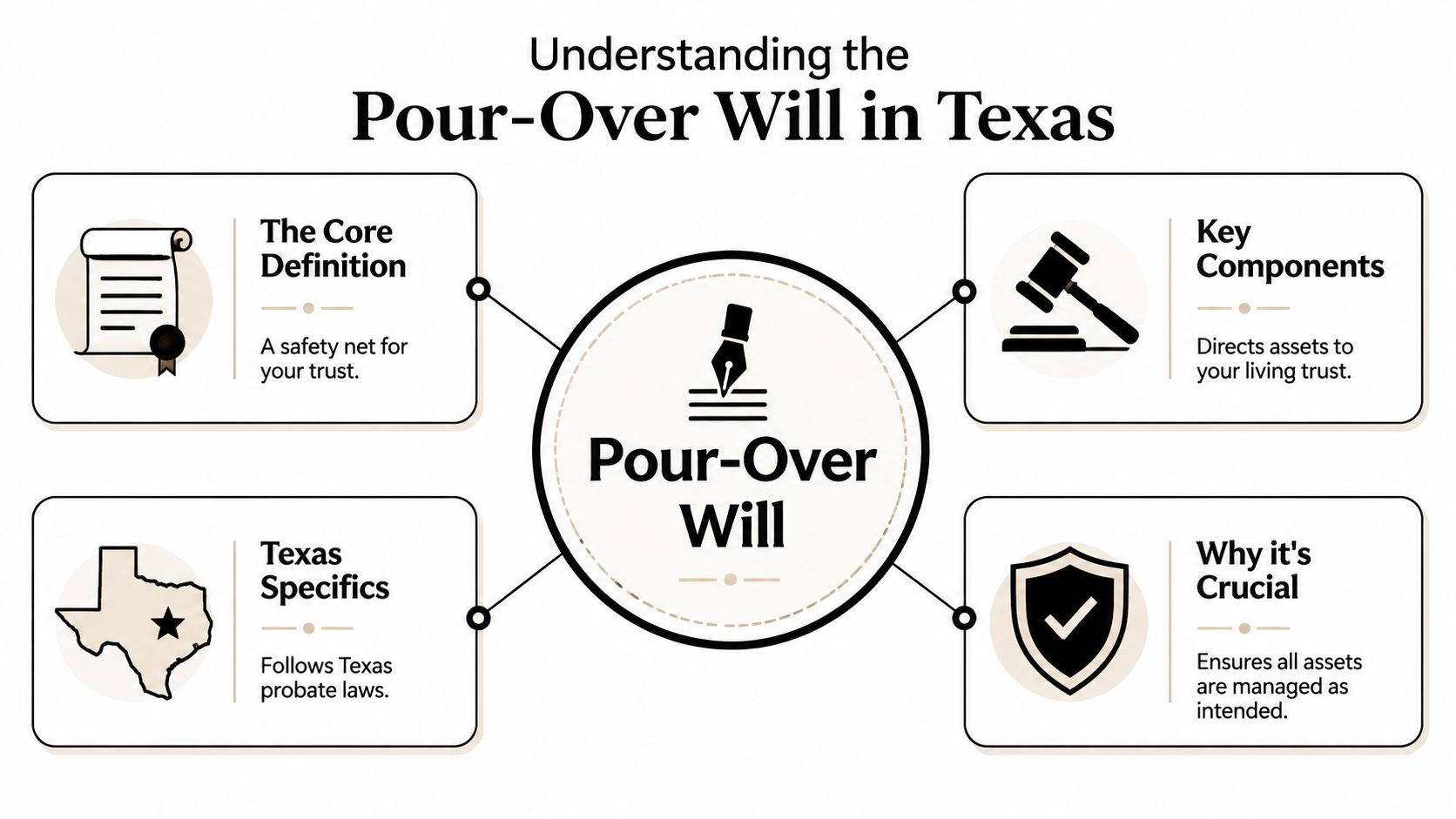
That's the heart of the pour over will Texas concept. It is not a separate plan competing with your trust. It works with your trust.
The legal foundation in Texas
Under Texas Estates Code Section 251.051, the document must meet Texas will-signing requirements to be valid. The testator must sign it, and two credible witnesses who are at least 14 years old must also sign in the testator's presence.
This age rule surprises many people. In many places, people assume witnesses must be adults in the usual sense. Texas is different here, and that difference can matter if a family signs documents casually without legal guidance.
Here's the key legal point in plain language:
If the execution requirements aren't met, the pour-over will can fail, and assets left outside the trust may pass under Texas intestacy rules instead of under the trust's instructions.
What the document actually does
A pour-over will does one specific job. It catches property not already in the trust and sends it there after death through the probate process.
Examples often include:
- A forgotten account that stayed in your personal name
- Real estate that was never retitled to the trust
- Unexpected proceeds that arrive after death
- Personal property you meant to include in your overall plan
This is one reason families often consider broader Estate Planning work. Wills, trusts, and estate plans protect assets and wishes, but they only work smoothly when the documents fit together.
A helpful way to think about it
A standard will acts like a direct delivery list. It says who receives probate assets from the estate itself.
A pour-over will acts more like a transfer slip. It sends the probate assets into the trust, and then the trust rules decide who receives what, when, and under what conditions.
Later in this guide, that distinction becomes important in two places many online articles skip: divorce-related disputes and outdated trust beneficiary designations.
A short visual explanation can help make that relationship easier to understand:
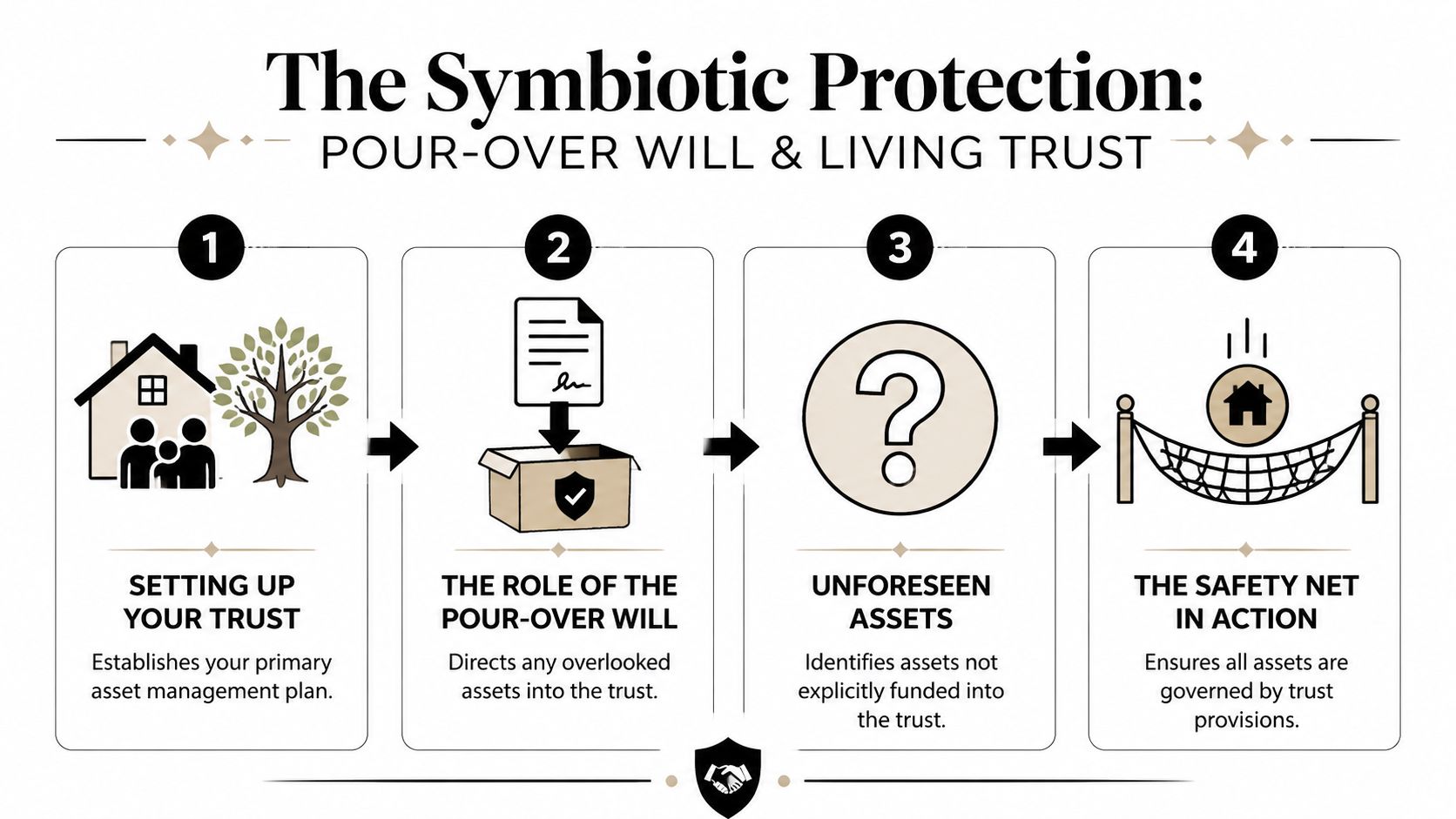
How a Pour-Over Will Protects Your Living Trust
A living trust is often built to create one set of instructions for your estate. You may want staggered distributions for a young adult, management for a beneficiary who isn't ready to handle money alone, or special handling for a loved one with extra needs. That planning only works fully if your assets end up inside the trust structure.
A pour-over will protects that structure when life leaves loose ends.
A family example
Consider a married couple in Texas who set up a trust and transfer their home and investment accounts into it. A year later, one spouse buys a vehicle and opens a new checking account. The paperwork for those newer assets never gets tied back to the trust.
If one spouse dies, those assets may not automatically follow the trust terms just because the trust exists. The pour-over will serves as the legal bridge that directs those probate assets into the trust.
That's why trust funding and backup planning belong together. If you want a practical look at the setup process, this guide on setting up a trust in Texas can help you understand how the pieces fit.
Why this matters in Texas
Approximately 40% of Americans die without a will, and in Texas, without a pour-over will, assets that weren't retitled into the trust can be distributed under intestacy law rather than under the trust plan. That can include a newly purchased vehicle or an unexpected inheritance. The result is a mismatch between what you intended and what the law defaults to.
The trust may contain thoughtful terms about timing, protection, and management. But if an asset never reaches the trust, those instructions may never apply to that asset.
What the safety net really catches
People often assume the missed assets will be unusual or trivial. Sometimes they are. Sometimes they aren't.
A pour-over will may catch:
| Missed asset | What can go wrong without the will |
|---|---|
| New bank account | It may pass outside the trust plan |
| Recently acquired vehicle | It may be handled as part of the probate estate without trust direction |
| Unexpected inheritance | It may land in an individual name and miss the trust structure |
| Unretitled real estate | It may require probate without the trust controlling final distribution |
A good trust plan isn't just about drafting. It's about making sure overlooked assets still arrive where they were supposed to go.
That's the practical value of a pour-over will. It doesn't replace careful planning during life. It protects your planning when real life gets in the way.
Understanding Probate and Your Pour-Over Will
One of the biggest misunderstandings about a pour-over will is the idea that it avoids probate. It doesn't. In fact, the pour-over will uses probate as the legal pathway to move unfunded assets into the trust.
That's not a flaw. It's how the tool is designed.
The common misconception
If an asset is still in your name alone at death, the court process may be required before that asset can be transferred into the trust. The will gives the executor authority to present the document to the probate court, have it admitted, and then transfer the covered property to the trust.
So the better way to think about a pour-over will is this: it doesn't erase probate for those assets. It helps probate accomplish the transfer you intended.
What stays public and what stays private
This distinction matters to many families. The probate estate becomes part of the public record, but the trust itself remains private. That means the court sees the will and probate filings, while the detailed trust terms controlling later management and distribution are typically handled within the private trust framework.
For many clients, that creates a practical balance. The public court process handles the transfer. The trust then governs the more personal instructions.
If your family may be facing this court process soon, the firm's overview on how to probate a will in Texas gives a useful starting point for understanding the steps involved.
The deadline many families miss
Texas law requires the pour-over will to be filed for probate within four years of the testator's death to be admissible. There's another practical reason not to delay. In Texas estate planning, benchmarks indicate that for every $1 million in assets, about 5-10% may remain unretitled at death. That's exactly the slice of the estate this process is designed to catch.
Here's a simple breakdown:
- Main trust assets are those already titled into the trust during life
- Residual assets are the ones still outside the trust at death
- Probate transfer is the mechanism that moves those residual assets into the trust
- Trust administration begins once the assets are inside the trust
The goal is not to send everything through probate. The goal is to make sure anything left outside the trust still ends up under the trust's instructions.
When probate help becomes important
If the executor is grieving, family members disagree, or property records are incomplete, even a well-written pour-over will can become harder to administer. Some families need support with the court filing itself, while others need help coordinating the executor's role with the trustee's responsibilities.
That's where Probate work becomes relevant in a factual, practical sense. Probate administration and estate settlement in Texas often intersect with trust planning, especially when a pour-over will is involved.
Creating a Valid Pour-Over Will in Texas
A pour-over will only helps your family if it's legally valid. Texas doesn't give much room for casual mistakes here. The formalities matter because the court must be able to admit the document to probate and rely on it to transfer assets into the trust.
The required steps under Texas law
Under Texas Estates Code Section 251.051, a valid pour-over will must be signed by the testator and attested by two credible witnesses who are at least 14 years old. That witness age is a notable Texas rule and differs from the 18-year-old expectation many people assume applies everywhere.
A step-by-step approach helps:
- Draft the will clearly so it identifies the correct living trust.
- Review the trust name and date so the will points to the right document.
- Sign the will properly as the testator.
- Use two credible witnesses who meet Texas requirements.
- Make sure the witnesses sign in the testator's presence.
- Store the will where the executor can locate it when needed.
Where mistakes happen
Most problems aren't dramatic. They're small drafting or signing errors that create major trouble later.
For example:
- Wrong trust name can create confusion about which trust should receive the assets
- Old trust reference can point to an outdated document
- Informal signing can raise validity challenges
- Missing witness formalities can cause the will to fail when the family needs it most
Why family changes should trigger a review
Your estate plan shouldn't sit untouched after major life events. Marriage, divorce, a new child, death of a beneficiary, or a major property purchase should all prompt review of both the trust and the pour-over will.
That's true for all kinds of family transitions. Some clients who come in for one issue later realize they need planning updates in another. For example, Adoption representation includes stepparent and agency adoptions, and that kind of family change often affects guardianship, inheritance planning, and trust design.
A valid will is not just about what you meant. It's about whether the document was executed in a way Texas courts will honor.
If you want your executor and trustee to have a smoother path later, precision now matters.
Avoiding Critical Mistakes with Your Pour-Over Will
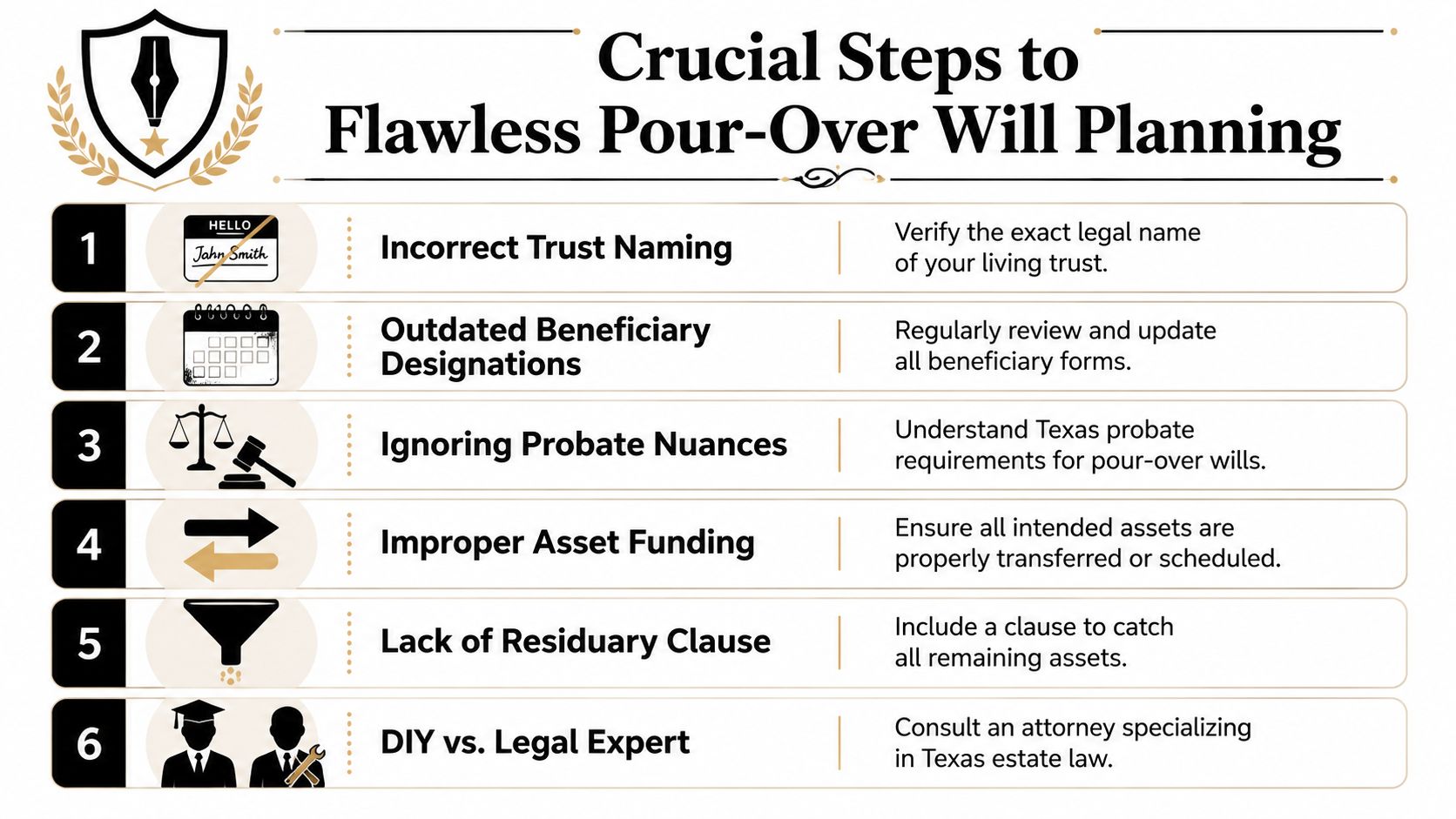
Basic drafting errors are only part of the risk. The harder problems often appear later, after divorce, death, incapacity, remarriage, or changes in the trust's beneficiary structure.
Divorce can complicate a pour-over plan
This issue deserves more attention than it usually gets. A 2025 survey by the Texas Bar Foundation found that 68% of divorce attorneys in Houston and Dallas lack clarity on how pour-over wills impact asset division, which shows a real gap in practical guidance for families navigating both estate planning and family law.
That matters because divorce changes how people view ownership, beneficiary intent, and future control. If a trust was created during marriage, or if assets are transferred after separation but before final divorce resolution, disputes can arise over whether those assets should be treated as separate or marital in character. The same concerns may affect support issues if trust distributions are argued to be available income.
Outdated beneficiary terms can derail the plan
Another overlooked problem happens when the trust named by the will still exists, but the trust's beneficiary structure no longer fits reality. A beneficiary may have died, become incapacitated, divorced, or no longer belong in the plan the way the original document assumed.
That creates a serious vulnerability. A pour-over will may succeed in transferring assets into the trust, yet the trust itself may contain outdated beneficiary terms that trigger confusion, disputes, or court involvement.
A practical way to reduce that risk is to review the trust whenever life changes. If you want to tighten the trust side of the equation, this article on how to fund a living trust is a useful companion because proper funding and proper updating often go hand in hand.
A checklist for avoiding preventable problems
Use this review list when looking at an existing plan:
- Confirm the trust's exact legal name in the will matches the trust document.
- Review beneficiary terms after divorce or death so the trust still reflects current relationships.
- Check successor roles for executor and trustee in case the first choice can't serve.
- Look for backup beneficiary language if a named beneficiary is deceased or incapacitated.
- Revisit newly acquired assets to decide whether they should be titled to the trust now.
- Coordinate family law issues early if divorce, support, or blended-family property questions are involved.
Families usually don't run into trouble because they ignored planning altogether. Trouble often starts because they planned once and assumed the documents would take care of themselves forever.
One practical option for clients dealing with both estate and family issues is the Law Office of Bryan Fagan, PLLC, a Texas firm handling divorce, family law, and estate planning matters. That overlap matters when a pour-over will intersects with property division, remarriage, or changing beneficiary relationships.
Get Help Protecting Your Family's Future in Texas
A pour-over will is simple in concept and powerful in practice. It catches assets left outside your living trust and moves them into the plan you already built, but only if the document is valid and the surrounding trust terms still make sense for your life.
For many Texans, the primary challenge isn't understanding the basic definition. It's knowing whether the trust is funded correctly, whether the will meets Texas execution rules, whether probate will be needed, and whether divorce or family changes have subtly created risks.
What to remember most
The most important takeaways are straightforward:
| Key issue | Why it matters |
|---|---|
| Proper execution | Texas requires signing formalities and two credible witnesses age 14 or older |
| Probate timing | The will must be filed within four years to be admissible |
| Trust coordination | The will and trust must point to the same current plan |
| Life updates | Divorce, death, incapacity, and remarriage can change everything |
A calm next step
You don't need to solve every estate planning question in one afternoon. But you should act before a missing signature, a stale beneficiary clause, or an unfunded asset turns into a legal problem for the people you love.
If your family situation involves a recent divorce, blended children, military relocation, a special needs beneficiary, or a trust that hasn't been reviewed in years, personal legal guidance matters even more. Those details can change how a pour-over will functions in practice.
A carefully prepared plan gives your family more than paperwork. It gives them clarity during a stressful time, a clearer path through probate, and a better chance of carrying out your wishes without unnecessary conflict.
If you need help navigating divorce, custody, or estate planning in Texas, contact The Law Office of Bryan Fagan today for a free consultation.