
You signed your living trust. You put the documents in a folder. You felt the relief that comes with finally handling something important for your family.
Then life got busy.
That’s the point where many Texas families stop, even though the trust still isn’t doing the work they think it is. A living trust only controls the assets moved into it. If your home, bank accounts, or investment accounts are still titled in your individual name, the trust may exist on paper but not where it matters most.
For many people, that gap creates anxiety. They know they’ve started estate planning, but they aren’t sure whether they’ve finished it correctly. The good news is that funding a trust is manageable when you break it into steps and handle each asset the right way.
Texas law gives families useful estate planning tools, including revocable living trusts, deeds, beneficiary designations, powers of attorney, and wills under the Texas Estates Code. But the value of those tools depends on follow-through. If you’re trying to understand how to fund a living trust in a practical, Texas-specific way, the process starts with knowing what you own, how each asset transfers, and where mistakes usually happen.
Why Signing Your Trust Is Only the Beginning
A newly signed trust often gives people a real sense of completion. That reaction makes sense. You met with counsel, made decisions about trustees and beneficiaries, and signed legal documents that reflect your wishes.
But signing is only step one.

A trust without assets is like a locked safe with nothing inside it. The structure is there. The protection isn’t.
What many families don’t realize
A common real-world scenario looks like this. A couple creates a revocable living trust, signs a pour-over will, and stores everything away. Years later, one spouse dies, and the family discovers the house, checking account, and brokerage account were never transferred into the trust. Those assets may still have to go through probate.
That defeats one of the main reasons people create a living trust in the first place.
One of the most frequent and costly mistakes in estate planning is failing to properly fund a living trust. When assets stay in an individual’s name, they may still be subject to probate, which can involve significant costs relative to an estate’s total value. For an estate of a certain size, this could mean substantial fees and public court proceedings, as explained in this discussion of how to fund a living trust.
Practical rule: Your trust controls what it owns, not what your trust document merely mentions.
Texas families usually need two things
Texas families usually need two things. These include:
- A valid trust document that names trustees, beneficiaries, and instructions
- A funding plan that transfers ownership of the right assets into the trust or names the trust as beneficiary when direct retitling isn’t appropriate
You should also think about document access. If your successor trustee can’t find your originals, your plan gets harder to carry out. This guide on storing your estate planning documents is worth reviewing once your funding work is underway.
The First Step Creating Your Asset Inventory
Before you sign deeds or visit a bank branch, slow down and make a complete inventory. This is the part many want to skip. It’s also the part that keeps the rest of the process from turning into guesswork.

An asset inventory is not just a list of valuables. It’s a working map of what you own, how it’s titled, where the documents are, and what transfer method each item will need.
What to gather first
Start with the assets most likely to matter in administration after incapacity or death. For many Texas families, that means liquid accounts and real estate before anything else.
Create a spreadsheet, legal pad list, or binder with sections for:
- Real estate including your homestead, rental property, land, timeshares, and mineral interests
- Bank accounts such as checking, savings, CDs, and money market accounts
- Brokerage and non-retirement investment accounts
- Business interests in an LLC, corporation, partnership, or sole proprietorship
- Insurance policies
- Vehicles and titled property
- Personal property including jewelry, art, firearms, collectibles, and family heirlooms
- Debts owed to you such as private loans or notes receivable
- Digital and document access information so your trustee knows where to begin
What to record for each asset
Don’t just write “Wells Fargo checking” or “house.” That creates confusion later.
Record details such as:
- Exact title of the asset as it appears now
- Institution name or county where records are kept
- Account or policy number
- Current owner listed on the title or statement
- Beneficiary designation, if any
- Approximate location of the original document
- Whether the asset should be retitled or handled by beneficiary designation
The cleaner your inventory is, the less likely a bank clerk, county recorder, or brokerage representative is to slow the transfer because of missing information.
Why this step matters under Texas law
Texas estate planning often intersects with homestead rights, community property issues, and non-probate transfer rules. Your inventory helps identify those issues early.
For example, married couples may own property together in ways that affect how a trust should be funded. Real estate may also carry title histories or exemption concerns that need review before a deed is prepared. A full inventory gives your attorney or financial institution a factual starting point instead of a reconstruction project.
If you’re wondering how to fund a living trust without feeling overwhelmed, confidence begins here. One line item at a time is enough.
Transferring Core Assets to Your Texas Trust
A family signs trust documents, feels relieved, and then leaves the house, bank accounts, and brokerage accounts titled exactly as they were before. Years later, a successor trustee discovers the trust was valid, but several of the assets never made it into it. That is the problem this step solves.
At this stage, your trust needs to match the way your property is owned. The goal is simple. Align title, account ownership, and transfer documents with the trust so your successor trustee can act without unnecessary court involvement.
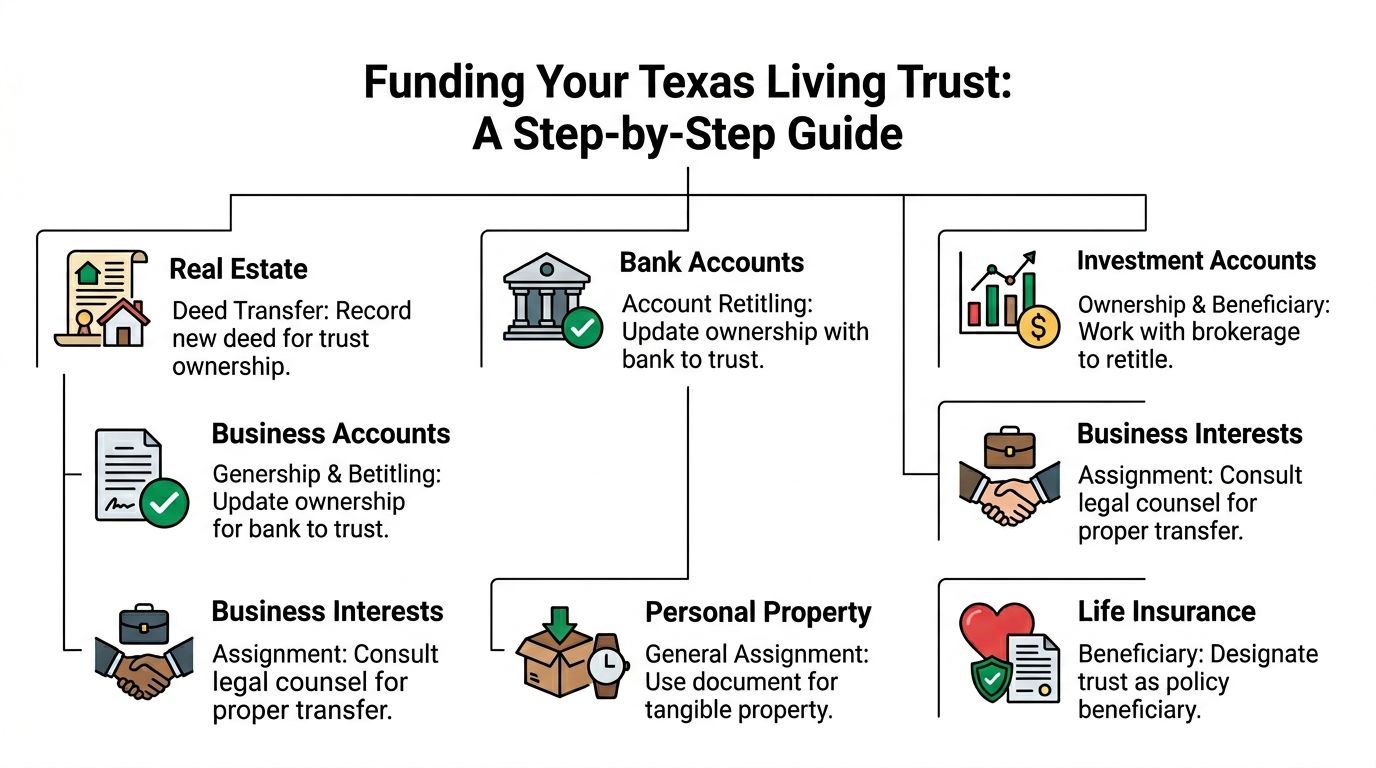
Funding your home and other real estate
For Texas real property, transfer usually happens by deed. The deed must identify the current owner, the trustee, and the trust name exactly. Then it needs to be signed, notarized, and recorded in the county where the property sits.
Small title errors create expensive cleanup later.
If your trust is named “Jane Smith, Trustee of the Jane Smith Revocable Trust dated January 10, 2025,” use that full legal name on the deed and in any related paperwork. Abbreviations, missing dates, and inconsistent trustee names can cause county recording problems or title questions when the property is later sold or refinanced.
The basic sequence is usually:
- Confirm current title by reviewing the last recorded deed.
- Prepare a new deed that transfers the property into the trust.
- Sign and notarize the deed correctly.
- Record it in the proper county so the public record reflects the trust.
- Keep the recorded copy with your trust papers and confirm the filing was accepted.
Texas real estate can raise added questions about liens, homestead treatment, mineral rights, and whether the property is separate or community in character. If avoiding probate is one of your goals, this overview of probate and real estate in Texas gives useful background.
One practical caution for Texas homeowners. Transferring a homestead to a revocable trust is often appropriate, but it should be done carefully so tax treatment, lender concerns, and title insurance issues are addressed before recording the deed.
Retitling bank accounts and brokerage accounts
Banks and brokerages do not treat your signed trust as enough by itself. Many institutions require their own change-of-ownership forms, a Certificate of Trust, and identification for the acting trustee.
Call first.
That short phone call usually tells you whether the institution will handle the change in a branch, through a trust department, or by mail. It also helps you avoid showing up with the wrong documents or using an ownership format the institution will reject.
A practical script is: “I want to retitle this account into my revocable trust. What documents and forms do you require?”
Use the exact trust name from your signed documents. After the transfer is processed, review the next statement and confirm the account owner now shows the trustee of the trust, not just your individual name. I have seen families assume an account was transferred because paperwork was submitted, only to find out later the institution opened a new linked profile or changed mailing instructions without changing legal ownership.
Brokerage accounts follow the same general pattern, but they often involve a longer review process. If the account holds taxable investments, confirm whether the trust will use your Social Security number during your lifetime or whether the firm wants other tax reporting documents.
Personal property and general assignments
Household goods, jewelry, collections, artwork, and similar items usually do not have a title document. In most Texas estate plans, those items are transferred by an assignment of personal property signed with the trust records or as a separate document.
This paperwork matters more than clients expect.
Families often disagree over tangible items with sentimental value, not just high-dollar assets. A clear assignment helps show that those items belong to the trust estate and can be managed under the terms you already put in place.
A practical funding snapshot
| Asset Type | Primary Funding Method | Key Action Required |
|---|---|---|
| Real estate | Direct retitling to trust | Prepare, sign, notarize, and record deed |
| Bank accounts | Direct retitling to trust | Complete institution ownership forms with exact trust name |
| Non-retirement brokerage accounts | Direct retitling to trust | Work with brokerage to change account owner to trustee |
| Personal property | Assignment to trust | Sign assignment document describing tangible items |
| Vehicles | Varies by asset and state procedure | Confirm title transfer requirements before changing ownership |
| Life insurance | Beneficiary designation | Review whether trust should be primary or contingent beneficiary |
| Business interests | Assignment or consent-based transfer | Review governing documents before transfer |
Beneficiary designations also need attention while you are handling core assets, especially if you want your trust plan to work as a whole. A short explanation of understanding the distinction between beneficiaries and dependents can help clarify why ownership and beneficiary forms do different jobs.
A short video can also help make the process feel more concrete.
Some assets should not be handled the same way as your house or checking account. Many well-meaning people make expensive mistakes at this stage because they assume every asset should be retitled into the trust.
That assumption doesn’t hold up.
Retirement accounts need beneficiary planning, not blind retitling
IRAs and 401(k)s come with their own tax rules. In many cases, the right move is not to transfer ownership to the trust during your lifetime.
Funding a living trust requires understanding the difference between direct ownership transfer and beneficiary designation. Directly transferring a significant IRA balance into a living trust, for instance, could be treated as a full withdrawal by the IRS, triggering immediate income tax liability, which is why retirement accounts are typically handled by naming the trust as beneficiary rather than retitling the account itself, as explained in this guide to funding your living trust.
That’s the central trade-off. A trust can help coordinate distribution, but the account itself often needs to stay where it is, with the beneficiary form doing the transfer work at death.
Life insurance raises control questions
Life insurance usually passes by beneficiary designation, not by the trust document alone. Naming your trust as beneficiary can make sense when you want the trustee to control timing, hold proceeds for children, or manage distributions under specific conditions.
But that choice should be intentional. If an adult spouse or adult child should receive proceeds directly and immediately, naming the trust may create more administration than the situation needs.
Readers who are comparing insurance designations often benefit from understanding the distinction between beneficiaries and dependents, because those roles are often confused in planning conversations even though they serve different legal and financial functions.
Business interests require a document review first
LLC memberships, partnership interests, and closely held corporate shares often cannot be transferred by signing a simple one-page assignment and calling it done. The transfer may be limited by:
- Operating agreements that restrict transfers
- Buy-sell agreements requiring notice or consent
- Shareholder agreements controlling ownership changes
- Lender documents that tie ownership to financing terms
For business owners, trust funding should be coordinated with incapacity planning too. A trust may hold the interest, but day-to-day authority can still depend on separate documents. This discussion of power of attorney paperwork for business owners in Texas is a useful companion if your estate plan includes an active company.
The right question to ask
Don’t ask, “Can this asset go into my trust?”
Ask, “Should this asset be owned by the trust now, or should it pass to the trust through a beneficiary designation later?”
That one distinction prevents a surprising number of avoidable problems.
Common Funding Mistakes and Texas-Specific Considerations
Most trust funding errors aren’t dramatic. They’re small oversights that stay hidden until a death, incapacity, sale, or title review forces someone to deal with them.
In Texas, those oversights can become more complicated because property rights often involve community property rules, homestead issues, and county recording practices.
The problem with casual trust names
A frequent mistake is using an informal title when retitling an asset. People say “put it in the Smith Family Trust,” but their signed document might read “Robert and Elena Smith Revocable Living Trust dated March 14, 2025.”
Those are not the same.
The solution: Use the exact legal trust name on deeds, account forms, and assignments. Match the trust documents exactly, including trustee capacity and date if the institution requests it.
The homestead question in Texas
For Texas homeowners, the family home deserves extra attention. Your homestead is not just another asset. It may involve tax exemptions, creditor issues, lender concerns, and occupancy rights.
The problem: A homeowner transfers title without checking how the county appraisal district, lender, or exemption records should be updated.
The solution: Review the deed strategy before filing and confirm what follow-up documentation may be needed to preserve existing treatment. A deed that avoids probate but creates an avoidable homestead issue isn’t good planning.
Community property and mixed ownership
Married couples in Texas often assume all property can be moved into one trust without consequence. Sometimes that works. Sometimes it doesn’t.
The problem: One spouse retitles an asset without first confirming whether it is community property, separate property, or a mixed-character asset. That can create confusion later in probate, divorce, creditor disputes, or distribution.
The solution: Identify how the property is characterized before transfer. If the asset was owned before marriage, inherited, gifted, or improved with mixed funds, the title decision should reflect that history.
Forgetting newly acquired assets
Trust funding is not a one-time paperwork event. Families buy cars, open accounts, refinance homes, inherit property, and start businesses.
The problem: The original trust was funded correctly, but later acquisitions were left outside it.
The solution: Build a simple habit. When you acquire a significant asset, ask right away whether it should be titled in the trust or coordinated by beneficiary designation.
The most effective trust plans are usually the ones people revisit after life changes, not the ones they sign once and never touch again.
DIY documents without local review
Online forms can be useful for organizing thoughts, but Texas property law is local in practice. County recording standards, lender concerns, and marital property questions don’t always fit a generic template.
The solution: If the trust includes real estate, blended families, business ownership, or substantial non-retirement accounts, a legal review is often worth it before transfers are made.
Keeping Your Trust Current Maintenance and Legal Guidance
A funded trust still needs maintenance. People often think of estate planning as a transaction. In practice, it works better as a system.
Review after major life events
You should revisit your trust and funding plan after events such as:
- Marriage or divorce
- Birth or adoption of a child
- A death in the family
- A major purchase or sale
- Starting or selling a business
- Moving into or out of Texas
- A significant change in health or caregiving needs
Texas Estates Code planning tools work best when they reflect your current reality. If the people named in your documents, the assets you own, or the way those assets are titled have changed, your trust should be reviewed.
Keep your records usable
Good recordkeeping helps your successor trustee act without delay.
That usually means keeping:
- Signed trust documents and amendments
- Recorded deeds
- Account statements showing trust ownership
- A current asset inventory
- Beneficiary designation confirmations
- Contact information for your attorney, CPA, and financial institutions
If you’re comparing broader tax concepts while reviewing your estate plan, a plain-English explanation of death tax vs estate tax can help separate commonly confused terms before you make beneficiary or distribution decisions.
Know when to stop doing it alone
Some trust funding tasks are straightforward. Others are not.
If your plan involves a homestead, retirement accounts, closely held business interests, second marriages, children from prior relationships, or a mix of separate and community property, legal guidance is usually the more efficient route. One practical option is working with a firm that drafts the trust and also helps implement transfers, including deeds, account instructions, and business-interest review.
A trust is not “done” because it was signed. It’s done when the assets, documents, and beneficiary designations all align.
If you need help navigating divorce, custody, or estate planning in Texas, contact Law Office of Bryan Fagan, PLLC today for a free consultation.