Skip to content

Your lawyer mentions a business valuation, or the other parent asks for a custody evaluation, and suddenly you're worried about another bill. You may not even know what the expert does yet, much less whether you can afford the work.
Understanding what a Texas family law expert costs and who pays starts with separating the bill due now from the cost a judge may allocate later. Those are different events, and planning for both can help you protect your case without making financial commitments you don't understand.
Texas Family Law Experts and Who Usually Pays Them
Clients often don't enter a divorce or custody case knowing which experts they'll need. A disputed account balance, a concern about parenting, or conflicting business-income records may reveal the need only after the case begins.
An expert witness supplies specialized analysis that your attorney generally can't provide through legal argument alone. Not every case needs one, and hiring more professionals isn't necessarily better. The useful question is whether the expert can answer a disputed question that matters to the court.
Match the Professional to the Dispute
A custody evaluator examines parenting arrangements and home environments for conservatorship and possession disputes. A forensic accountant follows financial records to identify income, trace assets, or investigate funds that haven't been disclosed.
Mental-health professionals may evaluate parenting capacity or trauma within an authorized scope. Appraisers address value, while vocational experts assess earning capacity rather than accepting a person's current paycheck as the whole picture.
Texas family law experts, billing and payment responsibility
| Expert | What They Do | How They Bill | Who Pays First | Who May Bear It Later |
|---|---|---|---|---|
| Custody evaluator | Assesses parenting and home environment for conservatorship | Written evaluation fee schedule and deposit | Requesting party or as the court orders | Court may allocate by order, not automatically |
| Forensic accountant | Traces assets, income and hidden funds | Hourly, set by scope | Retaining party | Court may award as costs, discretionary |
| Mental-health expert | Evaluates parenting capacity or trauma | Evaluation and testimony charges under a written agreement | Retaining party or as ordered | Court may allocate, discretionary |
| Business or property appraiser | Values companies, homes and retirement accounts, using the appropriate specialty | Hourly or per valuation | Retaining party | Court may allocate, case-specific |
| Vocational expert | Assesses earning capacity for support or maintenance | Assessment, report and testimony fees under a written agreement | Retaining party | Court may allocate, case-specific |
These are billing arrangements, not statewide price quotes. There isn't a single statewide expert rate to apply to every case. The professional's assignment, records, interviews, report requirements, and anticipated testimony determine the proposed fee.
Clarify Who Is Hiring the Expert
A professional retained by your attorney isn't the same as a court-appointed evaluator. Before agreeing to payment, identify who selected the professional, what the appointment order says, and whose questions the professional must answer. Our explanation of how a Texas family court appoints an expert witness addresses that distinction.
For example, tracing business income and determining a business's sale value are different assignments. Ask whether you need both before authorizing either.
Request a written scope, rate schedule, deposit requirement, and estimate before retention. Also ask what would trigger additional work, so a limited review doesn't become a broader investigation without a budget discussion.
Typical Attorney and Expert Costs in Texas
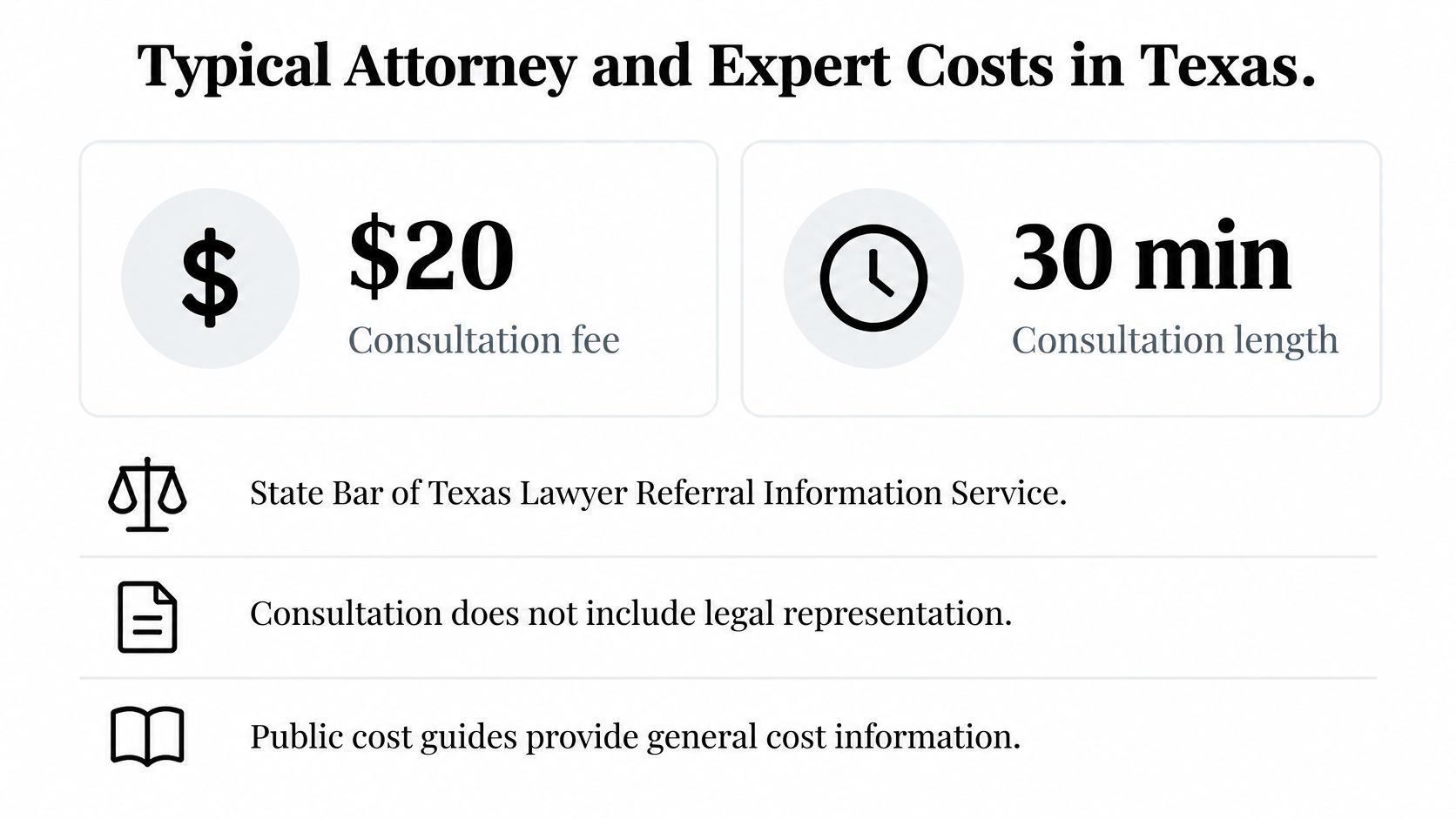
The State Bar of Texas Lawyer Referral Information Service offers a $20 consultation lasting 30 minutes, but it doesn't include representation and isn't a pro bono or reduced-fee program, according to the State Bar's legal-access directory. That directory also lists a Brazoria County reference of approximately $250 to $450 per hour, with regular retainers typically equal to four hours of work, implying an initial deposit of roughly $1,000 to $1,800.
Those are reference points, not a quote for your case or this firm. The consultation arrangement described above is separate from our free initial consultation.
The graphic highlights the referral program's consultation terms.
Understand What the Reference Figures Cover
Public cost guidance summarized by Divorce.com's Texas cost guide reports attorney rates of roughly $200 to $450 per hour in major metropolitan areas, $150 to $275 per hour in rural areas, and contested matters potentially reaching $30,000 to $50,000 or more. These broad figures don't establish an expert's price or predict your final bill.
Texas family law cost reference points
| Cost Item | Typical Figure | Context |
|---|---|---|
| Lawyer referral consultation | $20 for 30 minutes | Does not include representation |
| Metro attorney hourly rate | $200 to $450 per hour | Major metropolitan areas, per public cost guides |
| Rural attorney hourly rate | $150 to $275 per hour | Rural areas, per public cost guides |
| Regular retainer | About four hours of work | Brazoria County directory reference at $250 to $450 per hour |
| Contested case total | $30,000 to $50,000 or more | Complexity, conflict and assets affect the total |
| Expert hourly fee | Individually quoted under the expert's agreement | Obtain a written estimate for the actual assignment |
Budget by Phase Rather Than One Headline Total
Say you're in a contested custody case and also dispute income from a closely held business. Your attorney may recommend a forensic accountant to determine whether the reported income matches the financial records.
Your cash requirements could unfold like this:
- Attorney retention: You fund the initial deposit, then pay replenishments under the engagement agreement.
- Financial investigation: The accountant requests a separate deposit before reviewing business records.
- Mediation: You budget for the mediator, attorney preparation, and any expert assistance needed to negotiate.
- Trial preparation: If settlement fails, updated reports, exhibits, testimony preparation, and court attendance create further charges.
An initial deposit isn't a total-case ceiling. Ask which expenses are paid through counsel and which professionals bill you directly.
Missing records, urgent hearings, extensive parenting disputes, and repeated disagreements can increase the work required. Organized documents, focused communications, clearly limited expert assignments, and negotiated resolutions can help control spending without abandoning important rights.
Court Filing Fees and How Waivers Work
Filing a divorce petition, obtaining issued papers, and serving your spouse may involve separate court charges, and county amounts aren't uniform. These costs are distinct from attorney fees and expert fees, so a waiver request applies to a different part of your budget than a lawyer's bill or an evaluator's invoice.
If you can't afford court charges, TexasLawHelp's court-cost guidance explains how to submit a Statement of Inability to Afford Payment of Court Costs. The statement addresses eligible court costs. For more on what happens if you cannot afford a Texas family law filing fee, review the filing-fee guidance before submitting your paperwork.
Follow the Court-Cost Process Carefully
- Check county charges. Contact the district clerk in the county where you plan to file. Confirm current filing, issuance, and service charges, along with the form and filing procedure.
- Complete the statement. Give a full picture of your finances and follow the form's instructions for entries that do not apply. Explain any blank fields.
- Sign and file it. Check the signature requirements and submit the statement with your petition, or as the clerk directs.
- Keep a copy and check the clerk's response. The clerk may accept the filing, or the request may be challenged and referred to a judge. Watch for the clerk's notice or a court order so you know whether a hearing or further action is required.
Keep Separate Expense Categories
For example, a parent filing for divorce with children may receive relief from filing and service costs, but still need to arrange payment under an attorney engagement agreement and plan for an evaluator's separate charges.
Keep the three bills distinct:
- Court charges: Filing, issuance, service, and other covered court expenses.
- Attorney fees: Legal advice, document preparation, negotiations, and hearings.
- Expert fees: Specialized review, evaluation, reports, and testimony.
A court-cost waiver does not automatically pay the other two categories. Identifying which bill you're facing helps you ask for the right kind of relief and plan for expenses that remain due. Don't assume every cost must be paid immediately, or that every cost will be waived.
Who Pays Attorney Fees and When a Judge Shifts Them
When divorce bills arrive separately, it helps to distinguish who pays first from who may ultimately owe the money. Each spouse usually hires and initially pays their own family-law attorney through an advance deposit, which the attorney bills against as work is performed. In Texas, the judge decides case by case whether one spouse must pay the other spouse's attorney's fees. In many cases, each party pays their own attorney.
Income alone does not decide fee shifting; the judge weighs the record and the law that applies to the proceeding. A fee award is a court's allocation of legal expenses, not an automatic refund. Even after an order, receiving payment is a separate step, so keep the timing of bills in mind when planning cash flow.
Identify the Statute That Fits the Proceeding
Texas Family Code §9.106 authorizes reasonable attorney's fees in proceedings under the property-division enforcement subchapter and permits payment directly to counsel, who may enforce the award as a judgment for debt, as stated in the statutory text published by Justia. This provision addresses enforcement of property division, rather than every stage of an original divorce. Related fee provisions include §6.708 for dissolution proceedings and §8.063 for specified spousal-maintenance proceedings, as described in the statutory text published by Justia. The governing authority depends on the type of proceeding.
A fee request should identify its legal basis, document the services and expenses, and explain why the requested amount meets the applicable standard. The court needs supporting evidence, not a comparison of the spouses' incomes.
Show Why the Requested Fees Are Appropriate
Depending on the proceeding and governing statute, the record may need to address:
- Reasonableness and necessity: What work was performed and why the case required it.
- Financial circumstances: Each party's resources and actual access to funds.
- Proportionality: Whether the hours and rates fit the work involved.
- Connection to the relief: How the requested fees relate to the matter the court is deciding.
A judge may award fees when the applicable law and evidence support the request. The word may signals discretion: permission to award fees does not guarantee that the other spouse will repay your bill.
Child-support proceedings also have a distinct path. State Bar of Texas family-law guidance explains that the Attorney General does not charge attorney's fees to the parent seeking child support, while private counsel charges for representation. That distinction does not provide a parent with a private lawyer for every related family dispute.
Before hiring counsel, read the written agreement for hourly rates, billing increments, replenishment requirements, filing costs, expert charges, and mediation expenses. Ask how interim payments will be credited. Clear records help prevent the same fees from being counted twice when the court considers an award.
How Expert Costs Come Due Before a Judge Decides
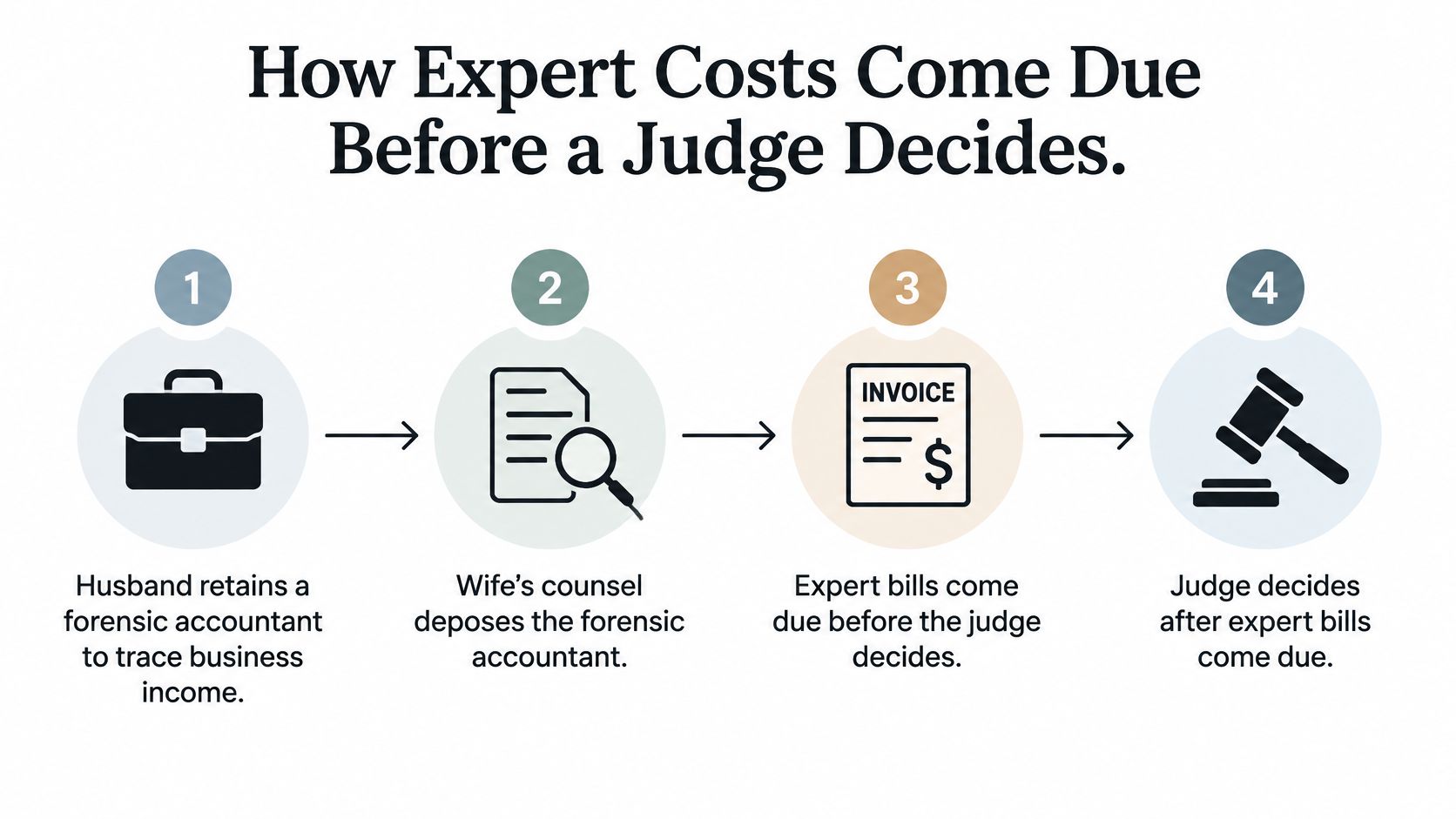
Consider a husband who retains a forensic accountant to trace business income. The wife's attorney later deposes that accountant. The accountant's invoices may come due well before the court decides whether either spouse should reimburse the other.
The timeline below illustrates why an expert budget needs to address payment dates, not just eventual responsibility.
Follow the Invoice Through the Case
- Retention starts the payment relationship. The husband signs the accountant's agreement and usually funds a deposit before the review begins. His expectation of reimbursement doesn't fund that deposit.
- Review and reporting generate charges. The accountant examines records and prepares findings. The estimate should cover document review, the report, and anticipated testimony preparation, not merely the initial interview.
- A deposition creates additional expert work. Under Texas Family Code §301.107, when a party deposes an expert retained by the opposing party, the retaining party must pay the expert's reasonable preparation, deposition, review, and correction fees. In this example, the husband's payment obligation isn't eliminated because the wife's counsel requested the deposition.
- Appointment status must be checked. A court-appointed professional may have a payment arrangement established by the appointment order. Identify who requested the work and read that order rather than applying the accountant's private arrangement to every professional.
- Allocation requires a separate request. The husband may seek an award of allowable expert expenses through the applicable legal authority. Counsel must explain the basis for shifting those particular charges.
- Collection follows an award. If the court orders reimbursement, determine the deadline, recipient, and enforcement route. Entry of an order doesn't itself place money in the husband's account.
Protect the Budget Before Work Expands
This timing problem matters in custody evaluations, business valuations, asset tracing, vocational assessments, and income disputes. Professionals may need to begin their assignments while the parties still disagree about who should ultimately pay.
An order directing the other side to pay doesn't eliminate the risk that you'll need money before payment arrives.
For evaluation-specific questions, our discussion of who pays for a Texas custody evaluation addresses the payment issue in that setting.
Use the engagement-review approach for expert contracts too, including cancellation terms and testimony charges. Add a dedicated expert line to your budget, with separate entries for deposits, ongoing work, and hearing attendance.
Paying for Representation When Money Is Tight
If your spouse controls the accounts and you cannot fund a retainer, explain that financial imbalance early. You may need to ask the court for temporary help, but first funding legal work and later receiving a fee award are separate steps. A court order does not guarantee the money will arrive when a bill is due.

Prepare a Supported Temporary-Orders Request
TexasLawHelp's attorney-fee guidance explains that Texas Family Code §6.502(a)(4) allows a request for temporary orders addressing reasonable and necessary attorney's fees and litigation expenses. The judge decides whether to grant the request. Evidence of the amount sought and the other spouse's ability to pay can support it.
Build the request from specific needs:
- Document available resources. Gather income records, account-access information, debts, monthly expenses, and records of prior legal payments. Note accounts you know exist but cannot access.
- Itemize the legal work. Separate household expenses from legal costs. Explain what the current stage requires instead of estimating every possible dispute.
- Clarify how payment would work. Ask whether the requested order seeks an advance, reimbursement, or direct payment to counsel, and how ongoing bills would be handled while payment remains unresolved.
A spouse can own valuable property and still lack cash to pay a bill now. If income is concealed or assets are difficult to sell, consider both what can be proved and whether an eventual award can be collected.
Consider Other Ways to Fund Focused Help
If private representation is out of reach, contact Texas legal aid providers such as Texas RioGrande Legal Aid or Lone Star Legal Aid. Eligibility commonly depends on income, location, and the type of case, and available help may be limited. Ask about their current requirements; being unable to afford a retainer does not by itself mean a provider can take the case.
Limited-scope representation may let you pay for a defined task, while mediation may narrow issues before more preparation is needed. Either option may be unsuitable if safety concerns or missing financial information prevent informed negotiation.
The Law Office of Bryan Fagan offers three different financing options. Ask the firm to explain the available options and their terms before deciding whether they fit your budget. Financing changes when you pay, not whether the legal work itself has a cost.
For an existing order, Custody & Support Modifications addresses changes to custody, visitation, and support provisions. Identify the specific change you seek before estimating the work.
This consultation video may help you prepare for the conversation.
Bring tax returns, pay records, account statements, debt statements, and records of prior payments. If a document is unavailable, note what is missing and who controls it.
Confirm Your Budget and Book a Free Consultation
A consultation is more useful when you can explain what you need help deciding, what records you have, and what questions remain. You do not need a finished budget. Bring the information you have and identify anything you still need to find.
Bring a Short Preparation Checklist
- Write down your immediate concern. For example, note whether you need advice about filing for Divorce or a dispute involving Child Custody. Include any upcoming decision or event that affects what you need to address first.
- Gather financial records. Bring income, asset, debt, and payment documents. These can help counsel understand your financial situation and assess whether a request for attorney fees may be appropriate.
- List the questions you cannot answer yet. You might need to clarify what work is needed, whether specialized analysis makes sense, or what information is missing. If a record is unavailable, note what it is and who controls it.
- Bring the Cost Pamphlet. The firm's website offers a Cost Pamphlet about budgeting for divorce. Use it to identify questions for the discussion, rather than treating it as a case-specific estimate.
A judge's decision about who ultimately pays attorney fees is separate from the bills that come due during a case. The spouse who hires an attorney or retains an expert may need to fund that work first. A later court order allocating fees does not ensure that the money will be paid, so ask how the immediate financial demands fit your circumstances.
Use the Consultation to Set Priorities
The firm offers a free initial consultation. Use the conversation to explain the legal issue, discuss whether expert analysis may be justified, and decide what needs attention first. You can also ask how the firm would match you with an attorney based on your situation.
The Law Office of Bryan Fagan, PLLC represents clients across Texas in family law matters, including divorce and child custody. Its attorneys handle a range of family law issues, and the firm also provides estate planning services.
Bring your notes even if some answers are incomplete. A clear list of concerns can help focus the discussion before you make major financial commitments. The Cost Pamphlet can help you prepare, while the consultation lets you discuss your own situation and priorities.