Under Texas Family Code §107.115, the court assigns the evaluation fee, and the parents pay the evaluator directly. In many Texas counties, a parent's share can land anywhere from $110 to $720 under common sliding scales, depending on income and the order.
The panic usually hits the moment the notice arrives. One parent sees “custody evaluation” and immediately thinks, “Who's paying for this, and how am I supposed to cover it?” That's the right question to ask early, because the answer is not automatic, and waiting until the deadline is the fastest way to create a second problem on top of the custody fight.
When the Court Orders an Evaluation and the Money Question Hits Home
A parent gets a court notice, opens it at the kitchen counter, and realizes the case just got more expensive. Maybe the other parent asked for the evaluation. Maybe the judge ordered it because the case is too heated for the court to sort out without professional input. Either way, the same fear lands first, how much of this bill am I responsible for?
The short answer is this, who pays for a Texas custody evaluation depends on the signed order and the county process behind it. Texas courts do not treat this like a vague family expense that can wait until the end of the case. They make payment part of the litigation plan, and that means the order itself usually controls the practical answer.
What worried parents usually miss
Parents often focus on the final split and miss the mechanics. That is a mistake. The key issues are who fronts the money, whether the evaluator starts work before payment, whether travel or testimony adds more cost, and whether a later reimbursement claim is realistic if one parent pays first.
Practical rule: Read the order before you assume anything. If the order is silent, incomplete, or inconsistent with the evaluator's written fee policy, fix that immediately.
Texas custody cases also involve the child's best interests, not just the parents' wallets. That is why lawyers handling Child Custody disputes have to think about both the legal strategy and the payment structure at the same time. If the fee structure is ignored, the case can stall before the evaluator ever meets the family.
The rest of the analysis turns on four things, the statute, the court order, county procedure, and each parent's ability to pay. Miss one of those, and you can end up arguing about money when you should be preparing for the evaluation itself.
The Texas Statute That Controls Who Pays
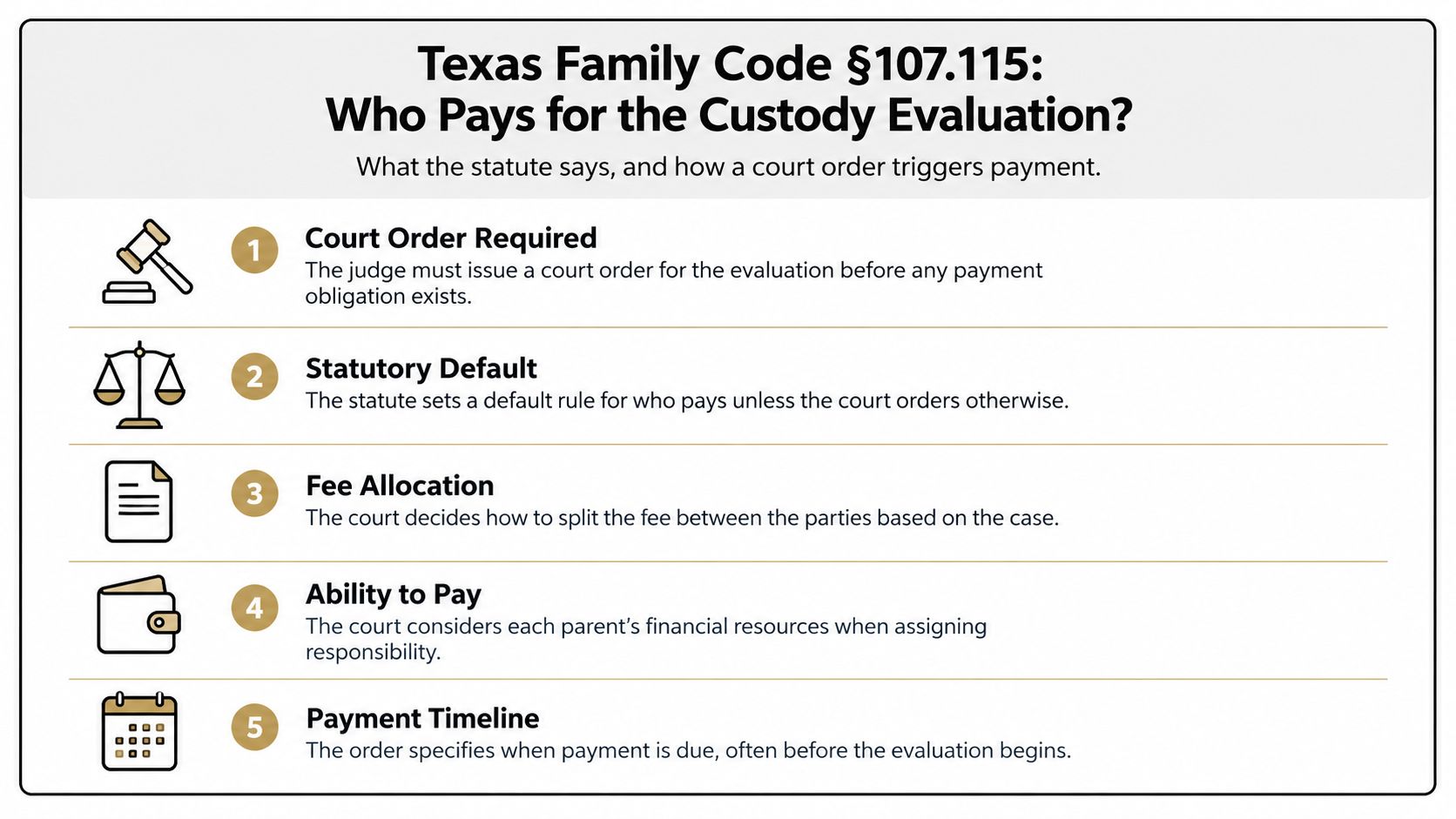
Texas Family Code §107.115 is the starting point. When a judge orders an evaluation, the evaluator is entitled to a reasonable fee for preparing it, and that fee is imposed as a money judgment paid directly to the evaluator, who can enforce it through ordinary civil-judgment procedures. In plain English, this is not just an optional invoice floating in the background of the case.
The order controls the details. It tells you who pays, how the fee is divided, when payment is due, and whether one parent pays the evaluator directly or the parents split the cost by percentage. The court can allocate the fee in a way that fits the case, and the signed order is what makes the obligation concrete.
What the statute means in real life
If the order says one parent pays 50% and the other pays 50%, that split is enforceable. If the order says one parent pays the evaluator directly, that parent needs to do it on time. If the evaluator is not paid, the issue can become a judgment-enforcement problem, not just a family-law annoyance.
That is why the paperwork matters so much. A parent should look for:
- Who pays first, the evaluator or the other parent
- How the fee is split, equal shares or a different percentage
- When payment is due, before the evaluation starts or on another deadline
- Whether travel or testimony is included
- What happens if someone does not pay
| Order Item | What It Controls | Why It Matters |
|---|---|---|
| Payment split | Each parent's share | Tells you your actual obligation |
| Payment deadline | When money is due | Determines whether the evaluation starts |
| Payee | Who gets the money | Usually the evaluator, not the court |
| Extra charges | Travel, testimony, cancellation | Prevents surprise invoices |
| Enforcement language | What happens if payment is missed | Turns a fee dispute into a judgment issue |
Texas law also treats these evaluation fees differently from attorney-ad-litem fees. Those are generally assigned to the parents unless a parent is indigent. That distinction matters because a parent sometimes reads one fee rule and assumes it applies to every professional in the case. It does not.
The signed order is the payment roadmap. Read it closely, because that document decides whether you owe money now, later, or directly to the evaluator.
How Much a Texas Custody Evaluation Costs
The price depends on where the case is filed. Harris County's Domestic Relations Office uses a seven-bracket sliding scale, with fees tied to gross income, ranging from $110 at the lowest bracket to $720 at the highest. That schedule is county-specific, not a statewide Texas price.
The local rules matter because they change the bill. One county may use an income-based fee schedule, while a private evaluator may bill in a completely different way. Geography, the evaluator's office, and the amount of travel required can all move the total.
Harris County also requires payment before the case is assigned, and once assigned, the fees are nonrefundable. That catches a lot of parents off guard. If you wait to “see how it goes,” the county policy may already have locked in your obligation.
Travel can add serious expense. Harris County requires parties living outside the county to prepay estimated travel costs, including mileage, airfare, parking, taxis, meals, gasoline, tolls, rental cars, and hotels. Tarrant County requires advance payment for estimated travel exceeding 50 miles one way, and its Family Court Services page lists a mileage rate of 56 cents per mile and a $40 full-day meal allowance.
Tarrant County also says a custody evaluation will not be assigned or started until intake is complete and all fees are paid in full. So the practical answer to “who pays?” often includes who pays first.
A parent who assumes the base fee is the whole bill is making a mistake. The better question is what the local schedule requires, what the order says about timing, and what extra expenses are attached to the evaluation.
How Texas Courts Typically Split the Fee
Texas judges use a few recurring allocation patterns. The most common is a simple split, but that's not the only outcome. The court can also use a percentage allocation, assign the full fee to one party, or craft another split that fits the facts.
The four patterns you should expect
- Equal split. Each parent pays half. This is common when both parents are litigating the same custody issues and neither has a clearly stronger financial position.
- Income-based percentages. The court assigns shares by financial ability, so one parent may pay more if the numbers justify it.
- One parent pays all. Sometimes the judge places the entire cost on the parent who requested the evaluation or the parent with greater means.
- A customized order. If the facts are unusual, the court can order a different fair allocation.
The court is supposed to think about ability to pay. Texas Family Code §107.021 requires judges to consider the parties' ability to pay reasonable fees, balance the child's interests against the cost, and consider less expensive alternatives before requiring an appointed professional to serve. That matters because a custody evaluation should not become a punishment for the parent with less money.
A simple example makes the point. If one parent earns $40,000 and the other earns $95,000, a flat 50/50 split may not be the order the judge chooses. If the parents are on more equal footing, the court may keep the split equal. If one parent created the need for the evaluation through conduct the court views as unreasonable, the allocation can shift again.
Bottom line: The fee split is not a moral award, it's a practical order. Judges look at money, fairness, and the child's best interests, not just who is angrier in the courtroom.
The smartest move is to treat the fee allocation like any other part of the custody strategy. If your finances are tight, tell the court that before the order is signed. Do not wait and hope the evaluator will sort it out for you.
County Programs Versus Private Evaluators
County programs and private evaluators perform the same broad work, but their billing systems differ. That difference affects when you must pay, which charges appear on the invoice, and what happens if you miss a deadline. County programs usually follow a published schedule and intake procedure. A private evaluator generally follows a written fee policy together with the court's order.
Side by side
| Factor | County Program | Private Evaluator |
|---|---|---|
| Fee setting | Often based on a published county schedule | Based on the evaluator's written fee policy and the court order |
| Payment timing | Commonly due before assignment or start | Often due before the evaluation begins, depending on the order |
| Travel | Usually handled through separate advance-payment rules | May be billed separately under the evaluator's policy |
| Sliding scale | Sometimes available, like in Harris County | Not guaranteed |
| Enforcement | Can still be tied to a court order | Payment obligation can still operate as a money judgment |
As noted earlier, Harris and Tarrant County programs require payment before the evaluation proceeds. A private evaluator's timing instead depends on the written fee policy and the language of the order. Read both before signing an agreement or sending money.
County schedules may offer sliding-scale fees, including the Harris County approach listed above. Private evaluators are not required to offer the same arrangement. If affordability matters, ask the court to address the fee structure in the order rather than assuming the evaluator can change it later.
Private evaluators may charge separately for postponements, cancellations, missed appointments, interpreter services, travel, or testimony. Texas administrative rules require written disclosure of the fee basis and payment method before the evaluation begins, including charges for postponement, cancellation, or nonappearance.
Get every payment rule in writing. For a county program, follow its intake and payment procedures. For a private evaluator, compare the fee disclosure with the court order line by line. A missed payment can delay the evaluation, and an unpaid obligation may still be enforceable as a money judgment under Texas Family Code §107.115.
If the evaluation fee is beyond your reach, raise the issue before the court signs the order or the payment deadline expires. Silence can leave you facing a missed deadline, delayed evaluation, or an enforceable payment obligation.
Put your finances before the judge
Bring records showing your income, expenses, debt, and available assets. Ask the court to consider a lower allocation, installment payments, or a less expensive alternative under §107.021. Explain the hardship in specific terms, including what you can pay, when you can pay it, and which expenses prevent you from paying more.
A request to reduce or defer your share is the proper way to address affordability. If the order is still being negotiated, ask for a different split. If a county fee schedule is outside your budget, document that fact and ask the judge to address the payment structure directly.
Ask whether the court can appoint a qualified professional with a different fee arrangement. That may solve the immediate problem. If a full evaluation is not necessary for the issue before the court, ask whether another procedure can answer the custody question at lower cost.
Make the timing clear. Some arrangements require payment before the evaluator begins, while others set payment deadlines in the order or fee agreement. Missing the deadline can stop the evaluation, and the unpaid fee may still operate as an enforceable money judgment under §107.115.
If the other parent refuses or cannot pay, distinguish between two requests: relief from your own share, or enforcement of the other parent's obligation. A judge needs to know which remedy you are asking for.
Practical rule: Ask for help before you become delinquent. A documented hardship request is stronger before the deadline than an explanation after nonpayment.
If you are handling a high-conflict custody case without counsel, consult a Texas family-law attorney or firm that regularly handles custody disputes. Address payment at the start, when the court still has room to structure the arrangement.
Disputing an Unfair Allocation or Chasing Reimbursement
Once the order is signed, your paper trail becomes your protection. Texas administrative rule 22 TAC §801.57 requires the evaluator to disclose the fee basis, payment method, and each party's pro rata share in writing before the evaluation starts. If you never got that writing, or if the order and the evaluator's policy do not match, document the gap immediately.
What to gather
- The signed order
- The evaluator's written fee disclosure
- Proof of every payment
- Any emails or letters about cancellation, travel, or testimony charges
- Any proof that the other parent refused or failed to pay
If you believe the allocation is unfair, the response depends on timing. Before payment is due, ask the court to clarify or modify the allocation if that's still available in your case posture. After payment, ask whether you can seek reimbursement or enforcement under the order's terms.
If the other parent has stopped paying, do not rely on verbal promises. Put the demand in writing and keep the demand focused on the order and the payment deadline. If the evaluator is still unpaid, the evaluator may pursue the money judgment directly.
A reimbursement request should be specific. Say what you paid, when you paid it, what portion the other parent owed, and attach the documents. Judges respond better to clean records than to general complaints about fairness.
A Practical Checklist Before You Sign or Pay Anything
Read the order end to end. Get the evaluator's written fee disclosure before work starts. Confirm whether the case is with a county program or a private evaluator, and document every payment you make. If money is tight, file the motion and present your financial information before the deadline passes.
If you need help navigating a custody evaluation order, don't guess. Get the fee issue mapped out before it becomes an enforcement problem, because the cheapest mistake is the one you prevent early.
If you need help navigating divorce, custody, or estate planning in Texas, contact The Law Office of Bryan Fagan today for a free consultation. Our team helps parents sort out custody evaluation orders, payment disputes, and the practical issues that can derail a case when no one addresses them early. Visit Law Office of Bryan Fagan, PLLC to get guidance suited to your situation.