 Skip to content
You may need a prior custody order for an enforcement action, a divorce decree for a new legal matter, or a transcript of testimony from a hearing that changed your family's future. Then the search becomes confusing. The county website shows no result, the clerk says the transcript isn't in the file, or you discover that the hearing was never recorded. Texas family court records and transcripts follow separate paths, but once you identify the right office and the exact document, the process becomes much more manageable.
Why Getting a Texas Family Court Record Is More Complicated Than It Looks
A parent preparing to modify possession needs last year's custody order. She remembers the county and the former spouse's name but not the cause number. A former spouse needs a final divorce decree to establish when the marriage ended. Another parent wants the words spoken during a contempt hearing, not merely the written order. Each person is looking for a “court record,” but those requests involve different records held by different custodians.
Texas doesn't maintain one statewide public database containing every court record. Each court maintains its own files, and the district clerk or county clerk generally holds filed pleadings, orders, judgments, exhibits, and docket materials. The official court reporter or court recorder handles a hearing transcript or other reporter's record. The Texas State Law Library explains this division in its Texas court records guidance.

Separate the three jobs
Think about the process as three distinct tasks:
- Locate the case. Identify the county, court, parties, cause number, and approximate filing or hearing date.
- Obtain filed documents. Ask the appropriate clerk for the docket sheet, decree, custody order, pleading, exhibit, or certified copy.
- Order the spoken record. Contact the reporter or recorder for a transcript of a specific hearing or portion of a proceeding.
A Google search can return nothing because the official file may not be indexed, the county may limit online access, or the case may be too old for the available portal. Re:SearchTX may assist with cross-county searching and document previews, but a preview isn't necessarily the official file, and full documents or additional functions may require payment.
Practical rule: Don't ask a clerk for “everything in the case” unless you actually need everything. Start by identifying the precise document or hearing.
Family-law records also carry special privacy concerns. A docket may be visible while an attachment involving a child, confidential identifying information, or a sealed filing remains restricted. The online result may therefore be incomplete even when the case itself is real and active.
Pinpoint the Right County, Court, and Case Number First
The fastest way to lose time is to send a well-written request to the wrong office. Start with the county where the case was filed, then identify the court and cause number before requesting copies or a transcript.
Build the case-identification file
Gather whatever you have, even if it seems incomplete:
- Party names: Use the legal names shown on the divorce, custody, or enforcement paperwork.
- County: Confirm where the petition, divorce, or custody case was filed.
- Court type: Determine whether the matter was handled by a district court or a county court at law.
- Cause number: Look for it on an old order, attorney letter, payment record, email, or case notice.
- Dates: Record the approximate filing date, final-order date, hearing date, and judge's name.
- Document description: Identify whether you need a decree, temporary order, modification order, docket sheet, exhibit, or transcript.
If you only know the former spouse's name, begin with the relevant county's clerk and court-directory resources. Re:SearchTX can be a useful starting point because it may search across counties and show previews, but confirm the case with the official clerk before relying on anything for a hearing, appeal, enforcement filing, immigration matter, or benefits application.
The Office of Court Administration doesn't maintain the individual case file. The clerk for the court that handled the case does. That distinction matters when you're trying to recover a lost cause number or determine whether a divorce decree was signed.
Confirm the final document
A docket sheet can help you identify the date of a final hearing and the entry of a decree, but it may not answer every legal question. If you need proof that a divorce was final, request the signed final decree, and ask whether you need a certified copy for the agency, court, or transaction involved.
A person resolving divorce through an out-of-court collaborative process for resolving divorce may still need the final court-filed order later. Keep the signed documents from counsel, but verify the official version with the clerk when the document will support another legal action.
Request the Case File From the District or County Clerk
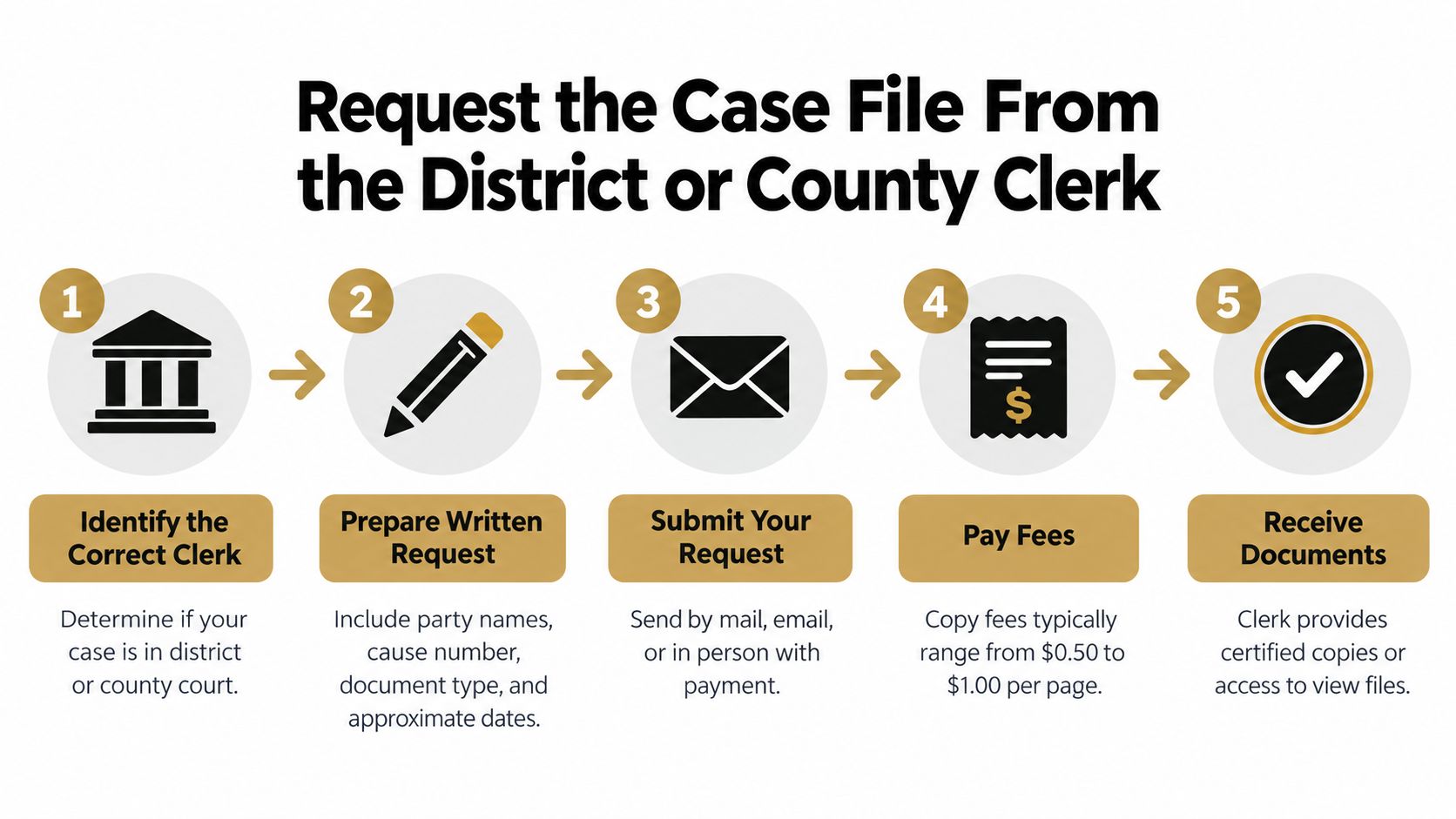
For filed documents, contact the clerk. In many Texas family cases, that means the district clerk, although some matters may be maintained through a county clerk or county court at law. County procedures differ, so use the official county website or courthouse contact information rather than assuming another county follows the same process.
Write a precise request
A useful request should identify:
- The parties' full names
- The cause number
- The court and county
- The specific document or documents
- The approximate filing, signing, or hearing date
- Certified or uncertified copy status
- Preferred delivery method
- Your contact information
Ask whether the clerk accepts requests online, by email, by mail, or at an in-person records desk. Also ask about identification requirements, payment methods, redactions, certification charges, and whether the file can be inspected before copies are ordered.
A good error-control method is to request the docket sheet first when you're uncertain about the exact order. The docket can help identify the signing date, document title, and filing sequence. You can then ask for the needed order instead of paying to copy an entire file.
Dallas County states that online access to family-court records is suspended and directs requesters toward an in-person desk or email request process. Travis County, by contrast, advertises free online viewing for family and civil cases from 2006 onward. These different practices show why a statewide search strategy fails. Check the specific county's current instructions before traveling or mailing a request.
The clerk may provide a redacted copy rather than the complete document. Public access to a docket doesn't guarantee access to every attachment, especially when the file contains confidential identifiers, information involving minors, sealed pleadings, or restricted family-law material.
Understand the distinction involving Rule 12
Texas Rule of Judicial Administration 12 concerns certain judicial records, particularly records relating to the judiciary's administrative operations. A family case file, such as a divorce decree, custody order, or pleading, is generally treated as a case record and should be requested from the clerk handling that case. The Texas Judicial Branch explains this distinction in its open-records policy.
If you're requesting an administrative judicial record under Rule 12, the written request must reasonably identify the record and go to the proper records custodian. The rule provides that generally accessible records should be available for inspection or copying during regular business hours, subject to exceptions and permitted extensions. If access is denied, the administrative appeal must be filed with the Office of Court Administration administrative director within 30 days after notice of the denial, as described in the published Rule 12 materials.
For a disagreement over the terms of a divorce, a Contested Divorce involves advocacy concerning disputed issues. Obtaining the underlying decree or hearing materials may be important, but a Rule 12 appeal isn't a substitute for requesting the case record from the correct clerk.
Order a Hearing Transcript From the Court Reporter
A transcript is not a copy of the divorce decree or custody order. It is a written record of what was said in court, generally prepared from stenographic notes or an electronic recording by the official court reporter or court recorder.
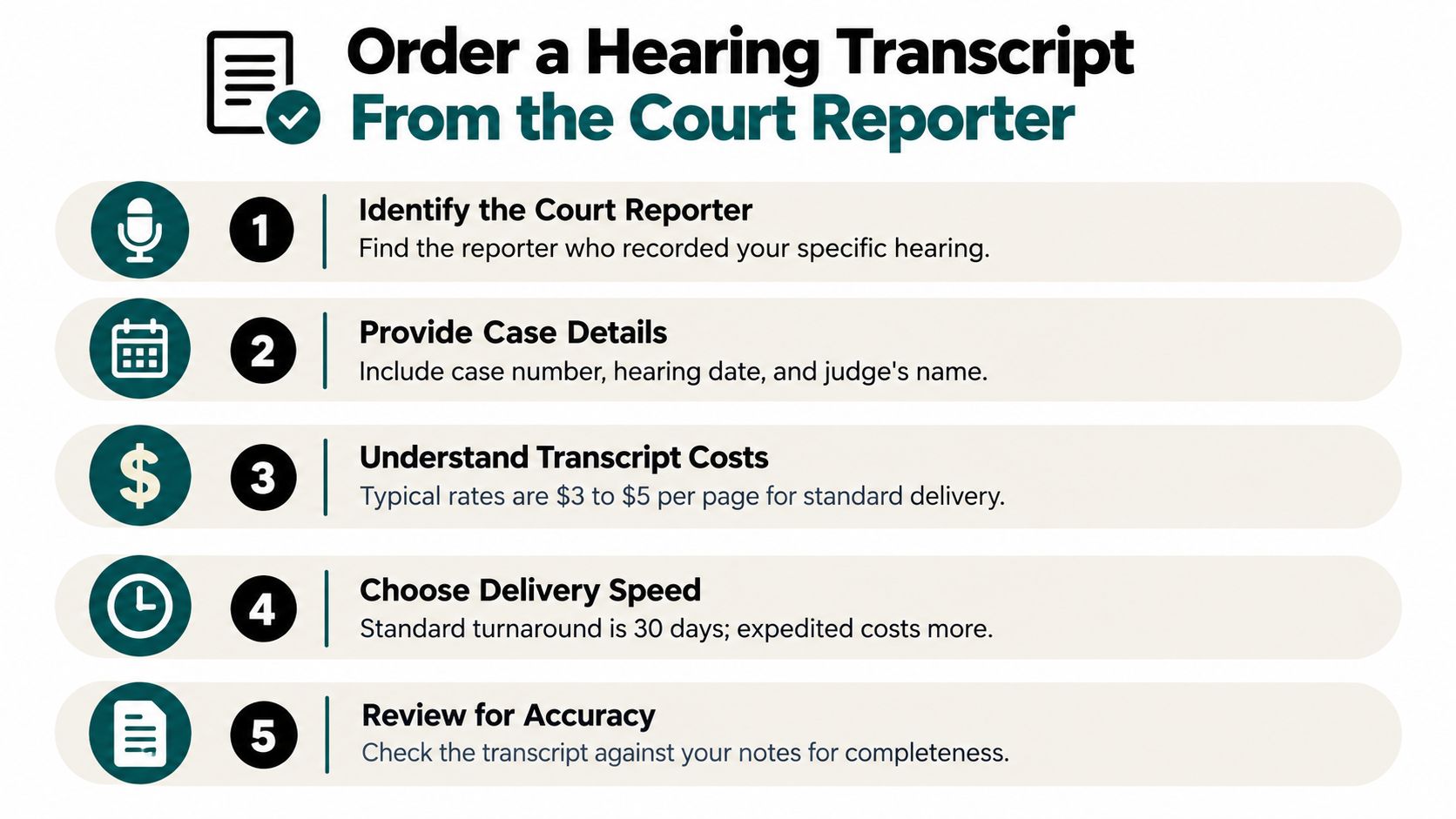
Start with the docket, judgment, or court notice. Confirm the cause number, hearing date, courtroom, judge, and reporter if that information is available. Then send a written request to the reporter or reporting office, not merely to the clerk.
Give the reporter usable instructions
State the exact proceeding and the portion you need. Your request should identify:
- The parties and cause number
- The county and court
- The judge
- The hearing date
- Whether you need the entire hearing or selected portions
- Exhibits that should accompany the transcript
- Certification requirements
- Delivery format
- Any appellate or hearing deadline
Ask for a written estimate before work begins. Transcript pricing depends on the proceeding, length, exhibits, certification, delivery format, and requested speed. Don't assume that ordering a few pages will be treated the same as ordering a multi-day evidentiary hearing.
Know the appellate distinction
In an appeal, the transcript generally forms part of the reporter's record, while filed pleadings and orders belong in the clerk's record. Texas appellate guidance explains that a reporter's record may include the court reporter's transcription and designated exhibits when proceedings were recorded stenographically. When the proceeding was recorded electronically, the record can include certified recordings, exhibits, and a certified transcription when transcription is possible. See the Texas court materials on preparing the reporter's record for an appeal.
An appellant must make a written request to the official court reporter within the time required to perfect the appeal, specify the proceedings and exhibits sought, and file a copy with the trial-court clerk. The covered Texas materials describe a 15-day filing milestone for the court recorder after an appeal is perfected. Missing an appellate deadline can affect the record available for review, so involve counsel promptly if an appeal is underway.
Check whether a record exists
Not every family hearing has a transcript. Texas family-law forms contemplate that a reporter may not have recorded a hearing when the parties and judge agreed that no record would be made. If no reporter's record exists, ask the clerk whether the file contains a Statement of the Evidence, signed findings, a docket sheet, or the final order.
A person who cannot afford appellate costs may have access to procedures requiring the court recorder to transcribe or arrange transcription of the recorded reporter's record for an indigent party's appendix. That process has its own requirements, and it should be raised early rather than after an appeal deadline has become urgent.
Confidentiality, Sealing, and Records Involving Minors
A public docket doesn't mean every page is public. Texas family cases often contain information that courts protect because it identifies children, exposes sensitive medical or mental-health information, reveals financial details, or could create a safety risk.
Expect limits on sensitive material
The clerk may restrict or redact:
- Documents involving minors
- Confidential identifying information
- Sealed pleadings and exhibits
- Mental-health evaluations
- Custody evaluations
- Adoption or juvenile-related materials
- Information protected by statute or court order
Some restrictions apply by law. Others result from a judge's sealing order. A final decree may be available while an attached evaluation or financial exhibit remains inaccessible. The clerk may tell you that you need a court order, a party's authorization, or a restricted-access procedure.
Consider a parent enforcing an out-of-state custody order. The parent may obtain a certified Texas order but still be unable to receive every exhibit from the original case. Or a spouse may need confidential financial disclosure from a prior divorce for a new proceeding and discover that the file contains redactions rather than a complete production.
Ask for the lawful alternative
If the complete document is restricted, ask what can be released. The available option may be a redacted copy, a docket entry, a certified order without attachments, or an application for court permission. Don't try to bypass a seal by sending repeated requests to different courthouse offices. That rarely solves the problem and can create confusion about what you're entitled to receive.
For a custody, enforcement, or modification case, a lawyer can help determine whether the requested material is legally necessary, whether a court order should be sought, and whether another document proves the same fact with less intrusion into a child's privacy.
Fees, Timelines, and What to Do if a Request Is Denied
Plan for two different cost structures. Clerk charges relate to copying, certification, mailing, and sometimes electronic delivery. Reporter charges relate to transcription, exhibits, certification, and speed. The office holding the record sets or applies the relevant charges, so request a written estimate before authorizing extensive work.
The figures shown in the clerk's process materials illustrate why estimates matter. A county may describe copy fees of $0.50 to $1.00 per page, while the hearing-transcript infographic identifies typical standard rates of $3 to $5 per page. These are planning ranges, not a promise that every county or reporter will charge the same amount. See the Texas court-record guidance and the reporter-record materials before relying on a quote.
| Item | Typical Range | Who Sets It | Turnaround |
|---|---|---|---|
| Clerk copy | $0.50 to $1.00 per page, as illustrated in the county-request guidance | County or district clerk | Depends on county process and file size |
| Certified clerk copy | Varies by certification and copying requirements | County or district clerk | Depends on county process |
| Standard transcript | $3 to $5 per page, as illustrated in the transcript-request guidance | Court reporter or recorder under applicable rules | Standard timing depends on the proceeding and reporter |
| Expedited transcript | Higher than standard delivery | Court reporter or recorder | Faster delivery may be available by agreement |
A reporter may request a deposit before beginning. Exhibits, certification, electronic media, and expedited work can add separate charges. If you need only one hearing segment, identify it precisely because narrowing the request may reduce cost and delay.
Use the right response to a denial
Ask the clerk to explain whether the denial concerns a missing record, a sealed document, an improper custodian, or an incomplete request. If the issue is a family case file, correct the request and direct it to the clerk. If the issue involves a Rule 12 judicial record, follow the written appeal process and remember the 30-day deadline described in the rule materials.
Do not treat a transcript denial and a clerk denial as the same problem. A clerk cannot create a transcript that was never recorded, and a reporter cannot release a sealed pleading maintained in the case file.
When It Pays to Have a Texas Family Law Lawyer Handle the Request
Self-help works well when you know the county, cause number, document, and hearing date. It becomes inefficient when the file is sealed, the county's online access is suspended, the reporter is difficult to identify, or an appeal deadline is approaching.
Legal help is especially sensible in four situations:
- An appellate record is required: Counsel can distinguish the clerk's record from the reporter's record and track the written requests needed for the appeal.
- The hearing may not have been recorded: A lawyer can evaluate whether a Statement of the Evidence, signed order, or other substitute may support your position.
- The file contains restricted family material: Counsel can determine whether to request a redacted copy, seek permission, or rely on a different document.
- The record affects another case: Interstate custody, enforcement, immigration, relocation, and modification matters often turn on the exact language of an earlier order.
The Law Office of Bryan Fagan, PLLC serves clients across Houston, Dallas-Fort Worth, Austin, San Antonio, and surrounding Texas communities in divorce, custody, enforcement, and related family-law matters. A consultation can clarify which records are likely obtainable, whether a transcript exists, and whether obtaining the document is enough or whether the court needs to address a larger legal issue.

A lawyer should step in early when a missing transcript could affect an appeal, enforcement action, or custody decision.
If you need help navigating divorce, custody, or estate planning in Texas, contact The Law Office of Bryan Fagan today for a free consultation.
The Law Office of Bryan Fagan, PLLC can help you identify the correct Texas clerk or court reporter, evaluate access barriers, and connect the record request to your divorce, custody, enforcement, or estate-planning needs. Schedule a free consultation so you can move forward with a clear records strategy and advice suited to your situation.


