
A Texas name change does not erase, seal, expunge, or hide a criminal record. Advice that a different surname will give you a clean background check confuses an identity change with criminal-record relief.
If you're rebuilding after divorce or trying to move forward from an old case, that distinction can feel discouraging. But understanding how a Texas name change affects a criminal record helps you choose the right paperwork, avoid inconsistent records, and pursue any separate relief you may qualify for.
A New Name Does Not Clear the Record
A court-ordered name change updates your civil identity, and that is all it updates. Your criminal-history record works like a folder: the order puts a new tab on the folder, and the papers inside stay the same.
Maria Lopez legally becomes Maria Garcia. Her new identification says Garcia. A background report lists Lopez as a former name tied to the same person, because the reporting system links both surnames to one identity. The report is doing exactly what it was designed to do.
That connection runs deeper than spelling. Fingerprints, birth dates, and government identification numbers let an agency identify the person behind either surname.
Why a different name doesn't defeat identification
Searches vary in depth. A shallow search and a thorough identity check produce different results:
- Name-only searches: A search using only the new surname can miss an older entry. The record still exists and can still be disclosed; the search failed to surface it.
- Name and birth-date searches: Adding a date of birth gives the searcher another way to distinguish people with similar names and connect identifying information.
- Fingerprint-based checks: Checks used in licensing, caregiving, schools, and law enforcement identify the person rather than relying on the surname. An existing state or FBI identification number stays attached to the underlying record.
The Texas Department of Public Safety criminal-history resources treat legal-name-change processing as a criminal-records function, which fits this picture: the state attaches the new name to an existing identity record.
A report can therefore show Maria Garcia as the current name and Maria Lopez as a former name or alias. In a criminal-history database, alias means another associated name. An alias entry carries no accusation that Maria used a false identity.
The petition itself creates a connection
Texas Family Code §45.102 requires an adult petition to disclose offenses above a Class C misdemeanor, together with relevant case, warrant, and known state or FBI identifying information. The district court may also obtain DPS criminal-history information under Texas Government Code §411.111.
Filing creates a formal occasion for disclosure and hands the court a channel to investigate criminal history before deciding whether to grant the request. A name change petition can therefore raise short-term scrutiny. The filing itself puts your history in front of the court.
Practical rule: Plan to explain how your names connect, because that connection stays in the record.
For employment, housing, licensing, immigration, and firearm forms, provide your current and former legal names where requested. Read each question carefully, especially when it asks about arrests rather than convictions. If an expunction or nondisclosure order already exists, get advice about its effect on your particular disclosure obligations.
A family-law finding can also remain important independently of the name on your identification. Our explanation of how a Texas family-violence finding follows you into later cases addresses that separate concern. Treat the new surname as a paperwork update, and discuss any existing finding with your attorney before filing.
Name Change Expunction and Nondisclosure Compared
What each Texas remedy does to a criminal record
| Remedy | What changes | Effect on the criminal record | Typical eligibility | What a later search can still show |
|---|---|---|---|---|
| Adult name change under Family Code Chapter 45 | Legal name on civil identity documents | Does not erase, seal, or expunge history | Petition with required disclosures; felony and registration limits apply | Former names or aliases, plus fingerprint and ID-number matches |
| Expunction | Eligible arrest records may be destroyed or returned | Can remove an eligible event from ordinary criminal-history reporting | Narrow statutory cases, including certain acquittals, dismissals, or no-bills, not a typical conviction | After the order is granted and processed, many public searches should no longer show that arrest |
| Order of nondisclosure | Public access is limited | Seals eligible records without deleting the event | Certain completed deferred-adjudication cases or listed offenses, subject to statutory exclusions and waiting requirements | Law enforcement and some agencies retain access; many public searches cannot show the sealed record |
| Divorce decree restoring a prior name | Authority to use the former name | No change to the criminal case or sentence | A spouse has a decree granting restoration | Records may remain indexed under the charging name until the relevant agency updates its file |
Start with the result you need, then identify the procedure that delivers it. A person who wants a different legal name files a Chapter 45 petition. A person who wants an arrest gone from ordinary reporting needs an expunction. A person who wants public access restricted needs nondisclosure. Each remedy answers a different question, and filing the wrong one changes nothing about the record you were worried about.
An adult name change concerns the name you legally use. The Texas courts' District Clerk Manual describes identifying disclosures that preserve connections between the petitioner and existing records, including birth date, government identification information, and criminal-history references. Those identifiers keep the old and new names on one file, so a search that finds either name can follow it to the other.
Record relief requires a different legal review
Expunction addresses eligible criminal records themselves. A dismissal may justify investigating eligibility, but eligibility is never automatic: the qualifying categories are narrow, and an attorney needs to review the disposition and the applicable statutory conditions before filing anything.
Nondisclosure addresses access rather than destruction. A person may qualify to restrict public access while law enforcement and certain agencies can still obtain the information. For an accessible explanation of the difference between deletion and restricted access, Brian Hansford Law's expungement guide provides useful context, although Texas eligibility requires a Texas-specific review.
Whichever remedy fits, it requires its own order. Finishing probation or deferred adjudication closes the case, but the relief exists only where a separate statute authorizes it and its requirements are met.
A divorce decree has a narrower job
A decree restoring a former surname gives you documentation for that identity change. It does not notify DPS, the FBI, employers, or background-screening companies, and it leaves the criminal judgment exactly as it was. If a record was indexed under the name used at charging, expect to show the decree before an agency updates its file.
A name change makes identity consistent. Only separate, authorized criminal-record relief can limit access to eligible history, and many convictions qualify for neither expunction nor nondisclosure.
If your real concern is public reporting, seek a criminal-law review rather than filing another name-change petition. Our Criminal Defense representation includes family-related charges, which can make coordination important when criminal and family proceedings overlap.
Felony Convictions and Registration Duties
Criminal history shapes whether the court may grant the change, not merely which agencies you contact afterward. Filing the petition invites that review. It requires disclosure, and the court can pull your DPS history. Fingerprints and ID numbers tie your old and new names to one file, so a new name never creates a new record.
Ordinary disclosure still matters
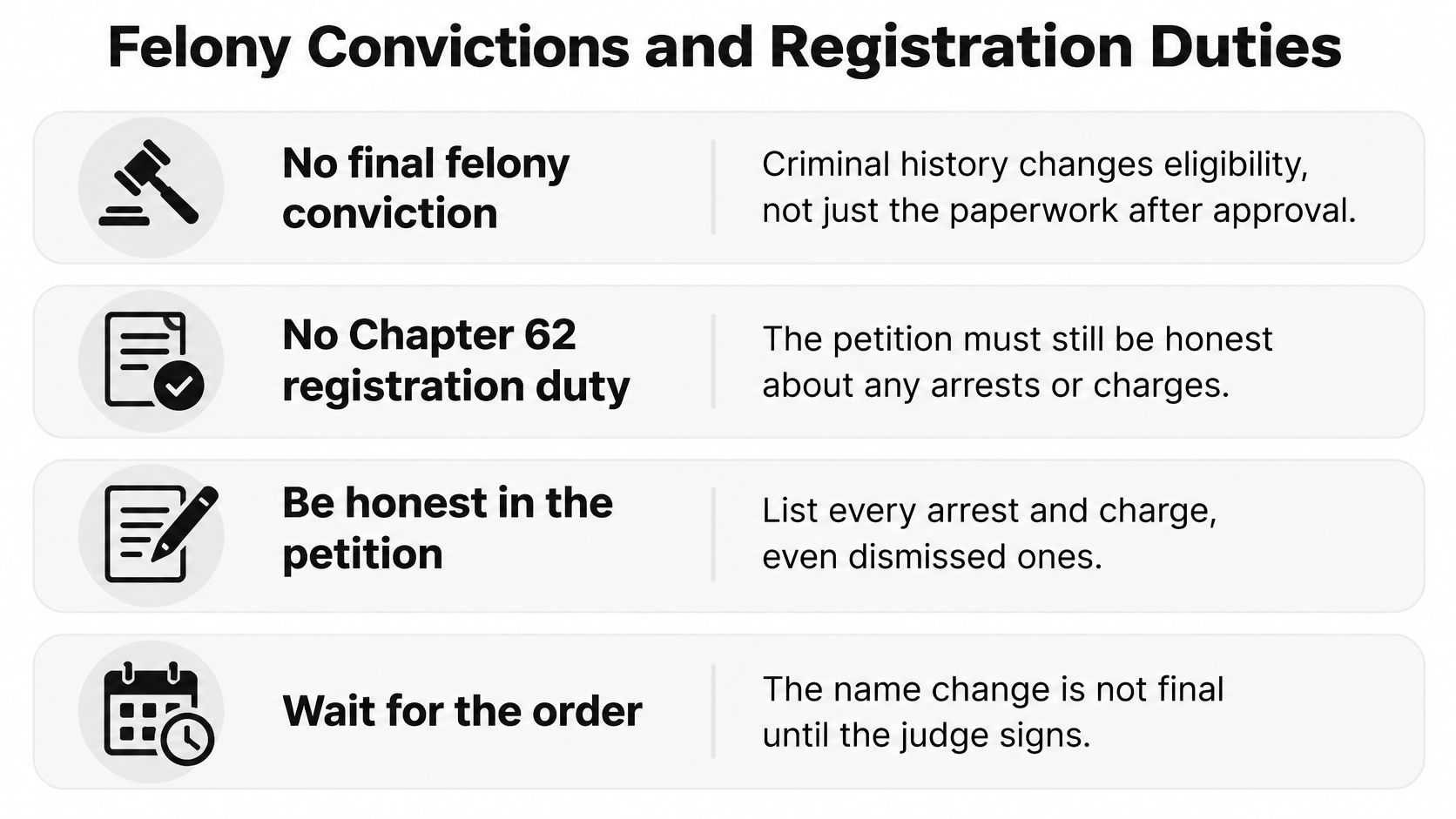
An applicant without a final felony conviction or registration obligation still needs an accurate petition. A dismissed charge can still belong in the required disclosures, and a case you completed years ago may need to appear in the petition too.
The disclosure trigger covers offenses above Class C, a different threshold from a traffic-level Class C matter. Don't classify an offense from memory or assume the punishment tells you everything you need to know. If you're uncertain, pull the charging document and the disposition.
Give your attorney the complete history so they can determine which events belong in the petition. An omitted case costs more credibility than a disclosed one ever will.
A final felony changes the eligibility analysis
Texas Family Code Chapter 45 bars a person with a final felony conviction from a name change until at least two years after discharge or completion of supervision, unless a pardon or another statutory pathway applies. The court also requires the documentation proving that discharge or completion.
To confirm the controlling date, pull the paperwork that establishes when your sentence or supervision ended, and have an attorney review it before you choose a filing date.
Texas law also treats two requests differently: adopting an unrelated surname versus requesting the primary name already used in your criminal-history record. The Texas State Law Library's family-issues guidance identifies that exception and explains the additional notification requirement for applicants subject to registration.
Registration requires notice and continued compliance
If sex-offender registration applies to you, the petition carries added conditions. You must satisfy the applicable eligibility rules and provide proof that the appropriate local law-enforcement authority received notice of the proposed change. A request motivated by personal safety still requires that legal review.
Gather these documents before filing:
- Case records: Charging papers, cause numbers, courts, and final dispositions.
- Eligibility documents: Discharge certificates, supervision-completion records, or pardon paperwork.
- Notice evidence: Proof of the required law-enforcement notification when registration applies.
Approval changes your name. Probation, registration duties, and conviction-based restrictions stay in force after the order is signed. Professional licensing deserves separate attention as well. Our discussion of what a Texas criminal conviction does to a professional license explains why the licensing question shouldn't be confused with permission to use a new name.
How to Update Agencies After the Order
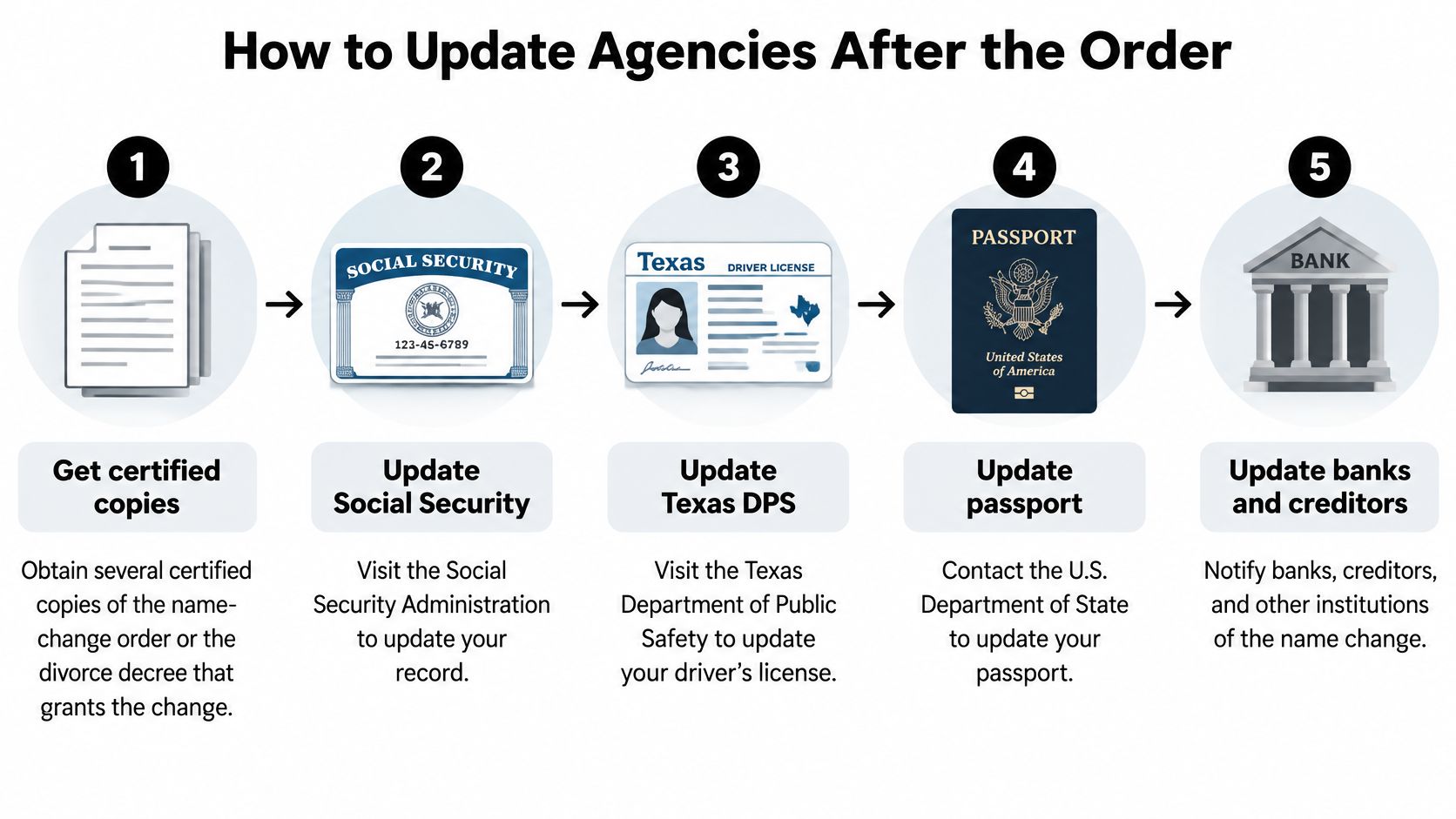
The signed order updates nothing on its own. Each agency keeps its own record, and the order is the document you carry from office to office to connect your new name to it. Your fingerprints and identification numbers already tie both names to one file, so you are documenting a single identity rather than starting a clean one. Each certified copy you submit creates another documented link between the two names, which is why consistency matters more than speed.
Order several certified copies of the signed order or the divorce decree granting the change, and keep one unmarked copy in your permanent records. Nearly every office below will ask to see one, and some will keep it.
Each office controls its own record
Updating Social Security while leaving DPS criminal history untouched produces two different names in the screening results an employer sees. The fix is documented coordination with every office that holds your file. Texas DPS treats the criminal-history update as its own legal-name-change procedure through its DPS criminal-history services, separate from the driver-license change.
Where to send a Texas name-change order
| Agency or user | What to supply | What gets linked | What does not disappear |
|---|---|---|---|
| Social Security Administration | Certified order and identity documents | SSN record reflects the new legal name | DPS, court, and FBI criminal files |
| Texas driver license or ID | Order plus DPS identification requirements | Photo ID matches the order | Historical criminal identifiers |
| Texas DPS criminal history | DPS legal-name-change materials and signed order | New name connects to the existing computerized record | Arrest, charge, or conviction entry |
| District clerk and trial court | Certified order and cause number | Case index can associate the new name with the existing case | Judgment, sentence, and court history |
| Probation, registry, or licensing body | Certified order and both names | Agency identifies the correct person | Registration, probation, and license restrictions |
| Employer, landlord, or firearm form | Current and former legal names as requested | Disclosure matches the background report | Information the law still permits to be reported |
For a family whose records span several proceedings, our guide to how a Texas name change works across divorce, adoption, and probate offers related context. Review estate-planning documents too, so an executor or agent can readily connect your names, and update the personal and financial records that still carry the old name.
Two follow-up steps protect you once the agencies are updated:
- Check the federal connection. Ask DPS how the legal-name update connects to any FBI identification number on file. Federal criminal-history identification generally follows fingerprints and underlying records rather than a typed surname.
- Keep a submission log. Record the receiving office, documents sent, and confirmation received for each agency. Before a major job or license application, obtain your criminal-history report and check whether the names and case outcomes are accurate.
Scenarios That Show What Actually Changes
Maria restores her surname after divorce
Suppose Maria Lopez's criminal case was dismissed, and her divorce decree later restores Maria Garcia. She can use the decree to update her Social Security record and identification, but the dismissal and name restoration answer different legal questions.
A fingerprint check may still associate Lopez with her history, including after DPS adds Garcia. If the dismissal qualifies for expunction, Maria needs to pursue that separate remedy. Her divorce decree can document who she is now without controlling who may access the old arrest record.
The practical outcome is a documented identity change, not automatic record relief. Maria should keep her dismissal paperwork alongside the decree so she can explain both accurately when necessary.
Name-change paperwork can be part of moving forward, but each document has a specific purpose.
James wants his spouse's surname after discharge
Suppose James has a final felony conviction, receives his discharge certificate, and wants to adopt his spouse's surname before the ordinary waiting period has run. He shouldn't assume that finishing the sentence makes him immediately eligible.
His attorney needs to determine whether the usual timing rule controls or whether a pardon or primary-criminal-history-name exception applies. An unrelated new surname and a name already central to his criminal-history file aren't necessarily handled the same way.
Even if James becomes eligible for the change, the order won't resolve separate firearm, licensing, or employment restrictions associated with his conviction. He needs answers to those questions before making plans that rely on the new name.
A parent seeks a protective change during custody litigation
Suppose a parent subject to registration wants a different name for safety reasons while a custody case is pending. The safety concern deserves careful attention, but it doesn't bypass eligibility or law-enforcement notice.
The parent must continue applicable registration appointments and reporting, including address and internet-identifier reporting where required. Counsel should coordinate the request with the custody disclosures rather than allowing different names to appear without explanation.
In a custody or CPS matter, explain inconsistent names before someone mistakes them for an attempt to conceal information.
Bring the draft petition, criminal dispositions, discharge documents, and any registration notice to a lawyer before filing. That gives counsel a chance to identify the actual obstacle, whether it's eligibility, incomplete documentation, or the need for separate record relief.
Fix the Mismatches Before You File
A closed case still belongs in the petition. The Texas adult name-change provisions require disclosure of criminal-history status, including whether a final felony conviction or registration obligation applies. Have counsel check the petition against the actual court records rather than your recollection.
A signed order reaches only the offices you notify. The order in your desk drawer does not tell a probation officer, licensing board, or registry administrator what changed. Keep proof that each relevant office received the documents.
Former-name questions call for every name you have used. On firearm, immigration, housing, and licensing paperwork, respond to the wording of the question. The name already sitting in your criminal-history file carries that history with it, and a signed identity order does not end a continuing legal duty attached to it. If you are unsure how existing record relief affects an answer, get advice before signing.
The filing itself is what raises the stakes. Submitting the petition forces the disclosures above, lets the court pull your DPS history, and keeps both names tied to the same fingerprints and identification numbers in one file. A mismatch that never surfaced before can surface now.
Prepare one accurate identity file
Before filing, assemble a short checklist:
- Names: Current, former, and other names appearing in your records.
- Cases: Cause numbers, courts, charges, and dispositions.
- Completion documents: Discharge, supervision-completion, or pardon paperwork.
- Registration status: Applicable obligations and proof of required notice.
- Your objective: Consistent identification, restricted public access, or both.
Our offices are in Houston, Austin, Dallas, and San Antonio, and a consultation can identify which family-law and criminal-record questions need separate attention before you file.
Information on this website is for general information purposes only, not legal advice for any individual case. Viewing the website does not create an attorney-client relationship.
The Law Office of Bryan Fagan, PLLC offers family-law and criminal-law representation for Texans weighing how a proposed name change connects with existing cases and continuing obligations. If you need help with divorce, custody, or estate planning in Texas, contact the firm for a free consultation.