
You've just come home from a temporary-orders hearing, and your monthly legal statement arrives. Your retainer has dropped by several thousand dollars, there's an amount-due box, and another line mentions replenishment. When you're already worried about your children and household expenses, it's easy to wonder whether you're being charged twice.
Learning how to read a Texas family law billing statement starts with separating money the lawyer has earned, money still held for you, and money you need to pay now. Those aren't necessarily the same amount.
What Every Line on the Statement Shows
A legal statement is a running account of your case, not automatically a demand for another payment. Read it from the top down before reacting to the largest number.
Start with the matter caption, billing period, and invoice number. Confirm that the statement identifies your case and the period you're reviewing. Keep the invoice number handy when asking questions so the billing team can locate the right record.
Next, examine the work entries. An hourly entry should identify the service date, person performing the work, task, time, and rate. A flat-fee charge works differently: it should correspond to a defined service or stage described in your agreement, such as preparing an agreed decree.
Separate legal work from case expenses
Attorney fees pay for professional services. Costs and disbursements cover items such as district-clerk filing fees, service of citation, mediation, copies, travel, and permitted electronic-payment charges. Separating these categories lets you compare the work with your case records and the expenses with your contract.
The Texas Disciplinary Rules of Professional Conduct, particularly Rule 1.04, prohibit an illegal or unconscionable fee, meaning one a competent lawyer couldn't reasonably believe is reasonable; for arithmetic purposes, a 0.3-hour entry at $400 per hour equals $120, before expenses or credits.
That standard doesn't mean an upsetting total is automatically improper. It means you should evaluate the charges against the agreement and the services performed. Outside-counsel or fee-sharing charges should also be identifiable rather than buried in an administrative category.
Use each block as a checkpoint
A detailed entry separates tasks clearly. Block billing combines several tasks into a single time total, making it harder to determine how much time went toward each activity.
The final account blocks describe money moving into and out of your account. Payments, credits, trust withdrawals, current charges, and requests for future deposits serve different purposes.
Sections of a Texas family law billing statement
| Statement section | What it usually shows | Compare it with |
|---|---|---|
| Matter caption and period | Case name, billing month, and invoice number | Cause number and the month the work occurred |
| Hourly time entries | Date, timekeeper, task, hours, and rate | Engagement-letter rates and work you know happened |
| Flat fee | One charge for a defined stage of the case | The scope named in the fee agreement |
| Block-billed entry | Several tasks combined into one time total | A request to split tasks, timekeepers, and increments |
| Costs and disbursements | Filing fees, service, mediation, copies, travel, card fees | Receipts and costs the contract allows |
| Retainer or trust activity | Opening balance, deposits, transfers, and closing balance | Your deposits and the earned-fee total |
| Payments and credits | Amounts already paid or written off | Bank, card, or trust records |
| Amount due | What the firm says is payable now | Earned fees and costs not already covered by trust |
| Replenishment request | A request to restore a minimum trust balance | The minimum in the letter, not the amount due |
How to Match the Bill to Your Fee Agreement
Your signed engagement letter, also called a fee agreement, is the starting point. It explains what the firm agreed to do and how you agreed to pay for that work.
The State Bar of Texas billing and collection materials recommend documenting the anticipated scope of services and the basis for fees and incidental expenses. Use that document, your statement, and your payment records together.
Follow the account from agreement to payment
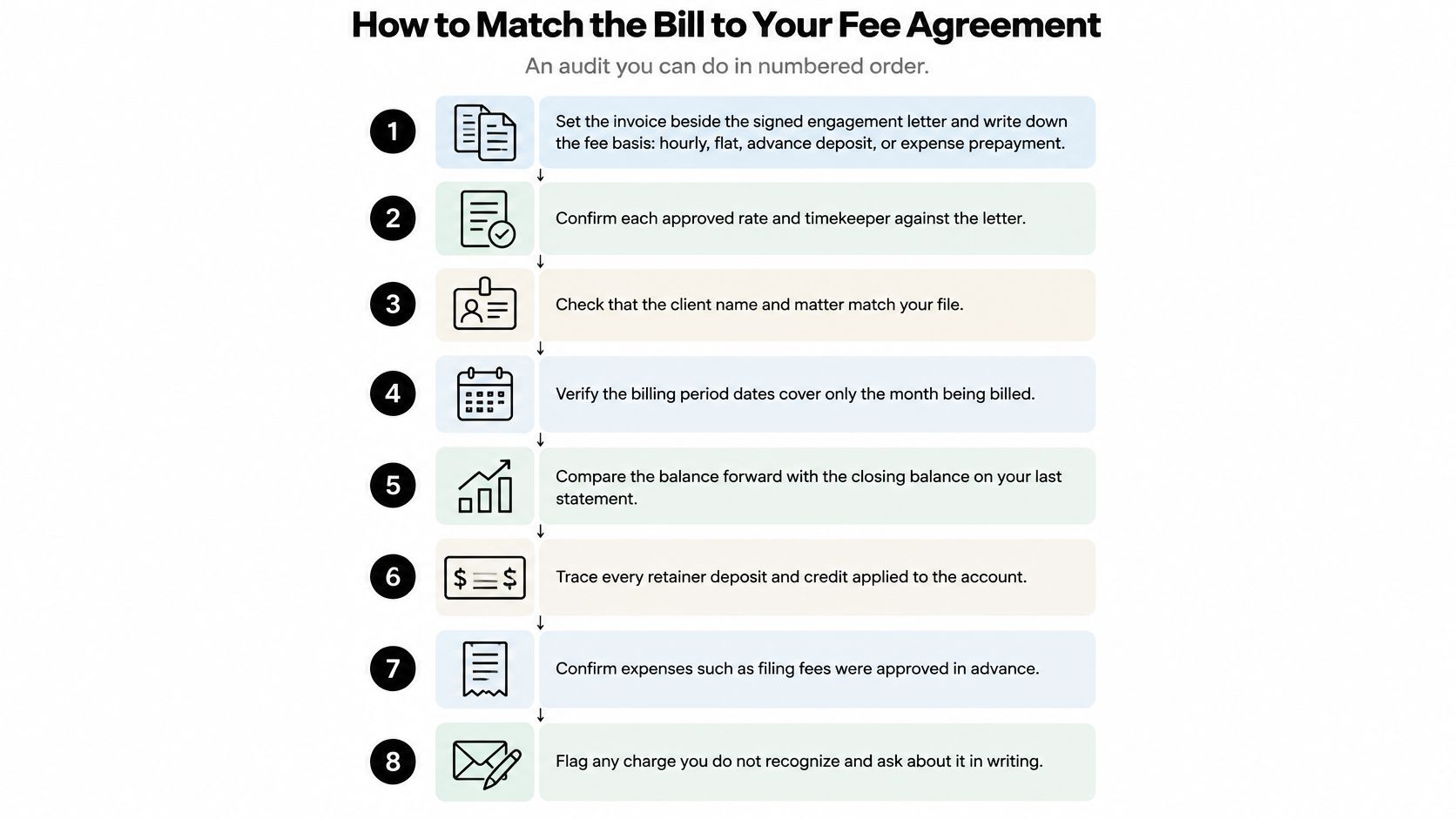
Identify the arrangement. Write down whether the agreement provides hourly billing, a flat fee, an advance deposit, or expense prepayment. Record approved rates, billing increments, covered services, chargeable costs, payment deadlines, and replenishment requirements. If the deposit language is unfamiliar, our explanation of what a Texas family-law retainer actually covers can help you interpret it.
Confirm the period and rates. Check the client name and matter, then compare each timekeeper's rate with the agreement and any written rate-change notice. Look for older work carried forward, and compare the opening unpaid balance with the previous statement's closing balance.
Calculate each hourly charge. Multiply the recorded time by that person's contract rate. Don't assume every person listed bills at the attorney's rate. If the arithmetic doesn't match, mark the line without assuming why the discrepancy occurred.
Review permitted expenses. Check whether the agreement allows the expense and whether any required approval was obtained. A vendor invoice or receipt can explain what a third-party charge includes.
Subtract payments and credits. Trace your bank or card payment to the statement. Distinguish a payment applied directly to an outstanding invoice from a deposit placed into trust for later work.
Reconcile trust separately. Use this formula: opening trust balance + deposits − earned fees − authorized costs − refunds = ending trust balance. Don't subtract the same trust transfer again as though it were another charge.
Match the work to the case calendar. Compare service dates with pleadings, hearings, emails, discovery requests, and approvals. Hearing preparation may occur before the court date, while follow-up drafting may appear afterward.
Request a written resolution. If a figure won't reconcile, ask for the client ledger and a written explanation or correction. Keep undisputed amounts current rather than rejecting the entire statement.
Check the deadline in the agreement
The State Bar's guidance on communicating fees says the fee's type, basis, or rate should be clearly communicated, preferably in writing, before or reasonably soon after representation begins; if your agreement requires payment within 30 days of the statement, that contractual deadline determines when the unpaid balance becomes overdue.
Monthly statements can help communicate case status, but your hearing date isn't necessarily your payment deadline. Review both calendars so a billing question doesn't get lost during litigation preparations.
Practical rule: Finish your review with separate figures for fees earned, money held in trust, and money payable now.
How Billing Increments and Time Entries Work
An hourly statement expresses time as a fraction of an hour, not as minutes written after a decimal point. Reading that distinction correctly can make an unfamiliar charge much easier to understand.
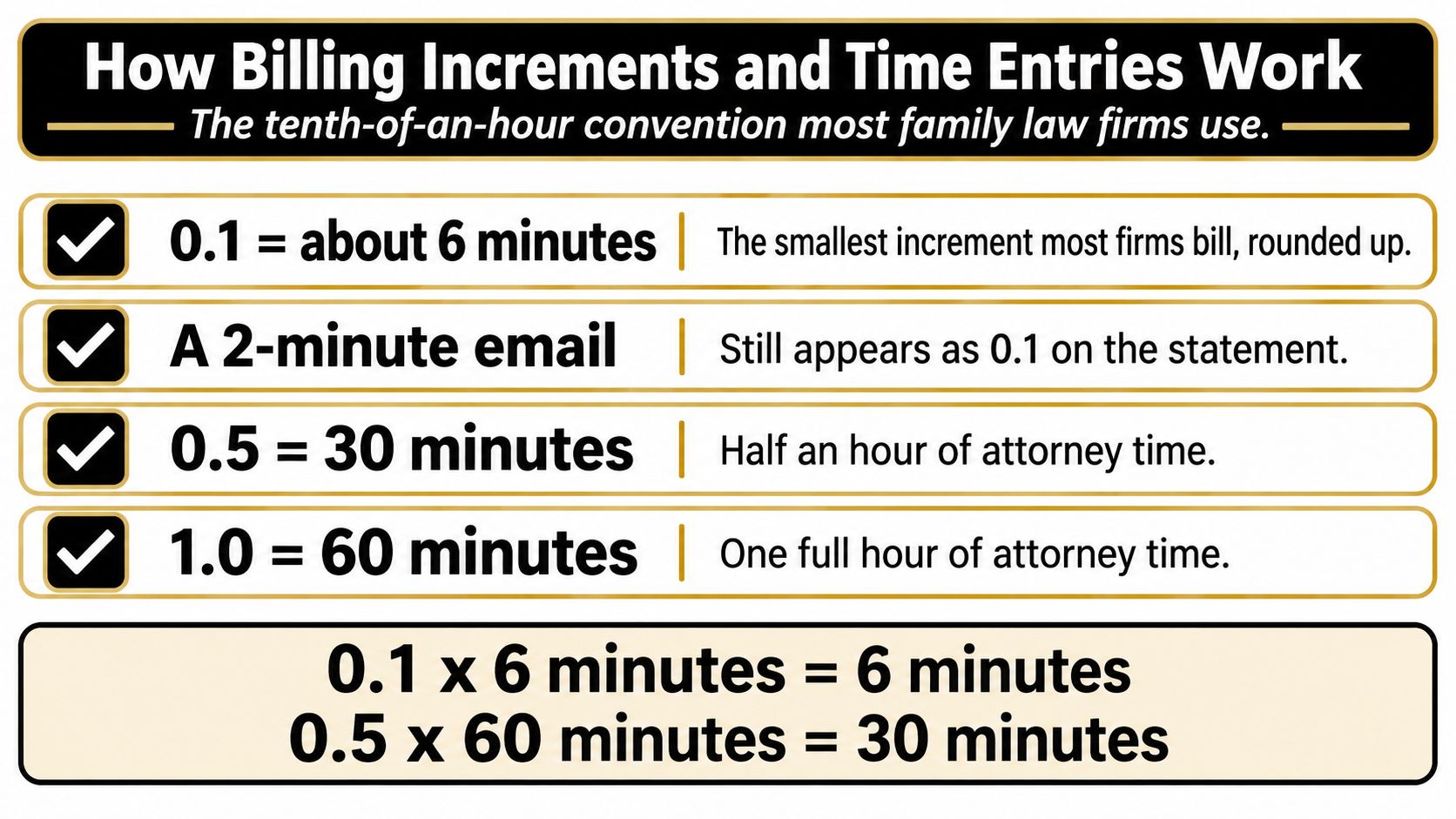
For a hypothetical agreement using tenth-of-an-hour increments, 0.1 means six minutes, 0.5 means thirty minutes, and 1.0 means a full hour. A two-minute email could appear as a tenth of an hour if that agreement permits rounding to that increment. Check your own contract rather than assuming every firm follows the same convention.
The timekeeper changes the calculation
Consider a hypothetical comparison: an attorney bills an hour at $400, while a paralegal bills an hour at $200. The duration is identical, but the charges differ because the approved rates differ. These are illustrations, not statements of our firm's rates.
That's why an entry needs more than a time total. The Texas Bar's discussion of billing records and fee proof identifies the information needed to evaluate work: the services performed, who performed them, approximately when they occurred, the time reasonably required, and the applicable rate.
Use those details as a reading checklist:
- Person: Can you identify the attorney, paralegal, or other timekeeper?
- Date: Does the entry indicate when the service occurred?
- Task: Does the description explain the legal work?
- Duration: Can you see the time attributed to it?
- Rate: Can you connect that person's charge to the approved rate?
A line saying “work on case” gives you little to evaluate. Reviewing a proposed custody order for consistency with the mediated agreement describes a task you can connect to your case, especially when the entry includes the timekeeper, duration, and rate.
No filing doesn't mean no legal work
An attorney may analyze a settlement proposal, discuss strategy with another lawyer, or advise you about a possession dispute without filing anything that day. A short call or email can therefore represent legitimate legal work.
The appropriate question is whether the entry describes professional services under the agreement. Routine scheduling or copying shouldn't be disguised as legal analysis. If a higher-rate professional handled something that appears clerical, ask what the task involved and why that person performed it.
A useful entry should let you understand the service without requiring you to reconstruct the lawyer's entire day.
Records made near the time of the work are strongly encouraged, particularly during lengthy litigation, even when contemporaneous records aren't always legally required to prove fees. If you're comparing payment arrangements, flat-fee versus hourly billing for a Texas family lawyer explains why the same time-based review won't fit every engagement.
Red Flags Worth a Closer Look
A billing red flag is a reason to ask a focused question, not proof that your lawyer overcharged you. Look for entries you can't evaluate, rather than treating unfamiliar work as unnecessary work.
Suppose a hypothetical statement lists 4.5 hours of hearing preparation before temporary orders. That may reflect substantial preparation, but a broad description won't tell you whether the lawyer reviewed exhibits, prepared testimony, or included routine administrative tasks. Ask for the components.
If attorneys both bill for an internal conference, each may have contributed necessary work. Still, you're entitled to understand their roles rather than guessing whether the statement repeats the same charge.
Look for missing explanations
A higher rate could reflect a previously communicated increase or a billing error. Compare the entry with your written records before making an accusation. Similarly, a falling trust balance without a corresponding transaction calls for a ledger, not speculation.
Advance-fee labels deserve particular attention. The State Bar of Texas Guide to Trust Accounts explains that unearned advance payments remain client funds and can't become earned solely because an agreement calls them nonrefundable. A true retainer for availability is a different arrangement, and the substance matters more than the label.
Costs can also be unclear. A messenger or filing-service charge may include services beyond the clerk's charge, but you need the underlying invoice to understand the difference. Ask whether the agreement permits any added charge.
Billing red flags and the question to ask
| What you see | Why it is hard to judge | What to ask for |
|---|---|---|
| Work on case or similar vague wording | No task to test for necessity | The task, timekeeper, date, and increment |
| Several tasks in one block of time | Clerical or duplicate time may be hidden | A split by task and timekeeper |
| Same task billed twice the same day | Possible double count of a call or conference | Which person did which part |
| Rate above the engagement letter | Unannounced change or billing error | The written rate and any agreed increase |
| Attorney rate on copying or scheduling | Staff or nonbillable work may be mislabeled | Reclassification or a write-off |
| Trust reduced with no related entry | Draw may exceed fees actually earned | The client ledger for that transfer |
| Advance called nonrefundable | The label does not by itself earn the fee | How much is still unearned and refundable |
| Cost with no receipt | Markup or third-party charge is unclear | The clerk, process-server, or vendor invoice |
Evaluate the work, not just the spike
Emergency hearings, custody evaluations, experts, business valuation, and extensive discovery can generate concentrated charges. The question is whether the descriptions and supporting records explain that activity.
These records may also matter if either party later seeks a contribution toward fees. The Texas Bar's recommendations on seeking attorney's fees explain that agreeing to pay a fee doesn't automatically establish that it is reasonable and necessary for recovery from an opponent. Under the lodestar approach, a judge needs records that permit evaluation of services, timekeepers, approximate dates, hours, and rates.
A Sample Statement With the Math Worked
A $10,000 advance sits in trust at the start of a contested custody case. Two months later, your statement shows a $7,200 balance. That $2,800 gap is the part that frightens people, and it is exactly the part a well-built statement explains line by line.
A falling trust balance means your own money moved from "held for you" to "earned by the firm." The sample below reconciles every dollar of that movement, so you can do the same with yours.
Texas Professional Ethics Opinion 608 explains why unearned advance fees must remain separate from the lawyer's funds until earned. Keep that separation in mind and the statement reads like a receipt rather than a demand.

Follow the deposit through the account
The following is a hypothetical reconciliation, not a standard figure: a $10,000 deposit, less $2,500 in earned fees and $300 in authorized costs, leaves $7,200 in trust.
For this hypothetical statement, split the earned fees into $2,200 in attorney work and $300 in paralegal work. Assume the expense is an authorized $300 filing-related cost; that is an example, not a representation of the filing fee charged in your county.
The table summarizes the account movements. An actual hourly invoice should also supply the underlying tasks and time calculations behind each fee line.
| Date | Task | Timekeeper | Rate | Fee earned | Expense | Trust-account credit applied | Balance remaining |
|---|---|---|---|---|---|---|---|
| Opening | Advance deposit received | Not applicable | Not applicable | None | None | None | $10,000 |
| During period | Custody-case legal work | Attorney | Contract rate | $2,200 | None | $2,200 | $7,800 |
| During period | Paralegal services | Paralegal | Contract rate | $300 | None | $300 | $7,500 |
| During period | Authorized filing-related cost | Third-party cost | Not hourly | None | $300 | $300 | $7,200 |
| Closing | Remaining client funds | Not applicable | Not applicable | None | None | None | $7,200 |
Separate a paid invoice from a refill request
In this scenario, the invoice's amount due for current charges is $0 because trust already covered the work and the expense. If the hypothetical agreement requires maintaining $10,000 in trust, a separate $2,800 replenishment request restores that reserve for future work.
Reading the statement correctly means seeing two different events at once: the firm applied deposited money to earned fees and costs, and the remaining funds continue to belong to you until properly earned or spent.
Budgeting distinction: Replenishment can require a new payment without being a second charge for completed work.
The State Bar of Texas trust-account guidance requires client-fund records to be retained for five years after representation ends. Unearned advance fees are generally refundable when representation ends, subject to the proper accounting.
On your own statement, identify earned this period, still in trust, and currently payable, including any separate deposit requirement. If those three figures will not reconcile, ask the firm for the client ledger. For broader planning, what a Texas family-law case costs from filing to final can help you place a busy billing period in context.
Ask for a Correction Without Risking Your Case
You can ask for clarity without accusing your lawyer of misconduct. A specific, written request gives the firm something concrete to investigate and helps preserve a workable relationship while your case continues.
TexasLawHelp's guidance on finding and affording a family-law attorney explains that clients can request itemized billing and should understand payment terms, expenses, retainers, and nonpayment provisions. Your immediate goal is an understandable account and a clear plan for ongoing representation.
Keep the request narrow and documented
Save the records. Keep the invoice, signed engagement letter, payment confirmations, and relevant emails together. Preserve the original statement even if the firm later replaces it.
List the disputed entries by service date and timekeeper. Describe the question for each line, such as an unfamiliar rate, missing credit, or unclear task, rather than objecting to the entire balance.
Ask for a written response. Request the explanation, any supporting documentation, and whether a voluntary adjustment is appropriate. If affordability is the problem rather than accuracy, ask whether a payment-plan discussion is available.
Keep undisputed obligations current and discuss any payment difficulty promptly. Review nonpayment and withdrawal language with counsel; don't assume a billing dispute pauses hearing preparation, discovery deadlines, or obligations under existing possession orders.
Request a formal accounting if needed. Ask for the client ledger, deposit confirmation, and receipts supporting unexplained withdrawals. Texas trust guidance provides that a client requesting an accounting must receive one.
Retain the corrected statement and the explanation. Make sure an adjustment appears in the account rather than relying only on a telephone assurance.
Use a calm, specific message
You might write:
Please explain the hearing-preparation entry and identify the tasks included. I also can't match the trust withdrawal to the invoice credits. Please send the client ledger and confirm whether a correction is needed.
Keep your billing obligations separate from the court's decisions under the Texas Family Code about divorce and custody. An invoice doesn't change a possession schedule, establish child support, or decide whether another party must contribute to fees. Continue following existing orders while addressing the account.
In Texas divorce cases, the judge decides case by case whether a spouse must pay the other spouse's attorney's fees. In many cases, each party pays their own lawyer, so don't budget on the assumption that your spouse will reimburse you.
Bring the court papers, petitions, fee agreement, statements, and relevant financial records to a meeting about your concerns. Include estate planning documents if those issues are involved. Our educational resources include a Cost Pamphlet on budgeting for divorce, which can help you prepare questions about future expenses.
You don't need to understand every billing term before asking for help. You need records, specific questions, and an explanation you can follow.
We help Texas families with divorce, custody, and estate planning, including understanding the financial questions that accompany those matters. Visit Law Office of Bryan Fagan, PLLC to schedule a consultation and bring your court papers, fee agreement, and statement for a focused discussion. If you need help with divorce, custody, or estate planning in Texas, contact The Law Office of Bryan Fagan today for a free consultation.