 Skip to content

A Texas family court judge is removed through a verified written motion under Rule 18b, generally filed no later than the 10th day before trial, after which the judge has three business days to recuse or refer the motion. That clock, not your frustration with a temporary order, is what decides whether anyone even looks at the request.
You left a temporary-orders hearing convinced the judge had already chosen a side. The other parent kept the school-week schedule. Your request for more time was denied. Sitting in the car afterward, the next setting feels dangerously close, and the fear is real in a custody or divorce case. A ruling you dislike does not, by itself, take that judge off the case.
Learning how a Texas family court judge gets recused starts with one concrete fact that fits a legal ground. Hurt and a legal ground are not the same thing. The pages below separate those two tracks, show the filing clock, and explain what stays in place if another judge is assigned.
Recusal or Disqualification for Your Family Judge
Texas uses two different bars, and mixing them up is how strong facts get written as weak motions. Disqualification is mandatory. Recusal is broader, and it turns on whether the judge's impartiality might reasonably be questioned. Both standards apply in Texas trial courts that hear divorce, custody, support, and property cases, as the Texas Supreme Court briefing materials on Rule 18b explain.
A judge must be disqualified when the judge previously served as a lawyer in the disputed matter, has an interest in the subject matter, or is related to a party within the third degree by blood or marriage. The Texas Government Code also bars a judge from sitting when a party is related by affinity or consanguinity within the third degree. A void judgment is the risk when a disqualified judge stays on the case. Recusal does not carry that same automatic jurisdictional defect, but it still requires the judge to step aside when the rule is met.
Recusal under Texas Rule of Civil Procedure 18b is required when impartiality might reasonably be questioned. That includes personal bias or prejudice, personal knowledge of disputed evidentiary facts, earlier work as counsel or as a material witness, certain financial interests, and specified family relationships with parties, witnesses, or attorneys. A custody order that went the other way is not on that list.
Disqualification versus recusal grounds
| Situation | Disqualification | Recusal under Rule 18b |
|---|---|---|
| Judge was a lawyer in this matter | Mandatory | Also a recusal ground if there was a prior counsel role |
| Judge has an interest in the subject | Mandatory | Financial-interest recusal may also apply |
| Related to a party within the third degree | Mandatory by constitution and Government Code | Specified family ties can also require recusal |
| Impartiality might reasonably be questioned | Not the disqualification test | Required recusal ground |
| Personal bias or prejudice | No, unless another bar applies | Yes |
| Personal knowledge of disputed facts | No | Yes |
| Prior material witness | No | Yes |
| Family tie to a witness or lawyer | Yes only if a constitutional or Government Code bar is also met | Specified relationships require recusal |
| Adverse custody or support rulings alone | No | No |
Say your temporary-orders judge used to represent your spouse in a suit affecting the parent-child relationship for the same child. That fact sits in the first row, and it is a disqualification problem, not a complaint that the possession schedule feels unfair. Say instead the judge denied two continuances and credited the other parent's testimony. That fact sits in the last row. It does not support either column.
You start the process by filing a written motion with the clerk of the court where the case is pending. The motion has to name the ground and the supporting facts. Mere dissatisfaction with a ruling is not a ground. Before you draft anything, match one real fact to one row in the table. If you cannot point to a row, a motion will not fix the order you dislike. Our divorce and custody guides on the firm site walk through temporary orders and SAPCR paperwork so you can see which paper holds that fact.
How to File the Motion Before the Hearing
The filing sequence is short, and most self-represented motions fail on verification, service, or the calendar, not on the story. There is no requirement in Texas that you be represented by an attorney in a divorce, so you can file this yourself. An unverified or unserved motion is still a common reason a judge never reaches the merits.

Mark two dates the day you learn the ground. Write down the day you learned it, then count to the 10th day before the trial or other hearing. Under the Texas Rules of Civil Procedure, the motion must be filed as soon as practicable after the ground becomes known, and generally no later than the 10th day before that trial or hearing. A late filing is allowed only when you neither knew nor reasonably should have known of the basis earlier. Waiting until the eve of a final hearing because you hoped the judge would soften is the usual slip.
Draft a verified motion that names one ground. Identify a Rule 18b ground, or a constitutional or Government Code disqualification ground, and state particular facts. The motion cannot rely solely on adverse judicial rulings. You verify the facts under oath. A narrative about unfair orders, without a named ground, is the draft that gets denied.
Attach admissible support, not a stack of feelings. Hearing transcripts, affidavits, financial or relationship records, and a dated chronology belong in the appendix. Conclusory allegations are vulnerable to denial because the assigned judge has to see proof, not tone.
File with the clerk where the case is pending and serve every party. The clerk of that court is the filing point. Skipping a party, including the attorney general if that office is a support party, is a service defect you can fix only by doing it again inside the same window.
Expect the clerk to send the filing two places. The clerk sends it to the respondent judge and to the regional presiding judge. You do not hand the motion to the judge in the hallway or attach it to a letter about next week's exchange.
Watch the three-business-day decision. Within three business days, the respondent judge must either sign an order of recusal or disqualification or refer the motion to the regional presiding judge. That presiding judge may hear the motion or assign another judge to decide it. Referral is a procedure. It is not a comment on whether you are right.
Know when the challenged judge must stop. If you filed before evidence is offered at trial, the challenged judge must stop acting in the case while the motion is pending, except for good cause stated in writing or on the record. Filing after evidence has started does not create that same pause.
A sentence you can adapt
Keep the verification sentence short and tied to one ground:
Movant verifies that Judge Alvarez represented the other parent in the 2019 SAPCR involving the same child, which is a disqualification ground, not a complaint about temporary orders.
Change the name, the year, and the fact so they match your file. Do not add a paragraph about who should have won temporary orders.
Temporary-order transcripts and enforcement filings are often where the usable facts live. A family-law docket call is also where settings get announced, so note the hearing date you are counting backward from before you leave the courtroom.
Evidence That Shows Bias Rather Than a Loss
A Houston father lost a temporary possession schedule, then a discovery fight, then a continuance. By the third loss he wanted the judge off the case before the next custody hearing. Those three rulings feel like a pattern. Under Rule 18a they are usually a record for appeal, not a recusal file.

The Hays County publication of the Texas Rules of Civil Procedure states the line plainly. A motion must identify the specific facts supporting recusal, and it cannot rely solely on the judge's rulings. Repeated adverse custody, support, discovery, or evidentiary decisions usually belong in an appeal, or in a mandamus aimed at the ruling itself, unless extra facts show a legally recognized appearance of bias, personal interest, relationship, or prior involvement.
Two scenes, one chart
Picture opposing counsel as the judge's former law partner, with a fee-sharing arrangement that still pays the judge's old firm on other matters. That is not "the judge likes them." Map the partnership and the money to the impartiality ground or the financial-interest ground, and attach the records that show the tie.
Now picture the same judge denying two continuances and believing the other parent about bedtime exchanges. That scene has rulings and credibility findings. It does not have a relationship, a financial interest, or personal knowledge learned outside the evidence. It is not enough.
Build a one-page chart before you write the motion. Each row gets one exhibit and one rule or constitutional provision. If a row only says "judge ruled against me," delete the row.
What evidence distinguishes legally cognizable bias from an unfavorable decision, and which remedy actually protects you before the next custody hearing?
What a denial does and does not do
The challenged judge must generally either recuse or refer the motion to the regional presiding judge within three business days. That referral does not mean the motion has merit. Denial is ordinarily reviewable after final judgment. Mandamus is generally unavailable when the judge timely performs the recuse-or-refer duty. You cannot treat a lost motion as an instant appeal of the custody order.
Clients should bring relevant documents such as court papers, petitions, contracts, financial records, and estate planning documents. Bring the petitions, the temporary orders, the transcripts, and the financial records so the chart can be tested against the file rather than against memory. A clean family court record or transcript is also what an appellate lawyer needs if the underlying problem is legal error in the order, not the judge's right to sit.
If you want a short walk-through of how lawyers separate a recusal record from an appellate record, this overview is a useful start.
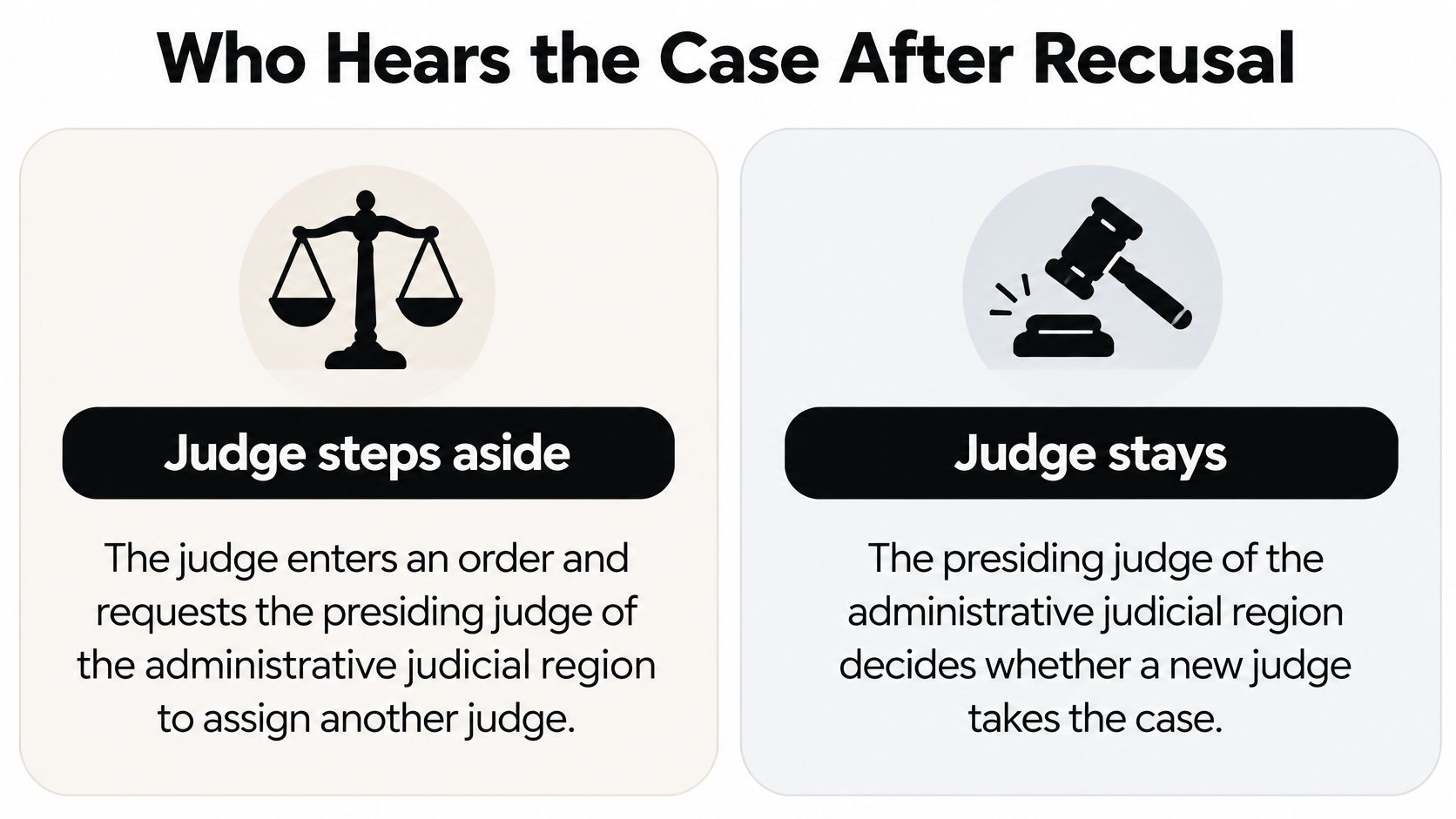
Who Hears the Case After Recusal
Two endings are possible, and neither one restarts your divorce.
If a Texas district judge independently concludes that recusal or disqualification is appropriate, the judge must enter an order, request that the presiding judge of the administrative judicial region assign another judge, and take no further action except for good cause stated in that order. If the judge instead refers the motion, an assigned judge decides whether removal is legally required. Either path changes who presides. It does not, by itself, vacate temporary custody, support, or property orders, cancel every setting, or send you back to an original petition.
What the statewide numbers show
This is ordinary judicial administration, not a rare appellate event. In fiscal year 2023, Texas trial courts recorded 2,338 visiting-judge assignments for voluntary recusal, 950 involving active judges and 1,388 involving retired or former judges, according to the Texas Judicial Branch FY2023 statistical report. The same report recorded 84 assignments for involuntary recusal (12 active and 72 retired or former), 169 for voluntary disqualification, and 3 for involuntary disqualification. Voluntary recusal was more than 27 times involuntary recusal. Those voluntary-recusal assignments increased by 29 percent from the preceding year, while assignments made to address heavy dockets declined by 9 percent.
Many of those assignments reflect a judge stepping aside, a retired judge's availability, or docket help. They are not a statewide finding that judges acted improperly. Once a judge recuses or is removed after a contested motion, another qualified judge may conduct hearings so the docket keeps moving. A visiting judge, including an eligible retired domestic-relations judge, can hear an emergency possession request. Your spring-break exchange does not wait for a brand-new case number.
What to ask the clerk
- Get the paper. Obtain the signed recusal order or the referral order before you leave the clerk's window.
- Confirm the name. Ask which judge has been assigned, and get the assignment order if one exists.
- Ask in writing about settings. Ask how existing hearings and deadlines will be handled, including any temporary-orders compliance date.
Statutory probate courts are subject to Rules 18a and 18b through Texas Government Code provisions, but special statutory procedures may apply. If the same family also has a probate or guardianship matter, that file needs its own look rather than an assumption that the family-court order covers it. Our probate and family-law materials are the related reading when both files are open.
Protect Orders and Choose Another Remedy
Your motion can be pending in the same week a spring-break exchange or a child-support withholding is already set. Recusal does not automatically stop the family case. Temporary custody orders, support orders, and protective orders do not vanish because you challenged the judge.
Under the Government Code provisions on judicial administration, if the district judge concludes that recusal or disqualification is appropriate, the judge enters an order, asks the regional presiding judge to assign another judge, and takes no further action except for good cause stated in the order. Proceedings in a temporary custody, support, or property case may still need to continue. The case is reassigned so the work can go on. Pending issues do not disappear.
While the motion is pending
- Ask in a filed request, not a side letter. Ask whether an emergency matter may proceed for good cause stated in writing or on the record. Do not argue the recusal facts to the challenged judge in a letter about the exchange.
- Get the stay or good-cause language in the order. If the judge keeps a setting, the reason should be on the order or on the record.
- Confirm the next setting with the clerk after any referral or assignment, and calendar it the same day.
- Keep exchanges in writing. Texts and emails about pickup times protect you if someone later claims you used the motion to skip possession.
Remedies that are not recusal
A motion to transfer addresses venue or convenience. It does not remove a judge because you disliked a possession schedule.
A complaint to the State Commission on Judicial Conduct addresses judicial ethics. It does not take the judge off this case, and it does not change existing orders.
Legal error in custody, support, or property rulings is preserved for appeal after final judgment, or for mandamus when that remedy is available. Objections, offers of proof, and a complete record do that work. A recusal motion does not.
If the problem is a missed deadline or a case sitting inactive, look at dismissal for want of prosecution and at enforcement of the orders you already have. Forcing a recusal motion onto a deadline problem wastes the only window you may have.
Practical rule: File only when a mapped ground and the 10-day window both exist. Otherwise protect the temporary orders and the appellate record.
Texas does not have a legal separation status, so you remain married until a final decree is signed. Temporary orders are what govern the children and the money until then. Guarding those orders matters more than winning an argument about the judge's tone.
Decide Whether to File and Get Help
Before filing, check whether you can identify a Rule 18b recusal ground or a constitutional disqualification ground, support it with facts beyond an unfavorable ruling, and meet both the as-soon-as-practicable requirement and the 10-day deadline. If one part is missing, filing may distract from the remedies that fit your situation. A disliked custody or support ruling does not, by itself, remove the judge. Preserve objections and the record for an appeal, and keep following the temporary orders unless the court changes them.
Kimberly P. Washington, the firm's Senior Managing Attorney in Houston, directs complex divorce and appellate strategy firm-wide. Review matters carefully: a genuine basis to seek recusal and a challenge to a custody order are separate issues, and each needs its own legal path.
When you contact the firm, you can choose Family Law, Criminal Defense, or Estate Planning & Probate. If you are unsure which fits, the firm can connect you with the right team. Bring any motion draft, temporary orders, and a chronology linking each exhibit to the ground it supports. The firm's attorneys handle complex family law and estate-related matters through negotiation, resolution, and litigation. If you do not need representation for every court setting, ask about limited-scope representation for help with a records review or hearing.
The Law Office of Bryan Fagan serves clients across Texas and has offices throughout the state. Advice about whether to file depends on the court and the documents in your case. The firm helps Texas parents distinguish a legally supported recusal or disqualification from a ruling that belongs in an appeal, while protecting existing temporary orders.
Bring your draft motion, orders, and chronology to a consultation so the timing and grounds can be reviewed. Visit Law Office of Bryan Fagan, PLLC to schedule.



