 Skip to content

Before a Texas firm takes your case, it compares every name connected to your matter against its current and former client records, and it should finish that comparison before it signs an engagement agreement or hears sensitive details about your marriage, your money or your children. That screening step is the conflict check, and it starts on your first phone call.
The call itself is hard enough. You've rehearsed what you'll say about the last three years, and you're braced for a stranger to hear the worst of it. Then the intake coordinator asks for your spouse's full legal name, your children's names and any businesses either of you owns, and it feels like paperwork standing between you and help.
It isn't paperwork. A conflict check is what keeps a firm from being disqualified later, and it also protects you from pouring your story out to a lawyer who can't act on it. Knowing how a Texas conflict of interest check works before hiring a firm helps you move through intake faster and with far less risk.
Why Texas Firms Run a Conflict Check Before They Take Your Case
A conflict check works like a physician reviewing an allergy list before writing a prescription. The doctor is not doubting your account of your own body. The doctor is preventing a reaction that would hurt you both.
Texas lawyers work under a comparable duty. A conflict-of-interest check is grounded primarily in Texas Disciplinary Rule of Professional Conduct 1.06, and before accepting a matter a firm generally compares the proposed client, opposing parties, related individuals, businesses and the subject matter against its current and former client records, as the Texas disciplinary rules published by the Texas courts set out.
Two bright lines do most of the work. A lawyer cannot represent opposing parties in the same litigation, and representation is restricted when the lawyer's responsibilities to another client, a former client or the lawyer's own interests materially and adversely affect the proposed representation. Those rules are the floor. A failed check can stop the hire before anyone signs an agreement.
| Party to name | Why the firm searches it | Example |
|---|---|---|
| Your spouse or the other parent | Direct adversary in divorce or custody matters | Firm previously advised the spouse on a business valuation |
| Children | Custody and support interests can be separately represented | Firm once represented a child's grandparent |
| Businesses and LLCs | Marital property or co-owner interests can be adverse | Spouse owns a company the firm already represents |
| Trusts, estates and executors | Estate matters can create adverse fiduciary positions | Executor is a former firm client |
| Opposing counsel and witnesses | Relationships can limit representation | Opposing lawyer is a current firm partner's relative |
| Alternate names and prior names | Spelling and name changes can hide matches | Former married name used in older files |
A firm searches beyond the caller's name because a divorce or custody matter is rarely two people. Children can carry separate custody and support interests. A family business can be marital property and a co-owner's livelihood at once. A trustee or executor can hold an adverse fiduciary position without anyone in the conversation using the word "adverse."
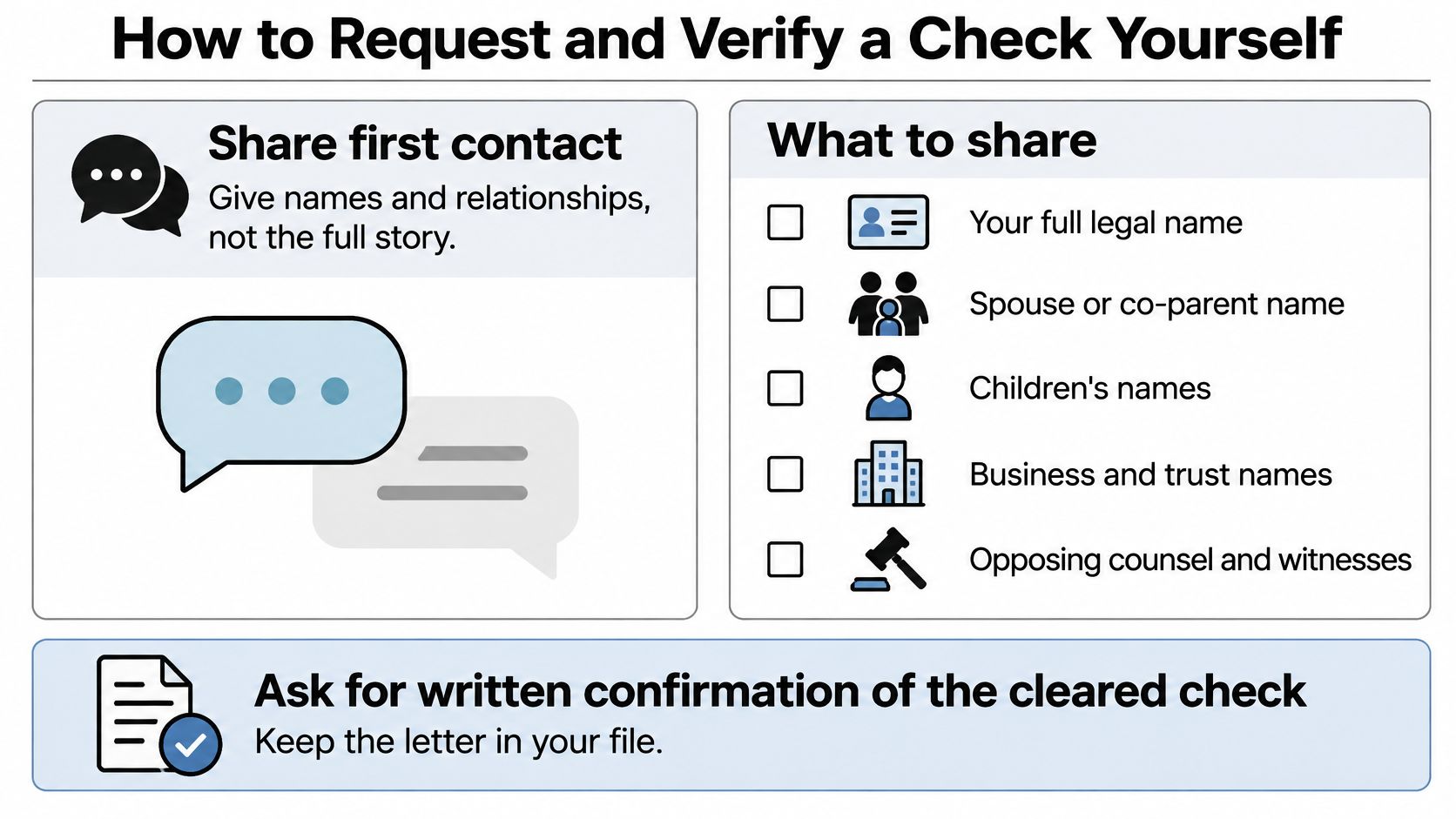
Share the names first, and hold the story. On that first call, give the spouse's or other parent's full legal name, the children's names, businesses and LLCs, trusts, opposing counsel if you know it, and every prior name or spelling you can remember. Hold back account numbers, settlement targets and the private plan you have rehearsed until the firm says the check is clear.
Oversharing can make a hire harder. A firm that has already absorbed your strategy has a much harder problem if a conflict surfaces, because the confidential detail is already in the room and the representation may have to stop. Names are what the search needs. The narrative can wait.
Alternate and prior names matter more than clients expect. A former married name, a maiden name, a spelling the intake form did not capture: each one can hide a match that a search of the current name alone would miss entirely. Ask whether those versions were included, and ask whether a lawyer, not only a database, reviewed any hit.
The search runs before the firm opens a file. That is why your first call is where the check begins, and why the person on the phone asks questions that seem to have nothing to do with why you called. Records questions in a different kind of case, including how autopsies support wrongful death claims, sit outside this name comparison.
How the Check Runs, Step by Step
A conflict check works like a lock on a gate. The firm tests whether your matter can come inside before anyone walks you through strategy. If the lock catches, the hire stops. A polite phone manner does not override that.
What you share first is a name list, not your case theory. Give the people and entities a caption would name. Hold the bank statements, the text screenshots, and the outcome you want until someone says the check cleared. Oversharing can make a hire harder. A firm that has already heard confidential facts may have to decline you, and it may be unable to send you to a colleague without carrying that information along.
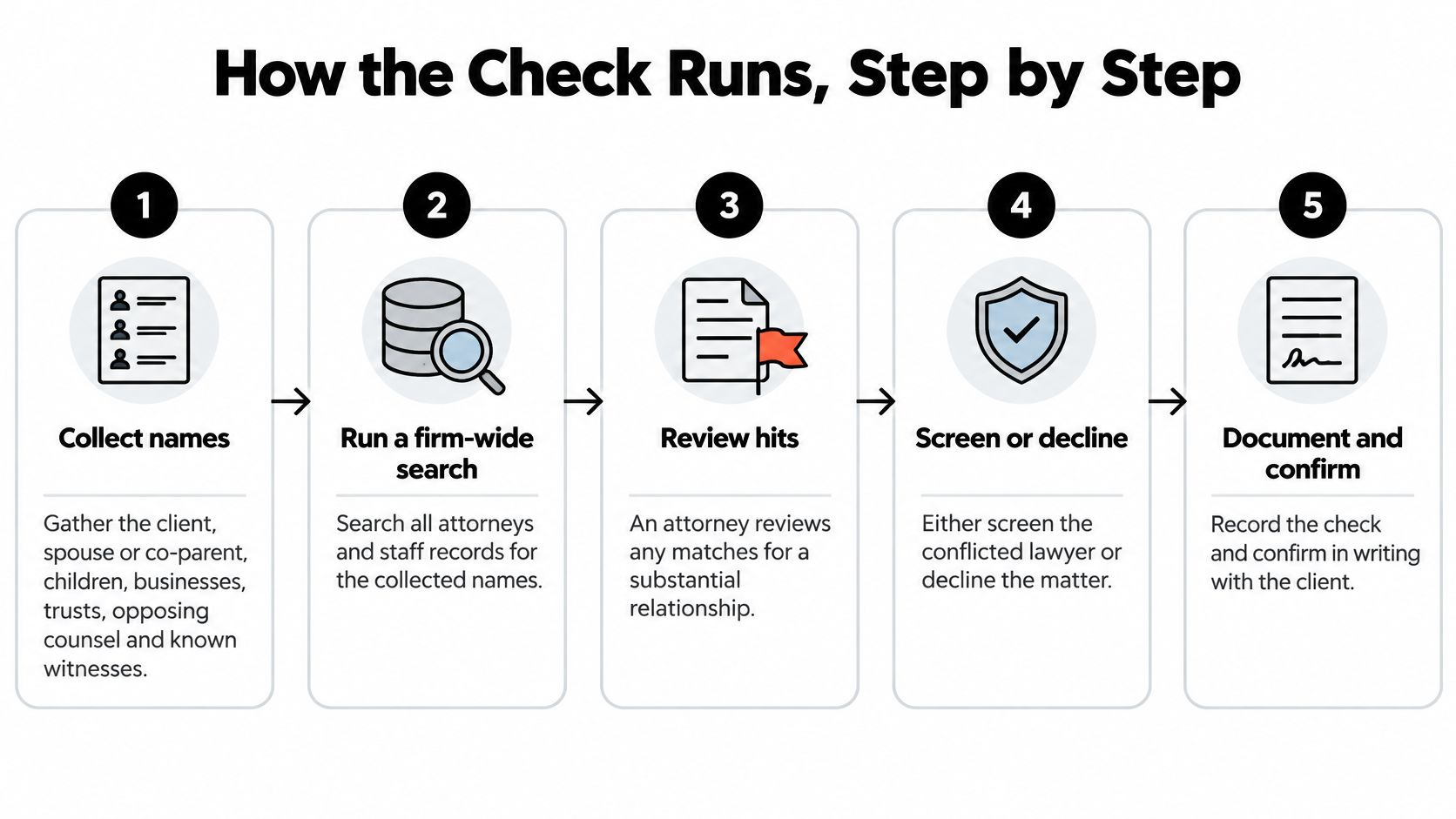
Five steps sit between that name list and a signed agreement. Each one fails in a predictable way when a firm treats it as a formality.
- Collect names at intake. You supply the people the matter will touch, and the firm writes them down before it asks how you want the case to end. A search is only as good as the names fed into it. The slip is a firm that takes your full story and treats the name list as optional.
- Run a firm-wide search of current and former clients and matters. Texas Rule 1.06(f) imputes one lawyer's conflict to the other lawyers in the same firm, so the search has to reach every attorney's and staff member's records, not one desk, under the Texas Disciplinary Rules of Professional Conduct. Include every version of a name the intake form asked you for. The slip is a search limited to the lawyer you happened to reach.
- Have a responsible attorney review every hit. Software can flag a last name. It cannot decide whether an older file is the same matter as yours or substantially related to it. A licensed attorney has to make that call, because a wrong clearance can stop the representation later, in court. The slip is treating a partial name match as automatic clearance.
- Record the outcome. Clear, flagged for analysis, or stopped. Ask what was written down: the names searched, the date, the attorney who reviewed the hits, and the conclusion. A verbal "I think we're fine" that never reaches the file leaves the next person guessing. The slip is a clean search that nobody documented.
- Only then sign and go deep. The engagement agreement, and the detailed strategy conversation, come after clearance. The slip is a consultation where you describe everything first and the firm checks names afterward.
What a finished check should look like
On the firm's side, a completed check is a written record the file can show later. It names the parties searched, the date the search ran, the attorney who reviewed the results, and the conclusion reached. If consent was part of the resolution, the writing confirming it sits with the rest of the file.
For you, that record is how you confirm the check was real. The answer should arrive before you sign and before you hand over financial records. If a firm wants your retainer before it will tell you whether the check cleared, ask again, and be ready to walk. A stopped check is an answer. It can end this hire, and that is the point of running it first.
Imputed Conflicts and Former Clients Explained
A law firm works like one shared kitchen. If one cook can't touch a particular dish, the whole kitchen is treated as unable to serve it unless that cook is kept away from the prep, the plate and the payment. The firm doesn't get to say "well, a different chef made it" and move on.
That's imputation, and Texas tightened the framework recently. Effective October 1, 2024, Texas adopted a general imputation rule under Rule 1.10, and Texas Bar guidance says firms should conduct a thorough pre-employment conflicts check before a lateral lawyer or nonlawyer employee starts, as the State Bar of Texas article on the change explains.

When a lawyer changes firms
Where a lawyer brings confidential information from a former client or former firm, the new firm may face disqualification unless it acts promptly. Screen the lawyer before participation. Block fee allocation to that lawyer. Give required notice where the rules call for it. Firms that skip the pre-employment check find out about the problem when opposing counsel files a motion.
For you, this is a reason to ask whether the firm checked its lawyers' prior matters, not just its own client list. A firm that hires laterals and never asks what they worked on before is a firm with an unexamined risk sitting in the middle of your case.
The honest caveat: a "no conflict found" result is not a guarantee that every factual or ethical issue has been resolved. Conflicts can emerge as identities, business interests or related proceedings become clearer.
Who was searched, which names were used, when the check was completed, and how a newly discovered conflict will be handled: those four questions tell you whether the answer you got was thorough or lucky.
Illustrative Scenarios Where a Conflict Check Changes the Outcome
A conflict check works like the metal detector at a courthouse door. The names you set on the belt decide what beeps. Give the other side's identity first. Hold the rest until someone asks. Extra names can create matches that stop a hire before anyone has compared the actual legal work.
The check asks whether you want help in a matter that is the same as, or substantially related to, work the firm already did for someone else, as the State Bar of Texas guidance on former-client conflicts describes.

A wife whose husband called first
Suppose Maria calls about a divorce and mentions, almost in passing, that her husband owns a flooring company. The search returns his name. It also returns a consultation he had months earlier about valuing that company.
Under Rule 1.09, a lawyer who formerly represented a client generally may not represent a new person whose interests are materially adverse in the same or a substantially related matter unless the former client gives informed consent confirmed in writing. The valuation and the divorce's property division sit close enough to force a hard look. That look can end in a decline. A clear no is a finished check, not a slight.
Maria's useful first facts are her husband's full legal name and the business name. She does not need to list every relative who signed a will, or every lawyer the family has met. Those extra names widen the search and can block a firm from a case it could have taken. If the firm steps back, she should ask for the outcome in writing that day and ask for a referral before a filing deadline moves.
A father and an old estate file
Daniel wants custody of his two children. His former mother-in-law, the children's grandmother, was a client years ago on a will. That estate work is not the same matter, and it is not substantially related to custody.
The firm writes down its reasoning: no confidential information from the will bears on where the children live, so it proceeds. A name on a list is a question the firm answers on paper. Daniel can confirm that work by asking which names were compared and what the written conclusion says. He should not volunteer every in-law's old legal problem. Unrelated history does not help the custody question, and it can manufacture a match nobody needed.
A file that changes offices
An associate who joined in March came from a practice that represented Daniel's ex-wife and saw confidential financial information in a support matter unrelated to custody. Before that lawyer opens his file, the new firm has to decide whether she stays off the case.
If you change lawyers midway through a Texas family case, your file gets this same pass at the new office. Read how changing family law attorneys mid-case in Texas works before you move. Ask the new firm what to send first: the other side's name, the prior firm's name, and the case number. Save the longer family history for the questions they ask.
Screening, Waivers and What Happens When a Conflict Appears
A conflict is not automatically the end of the conversation. It's a fork. What matters is that you understand which branch the firm took and what it means for you.
| Result | What it means | What to ask |
|---|---|---|
| Clear | No substantive match in the firm's records | Which names were searched, and on what date |
| Informed consent | A conflict exists, but affected parties consent in writing where the rules permit | Exactly what each party agreed to and whether it's in writing |
| Ethical screen | A lawyer with relevant information is isolated, takes no fee share, and written notice is given | Which lawyer is screened and how the isolation is enforced |
| Decline | The conflict cannot be cured and the firm won't take the matter | A referral to another firm and any deadlines that are running |
| Late discovery | A conflict appears after intake | How the firm handles withdrawal and protects your information |
Screening is the outcome people misunderstand most. It is not a magic eraser, and it isn't available on demand. It requires timely isolation of the disqualified lawyer, no fee allocation to that lawyer, prompt written notice to the affected prospective client, and a rule that permits it in the situation at hand.
A signed waiver is a document about your rights. Read it slowly, and don't sign one you don't understand.
Consent works the same way. Where the rules allow it, both affected parties may give informed written consent, and "informed" means you know what the conflict is and what it could cost you. If someone hands you a waiver with no explanation, ask them to walk you through it line by line. A firm that can't explain its own consent document hasn't earned the signature.
The decline branch deserves its own warning. Court deadlines don't pause while a firm sorts out its conflicts, and a hearing date set three weeks out stays three weeks out. If the answer is no, ask for a referral in the same phone call and calendar every date you're carrying.
How to Request and Verify a Check Yourself
Here's the counterintuitive part, and it's the piece most explanations skip. Sharing too much too early can make it harder for a firm to take your case, not easier. Once a prospective client discloses information that could be significantly harmful, restrictions can attach to the firm even if no engagement ever follows, which is why the Texas legal ethics guidance on duties to prospective clients treats the intake sequence as something that matters.
So give names first.
- Your full legal name, plus any name you've used before.
- Your spouse's or co-parent's full name, including a maiden or former name.
- Your children's names, and anyone who has cared for them.
- Every business, LLC and trust connected to the family, with the entity's name.
- Opposing counsel, if you know it, and the names of likely witnesses.
- Any related proceeding, such as a protective order, a CPS investigation or a probate case.
Hold back the narrative until the firm confirms it can proceed. Detailed facts, litigation strategy and sensitive documents can wait a day. If you're assembling paperwork, our guide to what to bring to your first Texas family law consultation helps you sort what's useful.
Six questions that confirm the work was done
Ask these plainly, on the phone, before you sign anything:
- Which names did you search? Listen for your spouse, your children, your businesses and the entities you named.
- Did you include alternate spellings and prior names? A maiden name or a company's former name is where matches hide.
- What date was the check completed? A check run yesterday isn't a check run today if the firm hired someone new since.
- Who reviewed the result? You want an attorney's name, not a database response.
- Is the result recorded in writing? A written record protects the firm and reassures you.
- What happens if a conflict turns up later? The answer should be specific, not a shrug.
A well-run firm answers all six without flinching. If the answers are vague or the questions seem to irritate someone, that's information too. The same instinct applies whenever you retain counsel of any kind, including when you're picking the right military defense counsel for a matter outside the family courts.
How Long a Conflict Check Takes
There's no single number, because the work moves through stages and the stages have different weights. What you can control is how much you help each one move.
Stage one is the intake call, when names get collected. Stage two is the firm-wide search across current and former records, including alternate and prior names. Stage three is attorney review of every hit, and this is the point where time gets consumed when a search returns several matches that each need analysis. Stage four is the recorded outcome. Stage five is the engagement agreement and the deep briefing.
A straight divorce with two named parties, no business interests and a clean search can clear quickly. An estate matter involving several entities and a prior executor who is a former client will take longer, because someone has to review each hit and document why it does or doesn't matter.
Ask the firm for its typical turnaround instead of assuming. If you have a hearing, a filing window or a mediation date already on the calendar, say so at the first call so the check gets prioritized. Keep a written list of every date running against you, because a conflict found late can still send you looking for another firm on short notice.
Next Steps After the Check
Start where the answer left you.
If the check is clear and the firm has told you which names it searched, you move into the consultation and can finally tell the full story. Bring the documents, name the incidents, ask the hard questions.
If a conflict appeared, ask for the outcome in writing. Ask whether consent is possible under the rules or whether a referral is the honest answer. Then protect your calendar, because a hearing date or a filing window doesn't care whose conflict caused the delay.
At intake, you'll choose a consultation type: Family Law for divorce, custody, child support and property division, or Estate Planning & Probate for wills, trusts, guardianship and estate administration. If you're unsure which fits, the firm makes sure you meet with the right team, and it matches you with an attorney based on your situation rather than whoever happens to be free.
After the consultation, you receive the firm's recommendations, decide whether to move forward, and begin building a strategy with your assigned attorney. If cost is on your mind, our breakdown of what a Texas family law retainer actually covers answers the question before you ask it.
This process can feel cold when you're already carrying something heavy. A free consultation gives you a calm place to start, with someone whose job is to explain the rules rather than rush you past them. If you need help navigating divorce, custody, or estate planning in Texas, contact The Law Office of Bryan Fagan today for a free consultation.
The Law Office of Bryan Fagan, PLLC works with individuals and families across Texas on divorce, child custody, CPS matters and estate planning, and we treat the conflict check as the first act of care in a representation, not a hurdle before it. When you call, we'll ask for names and relationships first, answer your questions about how the check runs, and tell you plainly where you stand before you share the details that matter most. Visit Law Office of Bryan Fagan, PLLC to schedule your free consultation.



