Skip to content

Bringing a document to court does not make it evidence. In most Texas family cases, the party offering an exhibit has to identify it, show that it is what it claims to be, and clear any hearsay or relevance problems before the judge admits it. If that sounds overwhelming, you are not alone. Understanding the process one step at a time can make it much more manageable.
How Texas Family Court Exhibits Get Admitted at a Glance
Picture a spouse walking into a property division hearing with a thick stack of bank statements. Those papers only help if the spouse can explain who created them and why they matter. In practice, that explanation is where most exhibits either succeed or fall apart.
Most family cases are decided by a judge rather than a jury, so the judge controls both admission and weight. That difference matters more than people expect. A document can come in and still carry little weight if its foundation is shaky.
Tracking an Exhibit from Start to Finish
Think of the process as a series of checkpoints. The table below lists each stage, the question the judge will ask, and the rule that governs it.
| Stage | Key Question | Governing Authority |
|---|---|---|
| Disclosure | Was it exchanged on time? | Tex. R. Civ. P. 193.6 |
| Authentication | Is it what it claims to be? | Tex. R. Evid. 901 |
| Relevance | Does it prove a disputed fact? | Tex. R. Evid. 401–403 |
| Hearsay | Is it offered for its truth? | Tex. R. Evid. 801–802 |
| Objections | Was the objection timely and specific? | Tex. R. Evid. 103 |
An exhibit is not admitted just because it was uploaded, emailed to the other side, or shown to a witness. Only the judge's ruling makes it evidence.
The infographic below walks through the admission path from identification to the judge's ruling, so you can see where each rule fits.
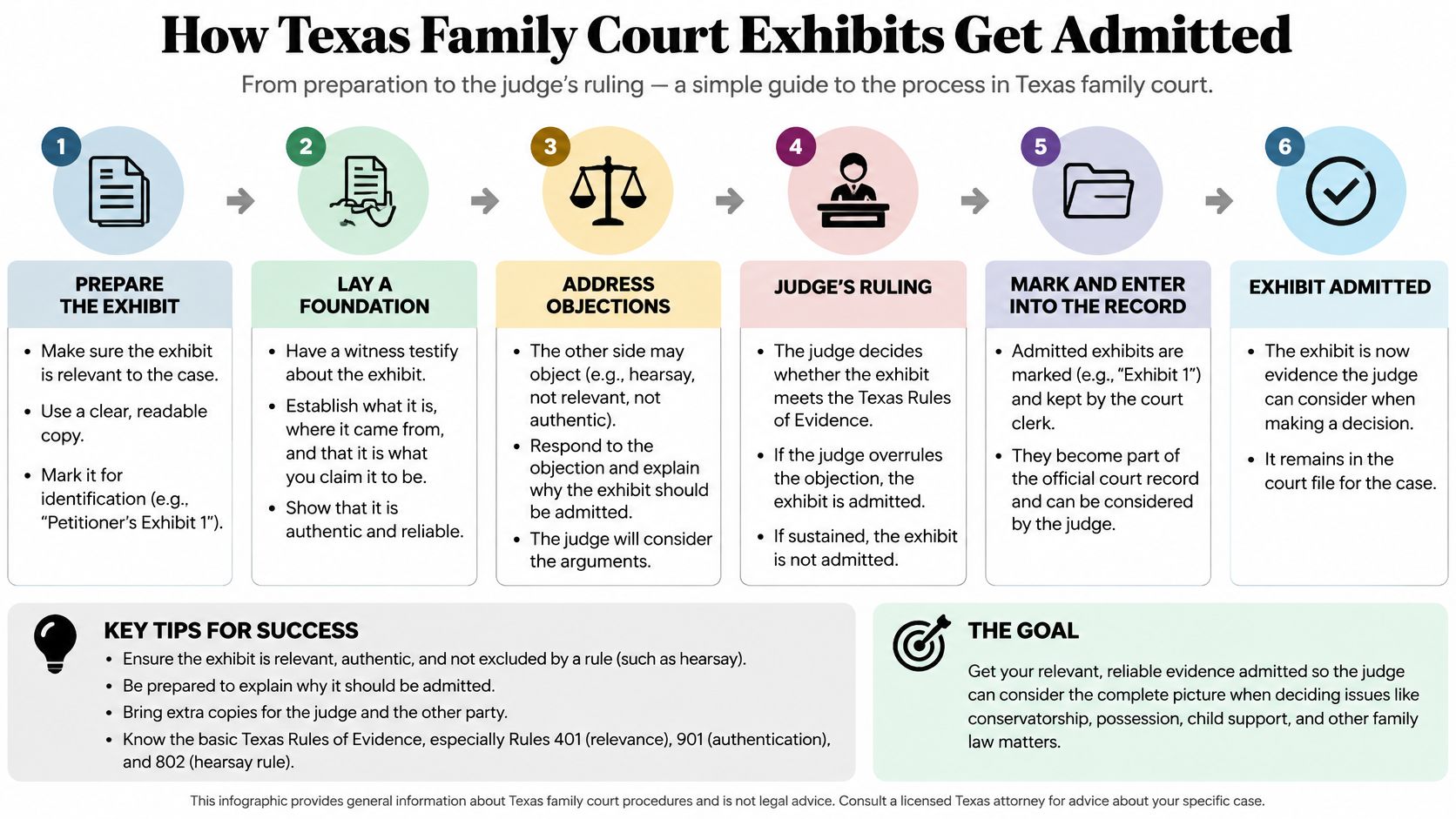
Admission works as a sequence rather than a single moment. A gap at any one stage can stall an exhibit, even when everything else is in order.
Good trial preparation depends on understanding this sequence. The Law Office of John P. Sherman’s guidance offers a useful look at organizing a divorce trial presentation.
If you need help with divorce, custody, or estate planning in Texas, contact The Law Office of Bryan Fagan today for a free consultation.

Most exhibit problems are decided long before anyone walks into a courtroom. Think about a parent preparing for a custody modification with months of text messages, a parenting calendar, school emails, and medical bills scattered across three phones and two email accounts. That kind of mess is where trouble usually starts, and it is completely understandable. The good news is that you can work through it step by step.
Start by Finding Everything
Getting an exhibit admitted in a Texas family court starts with a basic question: where is all of it? Before you worry about objections or foundation, track down every relevant record and make sure nothing gets lost along the way.
Preserve Records in Their Original Form
Judges and opposing counsel pay close attention to where a document came from. An original file carries dates, metadata, and context. A screenshot often strips most of that away.
- Export text messages with dates and contact names showing, so it's clear who sent what and when.
- Save native files like PDFs, original photos, and email attachments whenever you can.
- Keep full message threads instead of hand-picked excerpts, including the parts that don't help you.
Cherry-picked screenshots are an open invitation for the other side to argue your record is incomplete.
Build a Spreadsheet That Links Each Item to an Issue
A basic spreadsheet can turn a pile of files into something you can actually work with. For every item, note:
- The date and source
- The issue it supports, such as income, child-related expenses, or possession and access
- Whether you have the original or only a copy
- Which witness could authenticate it
If an item doesn't support a disputed issue, it may not belong on your exhibit list at all.
Separating Useful Records from Risky Ones
Not every painful message belongs in front of a judge. Some records help you, some are neutral, and a few create real risk once they're pulled out of context.
Attorneys help clients make these calls all the time, especially when emotions are running high. Reviewing everything early gives you time to decide what to keep, what to explain, and what to leave out.
If your records are messy or emotionally loaded, a free consultation with The Law Office of Bryan Fagan can help you sort through them.

Plenty of people assume a real document speaks for itself. In a Texas family court, it usually doesn't, at least not on its own.
Under Texas Rule of Evidence 901, the party offering an exhibit has to produce enough evidence to support a finding that the item is what it claims to be. That sounds heavy, but it's really a threshold. You don't have to prove everything about the document. You just have to give the judge a reason to believe it's genuine.
Witnesses Who Can Vouch for a Record
The most common route is a witness who created, received, or recognizes the document. Bank and employer records often come in through a custodian or another qualified records witness, who can explain how those records are kept.
The witness does not need to prove the document is perfect. The witness only needs to connect it to the facts of your case.
Distinctive Details That Support Authenticity
Sometimes the document vouches for itself. Account numbers, dates, letterhead, or identifying language can show where a record came from.
Admissions by the opposing party count too. If the other side never disputes that a text message came from their phone, that works in your favor.
How a Vacation Receipt Gets Authenticated
Say a spouse wants to offer a photo of a vacation receipt to show a pattern of spending. The person who took that photo can testify about when and where it was taken.
That testimony does most of the heavy lifting. It ties the image to a real event, which is exactly what the judge needs to hear.
Authentication Is Not the Same as Relevance
A genuine document can still be kept out. Authentication answers whether an item is real. Relevance asks whether it actually helps prove a disputed issue.
That's why a real receipt can still go nowhere if it has nothing to do with the property or support issues before the court.
Lining Up Your Authenticating Witness Early
Decide before the hearing who will authenticate each exhibit. You don't want to be hunting for a name in the middle of trial. Write that person's name next to each item on your exhibit list.
- Confirm the witness has personal knowledge of the record.
- Ask whether that witness can attend the hearing.
- Line up a backup witness for any document that depends on a single person.
Planning ahead keeps a hard day from getting harder. If you're not sure who should authenticate an exhibit, schedule a free consultation with The Law Office of Bryan Fagan to talk it through.
Hearsay and relevance catch even careful litigants off guard. Learning how both work before you reach the courtroom can save you a lot of stress, and a little preparation goes a long way.
What Hearsay Really Means
Under Texas Rule of Evidence 802, hearsay is generally not admissible. Put simply, hearsay is an out-of-court statement offered to prove that what it says is true, unless a statute, a rule, or a recognized exception applies.
Consider a common scenario. A father wants to show that the mother actually arrived late for pickup, and he has a text in which she said she'd be running behind. If he offers that text to prove she really was late, the judge will likely treat it as hearsay.
That same message might still come in for a different purpose. It could show notice, state of mind, or when certain communications happened. The reason you offer something often matters more than the document itself.
Asking Whether an Exhibit Is Relevant
Relevance is a simpler question. Under Rule 401, does the exhibit make a disputed fact more or less likely to be true? If the answer is no, it probably doesn't belong in front of the judge.
Even relevant evidence can get excluded. Rule 403 allows the court to keep out material when its value is outweighed by unfair prejudice, confusion, or misleading the fact-finder. A document can prove something and still be too inflammatory or confusing to help you.
Before you offer any exhibit, ask yourself three things: who made the statement, why you're offering it, and which issue it proves.
Questions to Ask Before You Offer an Exhibit
Working through these questions early tends to prevent surprises. Here's a quick checklist to run through:
- Speaker: Who wrote or said this, and can they be identified?
- Purpose: Am I offering this for its truth, or for something else?
- Issue: Which specific disputed fact does it help prove?
- Exception: Does a recognized exception, such as a business record, apply?
If you're dealing with bills or account statements, our guide to business records affidavits in Texas walks through how a sworn statement can help clear the hearsay hurdle.
If a key exhibit is at risk of being excluded, bring these answers to a free consultation. A calm, early conversation can make a tense hearing feel a lot more manageable.
Timing can decide whether your evidence gets considered at all.
Why Deadlines Vary by Court
There isn't one statewide deadline that covers every family case. Your date comes from the scheduling order, the court's standing orders, and its local rules, so the answer may look different from the courthouse down the road.
Local habits matter more than most people expect. Some courts want exhibits exchanged before the pretrial conference, and objections get raised right there. Others want pretrial materials and printed copies in the judge's hands a day or more before the hearing.
A father I'll call Mark learned the week before trial that his exhibits had been due a month earlier. He had assumed the hearing date controlled everything. That one assumption cost him time and a good deal of credibility.
Under Texas Rule of Civil Procedure 193.6, a court can bar evidence that wasn't timely disclosed. Surprise exhibits often lead to delays, continuances, or exclusion arguments, and none of those help your case.
Building an Exhibit List That Tracks Deadlines
Your exhibit list can do double duty as a deadline tracker. For each item, record:
- Item number and description
- Date and source
- The issue it supports
- The witness who will authenticate it
- Whether a stipulation or certified record could avoid live testimony
That last point is worth real effort. Stipulations and certified records can spare a witness a trip to court, but only if you ask the other side early. Waiting until the week of trial usually means you've lost that option.
Pull your court's current orders as soon as your case is set. Then check them again.
Orders get amended, so check again before each hearing.
Before your deadlines start stacking up, take a look at how initial disclosures fit into Texas family cases. It's easier to plan around the rules now than to scramble later.
What to Do if You Miss a Deadline
Call your attorney right away. Ask directly whether a late exhibit can still be offered, because the answer depends on the court and the circumstances.
Judges sometimes allow late exhibits for good cause. Even so, the other side can argue surprise, and that argument can work. Acting fast gives you the best chance of keeping the evidence in play.
If you're unsure which deadlines apply to your case, schedule a free consultation. Confirming them for your specific court is the surest way to avoid a problem you could have prevented.
Objections can feel like ambushes when they land in the middle of a hearing. Still, most of them follow patterns you can see coming. Once you recognize the pattern, the moment becomes much easier to handle.
Why Timing and Specificity Matter
Under Texas Rule of Evidence 103, an objection usually has to be both timely and specific to preserve the issue for appeal. A vague or late objection can cost a party a point it cared about. That's why judges and attorneys listen closely to exactly what was said, and why the wording matters almost as much as the timing.
Common Exhibit Objections and Practical Responses
Certain objections to exhibits come up again and again in family court. The table below covers the usual ones, what each objection is really attacking, and a general way to respond so you aren't scrambling when it happens.
| Objection | What It Challenges | Typical Response |
|---|---|---|
| Lack of foundation | Whether a witness can vouch for the exhibit | Offer business-records testimony, a custodian affidavit, or ask to admit subject to later connection |
| Hearsay | Whether an out-of-court statement is offered for its truth | Identify a non-truth purpose, such as notice or state of mind, or point to a recognized exception |
| Best evidence and duplication | Whether a copy can stand in for the original | Show the original is preserved and rely on Rule 1003 |
| Incomplete record | Whether the exhibit leaves out important context | Offer the full thread or the remaining pages |
| Unfair prejudice | Whether the exhibit will inflame or mislead the court | Explain the limited purpose and request a limiting instruction |
Treat this table as a starting point rather than a script. Every judge runs a hearing a little differently, and the facts of your particular exhibit will shape the best answer.
A Scenario at the Hearing
Picture this: opposing counsel stands up and argues that a printed spreadsheet lacks foundation because your witness never prepared it. Rather than panic, you might point out that the witness reviews those records every month. From there, you can offer business-records testimony or a custodian affidavit. If neither is ready, ask the court to admit the exhibit subject to a later connection, which keeps your point alive without pretending the problem doesn't exist.
Keep Your Composure
Remember that Texas Rule of Evidence 1003 generally allows duplicates unless someone raises a genuine question about authenticity. A clean, legible copy often holds up well, especially when you can show the original is safely preserved.
Most objections are not really about the document. They are about a gap in foundation or context, and you can usually close that gap with the right witness or paperwork.
Staying calm is a skill, and it gets easier with practice. Many people find that rehearsing with an attorney makes a tough hearing far more manageable. Read also: our guide on preparing for a Texas family law trial.
Plenty of readers arrive here with a few nagging questions. Here are the ones that come up most, answered without the legalese.
Does a Text Message Need a Forensic Expert?
Usually not. A witness who can identify the sender, confirm the phone number, and explain the context of the conversation can often authenticate a text under Texas Rule of Evidence 901. A full thread also holds up far better than a cropped screenshot, since the other side has less room to argue that something was left out.
A forensic examiner tends to earn their fee when someone seriously claims the messages were altered or deleted. Short of that, you probably don't need one.
Is a Copy Acceptable If the Original Is Lost?
Often, yes. Under Texas Rule of Evidence 1003, a duplicate generally carries the same weight as the original, unless someone raises a real question about whether it's authentic.
That's where the paper trail matters. Keep a clean, complete copy, and write down what happened to the original while the details are still fresh. A short affidavit describing how the copy was made can save you a lot of trouble if the other side starts pushing.
What If a Witness Cannot Authenticate a Document at the Hearing?
The judge may exclude the exhibit, or may give you more time to line up proof. Neither outcome is fun, which is why a backup witness is worth the effort. Someone who can vouch for a key record, even if they weren't your first choice, can rescue an exhibit that would otherwise disappear.
Don't rely on a single witness for an important record. A backup who can vouch for it is often the difference between an admitted exhibit and one that never makes it into evidence.
Can an Admitted Exhibit Still Carry Little Weight?
Yes, and it happens more often than people expect. Picture a self-employed spouse whose invoices come in through custodian testimony, but there are no matching bank deposits or tax records to back them up. The judge can admit the invoices and still decide they deserve little weight.
Admission and weight are two different questions. Supporting records still matter after an exhibit gets in, so don't treat admission as the finish line.
If you want more background, take a look at the firm's family law services and our post on business records affidavits in Texas.
If you're dealing with divorce, custody, or estate planning in Texas, reach out to The Law Office of Bryan Fagan and schedule a free consultation today.