
Divorce can be one of life's hardest transitions. If you're trying to figure out what the house is worth, whether your spouse's number is fair, or how a Texas judge will look at it, you're not alone.
Many people reach this point feeling stuck between emotion and math. The home may hold years of memories, but in a Texas divorce it's also property that has to be valued carefully. A proper appraisal for divorce gives you a grounded starting point when everything else feels uncertain.
Why an Appraisal Is Crucial in a Texas Divorce
When spouses disagree about value, a court can't divide property based on guesses, online estimates, or whoever argues more confidently. In Texas, property division is guided by Texas Family Code § 7.001, which requires the court to order a division of the marital estate that is “just and right.” To do that, the court needs reliable evidence of value.
That matters most when the family home is one of the largest assets in the case. If one spouse wants to keep the home and buy out the other's share, or if the spouses disagree about whether the property should be sold, the value has to be supported by something more solid than opinion.
Fair market value matters in real life
A simple example helps. Suppose you believe the house is worth much less because it needs repairs. Your spouse believes it's worth more because nearby homes sold at strong prices. Both views may contain some truth, but neither one answers the legal question by itself. An appraiser evaluates the property, studies comparable sales, and gives the court a market-based opinion.
That opinion often becomes the reference point for settlement talks, mediation, and, if needed, trial.
Practical rule: An appraisal for divorce isn't about “winning” a value dispute. It's about giving the court and both spouses a defensible number to work from.
When a retrospective appraisal is needed
Some divorces involve a second layer of complexity. The current value may not be the only value that matters. In some Texas cases, one spouse argues that the property's value at the time of marriage, separation, or another past date is important to determine what portion is separate property and what portion is community property under Texas Family Code § 3.002.
In those situations, a retrospective appraisal may be necessary. According to Cullen Real Estate and Appraisal's divorce appraisal guidance, fees for these specialized valuations typically range from $500 to $800 for single-family homes, while multi-family or complex business assets are quoted individually.
If you're dealing with whether to keep or sell the home, this discussion often overlaps with practical housing questions after divorce. Our discussion of how to split a house in divorce can help you think through the next step.
For some families, divorce valuation issues also connect to longer-term asset protection concerns. Estate Planning includes wills, trusts, and estate plans to protect assets and wishes, which can become especially important after property is divided.
The Different Types of Divorce Appraisals
A Texas divorce can involve a house, a business, and valuable personal property all at once. Each asset calls for a different kind of appraisal because each one is valued in a different way. Treating them as if they work the same can create expensive mistakes.
That risk is even sharper in Texas community property cases. If one spouse hires an appraiser alone, gives selective records, or schedules an inspection without the other side's input, the valuation can become what many attorneys informally call appraisal contamination. The number may still exist on paper, but the other side can argue the process was biased from the start. That often leads to dueling experts, added cost, and a harder path to settlement.
Comparing Appraisal Types in a Texas Divorce
| Asset Type | Examples | Complexity and Method | Typical Cost Range |
|---|---|---|---|
| Residential real estate | Marital home, rental house, vacation property | Physical inspection, comparable sales, written valuation report | Costs vary by property type, location, and whether the appraisal is current or retrospective. Many standard home appraisals fall within the several-hundred-dollar range, while complex properties can cost more, as noted by Cullen Real Estate and Appraisal's divorce appraisal guidance |
| Business interests | Family business, medical practice, construction company | Financial statement review, earnings analysis, asset review, and a valuation method matched to the business | Business valuations often cost far more than real estate appraisals because they require deeper financial analysis and sometimes expert testimony |
| Valuable personal property | Jewelry, art, antiques, collectibles, watches | Item-by-item expert review, condition analysis, and specialty market knowledge | Varies by item, market, and the expert's specialty |
Real estate appraisals are common, but they are not always simple
The family home usually gets the most attention because it affects both the property division and practical decisions about where each spouse will live. A residential appraiser typically considers the home's condition, square footage, features, updates, and recent comparable sales.
In divorce cases, the method matters almost as much as the final number. A rushed appraisal based on incomplete access or one spouse's version of the facts can invite attack later. PropLab's AI valuation insights show how different valuation methods can produce different estimates. In a Texas divorce, that difference becomes a legal problem if the opinion is presented as neutral when the process was not.
A clean process helps. Jointly selecting the appraiser, agreeing on the scope, and giving equal access to records can reduce later disputes about whether the opinion was shaped by one spouse.
Business valuations require a different level of scrutiny
A business is harder to price than a house because there may be no obvious market listing to point to. The appraiser may need to examine revenue, debt, payroll, equipment, contracts, owner perks, and goodwill. A professional practice adds another layer because personal goodwill and enterprise goodwill can become contested issues.
This level of financial detail is why these cases are often handled as complex property division matters, similar to those seen in High-Net-Worth Divorce proceedings.
If a spouse owns all or part of a company, be careful about unilateral valuations. A business appraisal based on incomplete books, informal spreadsheets, or management-only interviews can be challenged as slanted. If that issue may arise in your case, our guide to valuing a business during a divorce in Texas explains what appraisers and attorneys usually examine.
Some assets have a visible resale market. Others require a specialist to explain not only the number, but how that number was reached.
Personal property appraisals are easy to underestimate
Jewelry, art, antiques, firearms, collections, and luxury watches often become an afterthought until settlement talks stall. That is a problem. Small items can carry large value, and replacement cost is not the same as fair market value.
A ring that cost a certain amount at retail may appraise for much less in the resale market. A collectible may do the opposite if demand has risen. The point is simple. Purchase price tells part of the story. A qualified specialist tells the court what the item is worth in the relevant market and on the relevant date.
In Texas divorces, the safest approach is usually to match the appraiser to the asset, keep the process transparent, and avoid any shortcut that gives the other side a reason to question the result.
The Appraisal Process Step-by-Step
Once an appraisal is on the table, many want to know what happens next. The process is usually less mysterious than it seems when you break it into stages.
A visual overview can help before you deal with the details.
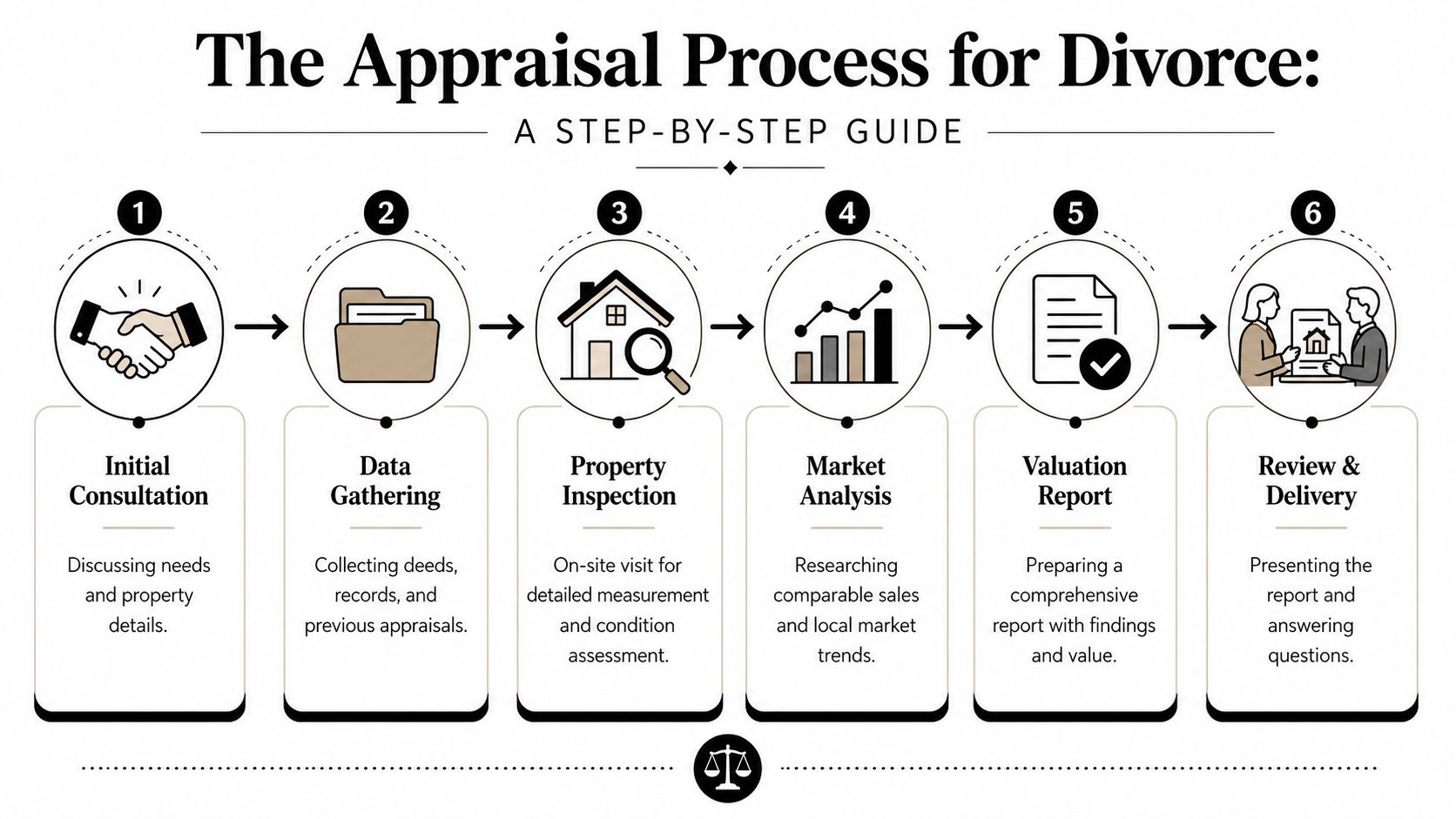
Step one through step three
A decision is made to appraise the asset
Sometimes both spouses agree. Sometimes the issue comes up in mediation. In other cases, the court expects a valuation because property division can't move forward without one.The appraiser is selected
The spouses may agree on one neutral appraiser, or each side may retain their own expert if the case is contested. A jointly selected appraiser often reduces friction, though it isn't always possible.The appraiser gathers records and inspects the property
For real estate, that may include deeds, prior appraisals, renovation information, and an on-site visit. For a business or personal property, the data collection phase looks different but serves the same purpose. The appraiser needs reliable information before giving an opinion.
Step four and step five
Market research and analysis take place
The appraiser reviews comparable sales, market conditions, property characteristics, and other relevant details. In a business case, the expert may study revenue, inventory, and earnings records.A written report is issued and reviewed
This report should explain the method used, the facts considered, and the final value conclusion. Your attorney then reviews it with you to decide whether the report supports settlement, needs clarification, or should be challenged.
What helps most: Keep your records organized. If you have permits, renovation invoices, surveys, or proof of improvements, provide them early.
This short video can also help you understand how professionals talk through valuation issues in divorce-related real estate matters.
What you can do during the process
You don't need to become an appraiser to protect yourself. You do need to stay practical.
- Confirm the purpose early: Make sure everyone understands whether the report is for settlement, court use, or a specific valuation date.
- Give complete information: Missing renovation records or access problems can create avoidable disputes.
- Ask questions about the final report: If a number surprises you, ask why. A good legal strategy starts with understanding the basis for the opinion.
Selecting and Working With a Qualified Appraiser
Choosing the right appraiser is one of the most important decisions in this part of a divorce. The wrong choice can waste money, delay your case, and leave you with a report the court won't rely on.
In divorce cases, “qualified” doesn't just mean someone who knows real estate. It means someone who understands legal use, proper reporting, and courtroom scrutiny.
What the court is looking for
A certified divorce appraisal must comply with USPAP, the Uniform Standards of Professional Appraisal Practice. Courts often reject broker price opinions and automated online estimates. According to Madison Park Appraisal's discussion of divorce appraisal standards, only a USPAP-compliant report based on a physical inspection carries evidentiary weight, and using an inappropriate report form such as a standard mortgage form can invalidate the report for legal proceedings.
That's why a real estate agent's CMA may be helpful for informal pricing discussions but not enough for a contested divorce.
Questions worth asking before you hire
Ask direct questions. You're not being difficult. You're protecting your case.
- Are you licensed and experienced with divorce assignments? Divorce work differs from refinance or listing work.
- Will your report comply with USPAP? This should be a straightforward yes.
- Have you handled retrospective valuations? If your case involves a past valuation date, that experience matters.
- Can you explain your process clearly? If the explanation is confusing now, it won't get easier later.
A good divorce appraiser acts like a neutral professional, not like part of either spouse's legal team.
Specialty assets need specialty experts
This issue becomes even more important when the property isn't a house. Watches, jewelry, antiques, and collections may require an appraiser with a narrow specialty. For readers trying to understand how specialized item valuation works, professional watch appraisal services offer a practical example of why general valuation knowledge isn't always enough for luxury property.
The same principle applies in divorce. A person who can value a suburban home may not be the right expert to value a vintage watch collection or rare jewelry.
Neutrality usually helps more than aggression
Many spouses assume they should quickly hire “their own” appraiser to get ahead. Sometimes that's appropriate. Often, it creates more problems than it solves.
A neutral appraiser chosen by agreement can reduce later arguments about bias, access, and methodology. If the case is already tense, your attorney can help structure communications so the appraiser gets the documents and access needed without becoming part of the conflict.
Understanding Appraisal Costs and Timelines
Two common questions arise right away. How much will this cost, and who has to pay for it?
In Texas, courts often treat appraisal costs as a shared litigation expense when the valuation is necessary to divide property fairly. According to Home Appraisals Inc. on divorce appraisal cost-sharing in Texas, Texas courts frequently order cost-sharing for divorce appraisals under Texas Family Code § 7.001. If one spouse insists on a separate appraiser without court approval, that spouse typically bears the full cost alone. The source states that this averages $475 for residential properties but can exceed $1,000.
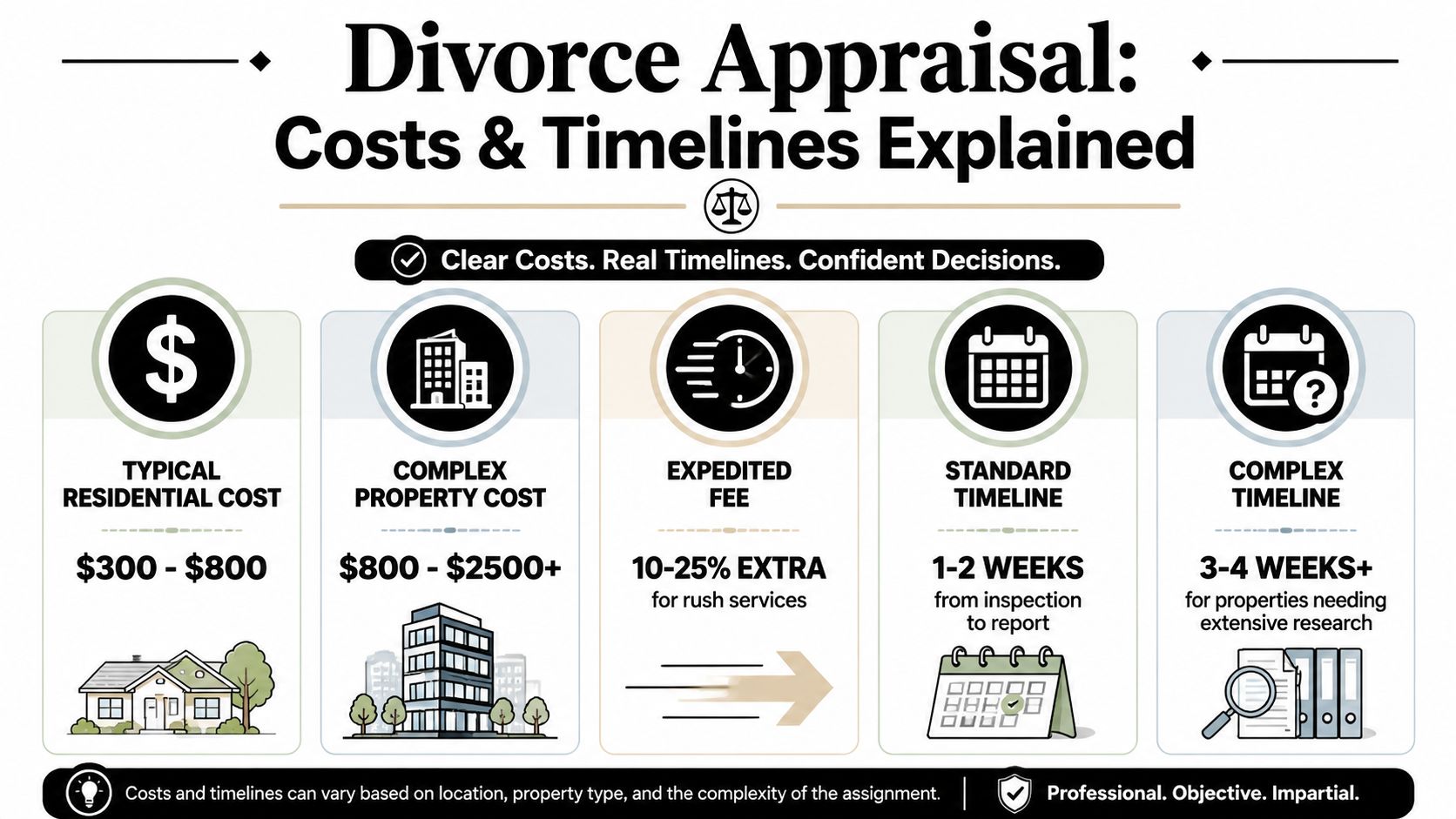
What affects cost and timing
A straightforward home usually moves faster than a disputed business or unusual property. Delays often come from missing records, disagreement over the valuation date, scheduling conflicts, or disputes about access.
If you're trying to budget for the larger picture, our guide to understanding Texas divorce costs can help you place appraisal expenses in context.
A simple rule on payment
- Court-ordered or jointly needed appraisal: Often shared.
- One spouse hires an extra appraiser by choice: Often paid by that spouse.
- Complicated assets: Usually require more planning, more documents, and more patience.
The timeline depends heavily on the asset and the level of conflict. A calm, organized case moves much more smoothly than one where every step becomes a fight.
Strategies for Handling Appraisal Disputes
You hire an appraiser quickly because you are worried your spouse will try to lowball the house. A week later, your spouse's lawyer argues the report is one-sided, the court hesitates to rely on it, and now you may be paying for a second appraisal anyway. That is a common Texas divorce problem, and it often starts with a decision that felt practical at the time.
Lawyers sometimes call this appraisal contamination. The idea is simple. If one spouse picks the appraiser, controls the contact, and shapes the flow of information before the other side is involved, the report may carry a cloud over it from the start. Even if the appraiser acted properly, the other side may argue the process was slanted. In a divorce, process matters almost as much as the final number.
Why unilateral appraisals can create risk
A unilateral appraisal is not automatically useless. Sometimes a spouse needs one for early case planning or settlement discussions. But in a Texas property dispute, a solo appraisal can become a target.
The risk is strategic as much as financial.
If the other side claims the appraiser received incomplete records, saw only favorable repairs, used the wrong valuation date, or lacked access to key parts of the property, the fight can shift away from value and onto credibility. That is time-consuming and expensive. It can also push settlement farther away because the spouses stop arguing about dollars and start arguing about whether the report can be trusted at all.
A good comparison is a measuring tape used after one person has already stretched it. Even if the final number looks precise, everyone now argues about the tool instead of the measurement.
Practical point: Being first rarely wins the dispute if the court believes the process was tilted.
Better ways to address a valuation disagreement
A cleaner approach usually starts with structure. Before anyone rushes to hire a separate appraiser, try to reduce the points the parties will later fight over.
- Ask whether a neutral appraiser is possible: A jointly selected appraiser often gives both sides a better starting point for negotiation or mediation.
- Confirm the valuation date early: In Texas divorce cases, value can change depending on the date used. If the spouses are using different dates, they may not be disagreeing about the same number.
- Give complete and balanced information: Renovations, defects, deferred maintenance, access limitations, and unusual features should all be disclosed.
- Read the report closely for objective errors: Wrong square footage, missed improvements, weak comparable sales, or incorrect condition ratings can materially affect value.
- Challenge methods, not motives: Courts respond better to specific problems in data or analysis than to broad accusations that an appraiser was unfair.
If two appraisals are far apart
That gap usually has a reason. The job is to find it.
Sometimes one appraiser used better comparable sales. Sometimes one inspected more thoroughly. Sometimes one valued the property as of a different date, or gave more weight to repairs, location issues, or market conditions. Once you identify the source of the difference, the dispute becomes more manageable.
In some cases, the best answer is a review appraiser or a neutral third appraisal. In others, the lawyers can narrow the disagreement by stipulating to certain facts and limiting the fight to one or two real points of difference. That is often far cheaper than turning every appraisal issue into a courtroom battle.
Legal advice matters here because the question is not only, “Is this value right?” The better question is, “Can I prove this value in a way the court will trust?” Law Office of Bryan Fagan, PLLC handles Texas family law matters involving property division, divorce, and related disputes, including cases where valuation strategy becomes central to settlement or trial preparation.
Frequently Asked Questions About Divorce Appraisals
Can't we just use the tax appraisal value or a Zillow estimate
Usually, no. Those numbers may give you a rough sense of value, but they aren't the same as a divorce appraisal prepared for legal use. In a contested case, courts want a proper professional valuation, not a convenience estimate.
Does the appraiser decide who gets the house
No. The appraiser gives an opinion of value. The spouses, their attorneys, the mediator, or the court decide how the asset will be divided, awarded, sold, or offset against other property.
What if my spouse won't let the appraiser into the home
Tell your attorney quickly. Access problems can affect the report and create unnecessary delay. In many cases, attorneys can resolve the issue informally. If not, the court may need to address access as part of the divorce proceedings.
Should I clean up or repair the property before the appraisal
You should make the home accessible and presentable, but don't panic about ordinary lived-in conditions. If important repairs are unfinished or if you've completed major renovations, gather documents that show what was done and when. Good records are often more helpful than cosmetic staging.
What if I think the appraisal is wrong
Start by identifying the specific problem. Did the appraiser miss an addition, use weak comparable sales, misunderstand the condition, or value the property on the wrong date? General frustration won't help much. Specific factual concerns will.
If you disagree with the result, ask for the reasoning behind it before you assume the entire report is unusable.
Do we always need separate appraisers
No. In many divorces, one neutral appraiser is the more practical choice. Separate experts are more common when the case is highly contested or when one side believes the first report is materially flawed.
Are appraisals only for houses
Not at all. Divorce valuation issues can involve businesses, professional practices, retirement-related interests, jewelry, art, antiques, and other high-value property. The right expert depends on the asset.
How do I prepare for an appraisal for divorce
Keep it simple:
- Gather records: deeds, mortgage statements, permits, renovation invoices, prior appraisals
- Clarify the purpose: current value, buyout, sale, or past-date valuation
- Work through counsel when needed: especially if communication with your spouse is strained
- Stay neutral in your approach: your credibility matters too
If you need help navigating divorce, custody, or estate planning in Texas, contact The Law Office of Bryan Fagan, PLLC today for a free consultation. A clear plan can make this process less overwhelming, especially when property values, buyouts, or appraisal disputes are affecting your next steps.