 Skip to content

The surviving parent is usually the presumptive conservator, while the deceased parent's estate passes through Texas intestacy or a will to the spouse and children on a separate legal track governed by the Estates Code. In other words, custody determines who cares for the child, but probate determines who receives and manages the property.
A Houston mother may find herself in exactly this position after six months of custody litigation. The father dies suddenly in a car accident, leaving her with a pending Suit Affecting the Parent-Child Relationship, a grieving daughter, and a stack of unanswered questions. She may be asking whether she automatically has custody, whether her daughter inherits her father's house or retirement account, who can manage that inheritance, and what must be filed immediately.
Those questions belong to two separate legal tracks. The custody court addresses conservatorship, possession, access, and the child's best interest. The probate court addresses the deceased parent's will, heirs, debts, property classification, and distribution.
The pressure points are practical:
- Who takes conservatorship of the child?
- Who inherits the deceased parent's property?
- Who manages money inherited by a minor?
- What paperwork must be filed during the first several weeks?
Texas law provides a framework, but the outcome still depends on the family structure, existing orders, parentage, property classification, and any evidence affecting the child's best interest. The sections below give you concrete answers instead of abstract legal language.
When a Texas Parent Dies Mid-Custody Case
Death doesn't erase every order already signed by the court. It changes the facts before the court and creates a need to place the child's care, property, and legal authority on the correct tracks.
Suppose the father in the Houston example was a conservator under an existing order. His death is treated under Texas Family Code § 156.106 as a material and substantial change of circumstances, which can support a temporary order and modification of the custody order. The statute doesn't say that custody ends automatically. Instead, it gives the court a procedural path to reevaluate conservatorship, possession, and access after a conservator dies. Texas Family Code § 156.106 remains a foundational provision for this situation.
The surviving parent is often the starting point for conservatorship, but that doesn't mean every question resolves automatically. The court may consider prior restrictions that denied or limited a parent's possession or access, and it may preserve those restrictions if doing so remains in the child's best interest under § 156.106(b).
Four questions families must separate
First, custody. The court determines who has authority to make decisions and where the child lives.
Second, inheritance. The child may inherit under a will or under Texas intestacy law, regardless of which parent receives conservatorship.
Third, financial management. A minor generally cannot control inherited property directly. A guardian of the estate, trustee, or another authorized fiduciary may need to manage it.
Fourth, procedure. Someone must notify the court, address the pending SAPCR, open or continue probate, gather death and family records, and protect assets from improper transfer.
A relative who believes the child is unsafe shouldn't remove the child or treat the death as permission to ignore the existing order. The appropriate response may involve temporary orders, a conservatorship action, probate filings, or, where applicable, Child Protective Services Defense for families facing CPS investigations and allegations.
| Triggering Event | Governing Rule | Practical Outcome |
|---|---|---|
| A conservator dies | Texas Family Code § 156.106 treats the death as a material and substantial change | The court can reconsider conservatorship, possession, access, and restrictions |
| The deceased parent had an existing custody order | Existing orders remain important until the court changes them | The surviving parent or another interested person should seek prompt court direction |
| A relative seeks custody | The relative must establish standing and satisfy the applicable legal standard | The court focuses on legal entitlement and the child's best interest |
| The child inherits property | Probate and Estates Code rules apply | A fiduciary may need authority to collect and manage the inheritance |
How Texas Family Code Treats a Parent's Death
Texas Family Code § 156.106 treats the death of a conservator as a legally recognized changed circumstance. That matters because the statute creates a way to modify an existing order rather than treating the parent's death as an automatic transfer of every legal right.
Start with the pending SAPCR and identify exactly what the deceased parent held. Was the parent a joint managing conservator, sole managing conservator, possessory conservator, or a party seeking modification? The answer affects which provisions of the existing order still matter and what relief the surviving parent or another relative should request.
The practical sequence
- Document the death. Obtain the death certificate and preserve the existing final order, temporary orders, pleadings, and hearing notices.
- Notify the family court. A Suggestion of Death or comparable filing alerts the SAPCR court that one party or conservator is no longer able to litigate.
- Request appropriate orders. The surviving parent may seek temporary orders and modification addressing conservatorship, possession, access, and decision-making.
- Review restrictions. The judge must consider prior limits on a parent's possession or access and may continue them only if they still serve the child's best interest.
- Address competing claims. A grandparent, relative, or other person cannot assume that the child's residence alone gives them custody. That person must establish a lawful basis to participate and prove the requested arrangement is legally and factually justified.
The survival of a prior order is important. Until a judge issues a different order, families should avoid acting as though the custody case disappeared. The child's routine, school, medical care, and possession schedule may need immediate clarification, but unilateral changes can create additional litigation.
The statute also means that death isn't a shortcut around the best-interest analysis. The surviving parent is often presumptive, but the court retains authority to address restrictions or other concerns supported by the record. Allegations of abuse, neglect, instability, or inability to care for the child must be handled through evidence and proper filings, not informal family decisions.
Practical rule: Treat the death as an emergency change in circumstances, not as an automatic cancellation of the custody order.
Texas Intestate Succession for the Deceased Parent
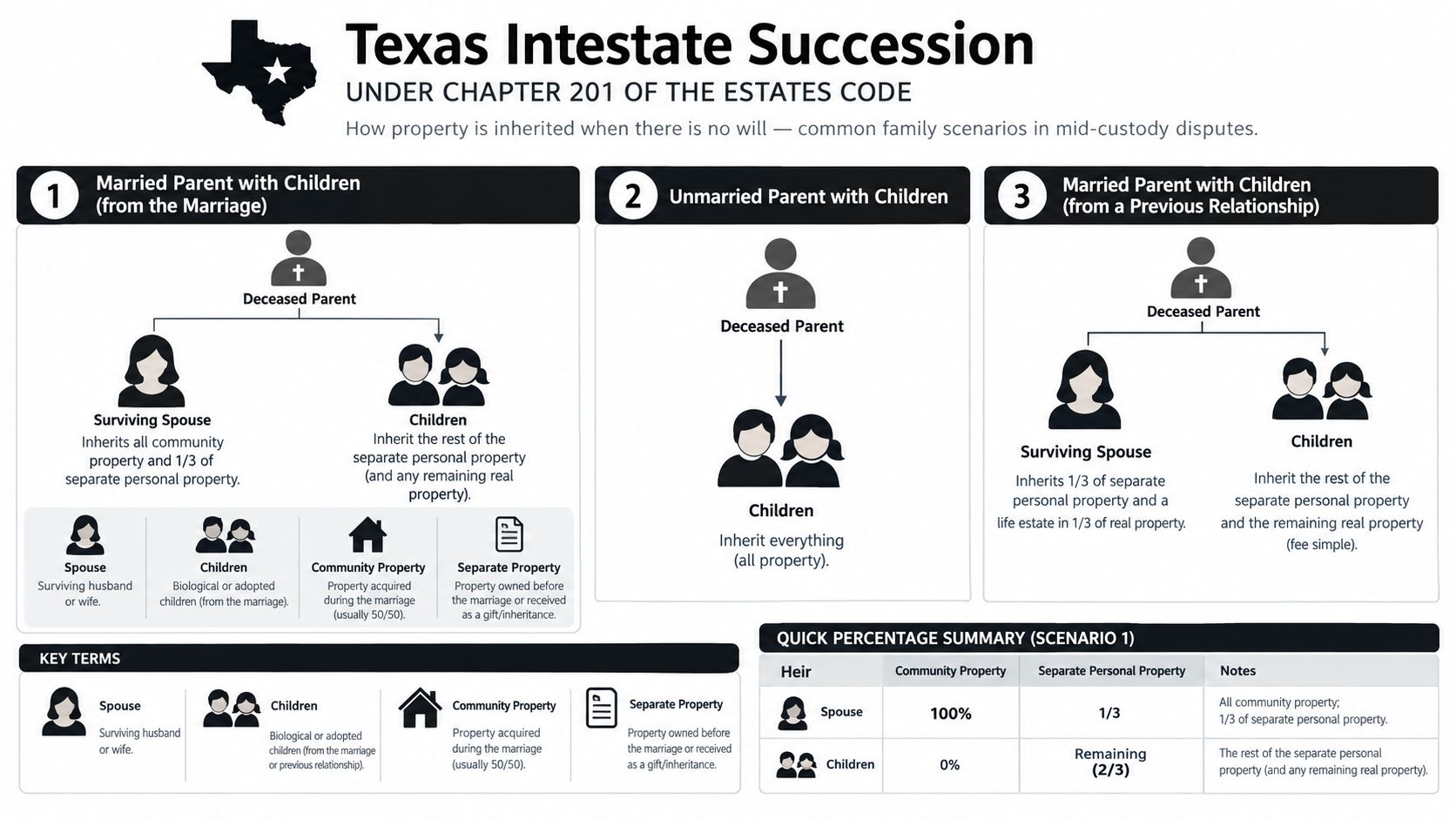
If the parent died without a will, Texas Estates Code Chapter 201 controls the probate estate. The answer to who inherits depends on whether the deceased parent was married, whether the property was community or separate, and whether the children are also children of the surviving spouse.
For a married parent with children, Texas law distinguishes between community property and separate property. Under the statutory separate-property rules, the surviving spouse generally receives one-third of the separate personal estate and a life estate in one-third of the separate real estate, while the children and descendants receive the remaining interests, including the remainder after that life estate. Texas Estates Code § 201.002 provides the governing statutory framework.
Community property follows a different structure. In some configurations, the surviving spouse retains one-half of the community property, while the deceased parent's share passes to the children. If all surviving children are also children of the surviving spouse, the spouse may receive all community personal property and one-half of the land under the statute's separate-property rules.
Other family structures
An unmarried parent with children generally leaves the separate and community property that belongs to the decedent to the children under Estates Code § 201.001. The children's shares still may require court-supervised management if they are minors.
Parentage matters. An adjudicated or acknowledged father can inherit in the same way as a biological mother. An unadjudicated father may inherit through his child by representation, but the family may need probate proceedings to establish the necessary relationship.
If the deceased parent leaves no descendants, the surviving spouse generally inherits under Estates Code § 201.002. Grandparents, siblings, and more distant relatives become relevant only when there is no surviving spouse and no descendants under the applicable statutory sequence.
A custody dispute doesn't decide these inheritance shares. Even a parent who never exercised possession may remain the child's legal parent for inheritance purposes, while a relative who provided daily care may receive no inheritance without a will or other legal basis. Families involved in a Contested Divorce should address estate planning before the divorce and custody issues are finished, especially when children, separate property, or blended families are involved.
Community vs Separate Property in the Estate
Before anyone calculates an inheritance, the estate must identify what the deceased parent owned. Texas community-property law divides property into two main classes, and custody has no role in that classification.
Community property generally includes property acquired during marriage by either spouse, unless an exception applies. Separate property includes property owned before marriage, inheritances received by one spouse, gifts made to one spouse alone, and certain personal-injury recoveries other than compensation for lost earnings. The surviving spouse keeps that spouse's own community interest and separate property, while the deceased parent's interests pass under a will or intestacy law.
A custody judge cannot award a house to the child by changing its property classification. Likewise, a probate court doesn't decide where the child should live because the child inherits an interest in the estate. The two courts may address related facts, but ownership and conservatorship remain different legal questions.
Consider three examples. A home purchased during the marriage is usually community property, subject to tracing and other legal issues. A condo one parent owned before marriage is generally separate property. An inheritance left to one parent alone generally remains that parent's separate property and passes under that parent's will or the Estates Code.
| Property Type | Examples | Who Receives It |
|---|---|---|
| Community property | Property acquired during marriage by either spouse | The surviving spouse keeps the spouse's own community interest; the decedent's interest passes under a will or intestacy law |
| Separate property | Property owned before marriage, a gift, or an inheritance to one spouse | The decedent's separate interest passes under the will or statutory inheritance rules |
| Non-probate assets | Life insurance, retirement accounts, and accounts with beneficiary designations | The named beneficiary generally controls, subject to plan terms and legal challenges |
| Real property subject to intestacy | A separate condo or land interest | Distribution follows the Estates Code, including applicable life-estate and remainder rules |
The practical recommendation is simple: don't move, sell, retitle, or withdraw estate property until someone has reviewed the title, account records, beneficiary forms, and marital history. A pending custody case doesn't authorize either parent to treat the estate as personal property.
Naming a Guardian Through Will or Written Declaration
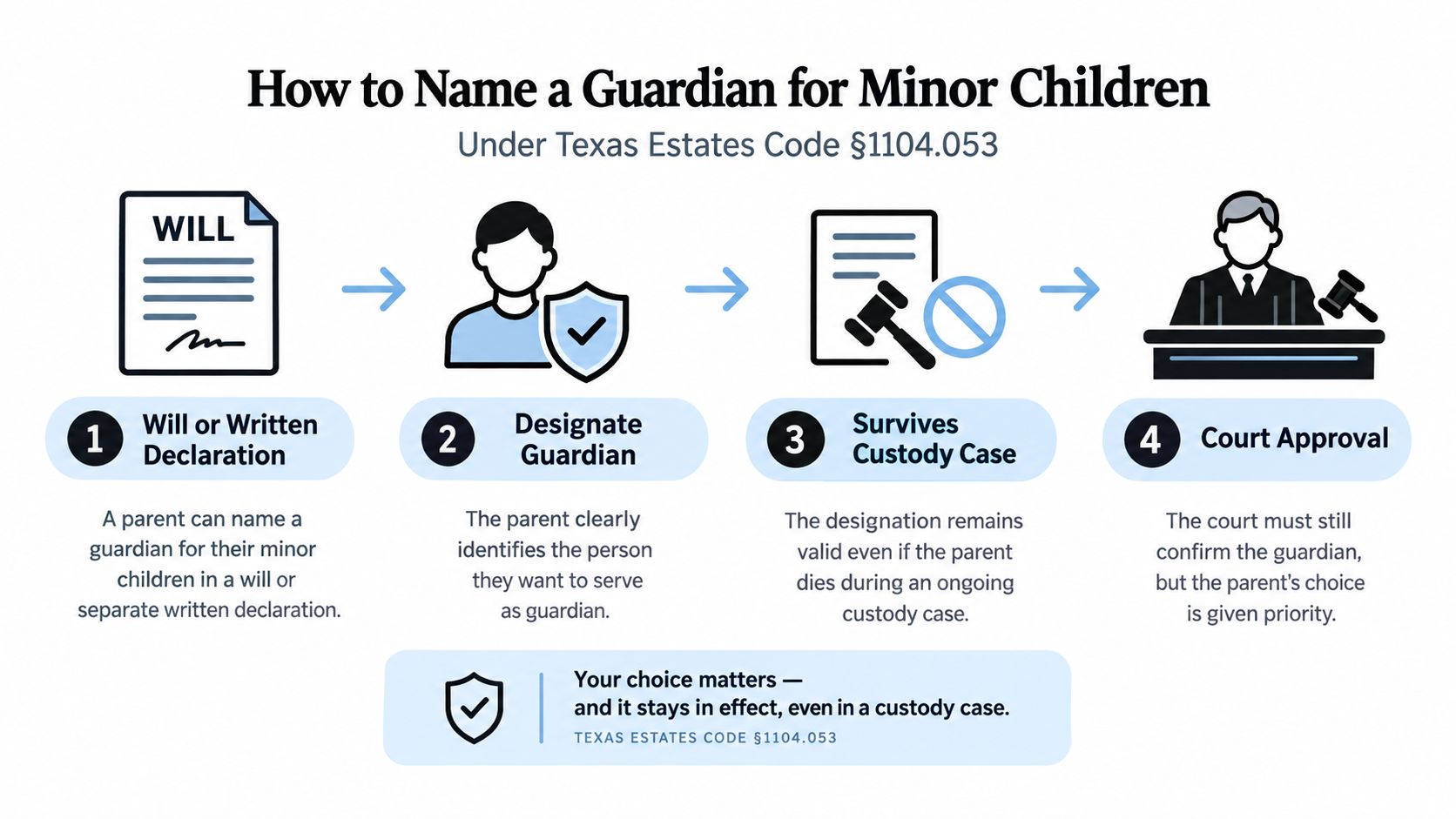
A parent can express a preference for who should care for a minor child after death. Texas Estates Code § 1104.053 allows a surviving parent to appoint a guardian by will or written declaration. After that parent dies or becomes incapacitated, the court generally must appoint the designated person unless the person is disqualified, deceased, refuses to serve, or the appointment isn't in the child's best interest. Texas Estates Code § 1104.053 supplies the statutory framework.
The document doesn't let a parent “bequeath” a child. Children aren't property. The designation gives the court clear evidence of the parent's wishes, while the judge retains authority to protect the child.
What a sound designation should contain
A practical declaration should identify the child, name the proposed guardian, and be signed by the parent. The written declaration should also satisfy the statutory execution requirements, including notarization or witnessing by qualified witnesses.
Choose someone who is not only loved by the child but also able and willing to serve. Consider the person's home, health, relationship with the child, ability to cooperate with the surviving parent, and capacity to manage school, medical, and emotional needs. Name an alternate where appropriate.
The 2025 Family Code change creates a serious complication for blended families. Recent Texas reporting explains that the change eliminated a prior path some step-parents and non-biological or adoptive same-sex parents used to seek custody after a parent's death. Texas Family Code changes effective September 2025 means older articles may give outdated advice to a step-parent or former partner who raised the child.
A guardian designation helps, but it doesn't replace a current custody order, a properly prepared estate plan, or prompt legal action after death.
If no designation exists, the court applies the Estates Code and the facts before it. The surviving parent's legal position remains central, but a relative or caregiver may need to act quickly if the child's safety or stability is at risk.
Guardianship of the Estate for an Inheriting Minor
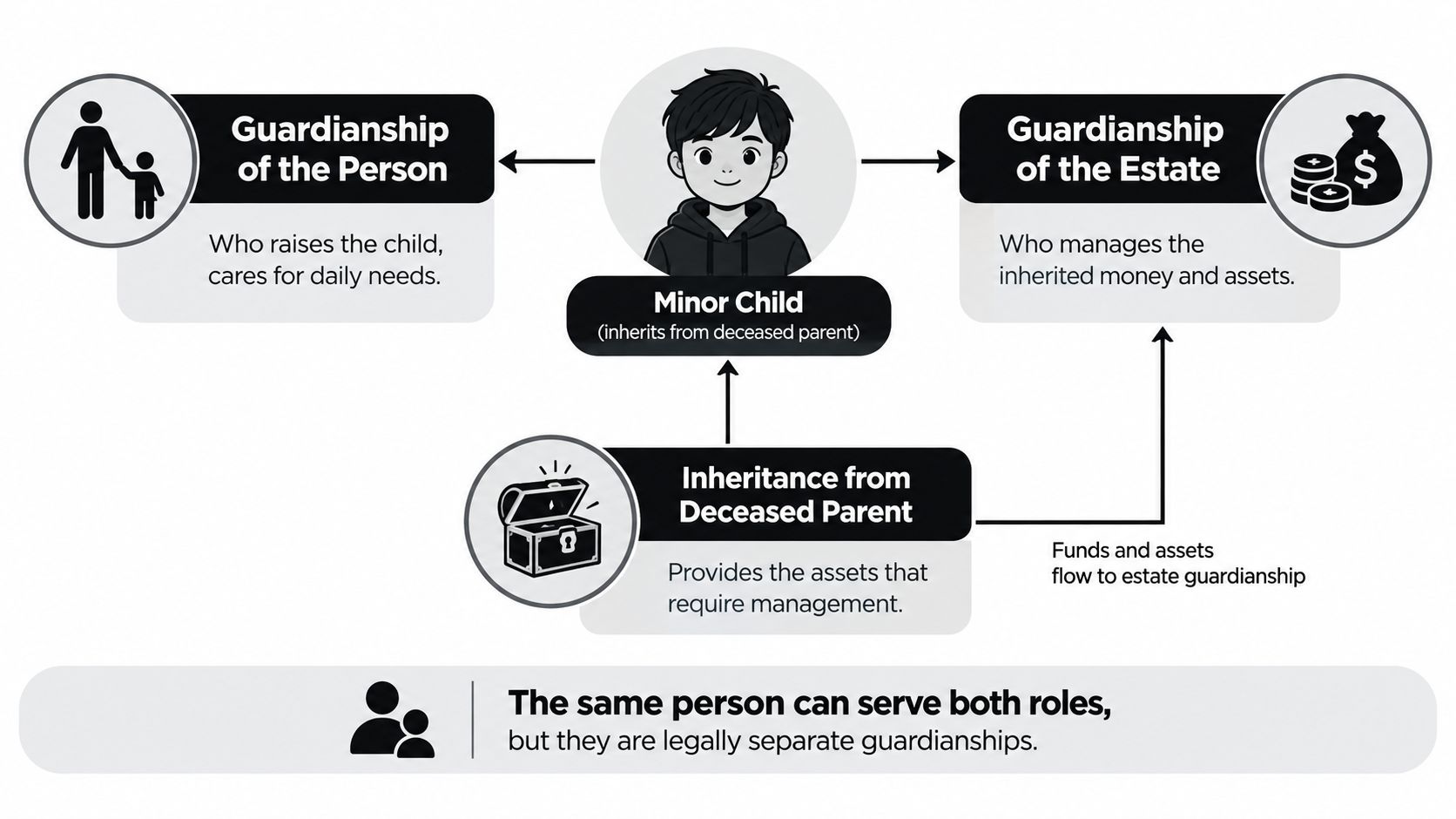
Texas separates guardianship of the person from guardianship of the estate. The first concerns who raises the child and handles daily care. The second concerns who collects, protects, and manages money or property belonging to the child.
A minor child generally can't control inherited assets directly. If the deceased parent's estate passes property to the child, the court may need to appoint a guardian of the estate or recognize another structure authorized by the will or law. The same person may serve both roles, but the duties remain legally distinct.
What the estate guardian does
Under the Texas Estates Code guardianship framework, the fiduciary may need to:
- Collect assets: Take control of inherited accounts, property, and proceeds.
- Protect value: Preserve the child's property rather than using it as the adult's personal money.
- Handle administration: Address debts, required inventories, accountings, and court filings.
- Spend for proper purposes: Use funds for the child's health, education, support, and welfare when legally authorized.
- Report to the court: Follow bond, accounting, and supervision requirements that apply to the appointment.
A parent who is also the natural guardian may qualify to serve without bond unless the court finds cause to require one. That does not eliminate the fiduciary duty. The guardian must keep the child's funds separate, document transactions, and avoid self-dealing.
A will can also create a testamentary trust, and an appropriate trust or UTMA arrangement may reduce the need for a traditional guardianship of the estate. The right choice depends on the assets, the child's age, the family relationships, and the drafting language.
The collision between custody and inheritance occurs here. The person who raises the child may be different from the person trusted to manage the child's money. Don't assume a custody order answers the financial question.
Probate Steps When There Is No Will
When a Texas parent dies without a will, the family may need a court determination of heirship before property can be distributed. The custody case doesn't replace that proceeding, and probate doesn't decide conservatorship.
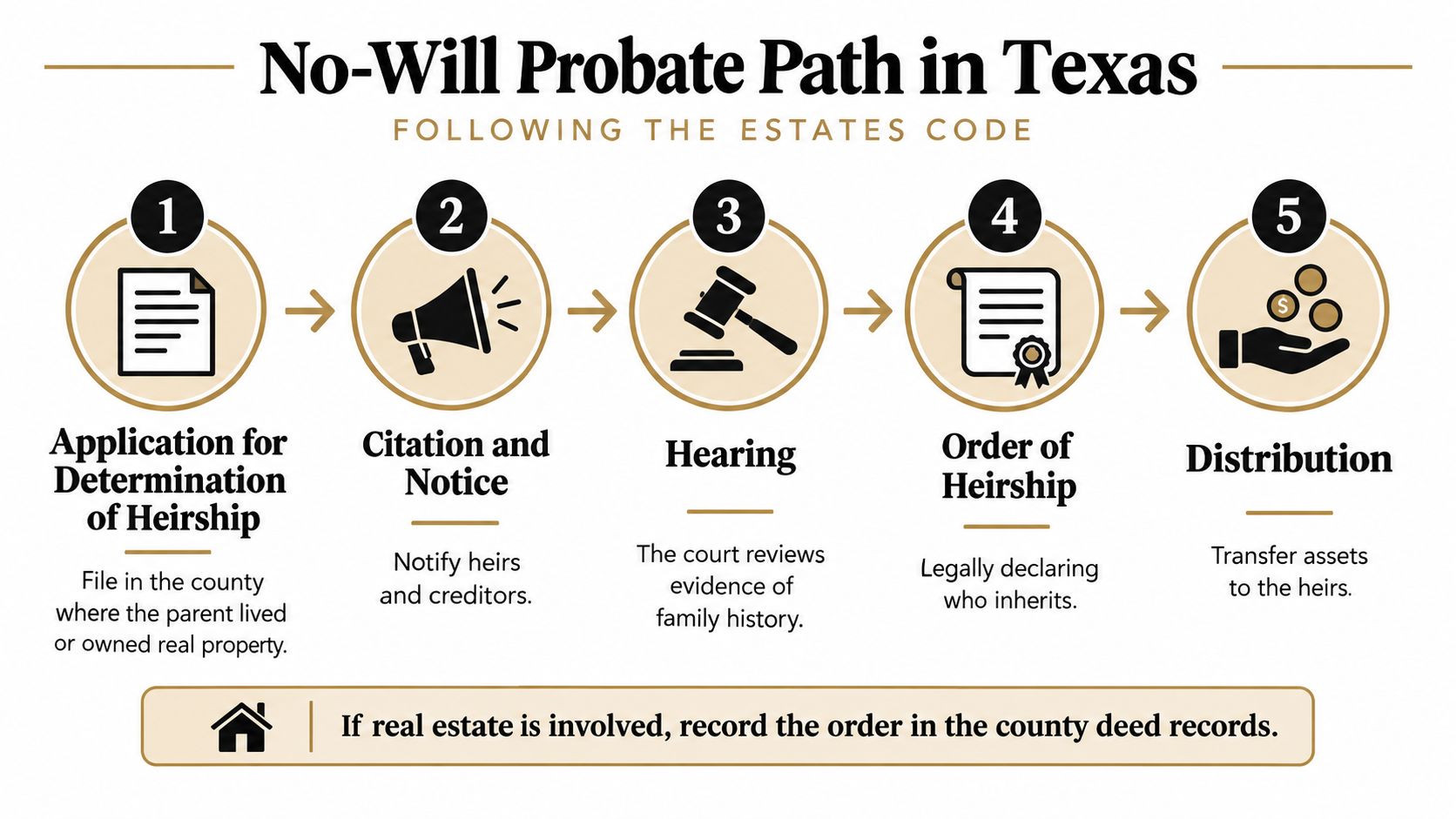
The sequence usually begins with an Application for Determination of Heirship filed in the proper county, often where the parent lived or owned real property. The applicant provides facts about the death, marriage, children, parentage, property, and family history.
The court-centered process
- File the application. The filing asks the probate court to determine the legal heirs.
- Provide notice. The clerk posts citation to known and unknown heirs as required by the proceeding.
- Appoint an attorney ad litem. The court appoints an attorney to represent unknown or absent heirs whose interests need protection.
- Prepare proof. The family gathers the death certificate, marriage records, birth records, parentage evidence, and sworn testimony about family history.
- Attend the hearing. The judge reviews the evidence and signs a judgment declaring the heirs and their shares.
- Administer and distribute. The family selects the appropriate administration path, then transfers property under the court's authority.
Texas probate guidance describes this heirship process as involving an application, an attorney ad litem for unknown heirs, a hearing, and a judgment declaring the heirs before administration and distribution. Tarrant County's intestacy manual also addresses the role of disinterested witnesses in proving family history.
After heirship is established, the estate may proceed through independent administration, a small-estate affidavit where the statutory requirements are satisfied, or dependent administration when closer court supervision is necessary. If a minor inherits, guardianship or another fiduciary structure may affect which option is practical.
If real estate is involved, record the heirship order in the county deed records. Keep the probate file separate from the SAPCR file, while coordinating both so the child's housing, care, and inheritance remain protected.
Practical Next Steps for Texas Families
The first days after a parent's death are emotionally chaotic, but the legal priorities are concrete. Start by protecting the child's immediate stability and preserving the estate.
If you're the surviving parent
- Secure the death certificate: Obtain certified copies and gather the existing custody orders and pleadings.
- Notify the SAPCR court: File a Suggestion of Death under Texas Family Code § 155.001 and ask counsel about temporary orders.
- Don't alter estate assets: Consult a probate attorney about the homestead, exempt property, bank accounts, retirement plans, and debts before transferring anything.
- Maintain records: Save communications, school information, medical records, insurance paperwork, and evidence of the child's routine.
If you're a designated or prospective guardian
Prepare a verified application, locate the will or written guardian declaration, and collect proof of your relationship with the child. Ask the probate court or your attorney about bonding, Letters of Administration, guardianship of the person, and guardianship of the estate.
If you're a concerned relative
Don't rely on an informal promise or a family meeting. Determine whether a custody order, guardian designation, probate application, or emergency filing is needed, and preserve evidence showing the child's current circumstances and best interests.
During the first thirty days, focus on court notices, insurance and retirement beneficiary forms, bank and investment accounts, digital access, housing, school, medical care, and funeral-related records. During the first sixty days, make sure the appropriate probate and family-law filings are moving forward and that no one is treating inherited money as personal funds. Texas probate guidance confirms that custody arrangements don't change a child's inheritance rights, while the exact property split depends on a will, intestacy law, and whether property is community or separate. Texas State Law Library probate guidance is a useful starting point for the probate track.
If you need help navigating divorce, custody, or estate planning in Texas, contact The Law Office of Bryan Fagan today for a free consultation.
The Law Office of Bryan Fagan, PLLC can help coordinate the custody response, guardianship questions, probate administration, and estate planning decisions that follow a parent's death. Visit Law Office of Bryan Fagan, PLLC to schedule a free consultation and discuss the child's immediate care and inheritance with a Texas legal team.



