
The moment you realize divorce is no longer a distant possibility but a real decision, your mind starts racing. How will this affect your children’s school routine? Will they fall behind? Can you afford what comes next without turning your family’s life upside down? For many Texas parents, those late-night worries pile up fast, blending emotional strain with financial fear. The Cost of Divorce in Texas isn’t just about court fees and attorney retainers—it’s about how the choices you make now can shape your child’s stability, confidence, and academic success for years to come.
At The Law Office of Bryan Fagan, PLLC, we’ve walked alongside thousands of Houston families facing this exact crossroads. Led by Bryan Joseph Fagan, a South Texas College of Law graduate and recognized authority on Texas divorce and custody law, our firm understands that divorce is not simply a legal transaction—it’s one of life’s hardest transitions. Texas courts don’t just look at who earns more or who files first. Under Texas Family Code §153.002, judges are required to focus on the best interest of the child, which increasingly includes educational stability, consistent routines, and a parent’s ability to support learning during and after divorce. Knowing how these factors intersect with cost can make a powerful difference in both your case and your child’s future.
This guide is designed to give you clarity and peace of mind. You’ll learn what truly drives the cost of divorce in Texas, how custody and child support decisions can directly impact your child’s academic performance, and how thoughtful legal planning can reduce conflict while protecting what matters most. Our goal is simple and rooted in our purpose: to empower you with knowledge, compassionate guidance, and practical insight so you can move forward with confidence—financially, legally, and as a parent who wants their child to thrive.
Key Takeaways
- Cooperation is the biggest cost factor: Uncontested divorces typically cost $300 to $5,000, while contested cases can reach $15,000 to $30,000 or more—the less you and your spouse fight, the less you’ll spend
- Filing fees are just the starting point: Court filing fees range from $250 to $400, but attorney fees, mediation, expert witnesses, and discovery can multiply your total expenses dramatically
- Children increase costs significantly: Cases involving child custody disputes average $23,500 compared to $15,600 for divorces without children
- Strategic planning saves money: Gathering financial documents early, using mediation when appropriate, and hiring an experienced Texas family law attorney can prevent costly mistakes and unnecessary delays
- Your choices matter more than you think: Many of the most expensive divorce costs are avoidable with the right approach and guidance

Your Family’s Future Starts Here
Don’t navigate your legal journey alone. Schedule a consultation now and get the clarity and support you deserve.
What Is the Cost of Divorce in Texas? (Short Answer)
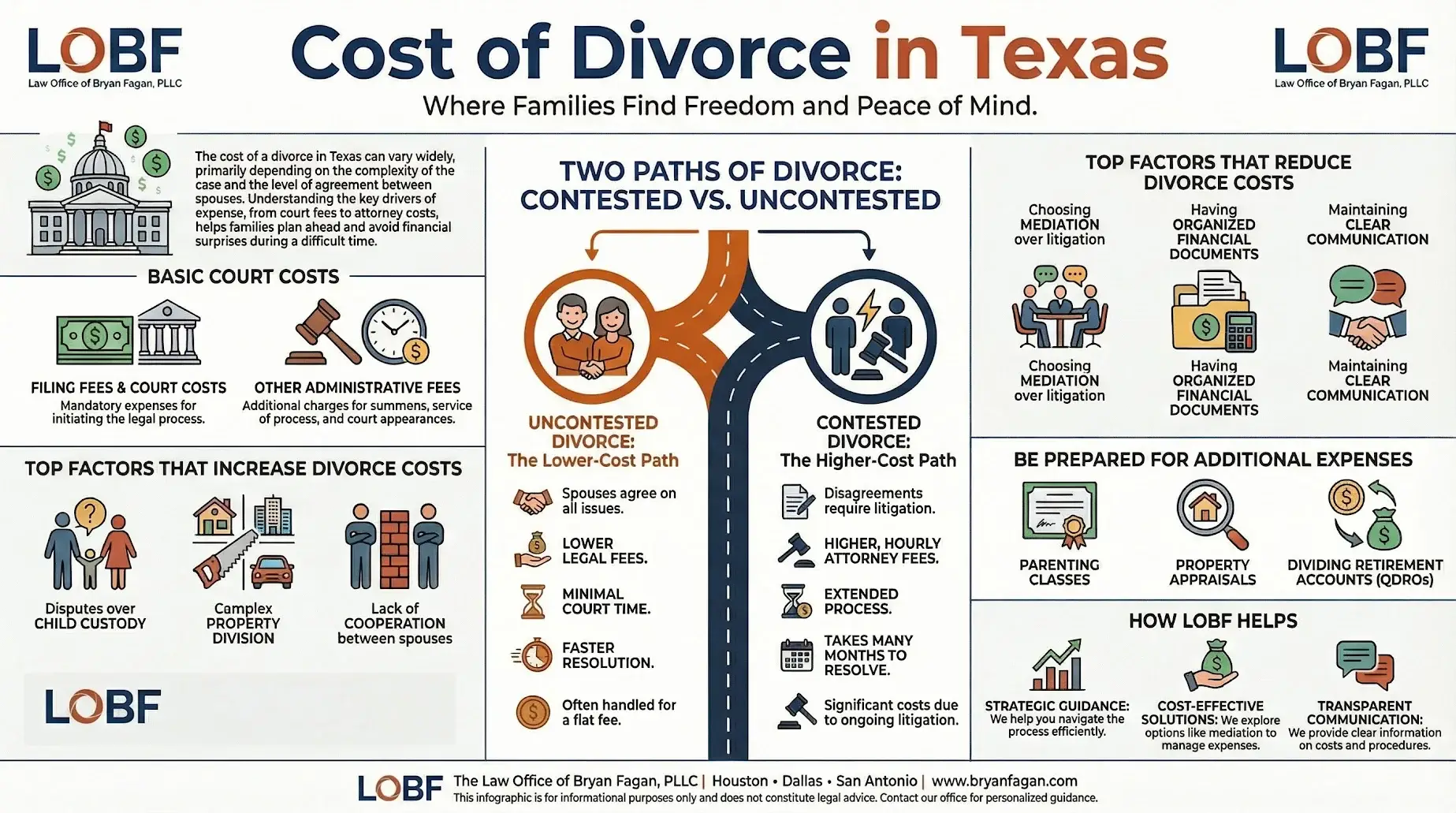
The Cost of Divorce in Texas spans a wide range, from a few hundred dollars in straightforward uncontested cases to tens of thousands in highly contested matters. Statewide data consistently shows Texas ranking among the more expensive states for divorce, with average costs around $15,600 for divorces without children and closer to $23,500 when children are involved. These figures reflect not just filing fees and attorney time, but the cumulative impact of disputes, court involvement, and the complexity of family and financial circumstances.
Where your case ultimately falls on this spectrum depends on several critical factors. Cooperation between spouses is often the most powerful cost-control tool, as agreement reduces the need for hearings, discovery, and trial preparation. Whether children are involved can significantly affect expenses, particularly because Texas courts must evaluate custody and parenting arrangements under Texas Family Code §153.002, which requires decisions to be made in the best interest of the child. Property division under Texas Family Code §7.001 also plays a major role, as complex assets, businesses, or disputed debts require additional legal and financial analysis. While a well-prepared do-it-yourself filing may cost as little as $300 to $700, high-conflict cases involving custody disputes or trial can exceed $50,000 or more.
Understanding these cost ranges allows families to plan realistically and make informed decisions early. Texas law requires a mandatory 60-day waiting period before a divorce can be finalized under Texas Family Code §§6.701 and 6.702, but how that time is used often determines whether costs remain manageable or spiral upward. Families who invest in preparation and negotiation tend to experience smoother outcomes and less financial strain.
For those exploring the lower end of the cost spectrum, the firm provides additional education in its detailed resource on how much an uncontested divorce costs in Texas with a step-by-step guide. That guidance is also reflected throughout the firm’s broader educational materials, which serves as a practical reference point for families seeking clarity.
By helping clients understand both the financial realities and the legal framework behind divorce costs, attorneys with the Bryan Fagan Law Firm continue their mission of educating families and protecting futures. With realistic expectations and informed guidance, families are better equipped to navigate divorce in a way that safeguards their finances, their children, and their long-term stability.
Basic Costs in Every Texas Divorce
Court Filing Fees
When families first start researching the Cost of Divorce in Texas, court filing fees are usually the first concrete expense they encounter. Every divorce filed in Texas requires payment of a filing fee to officially open the case and assign a cause number, regardless of whether the divorce is contested or uncontested. While the exact amount varies by county, most filing fees fall between $250 and $400, with many Texas families seeing an average cost around $350. These fees are unavoidable and form the foundation of your overall divorce budget.
Filing fees cover the court’s administrative processing of your divorce petition, but they are rarely the only court-related costs. Many counties charge separately for certified copies of the final divorce decree, which are often needed to update financial accounts, property records, or personal identification documents. If children are involved, Texas courts may also require parents to complete a court-approved parenting education course under Texas Family Code §105.009, adding another mandatory expense. For most families, planning for a realistic initial outlay of $300 to $450 helps prevent surprises during the early stages of the case.
For those facing genuine financial hardship, Texas law does provide a potential safety net. Under Texas Rule of Civil Procedure 145, individuals who cannot afford court costs may request a waiver by submitting a sworn statement detailing income, expenses, and financial obligations. When properly completed, this process can reduce or even eliminate filing fees, easing the immediate financial pressure of starting a divorce. Attorneys at The Law Office of Bryan Fagan, PLLC regularly guide clients through this process to ensure paperwork is accurate and deadlines are met, helping families avoid costly delays.
Understanding how filing fees fit into the broader Cost of Divorce in Texas allows parents to make informed, strategic decisions from the outset. Factors such as cooperation between spouses, the complexity of assets, and whether children are involved can significantly influence overall costs. For readers who want a deeper understanding of how agreement and preparation can lower expenses, our firm offers additional insight in our article on factors that influence the cost of an uncontested divorce in Texas. By pairing clear legal guidance with practical financial planning, the Bryan Fagan Law Firm continues its mission of educating families and protecting futures throughout every stage of the divorce process.

Service of Process Fees
After filing your divorce papers, your spouse must be officially notified of the proceedings. This requirement is called service of process, and how it’s handled affects your associated costs.
The most cost-effective approach involves your spouse signing a Waiver of Service, which eliminates this expense entirely. When spouses cooperate and acknowledge receipt of the divorce petition voluntarily, you pay court costs for the waiver document only—typically minimal.
If your spouse won’t sign a waiver or you cannot locate them, you’ll need to hire someone to deliver the divorce paperwork formally. A process server or county constable typically charges $100 to $250 for serving divorce papers, depending on your location and how easy your spouse is to find. This expense seems small but represents one of many areas where early cooperation between spouses directly reduces the overall cost.
Attorney Fees and How They Affect the Cost of Divorce in Texas
Legal fees are often the most unpredictable part of the Cost of Divorce in Texas, which is why understanding how attorneys charge is so important when planning your case. Unlike filing fees, legal costs vary widely depending on the complexity of the divorce, the level of conflict, and how efficiently the case is handled. Having a clear picture of billing structures allows families to budget realistically and avoid surprises as the case progresses.
Most Texas divorce attorneys bill by the hour, with statewide averages hovering around the mid-$200s per hour. Rates can vary significantly based on experience, geographic location, and case demands, with attorneys in major metropolitan areas such as Houston, Dallas, and Austin typically charging more than those in smaller communities. While hourly billing provides flexibility, it also means that prolonged disputes, repeated hearings, or inefficient communication can quickly increase total costs.
In most cases, hiring an attorney requires paying a retainer upfront. A retainer functions as an advance deposit against future legal work, and your attorney bills their time against that balance as the case moves forward. Once the retainer is exhausted, additional funds are usually required to continue representation. Understanding this structure early helps families plan cash flow and avoid interruptions in legal services during critical stages of the divorce.
For couples pursuing a straightforward uncontested divorce, many Texas family law attorneys offer flat-fee arrangements instead of hourly billing. These flat fees often range from $2,500 to $5,000 and can provide cost predictability when both spouses agree on all major issues. Uncontested cases still must comply with procedural requirements under Texas Family Code §§6.701 and 6.702, including the mandatory waiting period, but they typically involve fewer court appearances and less attorney time. Families interested in this approach may benefit from reviewing the firm’s detailed explanation of the uncontested divorce procedure in Texas, which walks through each step in plain language.
Although it may seem counterintuitive, working with an experienced Texas family law attorney often saves money over the long term. Skilled attorneys help clients avoid procedural errors, comply with Texas Family Code requirements, and make strategic decisions about when to negotiate and when litigation is truly necessary. Attorneys with the Bryan Fagan Law Firm focus on efficiency, clarity, and informed advocacy, helping families manage the Cost of Divorce in Texas while protecting their rights and long-term stability. That same educational focus is reflected throughout the firm’s resources, including reinforcing the firm’s commitment to guiding families through divorce with confidence and care.
Uncontested vs. Contested Divorce Costs
When families are trying to understand the Cost of Divorce in Texas, the difference between an uncontested and a contested divorce often has the greatest impact on both the final expense and the overall experience. In real terms, cooperation between spouses translates into fewer court appearances, less attorney time, and far less emotional strain. Texas courts are structured to encourage agreement where possible, and families who are able to work through issues collaboratively are typically rewarded with a faster, more affordable path forward.
An uncontested divorce occurs when both spouses agree on all required issues, including the grounds for divorce, division of property and debts, and—when children are involved—custody, visitation, and child support. Texas Family Code §6.701 and §6.702 still require a mandatory 60-day waiting period, but once that period has passed, uncontested cases often move swiftly to finalization because there are no disputes requiring hearings or trials. This streamlined process reduces both legal fees and the stress placed on parents and children alike.
From a financial standpoint, uncontested divorces are usually far more manageable. Families typically pay court filing fees in the $350 to $450 range, minimal service-of-process costs that are often waived when a spouse signs a waiver, and attorney fees that are commonly offered as flat rates instead of open-ended hourly billing. Depending on how much assistance is needed, total costs can range from a few hundred dollars for well-prepared do-it-yourself filings to around $5,000 with attorney guidance. Because there is little conflict, mediation is often unnecessary, and the reduced tension can help preserve stability for children during a difficult transition.
Online divorce services have also made uncontested divorces more accessible for couples without children or complex assets. While these services can help prepare basic paperwork at a lower upfront cost, they do not offer legal advice or representation. This is where experienced Texas family law counsel can add long-term value by ensuring agreements comply with the Texas Family Code and by preventing errors that may lead to costly enforcement or modification proceedings later. For readers who want a deeper understanding of how this process works, the firm provides additional education in its Beginner’s Guide to the Cost of an Uncontested Divorce in Texas, which walks families through common expenses, timelines, and planning considerations.
By contrast, contested divorces involve unresolved disagreements that require court intervention, discovery, hearings, and sometimes trial. These disputes can cause the Cost of Divorce in Texas to rise quickly while extending uncertainty for parents and children. Attorneys with the Bryan Fagan Law Firm regularly help clients evaluate whether issues can be resolved through agreement rather than litigation, balancing legal rights with financial reality. This guidance reflects the firm’s broader mission of educating families, protecting futures, and helping clients choose paths that reduce conflict while supporting long-term stability.

Contested Divorce
A contested divorce involves disagreement on one or more significant issues. When spouses cannot reach agreements through negotiation, legal expenses escalate dramatically as attorneys prepare for hearings, conduct discovery, and potentially go to trial.
Contested divorce expenses often include:
- Filing fees: $350 to $450
- Service of process: $100 to $250
- Attorney fees: $10,000 to $25,000 or more (hourly billing)
- Discovery costs: $2,000 to $7,500
- Mediation expenses: $1,500 to $5,000 or more
- Expert witnesses: $5,000 to $20,000
- Trial preparation and appearance: Additional thousands
Total contested divorce costs typically range from $15,000 to $30,000, with high-conflict cases exceeding $50,000 to $100,000. These cases often take six to eighteen months to resolve, sometimes extending to two years if trial becomes necessary.
National research shows that going to trial on just one or two issues averages $11,600 in additional legal fees, while trials involving three or more contested issues average $21,500. Every argument translates to billable hours—making cooperation the most cost effective divorce process strategy available.
Additional Costs That Can Increase the Cost of Divorce in Texas
Beyond basic filing fees and attorney retainers, a number of additional expenses can significantly increase the Cost of Divorce in Texas, particularly in contested or high-conflict cases. Families are often surprised to learn that these costs are not unusual but are tied directly to how Texas courts ensure fairness, accuracy, and the protection of children’s best interests. Understanding where these expenses come from allows you to plan ahead and make strategic decisions about how disputes are resolved.
Mediation is one of the most common added costs in Texas divorce cases. Courts frequently require mediation before allowing contested issues to proceed to trial, especially when children or complex property issues are involved. Under Texas Family Code §6.602, a properly executed mediated settlement agreement can be binding, which is why mediation often saves money in the long run despite upfront fees that may range from $1,500 to $5,000 or more. When mediation resolves disputes early, it can prevent the far greater expense of prolonged litigation.
Expert involvement is another major cost driver. In divorces involving businesses, real estate, or significant assets, courts rely on qualified professionals to provide accurate valuations and financial analysis. Real estate appraisers, business valuation experts, and forensic accountants commonly charge thousands of dollars for their work, but their input is often essential to achieving a just and right division of property as required by Texas Family Code §7.001. When one spouse suspects hidden income or assets, forensic accounting may be unavoidable to ensure fairness.
Cases involving children can also incur additional expenses through custody evaluations. When parents cannot agree on conservatorship or possession schedules, courts may order evaluations to assess parenting abilities and make recommendations focused on the child’s best interest under Texas Family Code §153.002. These evaluations can extend timelines and increase costs, but they play an important role in helping courts craft custody arrangements that support long-term stability for children.
Dividing retirement accounts and managing temporary needs during the divorce process can further add to overall expenses. Retirement assets often require a Qualified Domestic Relations Order, or QDRO, to divide accounts without triggering tax penalties, which involves specialized legal work. Temporary orders hearings addressing custody, child support, spousal support, or use of marital property also require preparation and court appearances, increasing attorney fees. Many of these costs arise only after eligibility and procedural requirements are met, making early planning essential. For families seeking clarity on qualifying for divorce and meeting statutory requirements, the firm offers helpful guidance in its resource on eligibility for divorce in Texas, which is also referenced throughout as an educational foundation.
By anticipating these additional expenses and understanding how Texas law applies, families can better manage the Cost of Divorce in Texas and avoid unnecessary financial strain. Attorneys with the Bryan Fagan Law Firm focus on educating clients about these potential costs early, empowering families to choose solutions that balance legal protection with long-term financial stability.
Costs When Children Are Involved
When children are part of your divorce, expect higher overall cost and a more complex process. Cases involving child custody issues average $23,500 compared to $15,600 for divorces without children—a difference of nearly $8,000.
Several factors drive these increased costs. Child custody disputes require court intervention to establish arrangements for conservatorship, possession schedules, and decision-making authority. These disagreements often require multiple hearings, extended negotiations, and sometimes custody evaluations by mental health professionals.
Child support calculations can become contentious, especially when parents have irregular income, own businesses, or disagree about educational or medical expenses. Financial experts may be needed to properly calculate support obligations under Texas guidelines.
Developing comprehensive parenting plans takes time and negotiation. Parents frequently disagree about holiday schedules, vacation time, extracurricular activities, and how to handle medical and educational decisions. Each disagreement adds to attorney fees as your legal representatives work toward resolution.
The emotional nature of child-related decisions often intensifies conflict. Parents naturally feel protective of their relationships with their children, sometimes making it harder to reach practical compromises. This emotional investment can extend negotiations and increase the financial burden of divorce proceedings.
Common Mistakes That Increase Divorce Costs
Many families unintentionally increase the Cost of Divorce in Texas by making decisions that seem reasonable in the moment but create long-term financial consequences. Divorce is emotional by nature, and without clear guidance, it is easy to take steps that add conflict, extend timelines, and drive up legal fees. Understanding where these mistakes commonly occur gives you the opportunity to protect both your finances and your peace of mind.
One of the most frequent cost drivers is prolonging disputes that could be resolved through good-faith negotiation. When spouses refuse to compromise or insist on repeated hearings over manageable issues, attorney fees climb quickly. Texas courts actively encourage resolution outside the courtroom, and under Texas Family Code §6.602, properly executed mediated settlement agreements can be binding and enforceable. Choosing cooperation over confrontation often results in faster outcomes and far lower expenses.
Another costly mistake is defaulting to litigation instead of exploring alternative dispute resolution. Mediation and negotiated settlements are often more efficient, less expensive, and less damaging to family relationships than court battles. Judges expect parties to attempt reasonable solutions before trial, especially in cases involving children, where prolonged conflict can undermine stability and well-being.
Poor financial preparation also adds unnecessary expense. When bank records, tax returns, retirement statements, and debt information are incomplete or disorganized, attorneys must spend billable time tracking down documents. This directly affects property division under Texas Family Code §7.001, which requires a just and right division of the marital estate. Clients who gather and organize financial records early often see significantly lower overall costs.
Emotions can also quietly inflate divorce expenses. Decisions driven by anger, fear, or a desire to “win” often result in rejected settlements and prolonged litigation. Experienced Texas family law attorneys help clients separate emotional processing from legal strategy, offering realistic advice based on how courts actually apply the law. Ignoring that guidance and pushing forward with trial rarely changes outcomes and often leads to higher bills with little benefit.
Finally, attempting to save money by filing paperwork without legal oversight can backfire. Errors in pleadings or final decrees frequently lead to delays, re-filings, or enforcement actions that cost far more to correct later. For families seeking deeper perspective on what truly influences divorce expenses, the Bryan Fagan Law Firm offers additional education through its detailed resource, expert insights on how much a divorce costs in Texas. By combining practical guidance with compassionate support, the firm remains committed to helping Texas families avoid costly mistakes while protecting their futures.

How to Reduce the Cost of Divorce in Texas
Strategic planning plays a critical role in managing the Cost of Divorce in Texas without giving up control over your future. Families who take time to understand their options and prepare early are often able to reduce unnecessary conflict, shorten timelines, and keep legal expenses in check. Texas divorce law provides flexibility, but the financial outcome is heavily influenced by the decisions you make from the very beginning.
One of the most effective ways to reduce costs is pursuing an uncontested divorce whenever possible. When spouses are able to agree on property division, debts, and any child-related matters, the process moves far more efficiently. Texas Family Code §§6.701 and 6.702 require a mandatory 60-day waiting period, but once that period passes, uncontested cases can often be finalized quickly with limited court involvement. Even couples who start out in disagreement may save thousands by negotiating toward resolution rather than litigating every issue. For a detailed breakdown of this approach, the firm offers guidance in its article on how much an uncontested divorce costs in Texas and key considerations before filing, which is also referenced throughout as an educational resource.
Preparing financial information early is another powerful cost-control strategy. Collecting tax returns, bank statements, retirement account records, property documents, and debt information before meeting with an attorney reduces the time spent on basic fact-gathering. This preparation directly supports the court’s obligation under Texas Family Code §7.001 to divide marital property in a just and right manner. Clients who come prepared often experience smoother negotiations and fewer delays, which translates into lower overall legal fees.
Clear communication and strategic use of mediation can also significantly limit expenses. Efficient communication—organized questions, prompt responses, and focused discussions—allows your attorney to concentrate on resolution rather than administrative tasks. Mediation, when used thoughtfully, often costs far less than litigation and can produce more durable agreements. Texas Family Code §6.602 gives properly executed mediated settlement agreements binding effect, allowing families to avoid trial while still reaching enforceable solutions that support long-term stability.
Finally, working with experienced Texas family law counsel helps families avoid mistakes that drive up costs later. Attorneys who understand local court practices and the practical application of the Family Code can guide clients toward realistic outcomes and away from emotionally driven decisions that rarely pay off. By helping clients focus on what truly matters, the Bryan Fagan Law Firm continues its mission of educating families, protecting futures, and providing steady guidance through one of life’s most challenging transitions.
Why Hiring the Right Attorney Can Save Money
Counterintuitively, professional legal representation often reduces your total divorce costs even though it adds upfront expenses. Here’s why working with an experienced divorce attorney typically pays for itself.
Skilled attorneys prevent costly mistakes that pro se litigants commonly make. Improperly filed documents, missed deadlines, and procedural errors can delay your divorce and require expensive corrections. An experienced family law attorney navigates these requirements efficiently.
Professional representation speeds resolution. Attorneys who regularly handle Texas divorces know how local courts operate, which judges prefer which approaches, and how to move cases forward effectively. This knowledge translates directly into lower overall legal costs through faster resolution.
Good attorneys help clients set realistic expectations early. When you understand what outcomes are likely, you can make informed decisions about where to negotiate and where to stand firm—avoiding expensive fights over issues you’re unlikely to win.
Strategic negotiation protects long-term interests. Property division, spousal support, and custody arrangements affect your financial implications for years or decades. An experienced divorce lawyer ensures you don’t trade short-term savings for long-term losses.
Finally, attorneys provide objective guidance when emotions run high. This perspective helps you avoid decisions driven by anger or hurt—decisions that often generate substantial additional costs without meaningful benefit.
Why Choose the Law Office of Bryan Fagan PLLC
Navigating the Cost of Divorce in Texas takes more than legal paperwork—it requires steady guidance from a team that values transparency, efficiency, and empathy. Families benefit most when their attorney explains not only what the law requires, but how each decision affects both short-term expenses and long-term stability. Clear communication and realistic planning help reduce anxiety and give clients confidence as they move through an unfamiliar process.
With extensive experience handling Texas divorces at every level of complexity, the Bryan Fagan Law Firm has seen what drives costs higher and what helps keep them under control. From uncontested divorces to high-asset and high-conflict cases, that experience allows attorneys to guide clients toward strategies that protect their interests while avoiding unnecessary expense. This includes helping clients understand how Texas courts apply Texas Family Code §7.001 when dividing marital property and Texas Family Code §153.002 when making decisions involving children.
Transparency is a cornerstone of that approach. From the outset, clients receive clear explanations of billing practices, anticipated costs, and available strategies so there are no surprises along the way. Regular updates allow families to budget realistically and make informed choices as their case evolves. This focus on education reflects the firm’s broader mission of empowering families with knowledge, not just legal representation.
Efficient case management further helps control the Cost of Divorce in Texas without sacrificing quality. Thorough preparation, prompt communication with opposing counsel, and a focus on resolution reduce delays that often lead to higher legal fees. While Texas law requires a mandatory waiting period under Texas Family Code §§6.701 and 6.702, how that time is used—whether for preparation or conflict—often determines whether costs remain manageable or escalate.
Finally, the firm’s family-centered philosophy prioritizes practical outcomes over drawn-out legal battles. Attorneys help clients distinguish between issues that genuinely require litigation and those better resolved through compromise, supporting long-term stability for parents and children alike. For readers who want a clear, step-by-step overview of what to expect, the firm offers a helpful resource explaining the Texas divorce process. That same commitment to education and clarity is reflected throughout the firm’s resources, reinforcing the firm’s role as a trusted guide through one of life’s most challenging transitions.

Actionable Checklist: Planning for the Cost of Divorce in Texas
Preparing financially for divorce is one of the most effective ways to manage the Cost of Divorce in Texas and reduce unnecessary stress along the way. Families who take time to evaluate their situation early are better positioned to make informed decisions and avoid costly surprises. One of the first steps is assessing whether an uncontested divorce is realistic. When spouses can agree on property division, debts, and, if applicable, child custody and support, cases tend to resolve more efficiently and at a significantly lower cost. Texas courts allow streamlined resolution in these situations, provided all statutory requirements are met under the Texas Family Code.
Establishing a realistic budget is equally important. Court filing fees alone often fall in the $300 to $450 range, and many cases also require an upfront attorney retainer depending on complexity. Understanding these baseline expenses helps families plan responsibly from the outset. Texas Family Code §§6.701 and 6.702 impose a mandatory waiting period before a divorce can be finalized, and how that time is used—whether for preparation or conflict—often affects both cost and outcome.
Gathering financial documentation early can dramatically reduce legal expenses. Collecting tax returns, bank statements, retirement account information, property deeds, vehicle titles, and debt records before meeting with an attorney minimizes billable time spent on basic fact-gathering. This preparation directly supports the court’s obligation under Texas Family Code §7.001 to divide marital property in a just and right manner. Clients who arrive organized often experience smoother negotiations and fewer delays.
Understanding billing structures is another key component of financial planning. Some attorneys offer flat fees for uncontested cases, while others bill hourly for more complex matters. Asking clear questions about how retainers work and what services are included allows families to choose representation that aligns with their needs and budget. When disputes arise, discussing mediation early can also be beneficial, as Texas Family Code §6.602 recognizes properly executed mediated settlement agreements as binding, offering a cost-effective alternative to prolonged litigation.
Finally, planning for both timeline and emotional support can protect your finances. Contested cases typically take longer and cost more, so factoring time into your financial planning is essential. Having emotional support outside your legal team—such as trusted friends, family members, or counselors—helps ensure attorney time is spent on legal strategy rather than emotional processing. For families seeking guidance on filing correctly and avoiding costly paperwork errors, the firm provides a detailed resource on divorce forms and filing requirements in Texas. That same educational focus is reflected throughout the firm’s materials, including reinforcing the firm’s commitment to educating families and protecting futures at every stage of the divorce process.
Conclusion
If there’s one thing to take away from this conversation, it’s that divorce is never just a legal process—it’s a turning point for your family, your finances, and your children’s sense of stability. The choices you make along the way can either add stress and uncertainty or create a clearer, calmer path forward. Understanding the cost of divorce in Texas, and how those decisions ripple into your child’s academic and emotional well-being, puts you back in the driver’s seat at a time when life can feel anything but predictable.
You don’t have to figure this out alone, and you don’t have to learn the hard way. Working with an experienced Texas family law attorney can help you avoid unnecessary conflict, protect your financial future, and design custody and support arrangements that truly work for your children—not just on paper, but in real life. At The Law Office of Bryan Fagan, PLLC, our focus has always been on education, clarity, and compassion, because informed parents make stronger decisions and families heal faster when they understand their options.
If you’re facing divorce or have questions about custody, support, or what comes next, consider this your invitation to take a thoughtful next step. Reach out, ask questions, and get real answers tailored to your situation. Peace of mind doesn’t come from guessing—it comes from knowing you have the right guidance in your corner. And if nothing else, remember this: protecting your child’s future and protecting your own don’t have to be competing goals. With the right plan, they can move forward together.
Frequently Asked Questions About the Cost of Divorce in Texas
If both spouses agree on all issues, an uncontested divorce in Texas is usually the most affordable option. Many people pay only court filing fees and basic paperwork costs, while attorney-assisted uncontested divorces typically cost a few thousand dollars depending on complexity. Factors like children, retirement accounts, or property division can raise the total, but agreement keeps costs significantly lower than contested cases.
You may qualify for a fee waiver if you cannot afford court costs due to financial hardship. Texas courts consider income, expenses, and whether you receive public benefits when reviewing these requests. While a fee waiver can eliminate filing fees, other costs—such as service of process or document preparation—may still apply.
The fastest and least expensive path is usually an uncontested divorce where both parties cooperate. Texas has a mandatory waiting period in most cases, so using that time efficiently—by gathering documents early and resolving disputes outside of court—can help minimize both delays and expenses.
Typically, the spouse who files for divorce pays the initial filing fees. However, final responsibility for costs can be negotiated in a settlement or decided by a judge. In some cases, especially when there is a large income imbalance or unreasonable conduct, a court may order one spouse to contribute to the other’s attorney’s fees.
The “10 year rule” is a common misconception. While the length of the marriage can affect certain issues—such as eligibility for spousal maintenance or how retirement benefits are divided—it does not guarantee alimony or automatic financial rights. Each case depends on specific facts and Texas law requirements.
There is no one-size-fits-all answer. Higher earners may feel the immediate impact of support obligations and legal fees, while lower earners may face challenges rebuilding financial independence. Long-term outcomes often depend on how well the divorce is planned and whether agreements are realistic, fair, and enforceable.
Moving out without a plan can unintentionally affect custody, property access, and negotiating leverage. In cases involving children, it may also disrupt routines that judges later consider when deciding custody. While moving out is sometimes necessary, it’s best to speak with a Texas family law attorney first to avoid creating avoidable legal and financial problems.
Texas does not have automatic divorce based on separation. Even if spouses live apart for an extended period, a divorce must still be filed and completed through the court system. Separation can be helpful for planning, but it does not end the marriage by itself.
Divorce without a lawyer can be cheaper upfront because you may only pay filing fees and basic document costs. However, mistakes in paperwork, unclear agreements, or overlooked issues—such as custody, child support, or retirement division—can lead to expensive corrections later. Many people choose limited legal guidance to balance cost savings with long-term protection.