 Skip to content
A trust is usually not split in a Texas divorce. Instead, the court looks at whether the spouse has a present right to distributions and whether the trust was funded with separate property or community property.
That's why a trust showing up on the financial inventory can feel unsettling, even when it doesn't mean the whole trust is on the chopping block. In Texas, the answer depends on who funded the trust, who controls it, what the trust says about divorce, and whether the money can be traced cleanly under Texas property rules.
When Divorce and Trusts Meet in Texas
A lot of people hear “trust” and assume the asset is automatically protected. Others assume the opposite, that anything inside a trust gets divided like a house or a bank account. Texas law is more precise than either of those assumptions.
The first question is usually simple to say and harder to prove. Who put the money into the trust, and what kind of money was it. Texas Property Code Chapter 112, Subchapter E, created in 2019, gives divorce lawyers a specific framework for certain trust transfers, while Texas community-property rules still decide whether the underlying property is even divisible in the first place. Under Section 112.102, a divorce generally revokes trust provisions that benefit an ex-spouse or the ex-spouse's family member, unless the trust instrument or another law says otherwise. Texas Property Code Chapter 112, Subchapter E
The four questions that usually control the outcome
A careful review often turns on four practical issues. Was the trust funded with separate property, such as premarital assets, gifts, or inheritances. Does the spouse have a present right to receive distributions. Does the trust document already limit an ex-spouse's rights after divorce. Can the money trail be traced with records.
Practical rule: In many Texas divorces, the trust document matters, but the funding source matters just as much.
That's where people get confused. A spouse may be named as a beneficiary, yet the trust corpus still may not be divisible if the assets were funded with separate property and the records support that claim. On the other hand, if marital income funded the trust, or if the spouse can demand distributions, the analysis changes quickly. For families dealing with a larger property dispute, the broader Property Division framework often overlaps with the trust analysis because the same records can affect both issues.
Texas also treats divorce as more than a personal event. It can change who benefits from the trust and who can serve in a fiduciary role. Section 112.102 can automatically revoke certain provisions in favor of an ex-spouse, and Section 112.103 can treat revoked interests as if the former spouse had disclaimed the gift or died immediately before divorce, depending on the revocation path. Texas Property Code Section 112.103
How Texas Classifies Property in a Divorce
Texas starts with a presumption that property possessed by either spouse during marriage is community property. A spouse who says something is separate property has to overcome that presumption with clear and convincing evidence. Separate property is generally limited to property owned before marriage or property received during marriage by gift, devise, or descent. Texas separate property presumption
That rule matters because a trust does not erase the source of the money. If a trust was funded with separate property, the trust may still hold separate property. If it was funded with community money, the trust can hold community property. The title on the trust account doesn't control the character by itself.
Separate and community property in plain language
Think of separate property like a premarital savings account, or a family inheritance that stays in one spouse's line. Community property is more like a paycheck earned during the marriage, which belongs to the marital estate even if it lands in one spouse's account first. Texas courts divide only the community estate in a just and right manner, not by a fixed 50/50 rule, and they do not divide separate property.
A spouse can be a trust beneficiary and still have no ownership interest in the trust corpus itself if the trust assets were never community property in the first place.
The timing rule also matters. Texas family law often turns on when property was acquired and how title and source of funds line up. That's why a trust dispute often becomes a tracing dispute. If the trust was funded over time, the character of each deposit may matter more than the label on the account.
| Category | Definition | Examples | Treatment in Divorce |
|---|---|---|---|
| Separate property | Property owned before marriage or received by gift, devise, or descent | Premarital assets, inheritances, gifts | Not divided |
| Community property | Property acquired during marriage other than separate property | Earnings, marital savings, community-funded accounts | Subject to just and right division |
| Mixed property | A combination of separate and community sources | Trust funded with both inheritance and marital income | Divided only after tracing and characterization |
This distinction is the backbone of every trust case. A spouse who thinks “the trust is in my name, so it's mine” can be in for a surprise if the source was community income. A spouse who thinks “my inheritance went into a trust, so the whole account is protected” can also be wrong if the paper trail is weak.
Revocable Irrevocable and Testamentary Trusts Compared
Not all trusts behave the same way in a Texas divorce. The easiest way to understand them is to compare what control the settlor kept, whether the trust was funded, and whether the spouse can demand money from it.
Revocable trusts
A revocable living trust usually offers the least protection in divorce because the settlor can amend or revoke it and often keeps practical control over the assets. If community funds were used to buy assets held in the trust, those assets generally still look like community property. In real life, that means a trust wrapper does not turn marital property into untouchable property.
Irrevocable trusts
An irrevocable trust can provide stronger protection, but only if the trust was funded properly and the spouse does not have a present right to distributions. If a trust was created with separate property and a spouse can't force the trustee to pay them, the trust is often easier to defend in divorce. If a divorce clause or discretionary trustee control limits the spouse's rights, that protection usually improves.
Testamentary trusts and funded versus unfunded trusts
A testamentary trust is different because it comes into being at death, not during the marriage. It's usually not the focus of a divorce unless a surviving spouse later claims a share through another estate issue. And if a trust is unfunded, there may be no assets inside it to divide at all.
Estate Planning usually sits right next to this analysis because wills, trusts, and estate plans often determine who controls the property after divorce and after death.
| Trust Type | Funding Source Matters? | Spouse's Distribution Right | Typical Divorce Outcome |
|---|---|---|---|
| Revocable trust | Yes | Often yes | Often treated like the settlor's own assets |
| Irrevocable trust | Yes, very much | Usually limited or none | Often protected if properly funded and traced |
| Testamentary trust | Sometimes, but usually later | Usually no present right during marriage | Usually irrelevant unless tied to a separate estate dispute |
| Unfunded trust | Yes | None | No corpus to divide |
The 2019 Chapter 112 changes sharpened this analysis by making beneficiary rights and fiduciary roles easier to unwind after divorce in many cases. That matters because divorce can affect both ownership questions and administration questions at the same time.
How the 2019 Trust Law Changes Beneficiary Rights
Texas Property Code Chapter 112, Subchapter E, brought a cleaner statutory rule to a problem that used to live mostly in family-law arguments and drafting disputes. The short version is that divorce can now automatically change certain trust benefits without a court first rewriting the trust.
The core rule in Section 112.102 is clear. A divorce generally revokes trust provisions that benefit an ex-spouse or the ex-spouse's family member, including dispositions of trust property, powers of appointment, and fiduciary nominations, unless the trust instrument or another law says otherwise. That means a former spouse may lose rights as a beneficiary, a powerholder, or a fiduciary because the marriage ended. Texas Property Code Chapter 112, Subchapter E

Why the statute matters in everyday divorce work
This is especially important in trusts where one spouse is only a remainder beneficiary. A remainder beneficiary usually has no present right to immediate distributions, so there may be little for the divorce court to divide right now. A current beneficiary with mandatory or discretionary distributions is in a different position, because a present right can have value in the divorce analysis.
Texas Estates Code Section 123.056 adds another edge case. When divorced joint settlors are involved and one settlor dies, the trust may have to be divided into two trusts attributable to each spouse's contributions. That keeps the surviving divorced settlor from controlling the former spouse's contributed portion. Texas Estates Code Section 123.056
If the trust document still names an ex-spouse as trustee or beneficiary after divorce, Texas law may already have changed that result before anyone updates the paper file.
Drafting details also matter. Pour-over wills, trust protector powers, and decanting provisions can affect how the trust operates after divorce, especially when the plan was written before the marriage ended. For families with older trusts, the safest move is to review the estate plan and the divorce decree together, not separately.
Tracing Trust Assets and the Community Out First Rule
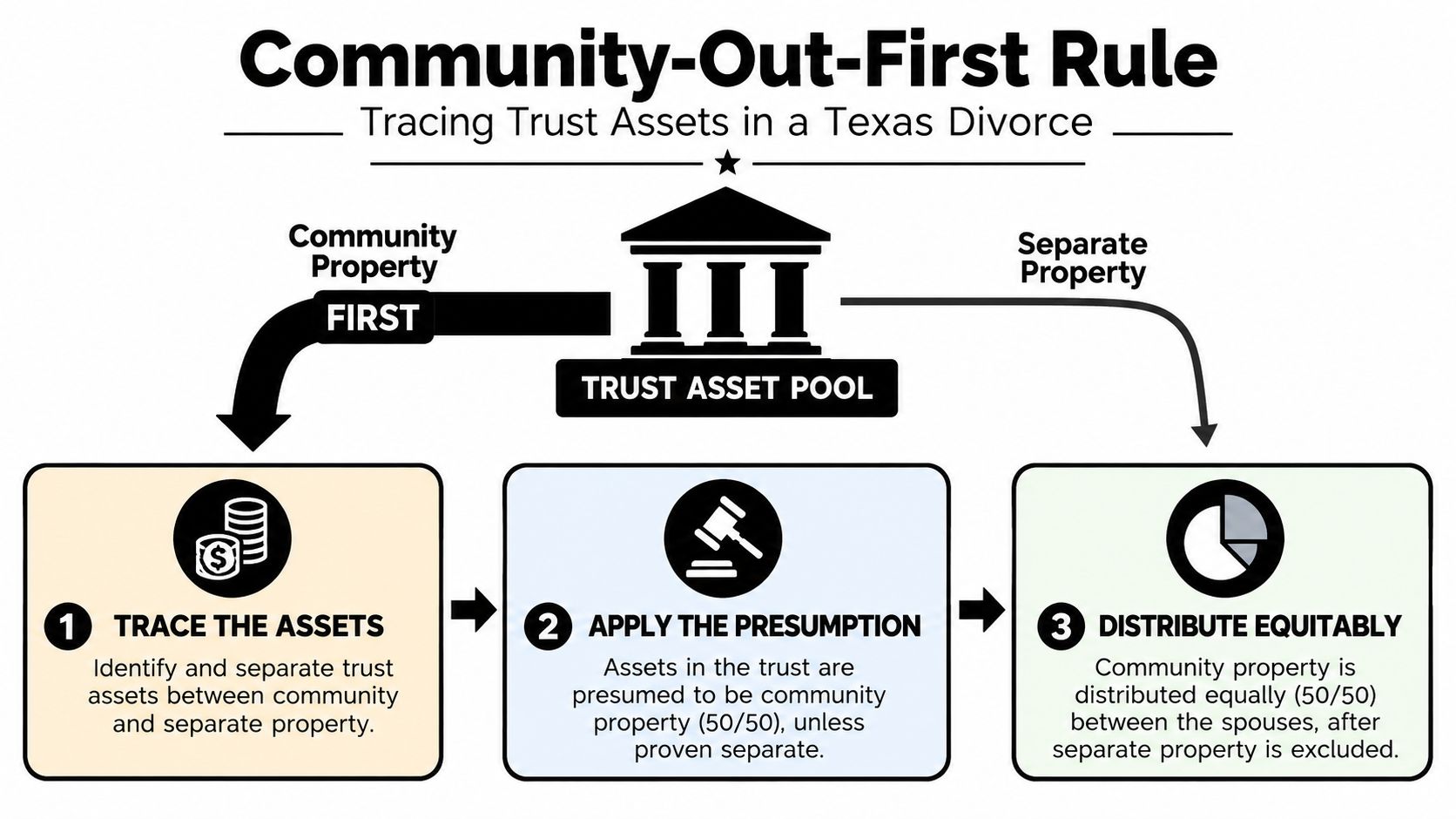
Tracing is where trust cases usually become document-heavy. If a trust contains both separate and community money, Texas courts want proof of exactly where each dollar came from and how it moved.
Texas tracing often uses bank statements, trust ledgers, deeds, tax returns, and wire records to reconstruct the money trail. The community-out-first rule adds an important presumption, when an account contains both kinds of money, community funds are presumed to be withdrawn first. That helps separate property remain in the account if the records support the trace. Tracing records and community-out-first method
The records that matter most
A clean trace usually starts with a simple inventory.
- List every contribution. Identify each deposit, transfer, and purchase tied to the trust.
- Label the source. Mark each item as separate or community, based on when and how it was acquired.
- Build a timeline. Put the transactions in order so the court can follow the money.
- Match the paper trail. Use trust instruments, bank statements, deeds, and wire records together, not in isolation.
The best tracing presentation is boring on purpose. It lets the records speak for themselves.
Commingled brokerage accounts, joint checking accounts, and repairs paid from a marital paycheck are the usual pressure points. Once funds are mixed, the burden shifts to the spouse claiming separate property to prove what stayed separate. If the records are incomplete, the court may treat the disputed amount as community property.
The process also helps in reimbursement claims. If community money paid for trust-related expenses or improved trust property, the spouse may not get the trust asset itself, but there may still be a claim for reimbursement. That distinction matters because a reimbursement claim is not the same thing as ownership of the trust corpus.
Real Scenarios From Texas Divorce Cases
The cleanest way to understand trust disputes is to watch the facts change the result. The trust label alone doesn't tell the story, the funding source and control rights do.
A revocable trust funded from a joint account
A married couple places marital earnings into a joint checking account and uses that money to fund a revocable living trust. During the marriage, both spouses can reach the money in practical terms, and the trust has no separate-property history to protect it. In that situation, the trust corpus is usually treated as community property because the funding source was marital income.
An inheritance trust created before marriage
A parent creates an irrevocable inheritance trust for one spouse before that spouse marries. The spouse later divorces, but the trust documents, account records, and distribution history all show the property came from the parent's separate estate. The other spouse usually walks away with nothing from the trust itself, although community earnings later reinvested into the trust can still create a division issue if the paper trail supports that claim.
A special needs trust and a community deposit
A third-party special needs trust receives a lump-sum deposit from community funds to buy a vehicle for the family. The spouse doesn't suddenly gain a share of the future trust distributions just because money passed through the trust. Instead, the community-out-first rule and tracing analysis may support a reimbursement claim for the community estate.
| Scenario | Trust Type | Funding Source | Court Treatment |
|---|---|---|---|
| Jointly funded revocable trust | Revocable living trust | Marital income from a joint account | Usually treated as community property |
| Parent-created inheritance trust | Irrevocable trust | Separate property from a third party | Usually protected if traced |
| Special needs trust with community deposit | Third-party trust | Community funds used for a purchase | Reimbursement claim may be more likely than ownership |
Each of these examples turns on the same three questions. Who funded the trust. Does the spouse have a present distribution right. Can the records prove the character of the money. Once you know those answers, the result usually gets much clearer.
Steps to Protect or Recover Trust Assets
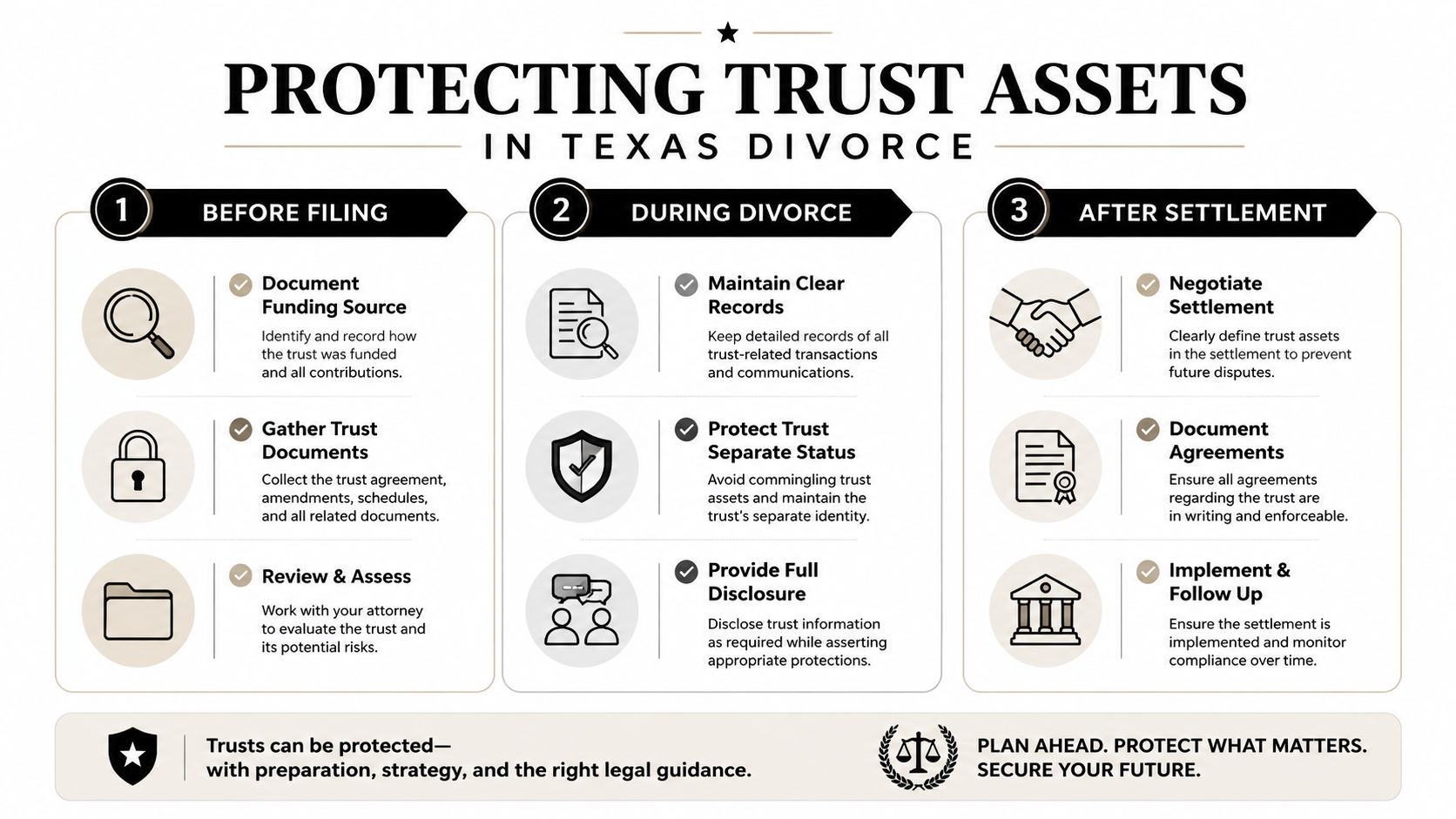
The smartest approach is calm and methodical. Trust cases reward organized records, and they punish guesswork.
Before filing
Start by collecting the trust instrument, amendments, account statements, tax returns, deeds, and wire records. If a trust was funded with inheritance money or premarital funds, keep those source documents together. Avoid mixing new marital earnings into accounts that you may later need to defend as separate.
During the case
Use formal discovery to request trust ledgers, trustee correspondence, and account histories. If needed, subpoenas to trustees can fill gaps in the record. Temporary orders can also preserve distributions so one spouse doesn't move assets while the case is pending.
After the decree
Enforcement may include contempt motions or turnover orders if one party refuses to comply. If a former spouse still appears as a beneficiary or successor trustee, the trust and estate documents need a fresh review so the plan matches the divorce decree and Texas law.
Practical rule: A forensic accountant can be useful early, especially when trust money and marital money were deposited in the same accounts.
The right help depends on the problem. Some cases need a divorce lawyer, some need estate planning review, and some need both. A firm that handles Divorce matters alongside trust issues can coordinate those pieces without forcing you to explain the same financial history twice.
Key Takeaways and How We Can Help
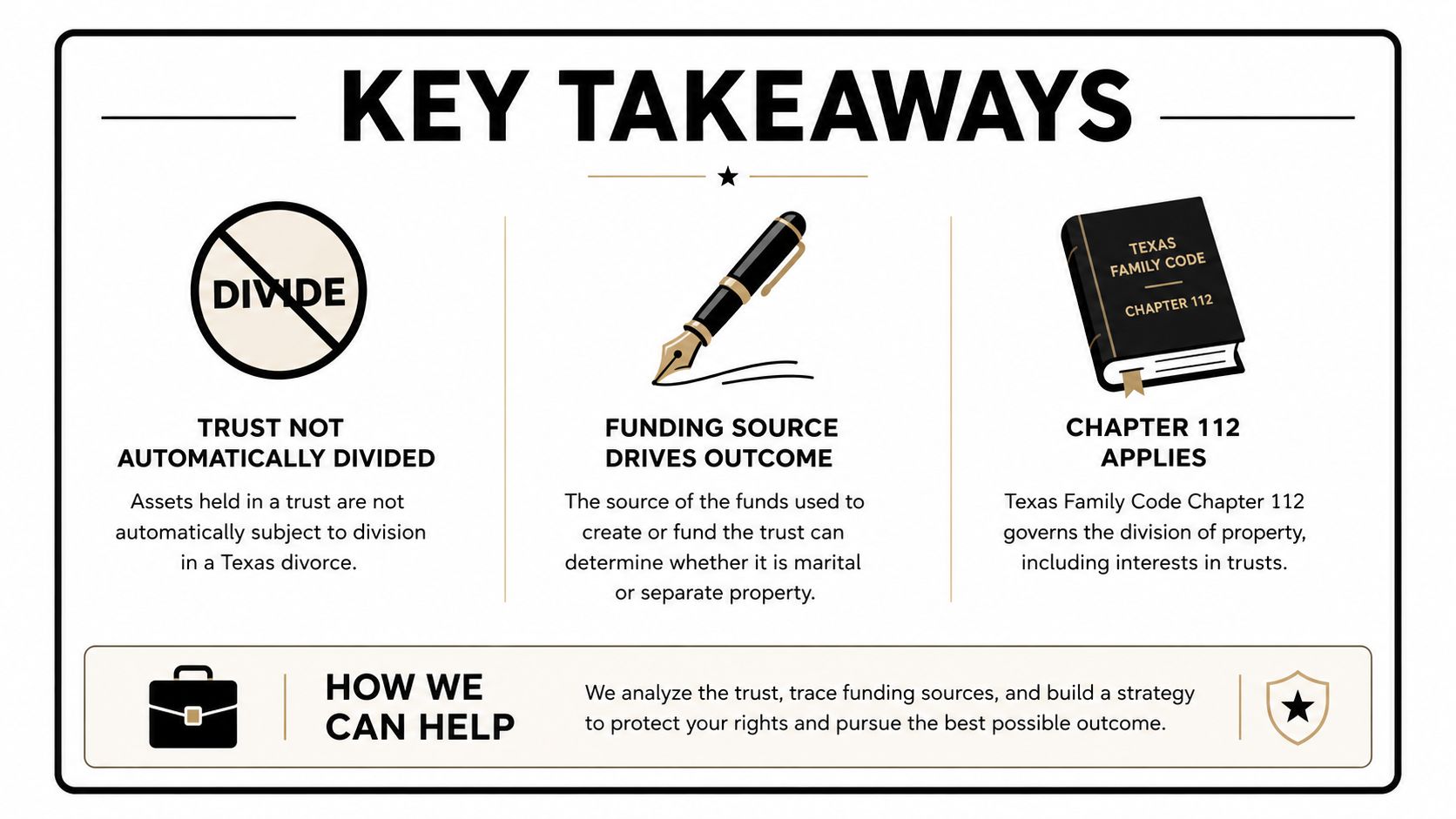
The most important point is simple. A trust is not automatically divided in a Texas divorce. The outcome usually turns on the funding source, the spouse's present distribution rights, and whether Texas Property Code Chapter 112, Subchapter E, automatically revokes certain benefits after divorce. Tracing decides the close cases, especially when separate and community money were mixed.
A few common questions come up again and again. Can a spouse still serve as trustee. Sometimes, but a divorce can affect fiduciary nominations under Chapter 112. What about inherited trusts. Those often stay separate if the records support the claim. What if a former spouse refuses to cooperate. Then discovery, enforcement, and careful document review become the tools that matter most.
The safest next step is to review the trust itself, not just the account title. A trust created years ago may have language that works fine during marriage and causes trouble after divorce. An estate plan that hasn't been updated since the wedding can also create avoidable conflict later.
If you're trying to figure out what happens to a trust in a Texas divorce, the details matter and you don't have to sort them out alone. The right plan starts with your documents, your account history, and your goals for the property and your family.
If you need help navigating divorce, custody, or estate planning in Texas, The Law Office of Bryan Fagan, PLLC can review your trust documents, trace funding sources, and help you understand how Texas law applies to your situation. Visit Law Office of Bryan Fagan, PLLC to schedule a free consultation and get guidance for your next step.


