 Skip to content
You're preparing for a Texas divorce or custody case, and one question keeps returning: who else can see your Texas family court file? You may worry that a neighbor, employer, relative, or member of the media can read private information about your children, finances, health, or relationship. That concern is understandable.
The honest answer is layered. Texas courts generally operate with a presumption that court records are open, but family-law records often include privacy restrictions, sealed documents, redactions, and role-based access. A single case folder may contain documents visible to the public alongside records reserved for the parties, attorneys, judge, court staff, or authorized child-protection professionals.
Why Your Family Court Privacy Matters
A client once asked whether filing for divorce meant anyone in the community could search through allegations made during the marriage. She was especially worried about information concerning her child and financial records. Her fear wasn't unusual. Family court pleadings can describe intimate relationships, parenting disputes, medical concerns, income, property, and allegations of abuse.
Texas law recognizes that family cases require more privacy protection than an ordinary business dispute. The Texas State Law Library's guidance on court records explains that most case files and docket sheets are accessible unless they're sealed, redacted, or otherwise restricted, while family cases and matters involving minors are commonly among the records that may receive restricted treatment.
That distinction matters. A divorce file isn't automatically invisible, but your neighbor doesn't automatically receive the same access as you, your lawyer, or the court. The right question isn't whether the file is “public.” You need to ask which document is involved, what kind of case it is, who is requesting access, and whether a statute or court order limits disclosure.
Privacy concerns that deserve attention
Consider three common situations:
- A custody case includes child-related records. Some documents may be available to the parties and attorneys, while investigative material connected to child protection remains confidential.
- A protective-order application includes sensitive contact information. Certain information may be redacted or kept confidential for the court or law enforcement.
- An adoption matter follows a different access rule. Adoption records maintained after the decree are governed by a specific confidentiality statute, not the ordinary public-record baseline.
Practical rule: Treat every filing as potentially sensitive before it reaches the clerk. Protecting privacy is easier before information enters the record than after someone asks to inspect it.
You have practical options. Your attorney can identify information that shouldn't be filed openly, request appropriate redactions, and determine whether a motion to seal is justified. The rest of this guide explains the people who may see your file and the legal walls that limit access.
The Baseline Rule for Texas Court Records
A family court file can contain public and restricted material at the same time. Start with Texas's general rule, then identify the document, the case type, and the access restriction that applies.
Most Texas court case files and docket sheets are public records. The Texas State Law Library explains that anyone may access them unless a court seals them, redacts information, or another rule restricts disclosure. Family cases and matters involving minors may receive different treatment, but the entire folder does not automatically become private.
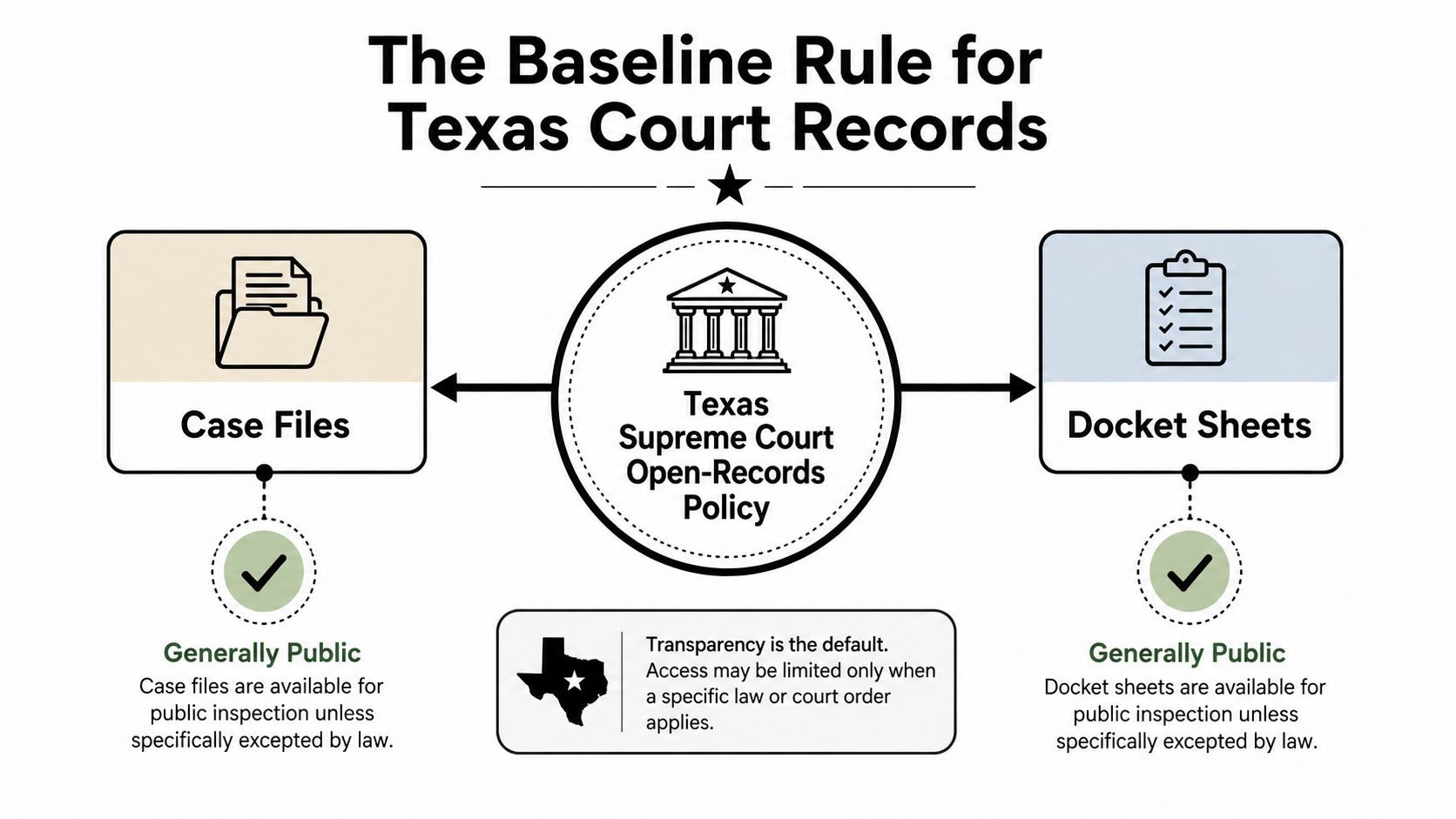
A request for a judicial record follows a court-specific process. Texas courts do not process these requests under the Texas Public Information Act or the federal Freedom of Information Act. Under the Texas Supreme Court open-records policy, a person seeking to inspect or copy a judicial record must submit a written request, identify the record clearly enough to locate it, and send the request to the record's custodian.
That custodian is usually the district clerk, county clerk, or another designated court official. A generic government-records request is not enough.
How the presumption of openness works
Texas Rule of Civil Procedure 76a provides the main sealing framework for civil court records, including family-related filings unless another law excludes them. The rule presumes that court records are open. A person requesting a seal must prove a specific, serious, and substantial interest that outweighs public access and any public-health-or-safety effect. The person must also show that no less restrictive option, such as targeted redaction, will protect that interest. The rule generally prohibits removing court records except as authorized by statute or rule. See Texas Rule of Civil Procedure 76a.
The practical rule is clear: family-law sensitivity alone does not guarantee a seal. Some records receive automatic protection or follow special procedures. Others require a focused request supported by specific facts. A clerk may therefore hold a file containing both publicly viewable pleadings and restricted documents, with access determined item by item.
Who Has Access to Your File
A Texas family court file can place public and restricted materials in the same case folder. The person requesting access, the role they hold, and the specific document determine what they can see.

The parties and their attorneys
The parties named in the case and their attorneys generally have the broadest working access to the official file. They may review pleadings, orders, evidence filed with the court, and other materials relevant to the representation, subject to confidentiality laws and court orders.
Clerks and other court staff also access the record to process filings, maintain docket entries, apply redactions, and enforce restrictions. Judges review materials relevant to their decisions. These roles authorize handling the file for court or legal purposes, not casual disclosure.
County procedures can change how that access works in practice. Some counties provide attorney access through electronic-filing or records systems while limiting public online access to family files. Dallas County explains family-record access and restrictions through its district clerk records information. An online search result may show only part of the official record.
Court-appointed professionals and agencies
A court-appointed ad litem attorney or amicus attorney may receive records needed to protect a child's interests or assist the judge. Texas Family Code Section 107.006 requires custodians of relevant records to provide access to these attorneys without a further order. That authority comes from the attorney's court-appointed role, not from public access.
Judges can see the materials necessary to decide the dispute. CPS and DFPS personnel handle child-abuse and neglect information under separate confidentiality rules, and disclosure remains limited to legally authorized people and purposes. A custody file can therefore contain ordinary pleadings available under one rule and CPS material restricted under another.
One case folder can contain both public and restricted components. Access to one filing does not give someone access to every document connected with the case.
The same principle applies when sensitive information moves through digital systems. Guidance on professional secrecy AI design verification explains why role-based controls and deliberate confidentiality practices matter.
Couples using Collaborative Divorce may keep some disputed material out of court, but that process does not erase existing court records or guarantee confidentiality.
Confidentiality Rules for Sensitive Case Types
Texas uses different confidentiality pathways for different kinds of family-related records. The governing statute matters more than the general label “family court file.”
Adoption records have a particularly strong statutory restriction. Texas Family Code Chapter 108 states that records maintained by the district clerk after an adoption decree are confidential. Except as otherwise provided by law or for good cause shown, no person is entitled to access or information from those records. If your matter involves Adoption, including stepparent and agency adoptions, ask about Chapter 108 before assuming ordinary court-record rules apply.
Child-abuse and neglect investigations follow a separate rule. Texas Family Code Section 261.201 makes reports and related investigative files confidential and not subject to public release under the Public Information Act. Disclosure is limited to authorized purposes and legal exceptions. A custody litigant may have access through a legally recognized role, but a member of the public doesn't gain access just because the information relates to a filed family case.
Juvenile records are also restricted. Texas Family Code Section 58.007 identifies a closed group that may inspect or copy those records, including the judge, juvenile justice agencies, the child's parent's attorney, the child's attorney, prosecutors, treatment providers, and other people only with juvenile-court permission.
| Case Type | Governing Statute | Who Can Access | Public Release Allowed |
|---|---|---|---|
| Adoption records maintained after an adoption decree | Texas Family Code Chapter 108 | Access as provided by law or for good cause shown | Generally confidential, not open public access |
| Child-abuse or neglect reports and investigative files | Texas Family Code Section 261.201 | Authorized people and agencies for legally permitted purposes | Not subject to public release under the Public Information Act, except through legal authorization |
| Juvenile records | Texas Family Code Section 58.007 | Listed officials, attorneys, agencies, treatment providers, and others with juvenile-court permission | Restricted to the statutory group or court-authorized access |
The differences are important. A public docket entry doesn't make confidential CPS material public. A party's access to a custody file doesn't give that party permission to distribute protected juvenile or investigative records. If your case involves CPS, juvenile proceedings, or adoption, speak with counsel before copying or sharing documents. For a focused discussion of child-protection issues, review the Houston Heights CPS lawyer resource.
How to Seal or Redact Your Court Records
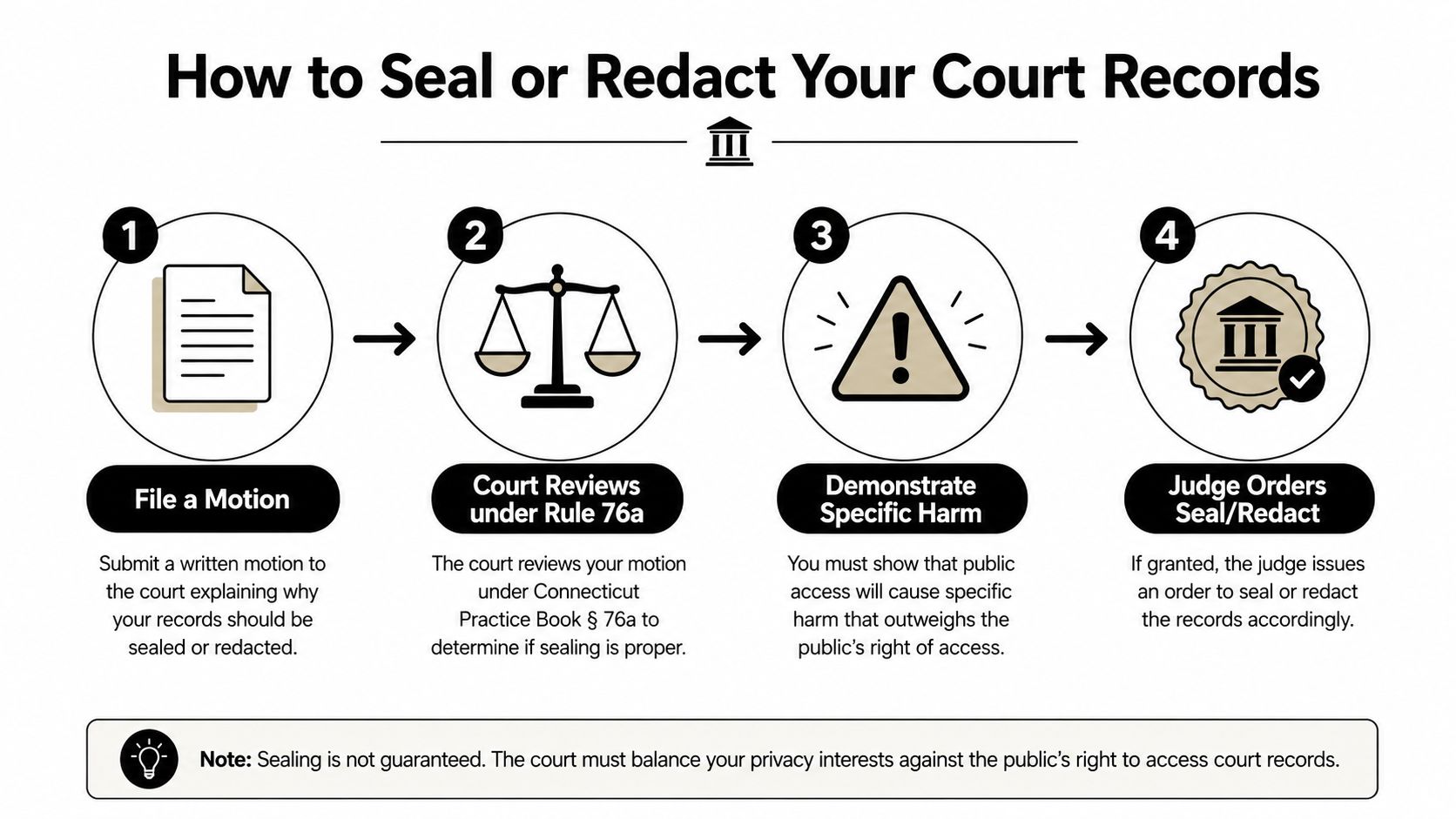
A family court folder can contain both public and restricted material at the same time. A clerk may provide public docket information, while a judge, ad litem attorney, or authorized agency reviews protected documents under a different access rule. Redaction removes or obscures specific information while leaving the rest of a filing available. Sealing limits access to an entire record or a defined portion of it.
Texas Rule of Civil Procedure 76a begins with a presumption that civil court records are open. A request to restrict access must identify the material at issue and satisfy the applicable legal standard.
Start with the specific harm
A strong request names the exact document, the exact information, and the concrete harm disclosure could cause. Rule 76a requires proof of a specific, serious, and substantial interest that outweighs the public's interest in access and any public-health-or-safety effect. You must also show that no less restrictive option, such as targeted redaction, would adequately protect that interest.
Supporting material may include evidence of a safety threat, confidential child-protection information, identifying details that create a risk of harm, or a directly applicable statutory confidentiality provision. General embarrassment usually will not meet the standard. Ask your attorney to connect each requested restriction to the rule instead of seeking to hide the entire file without explaining why.
Ask for the narrowest protection that solves the problem. A focused request gives the judge a workable remedy and preserves access to material that does not create the identified risk.
File, notify, and prepare for review
Your lawyer can draft and file the motion under the rule governing the record. The court may require notice, briefing, and a hearing. Prepare to explain why the information is sensitive, how public access creates a serious risk, and why redaction or another narrower remedy will not work.
Protective-order records may receive partial redactions. The clerk can be ordered to keep specified information confidential for use by the court or law enforcement. This approach protects sensitive details while leaving other parts of the proceeding accessible.
Review every document before filing. A practical guide to redact PDF for legal filings explains the mechanics of removing visible information, but technical editing does not satisfy Texas filing rules by itself. A private copy also is not an officially redacted court filing. If you need a certified divorce record or decree, consult this Texas divorce decree copy guide.
Probate administration and estate settlement can also contain private personal and financial information. Access depends on the particular probate record and the law that governs it.
Practical Steps to Protect Your Privacy Today
Privacy protection begins before filing. Have your attorney review each pleading, exhibit, affidavit, and proposed order. Remove details that do not help the judge decide the issue, especially when a single case folder may contain both public filings and restricted material.
Review each document before filing
Check for Social Security numbers, financial account numbers, private contact information, and unnecessary identifying details about children. Relevant personal history still may not belong in a public pleading. Include the facts the court needs, then ask whether additional information should be omitted or placed in a restricted filing.
- Request appropriate redaction: Ask the clerk or your attorney how that county handles personal identifiers and whether an already filed document can be corrected or replaced under the applicable rule.
- Consider targeted sealing: If redaction will not adequately protect financial details, safety information, or child-related material, discuss a narrowly drafted motion.
- Limit contact information: Follow the court's approved filing and service procedures instead of listing unnecessary home, workplace, or school details.
- Review online access: Check the county clerk or district clerk portal to see which docket information and documents appear online. Online access may be limited for family files, but the portal does not determine whether the official record can be inspected through its custodian.
A clerk may handle the public portion of the file differently from restricted material available to the judge, an ad litem attorney, CPS, or another authorized participant. Ask which role can view each document before assuming that online visibility or invisibility answers the question.
Make requests through the proper channel
Texas courts require written requests to inspect or copy a judicial record. Identify the record clearly and send the request to its custodian under the Texas Supreme Court's open-records policy. Use the court's stated process rather than treating the request as a general Public Information Act or federal FOIA matter.
If you already filed sensitive material, act promptly. Ask counsel whether a correction, redaction request, protective order, or Rule 76a motion is available. Deleting a file from your computer does not remove it from the official court record.
Keep your personal case file organized and share it carefully. Send restricted documents only to people who need them for the case. Ask your attorney before forwarding CPS, juvenile, adoption, or protective-order material, because those records may carry separate access limits.
Get Personalized Guidance for Your Case
Privacy questions become harder when you're also managing service, temporary orders, custody exchanges, financial disclosures, or a child-protection investigation. You shouldn't have to decide alone whether a document is public, restricted, confidential, or appropriate for sealing.
The Law Office of Bryan Fagan, PLLC can review your case posture, identify documents that may be accessible, and help you evaluate redaction or sealing options. A lawyer can also explain how the rules affect your specific county, whether your matter involves divorce, custody, CPS, adoption, or another family-law proceeding.
For local guidance, you can review the family lawyer near Houston Heights resource, along with the firm's service information for divorce, child custody, and collaborative options. The firm serves clients across Houston, Dallas–Fort Worth, Austin, San Antonio, and surrounding Texas communities with an emphasis on transparency, education, and personalized client care.
If you need help navigating divorce, custody, or estate planning in Texas, contact The Law Office of Bryan Fagan today for a free consultation. The firm can help you assess access to your family court file, pursue appropriate redactions or sealing, and plan the next step with a Texas family law attorney. Visit Law Office of Bryan Fagan, PLLC to request guidance for your situation.


