
A lot of people in Houston Heights reach out for legal help at the same point. The marriage is strained, the children can feel the tension, and every practical question suddenly feels urgent. Who stays in the house? How will bills be paid? What happens if one parent wants to move? If you're in that position, the uncertainty can feel heavier than the legal paperwork itself.
The good news is that confusion doesn't have to control your next step. Texas family law has rules, Harris County has procedures, and a clear plan can make a difficult season more manageable. When you're looking for a family lawyer near Houston Heights, what often helps most is not more noise, but calm, accurate guidance.
You may be reading this late at night after another hard conversation at home. Or after opening an email from your spouse's attorney. Or after realizing that a verbal parenting agreement isn't working anymore. In Houston Heights, many families are balancing demanding jobs, school schedules, mortgages, and extended family expectations at the exact moment their legal situation becomes more complicated.

One parent might be wondering whether filing for divorce means losing time with the children. Another may be anxious about how to rebuild financially after years of shared accounts and shared plans. Emotional recovery matters too, and some readers find it helpful to pair legal guidance with broader support such as dealing with divorce and rebuilding life.
You don't need to know everything before you speak with a lawyer. You only need to know enough to protect yourself from avoidable mistakes.
Family law cases are personal, but they're also procedural. That combination is what catches many people off guard. You can be grieving a relationship while still needing to gather bank records, review court orders, and make decisions that affect your children for years.
A steady legal approach helps turn panic into steps. It helps you separate what feels unfair from what the court can address. It also helps you focus on what matters most right now: safety, stability, parenting, and financial clarity.
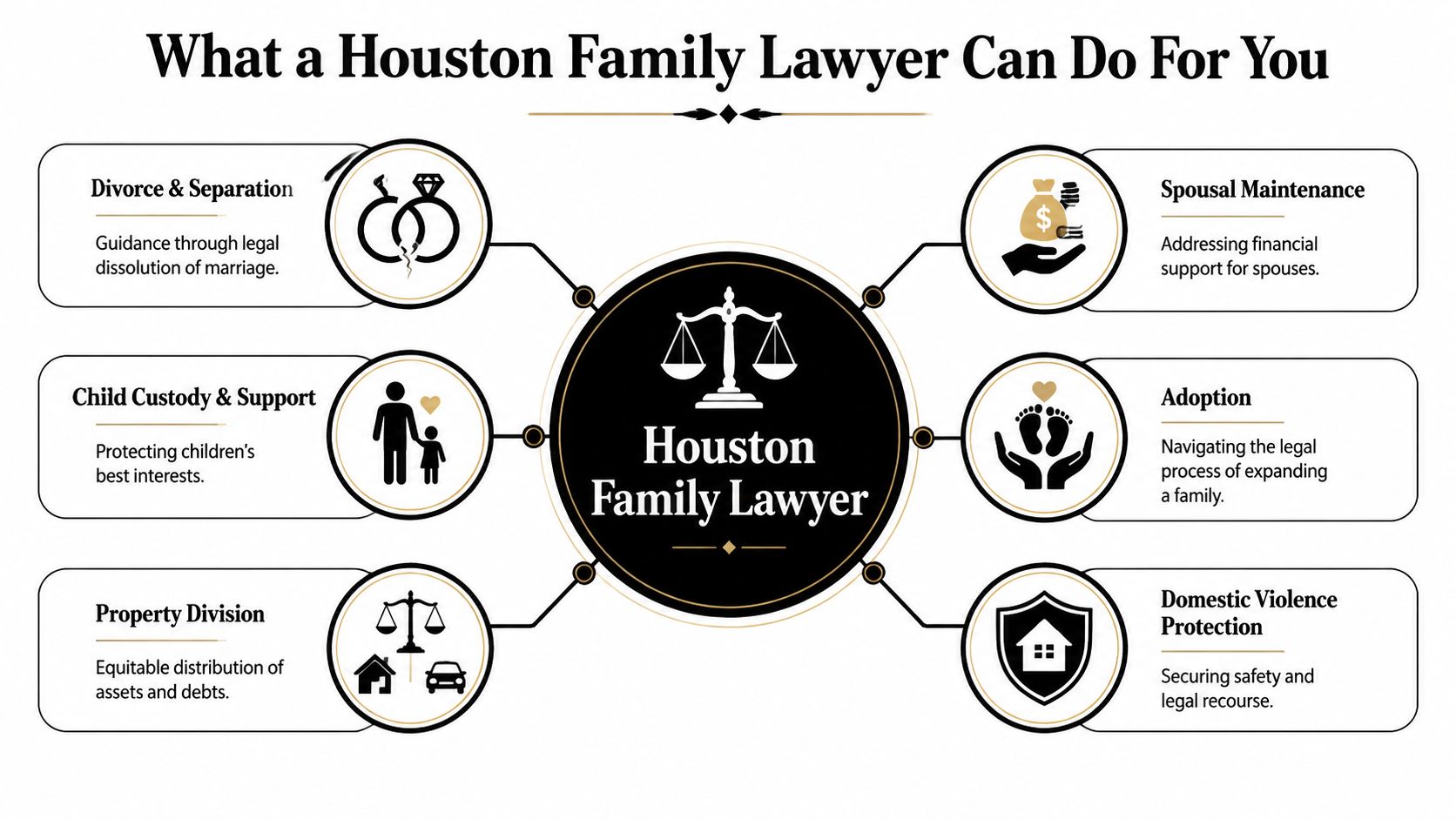
What a Houston Family Lawyer Can Do For You
A family lawyer doesn't only file divorce papers. In Harris County, a family lawyer often acts as planner, problem-solver, negotiator, and courtroom advocate. That matters because Harris County courts handle a significant volume of family law cases, and dissolution cases in Houston are handled in Harris County courts, which are known for their high case load and complex procedural requirements according to this Harris County family law overview.
More than divorce paperwork
Some clients need help preparing for a divorce filing. Others already have orders in place and need enforcement or modification. Some aren't ending a marriage at all. They may need help with paternity, adoption, or planning for a vulnerable loved one through estate planning documents.
That broader view matters in real life. A divorce can raise title issues with a home, support concerns, safety concerns, and questions about who will make decisions for a child. A good lawyer helps you see the whole legal picture, not just one form or one hearing.
Common Texas family law matters
| Case Type | What It Involves |
|---|---|
| Divorce | Ending a marriage, addressing property, debts, and final orders |
| Child custody | Conservatorship, possession schedules, and parental decision-making |
| Child support | Establishing, enforcing, or adjusting support obligations |
| Modifications | Changing existing court orders when circumstances have materially shifted |
| Adoption | Completing the legal process to create or confirm a parent-child relationship |
| Protective matters | Addressing family safety issues through court intervention |
| Estate planning | Wills, powers of attorney, and planning for family transitions |
What legal representation changes
A lawyer helps organize facts into a legal position the court can act on. That includes:
- Clarifying the issues: Not every conflict belongs in court. A lawyer helps narrow the dispute to what legally matters.
- Preparing documents correctly: Family cases can stall when pleadings, inventories, or proposed orders are incomplete.
- Managing deadlines and hearings: Harris County procedure can feel intimidating if you've never been through it.
- Negotiating with purpose: Many cases resolve through agreement, but only after both sides understand the legal risks.
- Protecting long-term interests: A quick compromise can create years of future problems if the order is vague.
Practical rule: The earlier you understand your rights and obligations, the more options you usually have.
For some families, legal help also extends beyond divorce into future planning. That may include updating powers of attorney, revising a will, or making sure property transfers match the final decree. Family law and estate planning often overlap more than people expect.
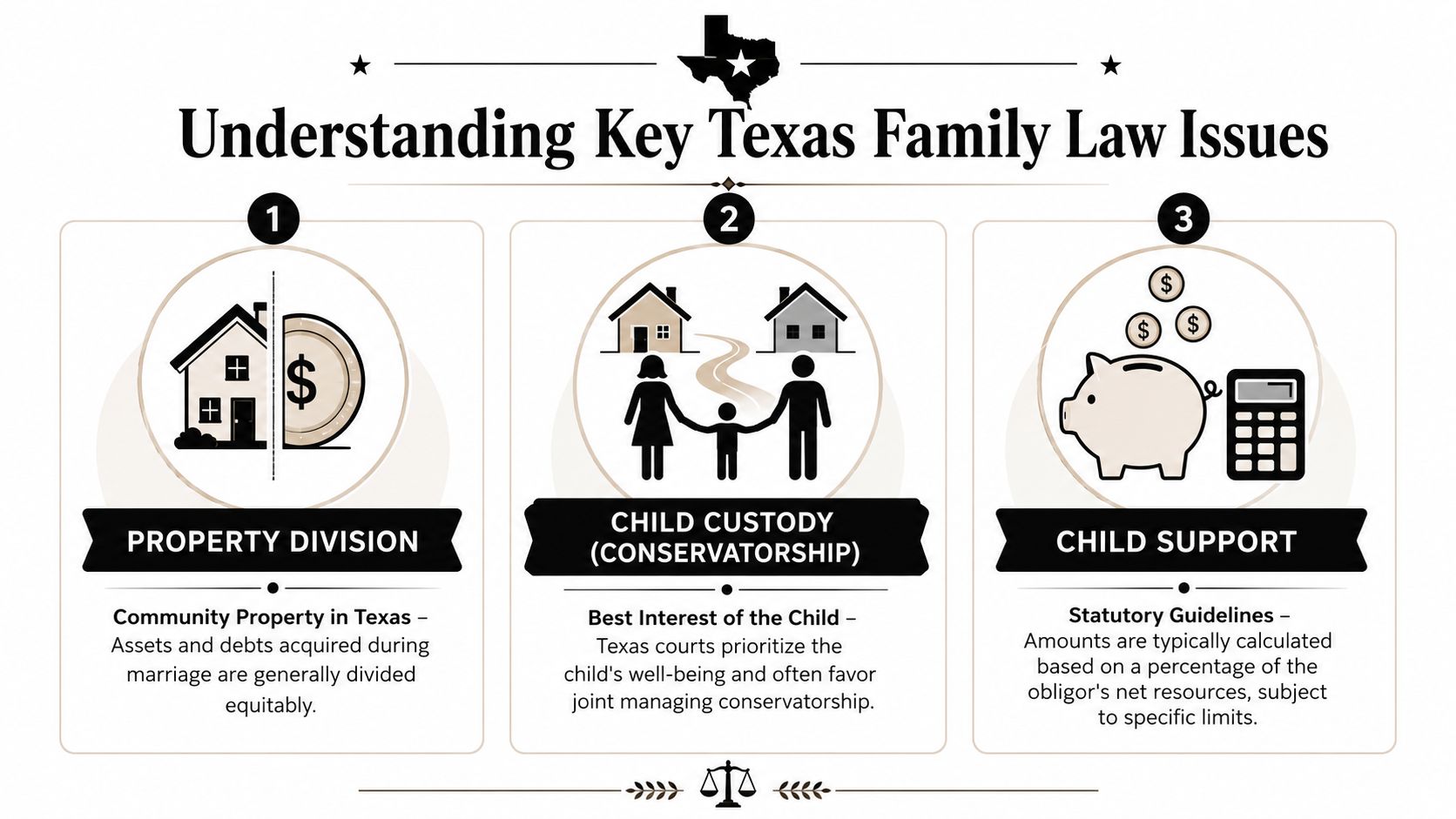
Understanding Key Texas Family Law Issues
The legal questions that worry most Houston Heights families usually fall into three categories. Property. Children. Support. Each has its own rules, and each can create major problems if handled casually.
Property division under Texas law
Texas is a community property state, but that phrase often causes confusion. People hear it and assume every asset is split automatically down the middle. That's not the right way to think about it.
Texas Family Code § 3.003 creates a presumption that property possessed by either spouse at the time of divorce is community property. To claim that something is separate property, a spouse must rebut that presumption with clear and convincing evidence, as explained in this discussion of Texas Family Code section 3.003 and tracing separate property.
A simple example helps. You bought a house before marriage, so you assume it's yours alone. But during the marriage, mortgage payments came from marital income, and records are incomplete. In court, the issue isn't just what you believe. It's what you can prove through deeds, statements, and tracing.
If a decree leaves out community property, Texas law may still offer a remedy. Texas Family Code § 9.201(a) allows a former spouse to file a suit to divide undivided property, and Texas Family Code § 7.006(a) allows written property settlement agreements so long as the court finds them just and right, as discussed in this article on community property and division in a Houston divorce.
Child custody and conservatorship
Texas doesn't usually talk about "custody" the way many parents do. The legal term is often conservatorship. That includes who makes decisions for the child and how parenting time is structured.
Parents also hear terms like possession, access, and Standard Possession Order. Those terms can sound cold, but the underlying issue is very human: where the child will live, when each parent will spend time with the child, and how major decisions will be made.
Here is a helpful overview before going further:
A court's focus is the child's best interest. In practice, that means judges look closely at stability, caregiving history, school needs, communication patterns, and any evidence of conflict that affects the child. If you already have orders but life has changed, Custody & Support Modifications address modifying existing custody, visitation, and support orders.
If safety is part of the picture, don't treat it as a side issue. Protective Orders concern domestic violence and family safety matters.
When children are involved, the most persuasive argument is usually the one grounded in routine, documentation, and the child's day-to-day needs.
Child support in plain language
Child support is another area where people often expect a quick answer and then discover the details matter. Texas uses statutory guidelines, but the final result still depends on facts such as each parent's role, the child's needs, and the financial information properly presented to the court.
For many parents, the first practical step is simple. Gather pay records, tax returns, health insurance information, and any prior support orders. Those documents shape the conversation far more than assumptions do.
What matters most is accuracy. If income is misunderstood or key expenses are undocumented, even a well-intentioned agreement can create avoidable tension later.
Choosing the Right Attorney in the Heights
Not every lawyer who handles a divorce is the right fit for a difficult family case. If you're hiring counsel for a matter involving children, property, or personal safety, your vetting process should be deliberate.

Start with credentials you can verify
In Texas family law practice, verifying that an attorney holds an active license and lacks disciplinary history with the State Bar of Texas is a baseline step. It's also wise to confirm that family law is the attorney's primary area of practice, not a side offering, as discussed in this guide to choosing a Houston family law attorney.
That distinction matters more than many people realize. A contested divorce involving property characterization, parenting disputes, or enforcement issues requires familiarity with the Texas Family Code and local procedure. General legal experience is not the same as focused family law experience.
Why Board Certification matters
Board Certification in Family Law by the Texas Board of Legal Specialization is an important benchmark for competency. It requires extensive experience and a rigorous exam, and it signals a higher level of expertise for complex matters involving business ownership or high-net-worth estates in Harris County, as described by Gray Reed's explanation of family law board certification.
That doesn't mean every capable attorney is board certified. It does mean the credential deserves your attention, especially if your case involves closely held businesses, separate property claims, interstate issues, or unusual financial questions.
Questions worth asking in a consultation
Bring questions that help you evaluate judgment, not just friendliness.
- How much of your practice is family law? You want to hear whether this is the attorney's core work.
- How do you approach contested cases? Their answer should show strategy, not just toughness.
- What documents do you want from me first? This reveals how organized and practical the office is.
- How do you communicate with clients? Expectations on calls, email, and updates matter.
- What issues in my case seem most urgent? A thoughtful answer often tells you whether the attorney is listening closely.
Key takeaway: The right lawyer should help you feel clearer about the process, even if the outcome is still uncertain.
A family lawyer near Houston Heights should also understand the local realities affecting your life. Commute patterns, school schedules, downtown court appearances, and the pace of Harris County proceedings all affect practical strategy. Local awareness doesn't replace legal skill, but it does sharpen it.
Preparing for Your Initial Consultation
The first meeting is often less intimidating when you treat it like preparation for an important financial and parenting decision, not a test you have to pass. You don't need a perfect file. You do need enough information for the lawyer to spot risks and outline options.
Documents that usually help
Bring what you have, even if the set is incomplete. Commonly useful documents include:
- Court papers: Existing divorce petitions, prior orders, modification orders, or enforcement paperwork
- Financial records: Recent pay stubs, tax returns, bank statements, retirement statements, and credit card records
- Property documents: Deeds, mortgage statements, vehicle titles, business records, and major loan information
- Child-related records: School schedules, medical information, daycare costs, and calendars showing parenting time
- Communications: Relevant texts, emails, or app messages if they relate directly to disputed issues
If your case involves property claims, records become especially important. Separate property arguments often succeed or fail based on whether a client can produce a clean paper trail.
Prepare your timeline and your goals
A short written timeline can save a lot of consultation time. Include the date of marriage, date of separation if applicable, names and ages of children, major property events, prior lawsuits, and any urgent safety or financial concerns.
Then write down your goals. Not broad feelings, but concrete priorities. For example:
- Stability for the children
- Staying in the home temporarily
- A workable visitation schedule
- Protecting a business or inheritance
- Resolving the case with as little conflict as possible
That list helps your attorney understand what matters most to you. It also helps you stay focused when emotions are high.
Treat the meeting as a two-way evaluation
You are not only asking for legal advice. You are deciding whether this is someone you trust with highly personal facts and serious decisions.
Notice whether the lawyer explains the law clearly. Notice whether they distinguish urgent issues from less urgent ones. Notice whether they ask for documents instead of making snap promises.
Timelines and Costs in Harris County Family Law
Clients usually ask two questions early. How long will this take, and how much will it cost? The honest answer is that both depend on the level of conflict, the complexity of the assets, the need for temporary orders, and how willing each side is to exchange information and negotiate in good faith.
What affects cost
Legal fees often involve a retainer, hourly billing, filing fees, and costs related to obtaining records or preparing for hearings. A simpler agreed matter usually requires less attorney time than a case involving contested parenting issues or disputed property characterization.
Houston is also a competitive legal market. In that market, the cost-per-lead for family lawyers ranges from $90 to $200, which reflects high demand and strong competition among firms, according to this local market guide on Houston family lawyer lead costs. That isn't a quote for your case, but it helps explain why experienced family law representation is a meaningful investment.
What affects timing
Some cases move steadily because both parties exchange documents, attend mediation seriously, and narrow disputes early. Others take much longer because one side delays, emotions stay high, or financial issues require deeper review.
A useful way to think about timing is this:
- Uncontested matters often move faster because the parties already agree on the major terms.
- Contested cases usually take longer because the court may need to resolve temporary issues, discovery disputes, or trial questions.
- Cases involving children or businesses often require more careful planning because mistakes can have long-lasting consequences.
Keep your expectations flexible. The fastest resolution isn't always the safest one, especially when parenting rights or significant assets are involved.
Transparency helps here. Ask how billing works, what events usually increase fees, and what practical steps can reduce unnecessary expense. A well-prepared client often helps control both time and cost.
Local Houston Heights Family Law FAQs
Where will my case be handled if I live in Houston Heights
For most family law matters, Houston Heights residents will deal with Harris County courts in downtown Houston. That affects logistics, scheduling, filing procedure, and hearing preparation.
Do military families face different custody issues
Yes, they often do. For military families in areas like Houston Heights, custody modifications can be triggered by relocation orders. Harris County courts must now consider military deployment schedules as a primary factor in visitation modifications under the 2024 Texas Family Code amendment, Section 153.007, as noted by the Harris County Domestic Relations Office community legal resources page.
That issue can become urgent when one parent receives orders and the existing schedule no longer fits reality. Military parents should get legal guidance early, before informal changes create confusion.
Is mediation common in Harris County family cases
Very often, yes. Mediation gives both sides a chance to resolve disputes outside a trial setting with the help of a neutral third party. It can reduce conflict, preserve privacy, and give families more control over the final terms.
Mediation isn't the right fit for every case, especially where safety is an immediate concern. But in many property and parenting disputes, it can be a productive step before trial.
If you need help navigating divorce, custody, or estate planning in Texas, contact Law Office of Bryan Fagan, PLLC today for a free consultation.