Divorce can feel especially heavy when you're sitting in a Heights home filled with memories, trying to figure out what happens next. You may be worried about the house, the kids, a family business, retirement accounts, or how to get through the next few months without making a costly mistake.
A Heights Houston divorce attorney should bring more than courtroom presence. You need someone who can explain Texas law in plain English, prepare you for Harris County procedure, and help you make steady decisions when emotions are high. If you're in that position now, you're not alone, and the process becomes much more manageable once you understand how it works.
What a Heights Houston Divorce Attorney Really Does
A lot of people assume a divorce lawyer mainly argues in court. In reality, much of the work happens long before any hearing. A Heights Houston divorce attorney often acts as your planner, negotiator, document manager, and problem-solver all at once.

Your attorney organizes the case from day one
The first job is usually to get the foundation right. That means identifying goals, gathering key records, and filing the correct opening documents. In Texas, the divorce starts with an Original Petition for Divorce, but the strategy behind that filing matters just as much as the form itself.
Your attorney also helps you avoid early mistakes, such as informal deals about money, moving funds without documentation, or sending texts that could later become evidence. Those choices can shape the tone of the entire case.
Most of the real work involves negotiation
In Texas, approximately 95% to 97% of all divorce proceedings are resolved without a bench or jury trial, with most cases ending through negotiation, mediation, or settlement agreements rather than a courtroom trial, according to this Houston divorce overview. That matters because the attorney you hire needs to be strong at settlement work, not just litigation.
Practical rule: A good divorce lawyer doesn't push every case toward trial. They prepare thoroughly so they can negotiate from a position of strength.
That often includes:
- Managing communication: Your lawyer can handle difficult exchanges with your spouse or your spouse's attorney so you don't have to.
- Collecting financial proof: Bank statements, tax returns, retirement records, mortgage information, and business documents often drive the outcome.
- Spotting pressure points: If one issue is blocking everything else, your attorney can narrow the dispute and create momentum.
Your attorney protects both legal and practical interests
A divorce case isn't only about legal rights on paper. It's also about daily life. Who stays in the home for now? How are bills paid? What happens with parenting schedules next week, not six months from now?
A seasoned lawyer helps with those practical concerns while keeping the long-term picture in mind. They can draft temporary requests, prepare for mediation, review settlement terms, and make sure the final paperwork says what you think it says.
If you're searching for a Heights Houston divorce attorney, that's what the job entails. It's not just arguing. It's guiding, protecting, clarifying, and helping you move from uncertainty to a workable plan.
The Divorce Process in Harris County Step-by-Step
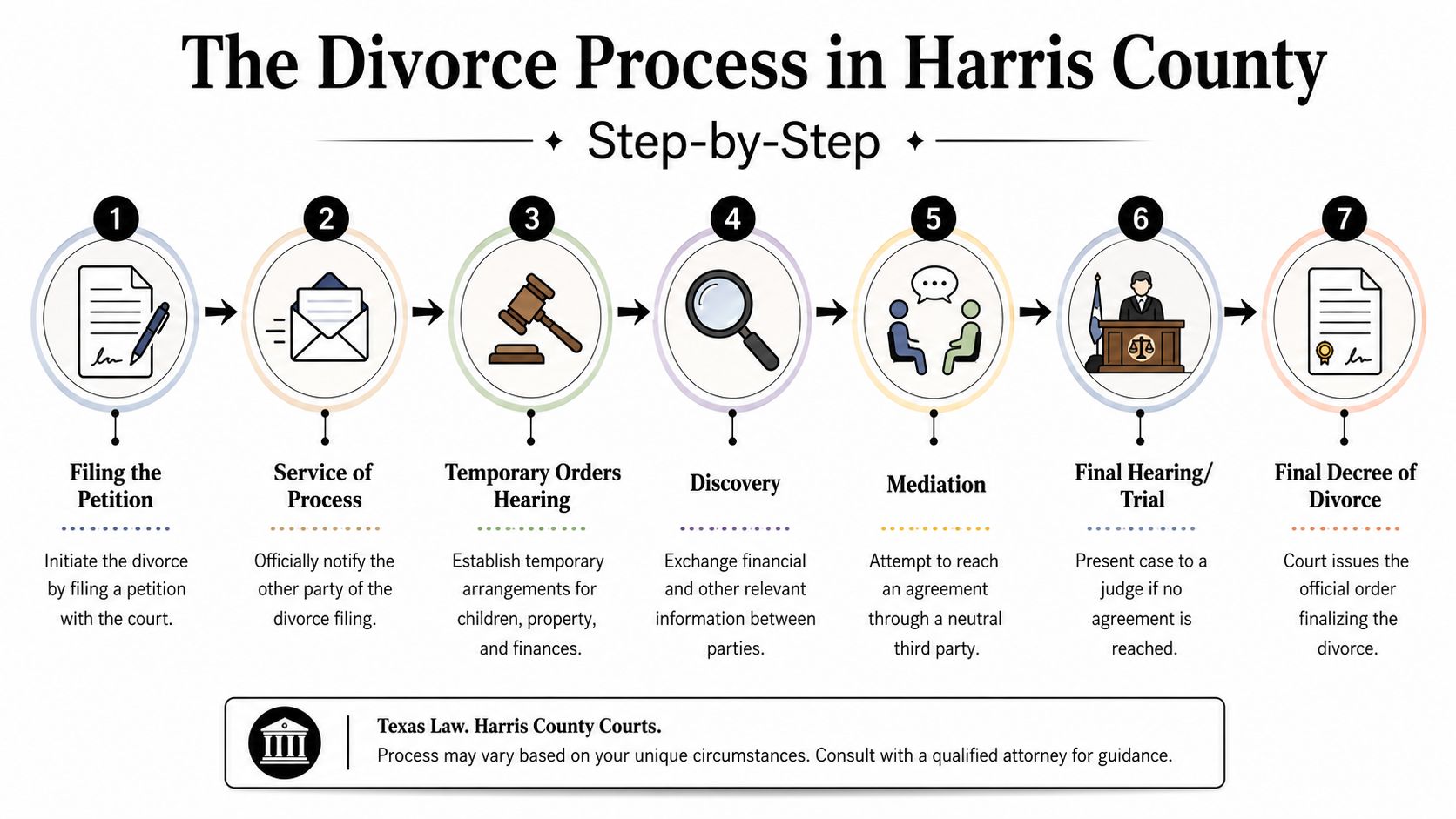
Clarity about the future often brings a sense of calm. Divorce in Harris County follows a sequence, and each stage has a purpose. When you know what happens first, what happens later, and where delays usually appear, the process becomes less intimidating.
Filing starts the case
A Texas divorce begins when one spouse files the Original Petition for Divorce. That filing opens the case and sets the legal process in motion. If you want a more detailed filing walkthrough, this step-by-step guide to filing for divorce in Harris County is a helpful companion.
After filing, the other spouse must usually be formally notified. That's called service of process, unless the spouse signs a valid waiver.
Temporary issues often need quick attention
Many families can't wait until the final decree to address day-to-day problems. Temporary orders can address who stays in the home, who pays which bills, how parenting time works for now, and whether either spouse must preserve property.
A case may also involve temporary restraining provisions or agreements designed to keep finances stable while the divorce is pending. This is one reason early legal advice matters. The first few weeks often shape the rest of the case.
Temporary orders aren't the final result, but they can strongly influence settlement discussions because they create a working pattern while the case is pending.
Discovery and mediation usually do the heavy lifting
Once the case is underway, each side gathers information. Lawyers may request financial records, retirement information, debt records, deeds, and business documents. This stage is often called discovery.
From there, many cases move into mediation. Texas courts and attorneys frequently use mediation to help parties reach agreement before trial. That approach fits with the practical reality of Divorce, which can involve contested, uncontested, and high-conflict cases depending on the facts.
Finalizing the divorce takes longer than many people expect
Texas law imposes a 60-day mandatory waiting period before a divorce can be finalized, measured from the date the Original Petition for Divorce is filed. In Harris County, though, a contested divorce typically takes between six months to one year because of scheduling, mediation, and negotiation, as explained in this Houston Heights divorce timeline discussion.
That timeline confuses many people. The 60 days is the floor, not the usual finish line for a contested case.
Here's the basic flow many individuals experience:
- Petition filed
- Other spouse served or waives service
- Temporary orders addressed if needed
- Financial and factual information exchanged
- Negotiation and mediation
- Final agreement or trial
- Final Decree of Divorce signed
A straightforward case can move more smoothly. A case involving children, real estate, retirement assets, or disputes over separate property usually takes more work. What helps most is knowing where you are in the sequence and preparing for the next step before it becomes urgent.
Key Issues We Handle in a Heights Divorce
Every divorce has its own facts, but most cases come down to a few core issues. In the Heights, those issues often involve a mix of property questions, parenting concerns, and financial support decisions. The legal rules are statewide, but the assets involved can be very local.
Property division under Texas law
Texas follows a community property system. Under Texas Family Code § 3.003, property or debt acquired by either spouse during the marriage is presumed to be community property unless someone proves otherwise with clear documentation. That rule matters even when only one spouse's name appears on the account or title.
In Harris County, courts divide community property in a “fair and reasonable” manner under Texas Family Code § 7.001, and attorneys often use tracing to distinguish separate property from community property. If tracing isn't done correctly, an asset may be presumed community property, as discussed in this Houston Heights property division resource.
A few common examples help:
- Inheritance received by one spouse: Often separate property if it was kept and documented properly.
- Salary earned during marriage: Usually community property.
- A Heights home owned before marriage: It may begin as separate property, but mortgage paydown, reimbursement claims, or commingled funds can complicate things.
- Retirement accounts: The portion earned during marriage often needs division, and a QDRO is generally required for a 401(k), though not for an IRA under Texas procedure, as explained in Texas Law Help's guide to dividing property and debt in divorce.
Heights property often creates unique valuation questions
The Heights isn't a generic market. Historic homes, mixed-use properties, and local businesses can make valuation more complicated than a standard suburban divorce. Existing local commentary also notes a gap in explaining how neighborhood-specific traits affect divorce analysis.
That matters because a home's character, renovation history, zoning context, or business use can influence negotiations. A family business operating from a mixed residential and commercial property, for example, may require a more careful review than a typical wage-earner case.
If you own a historic home or a neighborhood business, don't assume the court will see the asset the same way you do. Value, character, and division are related, but they aren't identical.
Children and support require a separate analysis
When children are involved, Texas courts focus on the child's best interest. Parents often hear the words conservatorship, possession and access, and child support. Conservatorship addresses decision-making rights and duties. Possession and access refers to the parenting schedule.
Support issues can also extend beyond child support. In some marriages, one spouse may ask for spousal maintenance or contractual support as part of settlement talks. The right outcome depends on the family's facts, the children's needs, and the documentation available to support each request.
Why a Local Heights Attorney Matters for Your Case
You may live a few blocks from your spouse, own a renovated bungalow near 19th Street, and still find that your divorce turns on procedures and expectations that are very specific to Harris County. Texas law sets the rules. Local court practice often shapes how those rules play out in real life.

Harris County procedure can affect strategy early
A local attorney does more than file paperwork. They help you avoid preventable delays, prepare for the way Harris County family courts handle temporary orders, and present your case in a format the court expects.
Those details matter sooner than many clients expect. A hearing request, a proposed order, or a mediation deadline may sound administrative, but each one can affect momentum in the case. Court procedure works a lot like traffic patterns in the Heights. The map shows where you can go, but local knowledge tells you which route will get you there without wasted time.
Attorneys who regularly practice in these courts also know that each courtroom may have its own preferences about scheduling, document organization, and how disputed issues are presented. That familiarity helps your lawyer prepare with fewer surprises and keep the focus on your goals instead of correctable procedural problems.
Local knowledge helps with Heights-specific assets
The Heights has its own property patterns. Older homes with renovation histories, mixed-use buildings, rental property, and closely held neighborhood businesses can raise questions that a generic divorce approach may miss.
A local attorney is more likely to spot issues such as whether a remodel changed value in a way that matters to division, whether business records need closer review, or whether separate property claims need tracing documents that go back years. Those are not abstract concerns. They often shape settlement discussions from the beginning.
If you want a broader look at what to ask when comparing attorneys, this Texas divorce lawyer selection guide can help you frame the conversation.
A short video can help clarify why local experience often changes the tone and pace of a case.
Familiarity often reduces cost, stress, and avoidable conflict
No attorney can make divorce easy. A lawyer who already understands Harris County practice and the kinds of assets common in the Heights can often make the process more orderly.
That may mean identifying the right records sooner, preparing more effectively for mediation, or recognizing early that a historic home, family business, military benefit, or interstate parenting issue will need added attention. You are not paying for your lawyer to learn the neighborhood from scratch. You are paying for judgment that fits the court, the community, and your family's facts.
How to Choose the Right Divorce Lawyer for Your Family
Choosing a divorce lawyer isn't only about credentials. It's about fit. You need someone who understands the law, but you also need someone who explains it clearly, responds appropriately, and approaches your case in a way that matches your goals.
Some clients want an early negotiated resolution. Others need firm litigation preparation because trust has already broken down. The right lawyer should be able to discuss both.
What to listen for in the first consultation
A productive consultation should leave you with more clarity than confusion. You should understand how the lawyer sees your main issues, what information they'll need, and what the next few steps might look like.
This guide on choosing the right divorce lawyer in Texas is a useful starting point, but it helps to walk in with your own checklist.
| Area of Inquiry | Question to Ask |
|---|---|
| Case experience | Have you handled divorces involving issues like mine, such as a business, retirement accounts, or a disputed house? |
| Court familiarity | How familiar are you with Harris County family courts and local practice? |
| Strategy | Do you usually push early settlement discussions, or do you prepare every case as if it may need a hearing? |
| Communication | Who will update me about the case, and how often should I expect communication? |
| Documents | What records should I gather before the case moves forward? |
| Children | If custody is disputed, how do you approach temporary schedules and final parenting arrangements? |
| Property | How do you handle tracing questions and disagreements over separate versus community property? |
| Billing | How do you explain retainers, hourly billing, and case-related expenses? |
Pay attention to the style, not just the answers
The lawyer's tone matters. If someone answers your questions with jargon, rushes through concerns about your children, or doesn't ask for details about your finances, that's useful information. A strong attorney should be direct without being dismissive.
“You should leave a consultation feeling informed, not pressured.”
A few practical signs of a good fit
You don't need perfection. You need confidence that the lawyer can carry the case responsibly.
Consider whether the attorney does these things:
- Explains terms clearly: You shouldn't have to decode every sentence.
- Identifies your key risks: A good lawyer can tell you where the case may become difficult.
- Talks about documents early: Divorce cases often turn on records, not assumptions.
- Distinguishes goals from positions: Wanting security is a goal. Demanding one exact outcome may be a position that needs refinement.
If you're comparing options, include practical service information too. The Law Office of Bryan Fagan, PLLC handles Texas family law matters, including divorce, custody, property division, mediation, and related disputes, which gives clients one example of the kind of broad family-law support some firms provide.
Understanding Divorce Costs and Billing Models
Financial uncertainty adds pressure to an already difficult process. Individuals commonly seek immediate answers to two key questions. What will this cost, and what exactly am I paying for? Those are fair questions, and a good consultation should address them directly.
The main billing models you may encounter
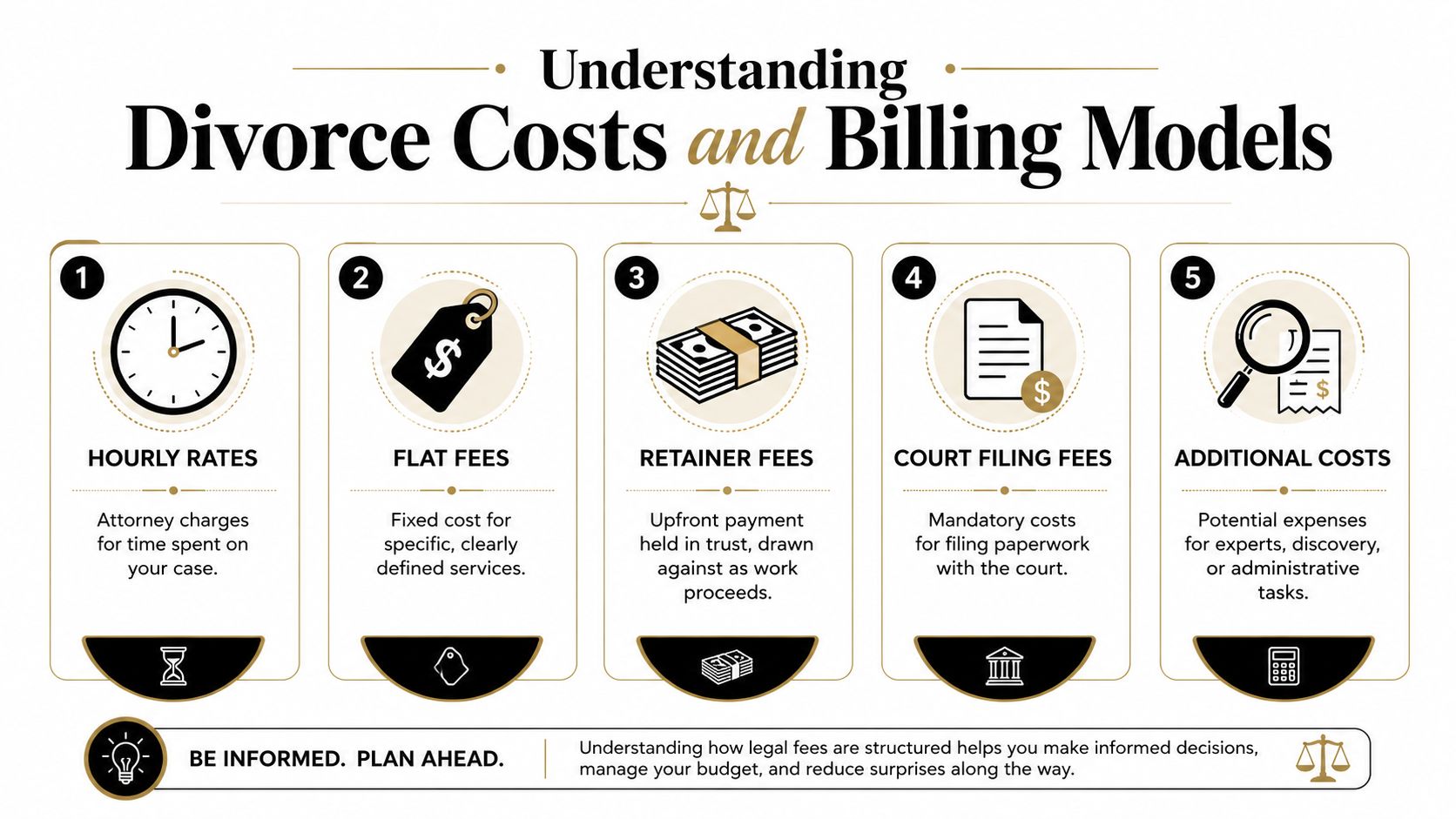
Most divorce lawyers use one or more common billing structures. The right model often depends on whether the case is straightforward, contested, or likely to involve extensive document review or hearings.
Here are the terms that usually matter most:
- Hourly billing: The attorney charges for time spent on the case.
- Retainer: An upfront payment placed in trust and billed against as work is completed.
- Flat fee: Sometimes used for limited, clearly defined services.
- Court filing fees: Separate court costs for opening and processing the case.
- Additional expenses: These can include mediation fees, document charges, or expert-related costs.
If you want a fuller explanation of fee structures, this discussion of divorce attorney fees can help you frame the right questions.
What usually increases cost
The biggest driver is usually conflict. A case where both spouses exchange documents promptly and negotiate in good faith is very different from a case involving emergency hearings, business records, or repeated disputes over parenting.
Asset complexity also matters. If your divorce involves a historic Heights property, a closely held business, retirement division paperwork, or a disagreement over whether property is separate or community, the legal work becomes more detailed.
How to have a better billing conversation
Ask for clarity, not predictions no one can guarantee. A lawyer can usually explain the billing method, the likely stages of work, and what kinds of events tend to increase expense.
Ask questions like these:
- What does the retainer cover at the beginning?
- What work is billed separately?
- How will I receive invoices or account updates?
- What choices can I make to control cost?
The point isn't to find the cheapest representation. It's to understand the system well enough to make informed choices and avoid surprise.
Frequently Asked Questions About Divorce in the Heights
You may be sitting at your kitchen table in the Heights, looking at a house deed, a retirement statement, and your child's school calendar, wondering which problem to solve first. That feeling is common. Divorce questions usually start with daily life, not legal jargon, and clear answers can make the process feel far less intimidating.
Can my spouse and I use the same attorney
No. In Texas, one divorce lawyer cannot advise both spouses because each person has separate legal interests, even in a friendly divorce. A lawyer may prepare documents for one spouse in an agreed case, but that does not make the lawyer neutral counsel for both sides.
A simple way to look at it is this. Your attorney is your guide and your advocate. That job requires loyalty to one client at a time.
Do I have to go to court to get divorced
Sometimes yes, sometimes no. Many Harris County divorces settle by agreement, and the final hearing can be short. If you and your spouse disagree about children, support, property, or temporary arrangements, the court may need to decide those issues at one or more hearings.
The answer often depends on how much remains contested and what the assigned court requires. Even in a relatively calm case, it helps to prepare as if a brief appearance may be necessary.
What happens to retirement accounts or property we forgot to divide
This issue causes more trouble than people expect. A divorce decree may say an account will be divided, but some retirement plans also require a separate court order called a QDRO before the plan administrator can act. Without that extra step, the wording in the decree may not be enough.
Property left out of the decree can create problems too. In some situations, a spouse may ask the court to divide omitted community property later through a Suit for Postdissolution Partition under Texas Family Code § 9.201, subject to the deadlines explained in Texas Law Help's article on dividing community property after divorce.
How do we handle a business or historic home in the Heights
With careful records and a practical plan.
These cases often involve two separate questions that people understandably mix together. First, what is the asset legally. Community property, separate property, or a mix because one spouse owned it before marriage but marital funds were later used on it. Second, what is the asset worth, and what is the fairest way to divide that value.
That distinction matters in the Heights. A historic home may carry renovation records, refinance documents, reimbursement claims, and emotional value tied to the neighborhood. A local business may have income that does not appear neatly on a paycheck, which makes valuation and cash flow analysis more detailed. Generic divorce advice usually skips over those neighborhood-specific issues. A local lawyer should be ready to sort through them with you step by step.
What about health insurance and other immediate concerns
Handle these early. Health insurance, temporary bill payments, beneficiary designations, and access to shared accounts can become urgent before the divorce is final.
One of the costliest mistakes in a Heights divorce is assuming a loose end will fix itself later. It often does not. If a family depends on one spouse's employer coverage, or if automatic payments are tied to a joint account, those details should be reviewed before they create a larger problem.
Will the court care that we live in the Heights
Texas family law applies across the state, but local procedure shapes how your case moves. Harris County courts have their own scheduling practices, standing orders, and expectations about paperwork, mediation, and hearings. Those practical rules affect timing, preparation, and strategy in ways an online article often misses.
That is one reason people often look for counsel familiar with Heights-area divorce matters, as noted earlier in the article.
Every family has a different pressure point. For one household, it is a parenting schedule that works around school and exchanges. For another, it is tracing separate property in a home that has been improved over many years. For another, it is figuring out whether a spouse can keep a neighborhood business without creating an unfair tradeoff elsewhere in the property division.
You do not have to solve all of that alone on day one.
If you need help with divorce, custody, or estate planning in Texas, contact The Law Office of Bryan Fagan today for a free consultation. A thoughtful conversation with a Texas family law attorney can help you understand your rights, protect your finances, and make a steady plan for what comes next.