You may be sitting at your kitchen table in Greater Heights right now, looking at a stack of bank statements, a school calendar, and a text thread that makes your stomach drop. That's often where family law starts for real people. Not in a courtroom, but in the middle of ordinary life when home, parenting, and money suddenly feel uncertain.
A Greater Heights family lawyer should help you turn that uncertainty into a plan. Texas family law can feel technical, but the rules become more manageable when you break them into steps and connect them to the decisions you need to make today.
Understanding Texas Family Law Fundamentals
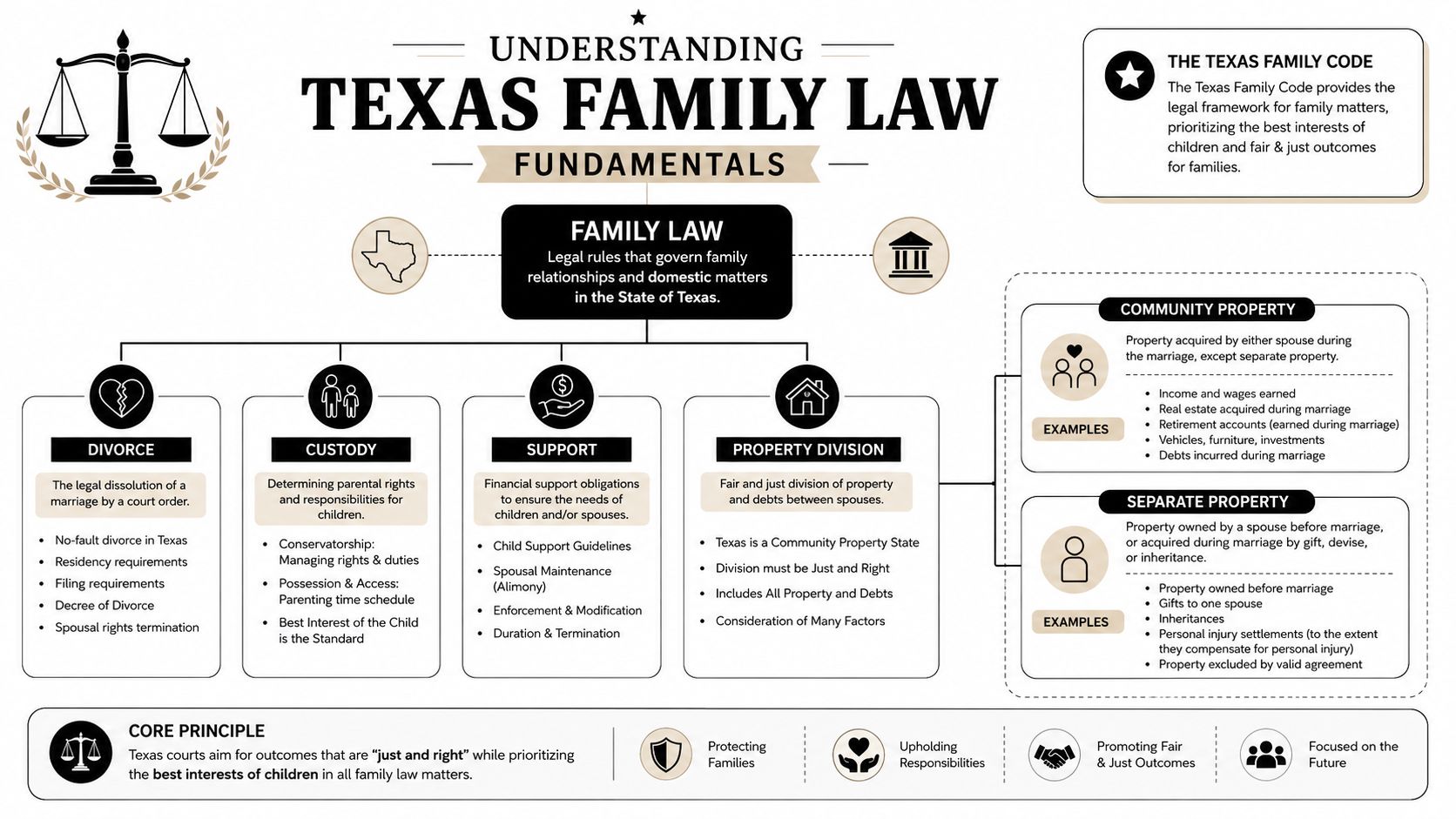
Texas family law works like the frame of a house. If you know which beams carry the weight, later decisions about divorce, children, and property feel less confusing.
The legal building blocks
Several rules appear again and again in Harris County family cases. The court may be asked to end a marriage, decide conservatorship and possession for children, set child support or in some cases spousal maintenance, and divide the marital estate under the Texas Family Code.
Those topics overlap more than many Greater Heights families expect.
A parent's work schedule can affect possession terms. A decision about who stays in the house can affect temporary finances. A dispute over whether an account is separate or community property can change settlement discussions across the whole case. Family law is less like four separate boxes and more like one system of connected parts.
The terms Texas courts actually use
Texas courts do not usually talk about "custody" the way people do in everyday conversation. Judges and lawyers use conservatorship to describe decision-making rights and duties, possession and access to describe the parenting schedule, and child support to address financial support for the child.
That wording matters. If you ask for "full custody," the court still has to translate that request into the legal categories recognized by the Texas Family Code.
Property law has the same kind of vocabulary shift. Texas starts with a community-property presumption, which means property acquired during marriage is generally treated as part of the marital estate unless a spouse can prove it is separate property. Separate property often includes assets owned before marriage and some property received by gift or inheritance. The proof matters as much as the claim. If separate funds were mixed into a joint account and records are missing, tracing can become difficult very quickly.
Why local practice changes the advice
Greater Heights families are still governed by statewide law, but local court practice shapes how those rules play out in real life. Harris County courts often expect parties to arrive organized, ready for mediation, and prepared to address temporary parenting and financial issues early in the case. Bench preferences also matter. Some courts want proposed orders in a specific format. Some expect focused evidence instead of broad complaints about the relationship.
That is especially important for military families and households shaped by remote work.
A parent who works from home may assume that flexibility automatically supports more parenting time. Sometimes it does. Sometimes the court asks a more practical question: who can handle school drop-off, pickups, homework, and exchanges without constant last-minute changes? Military service adds another layer because deployment risk, training schedules, relocation, and virtual contact with children may need to be addressed with unusual care under Texas law and local practice.
How these rules show up in ordinary decisions
The legal issues often start small. One spouse keeps using a joint account after separation. A parent accepts a new remote position with travel days that were not part of the old routine. Grandparents help with after-school care, but no one has written down who handles weekday responsibilities.
Each fact can matter later.
For example, a paycheck earned during marriage is often part of the community estate, even if it was deposited into an account in only one spouse's name. An inheritance may remain separate property, but only if the records clearly show where it came from and where it went. For children, the court's guiding standard is the best interest of the child, which usually brings the judge back to stability, safety, routines, school needs, and each parent's ability to follow through.
Practical rule: Start a clean file now. Save school notices, pay records, account statements, calendars, and a simple timeline of major events. Good records often resolve arguments before a hearing starts.
Estate planning can also come into view during a family case. After separation or divorce, people often need to review wills, beneficiary designations, powers of attorney, and medical directives so older documents do not give authority to the wrong person.
Texas Divorce Process in Greater Heights
A divorce in Harris County usually moves through a series of practical stages. Knowing the sequence helps you make better decisions and avoid reacting emotionally to each new filing.
How a divorce usually unfolds
The case begins when one spouse files an original petition for divorce. The other spouse is then served or signs a waiver, and the court gains a formal framework for addressing the marriage, children, and property.
After filing, many families need temporary rules before the final decree. Temporary orders can address who stays in the home, how bills get paid, and how parenting time works while the case is pending.
If you're looking at Divorce representation, the legal work usually falls into contested, uncontested, or high-conflict paths depending on whether you and your spouse agree on key terms.
Why local practice matters
In the Greater Houston family law market, including the Heights area, firms handling high-net-worth divorces often use property characterization and business valuation to affect asset division outcomes. Local practice also requires lawyers to account for Harris County judges' preferences for mediation before jury trials in contested custody matters, as noted in this Houston Heights divorce law discussion.
That matters because your strategy shouldn't focus only on what the statute says. It should also reflect how the court expects parties to behave during the case.
- Document gathering: Pull tax returns, pay records, account statements, and property records early.
- Communication discipline: Use written communication carefully. Assume angry texts may later matter.
- Mediation readiness: Even if settlement feels far away, prepare your goals and fallback positions before mediation.
A strong divorce file is usually built before the first major hearing, not after it.
When parents separate, the hardest questions usually aren't legal definitions. They're personal. Where will the child sleep on school nights? Who handles pickup if one parent works late? What happens when distance, military service, or changing work arrangements complicate a stable routine?
What judges usually examine
Texas courts look at the child's best interest when deciding conservatorship, possession, and support. In practical terms, judges often care about stability, the child's emotional and physical needs, each parent's ability to meet those needs, and whether the proposed schedule works in real life.
A workable parenting plan usually answers questions like these:
- School logistics: Who gets the child to school on time?
- Medical decisions: How will parents share information and authority?
- Work schedules: Can each parent consistently exercise the time requested?
- Safety concerns: Is there any issue involving violence, substance abuse, or serious instability?
If one parent later blocks access or stops following the order, enforcement may become necessary. If work, school, or a move changes the family's situation, modification may be the better path.
Military families and remote work complications
An issue many families miss involves military parents and spouses whose work can be done remotely. A recent discussion of Texas family challenges noted that 28% of active-duty military spouses now hold remote civilian jobs, which can create jurisdictional ambiguity in Harris and Montgomery counties when relocation disputes arise under the Uniform Deployed Parents Custody and Visitation Act, as described by Houston Landing's legal help resource.
That can create a confusing scenario. One parent may be tied to military orders, while the other can work from almost anywhere. The court may still ask where the child's life is most anchored, not just where a laptop can be opened.
If false allegations enter a custody or divorce dispute, resources discussing defense strategy, such as Gonzalez & Waddington divorce defense, can help parents understand how quickly accusations can reshape a case.
Division of Property under Texas Community Property Rules
A Greater Heights spouse may walk into a divorce confident about one point: “I paid for that, so it's mine.” Texas property law often reaches a different answer. In court, the question is usually not who used an asset or whose name appears on one statement. The question is when the asset was acquired, where the money came from, and whether you can prove it.
The first step is classification
Property division starts with classification. Under Texas community property rules, assets and debts acquired during marriage are generally presumed to belong to the community estate. Property owned before marriage, or received later by gift or inheritance, may remain separate property if the owner can prove that claim clearly.
That proof issue matters more than many families expect.
Separate property works a bit like oil and water. It can sit beside community property without changing character, but once funds are mixed together and used over time, sorting them back out can become difficult. A common Greater Heights example is inherited money deposited into a joint account and then used to pay contractors for a kitchen remodel. The inheritance may still have a separate-property argument behind it, but tracing records usually become the difference between a strong claim and an expensive fight.
The same problem shows up with retirement accounts, stock grants, and small businesses. If a business existed before marriage but grew during marriage because of either spouse's work, the court may need to examine whether the business itself is separate property, whether part of its growth affects the community estate, and whether reimbursement claims should be raised.
Types of Property in Texas Divorce
| Property Type | What It Includes |
|---|---|
| Community Property | Earnings during marriage, homes bought during marriage, vehicles purchased during marriage, retirement contributions made during marriage, joint bank funds |
| Separate Property | Property owned before marriage, gifts to one spouse, inheritances received by one spouse |
What to gather before negotiations start
Good property cases are built with paper, not assumptions. If you cannot show the history of an asset, the court may fall back on the community-property presumption.
Gather records early, especially if Harris County temporary orders will soon limit account activity or require disclosures on a short timetable.
- For real estate: Deeds, closing papers, mortgage statements, refinance records, and proof of the source of any down payment.
- For bank and retirement accounts: Statements showing balances before marriage, during marriage, and near separation.
- For gifts or inheritances: Letters, probate papers, trust records, wire records, or account histories showing exactly where the funds came from.
- For business interests: Formation documents, tax returns, profit and loss statements, payroll records, and any valuation materials.
- For military or remote-work households: LES statements, retirement benefit records, relocation orders, and records showing where employment decisions affected the family's finances.
That last category is easy to overlook. In families dealing with military service or remote work, one spouse may have unusual compensation, deferred benefits, or relocation-related expenses that complicate reimbursement and valuation questions. Those details can affect settlement bargaining position even if the family's biggest visible asset is still the house.
Texas courts divide community property in a way that is “just and right,” not by an automatic 50-50 formula. Judges may consider earning power, fault allegations if properly raised, wasting of assets, the needs of children, reimbursement claims, and the size of each spouse's separate estate. In practice, many cases still resolve near the middle, but “near the middle” and “equal” are not the same thing, as discussed in this Texas divorce asset division overview.
One practical point for Greater Heights families. Bench preferences can matter in contested property hearings. Some courts want clean inventories with backup documents attached and values tied to records, not estimates pulled from memory. If your inventory is vague, the judge may give more weight to the spouse who came prepared with statements, appraisals, and a traceable timeline.
Hiring a Greater Heights Family Lawyer Step by Step
Choosing a lawyer is one of the few parts of the case you fully control at the beginning. Use that control carefully. The right fit depends on your facts, your communication style, and the complexity of your case.

Step one through step three
Start with basic research. Look at whether the lawyer regularly handles divorce, custody, enforcement, and property cases in Texas courts. If your case involves business ownership, interstate issues, or military concerns, ask directly how the lawyer approaches those problems.
Bring organized information to the first consultation. You don't need a perfect file. You do need a usable one.
- List the main disputes. Children, house, support, business, safety concerns.
- Collect core records. Recent statements, court papers, and any existing orders.
- Write your questions down. People forget important questions when they're stressed.
What to ask in the consultation
A good consultation should leave you clearer than when you arrived. Ask how the lawyer approaches temporary orders, mediation, contested hearings, and settlement decisions. Ask who will communicate with you and how quickly you should expect updates.
Some clients also need to understand the scale of a firm before choosing counsel. The Law Office of Bryan Fagan, PLLC was founded in 2012 by Attorney Bryan Fagan and has grown into one of the largest family law practices in Texas, serving clients across eight counties with over 170 professionals, including 27 attorneys and 23 paralegals, and more than 100 years of combined legal experience.
That kind of information can help you decide whether you want a larger team structure or a smaller practice model. Neither is automatically right for everyone.
How to judge fit after the meeting
Use a simple test after each consultation.
- Did the lawyer answer directly? Evasive answers early usually don't improve later.
- Did the strategy make sense? You should understand the next step, even if the outcome can't be promised.
- Did the lawyer listen to the facts that matter most to you? Parents often care about schedule stability more than abstract legal language.
- Did the fee explanation feel clear? You should know what a retainer is, what hourly billing means, and what events typically increase cost.
The best attorney-client relationships usually begin with realistic expectations, not sweeping promises.
If you're hiring a Greater Heights family lawyer, think of the first meeting as both a legal consultation and a working interview. You're choosing someone to help guide some of the most sensitive decisions in your life.
What to Expect During Your Case Timeline and Costs
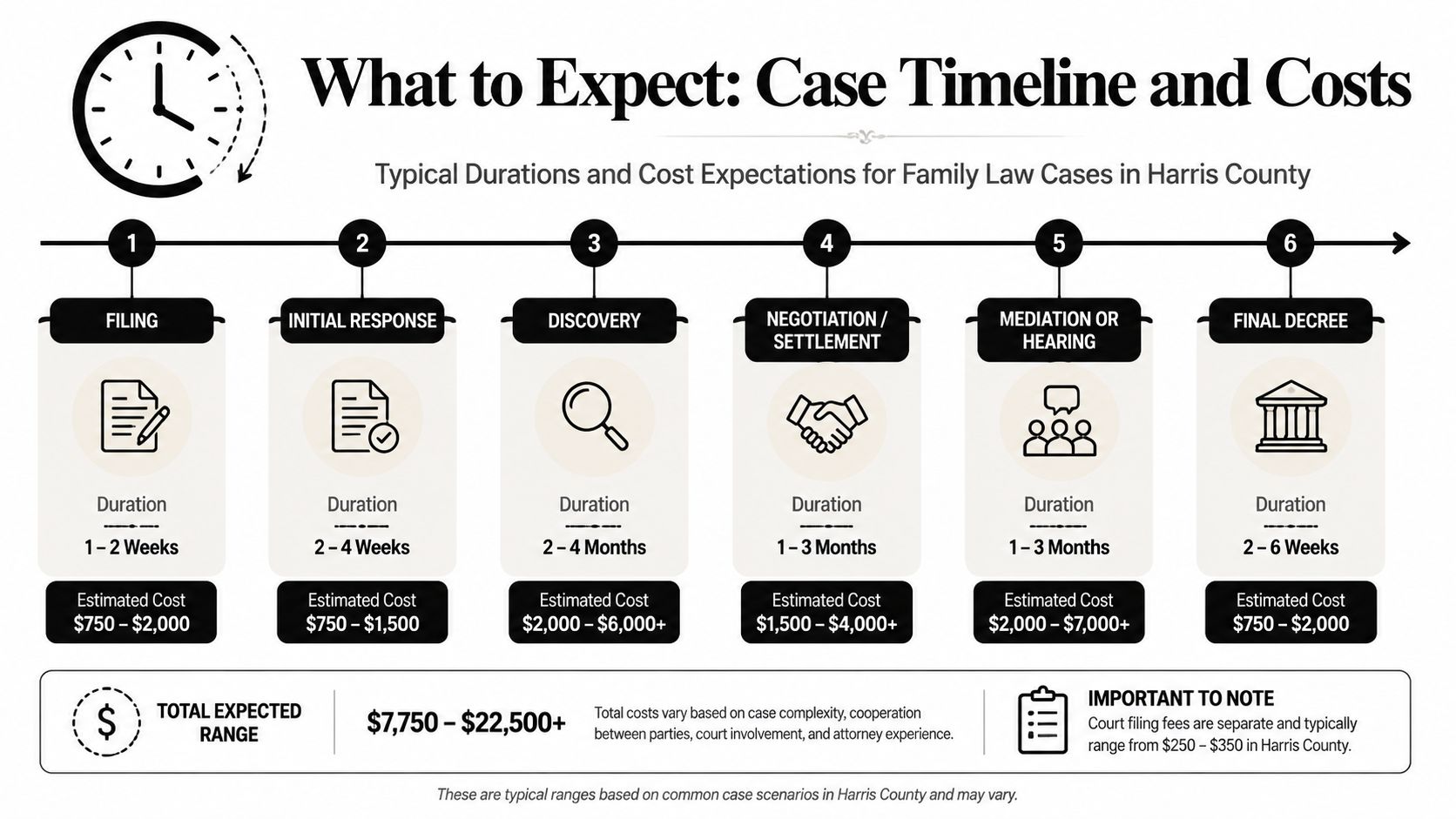
Family law cases move in stages, but the exact pace depends on conflict level, court scheduling, document exchange, and whether experts become necessary. That's why any honest lawyer should speak about timing and costs qualitatively unless your case has already developed enough facts to estimate more precisely.
The phases most clients experience
Many divorce and custody matters follow a familiar pattern:
- Opening phase: Filing, service, initial consultation, and immediate planning.
- Stabilization phase: Temporary orders, exchange of basic information, parenting logistics.
- Resolution phase: Negotiation, mediation, and if needed, trial preparation and final orders.
A straightforward agreed case usually moves differently from a contested matter involving business valuation or a custody dispute. Costs also rise when experts, extensive discovery, or enforcement proceedings become necessary.
Deadlines that can change your options
Some deadlines aren't flexible. Under Texas Family Code Chapter 9, a suit to enforce division of tangible personal property that existed when the divorce decree was signed must be filed before the second anniversary of the date the decree was signed or became final after appeal, or the claim is barred, according to the Texas Family Code Chapter 9 text.
That rule matters more often than people expect. A former spouse may assume a dispute over furniture, heirlooms, tools, or other personal items can wait. Sometimes it can't.
Waiting to “see if things calm down” can quietly eliminate legal remedies when a statutory deadline applies.
If you're unsure whether your post-divorce issue involves enforcement, clarification, or another claim, get specific advice before time passes.
Common Client Questions and Answers
Can I change custody if one parent wants to move
Possibly. A relocation can justify a modification if it materially affects the child's circumstances or the practicality of the current order. The court will still focus on the child's best interest and the actual effect on school, routine, and parent-child contact.
What if the other parent ignores the visitation order
You may need an enforcement action under the Texas Family Code. Keep records of denied periods of possession, communications, and any related expenses or missed exchanges.
Does remarriage automatically change support
Not automatically in every circumstance. A remarriage may affect household finances and practical parenting arrangements, but support usually changes only through proper legal steps and a court order when required.
Should estate planning wait until after divorce
Not always. Many people should review wills, beneficiary designations, and powers of attorney during a pending divorce so older documents don't conflict with current intentions under Texas estates law.
Conclusion and Next Steps
Family law problems in Greater Heights often feel urgent because they affect the parts of life you can't put on hold. Your children still need a schedule. Bills still need to be paid. Property still has to be identified, valued, and divided under Texas law.
A careful approach helps. Learn the rules. Organize your records. Pay attention to local court practice. Ask direct questions before you hire counsel. If your case involves unusual facts, such as military service, remote work, or complex property issues, get guidance early instead of hoping the problem will sort itself out.
You can also continue learning through resources on contested divorce and related firm materials on custody, support modifications, protective orders, and estate planning topics.
If you need help navigating divorce, custody, or estate planning in Texas, contact Law Office of Bryan Fagan, PLLC today for a free consultation.