
Divorce can feel especially heavy when your life is rooted in a close-knit neighborhood like Timbergrove, because you're not just separating households, you're trying to protect routines, children, finances, and privacy all at once. If that's where you are right now, the first thing to know is simple. Texas law gives you a process, and once you understand the moving parts, the process becomes much less intimidating.
A Timbergrove divorce lawyer should help you do more than file papers. The right guidance gives you a plan for timing, parenting decisions, property questions, and the practical details that can make a hard season feel more manageable. In Houston, those details matter because local court logistics and family schedules often shape how smoothly a case moves.
A divorce often starts with one quiet but difficult realization. Maybe the conversations at home have gone cold. Maybe you're trying to stay calm for the kids while also wondering how bills, school pickup, and the mortgage will work if you move forward.
That uncertainty is normal. What helps is turning confusion into a sequence of manageable decisions, instead of trying to solve everything at once.
For a Timbergrove family, that might look like this. One spouse is still living at home, the other is weighing whether to move out, and both are worried about how a sudden choice could affect custody, property, or temporary support. Texas law does not reward rushing blindly. It rewards good preparation.
Practical rule: clear information usually lowers conflict. When people understand the residency rules, the waiting period, and the issues the court will care about, they tend to make steadier decisions.
That is why legal guidance matters early. A calm, experienced approach can help you protect your position while you decide what comes next. If you understand the steps now, you can focus on the choices that change your outcome later.
The Role of Your Divorce Lawyer in Texas
A divorce lawyer is not just the person who files the petition or appears in court. In a Texas case, that lawyer becomes your translator, strategist, and buffer when emotions run high. They help you make decisions with the law in mind, not just the heat of the moment.
Turning the facts of your life into a legal plan
Your lawyer starts by sorting the case into the issues that matter most. If there are children, the focus may be on custody schedules, temporary orders, and school stability. If there is significant property, the focus may shift to tracing separate property and identifying what belongs in the community estate.
That is where a service like Divorce can fit naturally into the process, because Texas divorce representation has to adapt to contested, uncontested, and high-conflict cases. The same legal framework applies, but the strategy changes with the facts.
A lawyer also handles communication with the other side, which can prevent arguments from escalating in text messages or email. They gather documents, review account records, and prepare discovery so you're not trying to answer complicated questions alone. In a contested case, that preparation can shape settlement advantage long before a hearing ever happens.
Why the lawyer's job is also about control
A good divorce lawyer keeps the case moving in a way that protects your goals. That may mean telling you when to compromise, when to hold firm, and when to document something instead of debating it by phone. It may also mean helping you think through temporary orders, because the choices made early can affect day-to-day life while the case is pending.
If you have children, your lawyer should explain conservatorship, possession, and access in plain English. If you own a home or business, they should explain how property characterization can change the whole settlement picture. That kind of guidance is what turns a legal emergency into a workable plan.
The Texas Divorce Process Step by Step
The Texas divorce process has a fixed structure, even when the facts are complicated. The first checkpoint is residency, because Texas law requires that at least one spouse has lived in Texas for 6 months, or 180 days, and in the filing county for 90 days before filing, and the state also imposes a 60-day waiting period after filing before a divorce can be finalized, so even an uncontested case usually cannot end immediately, as explained in the Texas divorce timeline guidance from Ramos Family Law.
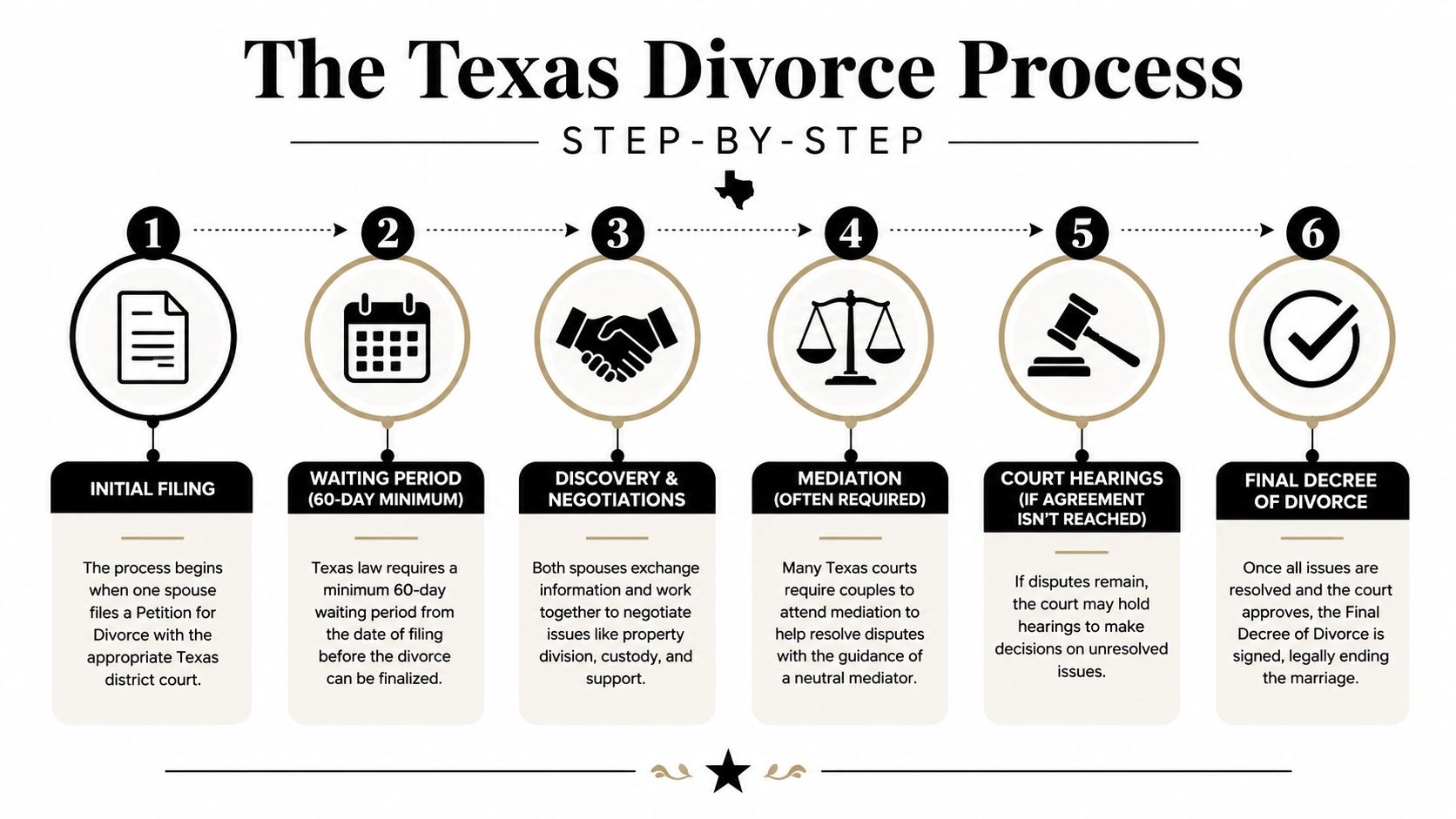
A simple timeline to keep in mind
| Stage | What happens | Why it matters |
|---|---|---|
| Initial filing | The petition starts the case | It opens the legal process |
| Waiting period | Texas requires at least 60 days after filing | It sets the earliest possible finalization date |
| Service and response | The other spouse is formally notified | It creates due process and moves the case forward |
| Discovery and negotiation | Financial and parenting information is exchanged | It helps both sides understand the real issues |
| Mediation or hearings | The parties try to resolve disputes | It can narrow or settle contested issues |
| Final decree | The court signs the divorce decree | It makes the divorce official |
Why the order matters
People often think the filing date is the finish line. It isn't. The better way to think about it is as a sequence of decisions. Filing starts the case, service brings the other party in, temporary orders stabilize life while the case is pending, and settlement or hearings resolve the outstanding issues.
That sequence also affects parenting schedules and financial planning. If your case involves a move-out, a new school arrangement, or a change in who pays certain bills, the timing of each step matters. Texas divorce law gives you structure, but your lawyer still has to manage the pace carefully so you don't lose your advantage or miss a key deadline.
Untangling Key Issues Property Custody and Support
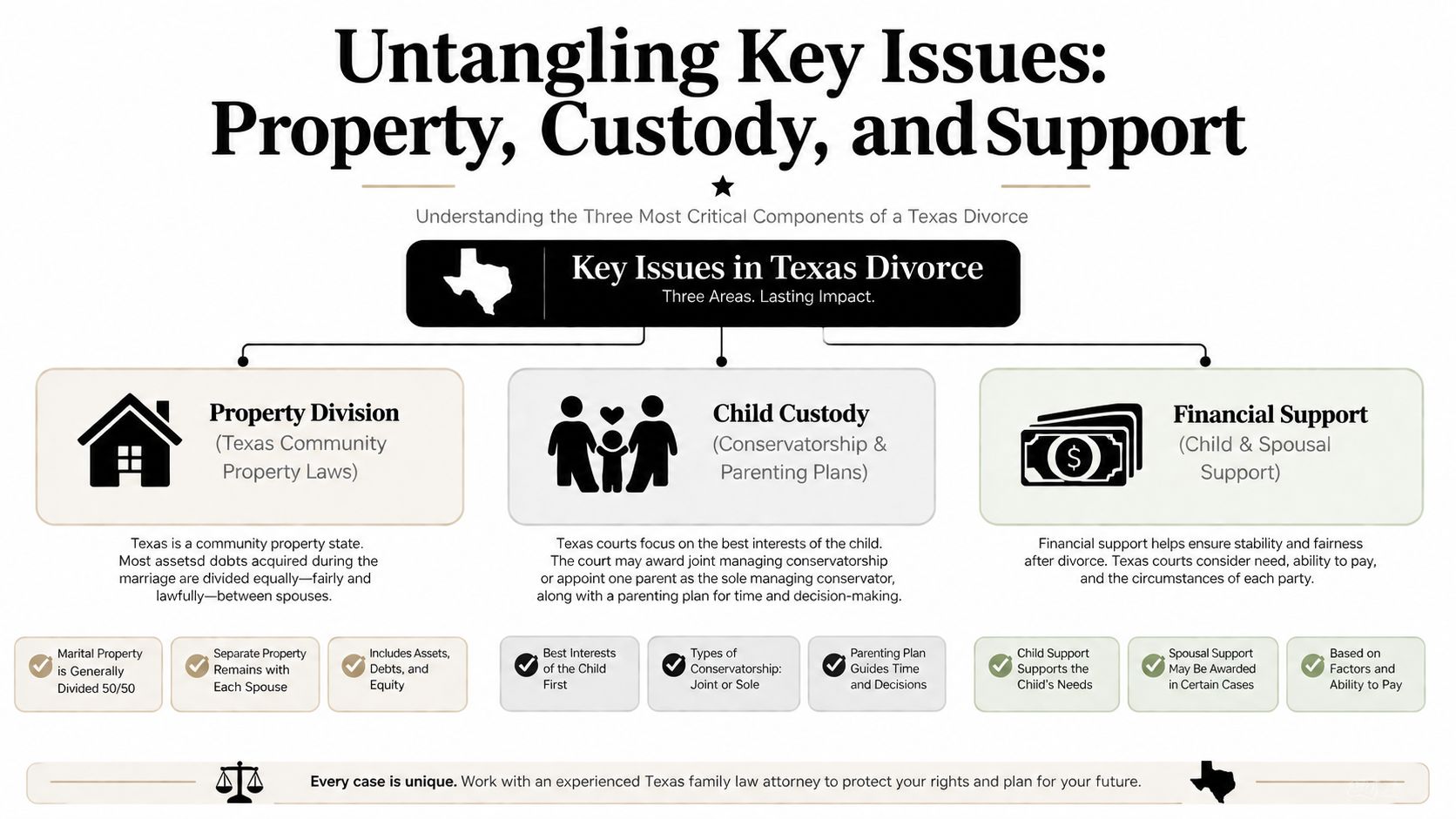
In most divorces, the hardest questions are not about whether the marriage is ending. They're about what happens to the home, the children, and the money. Texas family law treats those issues differently, and understanding the differences helps you make smarter choices.
Property division starts with characterization
Texas generally treats property acquired during marriage as community property, while separate property stays with the spouse who owns it, and each spouse keeps sole management and control of that spouse's separate property under Texas law Texas Family Code Chapter 3. That sounds straightforward until you have a house purchased during marriage, a retirement account funded across several years, or a business with both marital and premarital value.
That is why characterization is often the primary battleground. If an asset is misidentified, the settlement math changes. Houston-area firms describe contested divorce and complex property division as core services because these cases often require tracing, valuation, and careful documentation, not just form completion Walters Gilbreath Houston family law services.
Texas courts divide community property under a just and right standard, not a strict 50/50 rule, and judges may award a disproportionate share based on factors like fault in the breakup, earning-capacity differences, or the needs of minor children Texas property division guide. That means the outcome depends on the facts, not a preset formula.
Custody uses Texas language, not everyday language
Texas usually talks about conservatorship, possession, and access rather than the simpler phrase “custody.” That matters because the label affects how parents talk about their rights and duties, especially when they're negotiating temporary arrangements.
A parent who expects to “win custody” may be disappointed if the actual issue is a possession schedule that still allows strong access for both parents. A lawyer should help you focus on the practical result, not just the terminology. If school routines, work travel, or safety concerns are part of your case, those facts need to be organized early.
Support is part of the long-term picture
Child support and spousal maintenance often sit in the background until they suddenly become central. The amount of support, who pays health-related costs, and whether temporary support is needed during the case can all shape settlement talks. Good planning means thinking beyond the decree, because the financial structure you create now can affect your household long after the divorce is signed.
For parents also thinking about insurance and financial protection after divorce, your 2026 life insurance financial guide can be a useful planning companion when you're reviewing beneficiary changes and coverage needs.
Local Insights for a Timbergrove Divorce
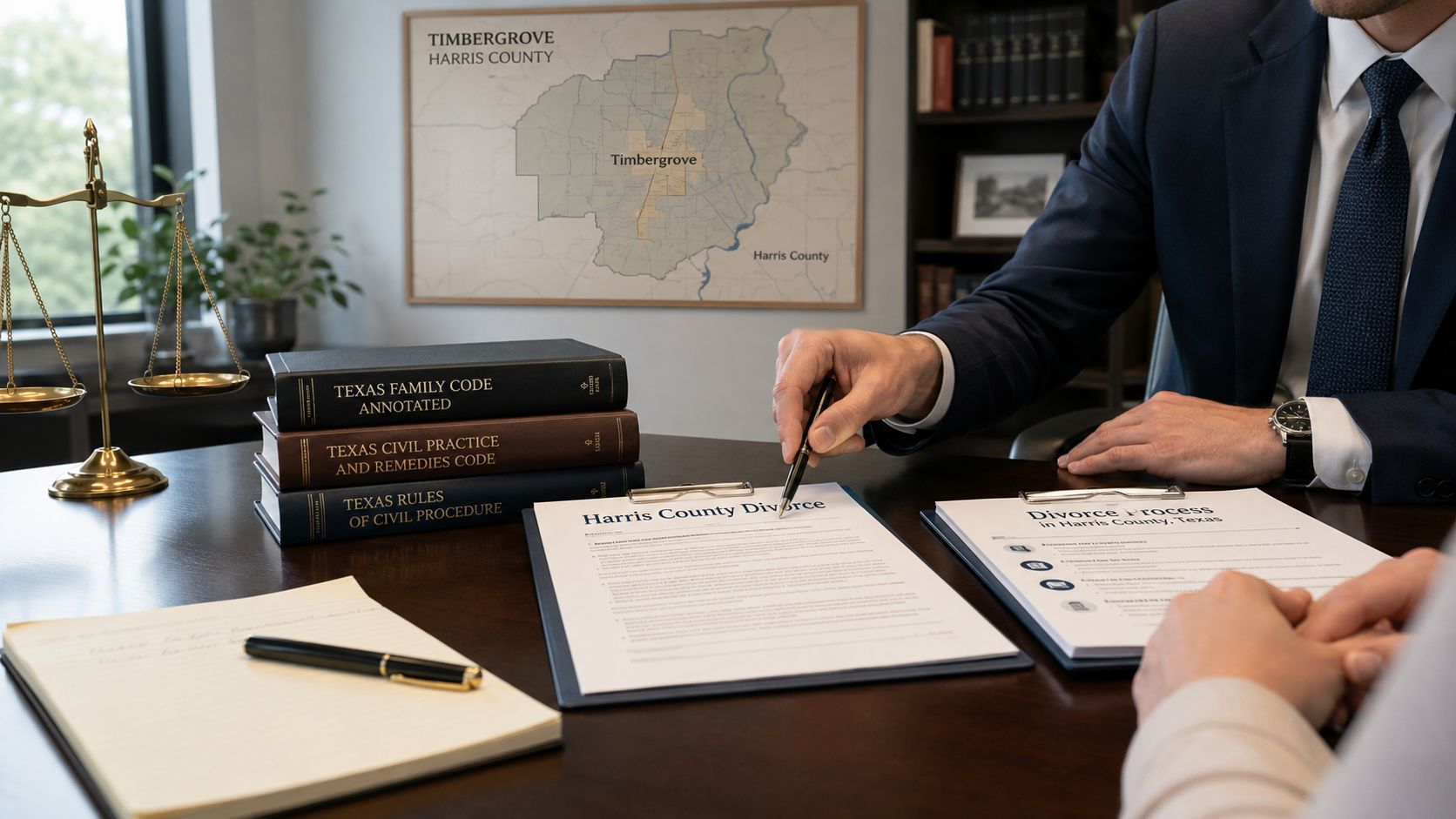
A divorce in Timbergrove does not happen in a vacuum. Your case will be handled within the Harris County system, and that means local logistics matter as much as statewide law. Where you live, work, and co-parent can affect how practical your temporary orders are and how often you'll need to travel for hearings or mediation.
Harris County cases work best with local coordination
Houston-area families often need more than courtroom advocacy. The Harris County Domestic Relations Office lists community legal resources that can support mediation, visitation help, domestic-violence services, immigration help, and other referral needs, which shows how often divorce cases overlap with real-life problems beyond a single petition Harris County community legal resources.
That's especially important when custody arrangements have to work around traffic, school pickup, and parents' work schedules. A possession plan that looks fair on paper can become unworkable if it ignores actual commute patterns or the logistics of exchanging children across Houston.
If you own a home, local property expenses also matter. If you're comparing post-divorce housing costs, INTELLI's guide to Houston property taxes can help you think through one of the recurring costs that may affect whether keeping the house makes sense.
Local strategy is about connection, not just filings
A strong local strategy links temporary orders, mediation, and support services into one plan. If safety is an issue, the lawyer may need to push for immediate protections. If immigration concerns exist, those should be factored into the timing and tone of the case. If the children's routine is fragile, the possession schedule should be built around stability first.
Divorce strategy in Houston works best when the lawyer understands both the courthouse and the neighborhood.
That's the difference local familiarity makes. The law is statewide, but the lived experience of the case is always local.
How to Choose the Right Lawyer for Your Family
A divorce consultation can feel overwhelming fast. The lawyer who helps most is usually the one who listens carefully, lays out the next steps in plain terms, and explains where you have choices and where Texas law leaves less room to maneuver. In a Harris County case, that kind of clarity matters because the legal rules are statewide, but the day-to-day impact still depends on local court practice, your schedule, and how the case fits your family's routine.

What to ask before you hire anyone
Start with the practical questions. Ask how the lawyer handles communication, whether emails and phone calls are billed, what payment options are available, and how they expect the case to unfold. Independent guidance on hiring a family-law attorney recommends asking about hourly rates, how communications are billed, and payment options, because the total cost comes from all billable time, not just the retainer Canadian Lawyer cost transparency guidance.
Ask how the lawyer handles Harris County cases in plain language. If your divorce involves children, ask how temporary orders and parenting schedules are usually handled in this area. If there is a business or a house at issue, ask how the lawyer approaches valuation, property characterization, and the paperwork needed to present those issues clearly. A good answer should sound like a roadmap, not a lecture full of jargon.
Value matters more than the lowest number
The lowest fee can become the costliest choice if communication breaks down or the strategy leads to extra hearings. Each delay creates more billable time, more stress, and more chances for avoidable mistakes. A lower upfront price does not help if no one is keeping track of deadlines, collecting financial records, or preparing the case in a way that matches how Harris County courts expect family-law matters to move.
Compare more than the fee quote. Look for responsiveness, familiarity with local courtroom practice, and a method for keeping you updated as the case develops. One option among many is the Law Office of Bryan Fagan, PLLC, which offers Texas family-law representation, but what matters is to choose counsel whose process fits your family's needs and your budget.
Helpful standard: if a lawyer's explanation leaves you more confused than informed, that is a warning sign.
A strong fit should leave you clearer about your options, not more overwhelmed. You are looking for legal judgment, and you are also looking for steady communication when the case becomes emotional.
Frequently Asked Questions About Divorce in Texas
Do I have to go to court for my divorce? Not always. Many couples resolve some or all issues through negotiation or mediation, and some uncontested cases can be completed with limited court involvement. If there's a dispute over property, children, or safety, court may become necessary.
What is mediation? Mediation is a structured settlement conversation with a neutral third party. It often helps couples resolve property, custody, or support disputes without asking a judge to decide every issue. In many Texas divorces, mediation can narrow the conflict even if it doesn't settle everything.
Can I change my name as part of the divorce? Yes, many people include a name change request in the final decree. It's usually easier to address that in the divorce paperwork than to handle it later.
What if we still own property after the divorce is over? Some property issues can still be addressed after the decree if the asset was not divided. Texas Law Help explains that post-dissolution partition issues can arise, and it also notes timing rules for certain partition claims Texas Law Help on dividing community property after divorce. That's one reason the decree should be drafted carefully.
Can I handle a divorce without a lawyer? You can, but that doesn't mean you should if the case involves children, complex property, or disagreement over support. A lawyer helps reduce mistakes that can be hard to undo later.
If you need help navigating divorce, custody, or estate planning in Texas, contact The Law Office of Bryan Fagan today for a free consultation.
A CTA for Law Office of Bryan Fagan, PLLC.