 Skip to content

If the parents are alive and fit, custody is usually the harder path, while guardianship of the person or estate is the route courts commonly approve. In Texas, a grandparent seeking custody must often overcome strict standing and significant-impairment requirements, while guardianship can address a child's care or property through the probate court.
You may be living this decision already. Your grandchild sleeps in your home, you handle school forms and medical appointments, and you're the adult who answers every urgent call. One parent may be alive but unable to provide consistent care. The other may drift in and out of the child's life, or no one may know where that parent is. You're not asking for a label. You're trying to make sure the child is safe and that you have enough legal authority to care for them.
The right answer depends on the legal door your facts open. Texas treats custody as conservatorship, a family-court matter governing residence, decision-making, possession, and access. Guardianship is a probate-court appointment under the Texas Estates Code that may cover the child's person, estate, or both. Those tracks overlap in daily life, but they aren't interchangeable.
Why Texas Grandparents Often Face This Choice
Maria, a San Antonio grandmother, has become the parent her daughter's two children rely on. Her daughter cycles through treatment and has periods when she can't provide dependable care. The children's father appears occasionally, but his location is often unknown and his involvement changes from month to month. Maria gets them ready for school, takes them to appointments, buys their necessities, and tries to keep conflict away from the children.
Maria's situation is common in one important respect. A grandparent may already be performing every practical parenting task while lacking formal authority to make decisions. A school may ask for documentation. A doctor may need consent. A government agency or benefits administrator may require proof that the adult asking for information has legal standing.
Texas law uses different legal systems for these problems:
- Guardianship is a probate-court arrangement under the Texas Estates Code. A guardian of the person may take responsibility for the child's physical care and certain personal decisions. A guardian of the estate manages property or benefits belonging to the child.
- Custody, called conservatorship in Texas, is handled under the Texas Family Code. A managing conservator may receive authority over residence and important decisions, while a possessory conservator generally receives possession or access under an order.
Grandparents often reach this crossroads after a parent's death, incarceration, addiction, military deployment, serious incapacity, or voluntary placement that has lasted far longer than anyone expected. The family may have relied on an informal arrangement because it felt less disruptive. Informal care can work until a major decision requires legal proof.
Practical rule: Choose the legal objective first. If you need authority to care for the child, guardianship may fit. If you need a family-court order deciding residence and parental decision-making, analyze conservatorship.
The distinction matters from day one because the filing, court, standing rules, and requested relief change with the path. A grandparent who files the wrong type of case may spend time and money addressing a threshold problem instead of the child's needs. The question isn't “Which one gives me custody?” It's, “Which court and statute match what this child needs now?”
Guardianship and Custody Under Texas Law
Start with the statute that matches the relief you need. Texas Family Code Chapter 153 governs conservatorship, possession, and access. It distinguishes between a managing conservator, who may have decision-making authority and responsibility for the child's residence, and a possessory conservator, whose order generally focuses on possession and access.
A custody case also involves the broader family-law framework under the Texas Family Code. The court's central concern is the child's best interest, but a grandparent must first clear the standing and statutory requirements that allow the court to hear the request. A better home, a close bond, or a sincere belief that you can parent more effectively may not be enough by itself.
Guardianship follows the Texas Estates Code. Chapter 1101 addresses guardianship of a minor, while Chapter 1104 includes provisions concerning temporary guardianships. Guardianship of the person focuses on personal care and decisions. Guardianship of the estate concerns the child's property, inherited assets, or benefits. Some families need only one form, not both.
The court applies a hierarchy of concerns
Texas courts generally look for the least restrictive arrangement that protects the child. A parent has a presumptive right to care for and make decisions about the child, and a grandparent ordinarily must present more than family disagreement to displace that presumption. The court also applies the child's best-interest standard rather than treating the grandparent's preference as controlling.
Guardianship may become especially relevant where a parent has died, is unable to function as a caregiver, or has made an advance plan. Under Texas Estates Code Section 1104.053, a surviving parent may appoint an eligible person by will or written declaration to serve as guardian after the parent dies or becomes incapacitated. A minor who is 12 or older, when a guardianship application is filed, may choose a guardian in writing if the court approves the choice and finds it serves the child's best interest. See the Texas Estates Code provision on a parent's appointment of a guardian.
Juvenile courts and the Department of Family and Protective Services can create a third route. Chapter 262 of the Texas Family Code addresses emergency orders and certain suits involving the state. If CPS becomes involved, the grandparent may be considered through a child-protection case rather than a private custody or guardianship filing. That venue can change who files, what evidence matters, and how quickly the court acts.
Research into Probate can help explain estate administration and estate settlement in Texas, but a guardianship application is a separate legal proceeding that requires its own analysis.
Who Can File and When Courts Will Listen
Standing is the gatekeeper. It determines whether you're legally permitted to ask the court for relief before the judge considers whether your proposed arrangement benefits the child.
For custody or conservatorship, Texas Family Code Section 102.004 gives a grandparent a route to seek managing conservatorship when the required proof exists. The statute requires satisfactory proof that the child's present circumstances would significantly impair the child's physical health or emotional development, unless the required parental consent applies. The statute also bars a grandparent from initiating a possessory-conservatorship claim as an original suit. That means asking only for visitation can be legally different from asking to become a managing conservator.
Texas law can also recognize standing where the grandparent has had the child's actual care, control, and possession for at least six months, and the filing occurs within 90 days after that period ends. The Texas State Law Library explains that a nonparent must first have standing before filing an initial custody case or a modification request. The six-month pathway is fact-sensitive, so preserve proof of when the child began living with you and who handled daily care. See the Texas State Law Library explanation of grandparent custody.
Guardianship has a different entry point. Under Texas Estates Code Section 1101.051, an adult may file, but the court must find that guardianship is necessary because of unfit parents, a parent's death, or another circumstance showing that the minor's interests require protection. A guardianship filing isn't automatic approval. It may offer a more suitable procedural route when a custody case is blocked by family-law standing rules.
| Requirement | Custody / Conservatorship, Family Code Chapter 102 | Guardianship, Estates Code Chapter 1101 |
|---|---|---|
| Who may begin the case | A person who meets a statutory standing route, including certain grandparents with actual care, control, and possession | An adult applicant may file, subject to the court's necessity and best-interest findings |
| Grandparent caregiving route | At least six months of actual care, control, and possession, with filing within 90 days after that period ends | The caregiver relationship supports the necessity analysis but doesn't guarantee appointment |
| Harm or protection showing | Present circumstances must significantly impair physical health or emotional development, unless consent applies | Guardianship must be necessary because of parental unfitness, death, or another protective circumstance |
| Type of relief | Managing conservatorship, possession, and access | Guardianship of the person, estate, or both |
| Special state involvement | CPS cases may proceed through a Chapter 262 pathway | A guardianship case may still intersect with CPS or juvenile proceedings |
If your goal is a court order controlling where the child lives and who makes family-law decisions, review Child Custody concepts before filing. If your goal is personal care or management of the child's property, guardianship may be the more direct fit.
What Each Path Actually Lets You Do
Legal labels matter because they determine what you can sign, request, approve, and challenge. A grandparent may be the child's daily caregiver yet still lack authority that a school, doctor, insurer, or agency will accept without a court order.
A managing conservatorship generally addresses the child's residence and important decisions. Depending on the order, the managing conservator may make decisions involving education, medical care, and other aspects of the child's welfare. The order controls what authority you receive and whether the parent retains particular rights or must be consulted.
A possessory conservatorship is narrower. It usually establishes possession or access, not the authority to raise the child or make every major decision. A grandparent seeking only scheduled visits must understand that this is not the same as becoming the managing conservator.
Guardianship divides authority differently:
- Guardianship of the person: Covers physical care, schooling consent, medical decisions, and other personal matters assigned by the probate court.
- Guardianship of the estate: Covers property and financial administration, which may include inherited assets, SSI, or survivor benefits belonging to the child.
- Both forms: May be requested when the grandparent needs authority over daily care and the child's property.
| Decision Area | Managing Conservatorship | Possessory Conservatorship | Guardianship of the Person | Guardianship of the Estate |
|---|---|---|---|---|
| Residence | Court order may give authority over the child's primary residence | Usually no authority to select residence | Personal-care authority may support physical placement as ordered | No authority over residence |
| Schooling | May include education decisions | Generally limited to access and possession | May include school enrollment and consent responsibilities | No education authority |
| Medical care | May include medical decision-making | Usually no independent medical authority | Focuses on medical and personal-care decisions | No medical authority |
| Finances | Not the primary purpose | No financial management role | No general property-management role | Manages qualifying child property and benefits |
| Parent's role | The order defines retained rights and duties | Parent usually retains decision-making authority | Parent's rights may remain subject to the guardianship order and court findings | Parent's personal rights aren't replaced solely because property is managed |
| Contact with parents | The order can set possession and access | The central purpose is possession or access | Contact depends on the court's orders and the child's best interest | No visitation authority by itself |
Parental rights don't automatically disappear because a grandparent receives an order. A court may limit, suspend, or structure a parent's authority based on the evidence and the type of proceeding. When abuse or neglect is alleged, the Department of Family and Protective Services may seek its own orders, and a private grandparent case shouldn't be treated as a substitute for emergency child protection.
For practical planning, ask a school, doctor, insurer, or passport office what documentation it requires. The court order may provide authority in one area while leaving another decision subject to a parent or additional court approval.
Filing Steps Timelines and Emergency Options
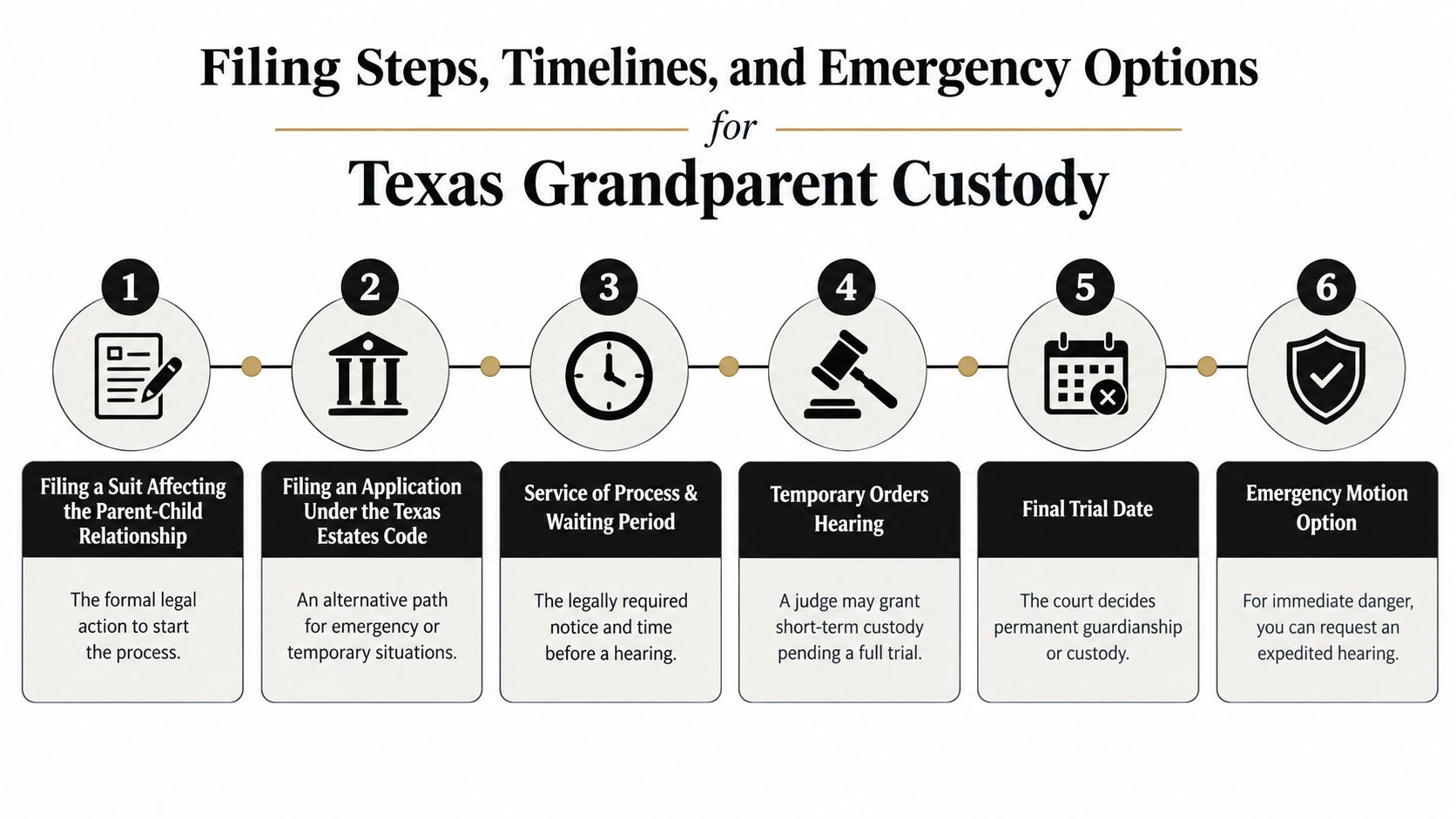
The process begins with identifying the correct pleading. A custody case generally starts with a Suit Affecting the Parent-Child Relationship, commonly called a SAPCR. A guardianship matter begins with an application under the Texas Estates Code. The filing must describe the facts supporting standing, necessity, and the requested relief.
Once filed, the parents and other required parties must receive legally sufficient notice. Don't assume that a parent's absence means service can be skipped. A court needs jurisdiction and proper notice before making lasting orders, although emergency procedures can address immediate danger while notice and a full hearing follow.
What happens after filing
In a custody suit, the court may require parenting education and may appoint an attorney ad litem or guardian ad litem for the child. These appointments serve different functions, but both can affect how the court receives information about the child's needs. Cooperate fully, provide records, and avoid coaching the child.
The court can issue temporary orders while the case continues. A temporary order may address possession, residence, support, or decision-making until the final hearing. If a child faces immediate danger, a grandparent may ask about an emergency ex parte order or a temporary restraining order. Emergency relief requires specific facts, not a general statement that the parent is unreliable.
The timeline varies with service, contested facts, court availability, investigations, and whether the parents agree. A contested conservatorship hearing may take months, and a guardianship case may also require investigation and court review. Some matters reach trial quickly, while others may wait substantially longer. Treat any timeline estimate as a planning range, not a promise.
CPS involvement requires careful distinction. A private report to CPS is not the same as an emergency removal. If the child is in immediate danger, call the Texas Abuse Hotline at 1-800-252-5400. A state-filed case may move through juvenile court under Chapter 262, and the court-appointed attorney ad litem's investigation can become important to the result.
Which Path Fits Your Family Situation
The facts should drive the recommendation, not the emotional intensity of the family conflict.
If a parent has died, guardianship may be appropriate when the surviving parent or the deceased parent's planning supports that route. If the surviving parent is also unable to provide safe care, a conservatorship case may be necessary. The death certificate, existing orders, and any will or written declaration should be reviewed together.
If a parent is incarcerated or has untreated addiction, don't assume incarceration alone gives you custody. Build evidence showing how the child's present circumstances affect health, safety, development, schooling, or emotional stability. A conservatorship request is stronger when the evidence shows why the current arrangement cannot continue, rather than merely showing that your household is more stable.
If the parent is deployed, temporary authority may be enough. A military family may prefer a written arrangement, power of attorney, temporary guardianship, or a court order suited to the deployment. Permanent custody may be unnecessary if the parent remains capable and intends to resume care.
If voluntary placement has lasted for years, evaluate whether informal care still protects the child. Guardianship of the person can be practical when parental rights remain but you need authority for school, medical treatment, and travel consent. Conservatorship may fit better when the child needs a permanent family-court structure governing residence and decision-making.
If a parent has abandoned the child, conservatorship deserves serious consideration, especially when the child's present circumstances show significant risk or impairment. But abandonment cannot be established by family frustration alone. Gather dates, missed contact, financial non-support records, messages, school history, and other evidence that shows what the child has experienced.
A limited guardianship of the estate may be enough when the only concern is inherited property, SSI, or survivor benefits. In other families, a kinship-care agreement or power of attorney may handle routine tasks without immediately pursuing a contested court case. Those informal tools have limits, so confirm that they provide the authority the school, doctor, agency, or benefits administrator requires.
Preparing Your Case and Next Steps
Your evidence should tell a clear story: who cared for the child, what the child needs, what the parents can or can't provide, and why your requested order protects the child. Start gathering records before filing, not after a hearing date arrives.
Create one organized binder or digital folder with:
- A sworn affidavit: Describe your caregiving history with specific dates, routines, appointments, school events, and examples of the parent's involvement or absence.
- School and medical records: Preserve documents naming you as the emergency contact, caregiver, or person who attends appointments.
- Residence evidence: Gather records showing that the child lives with you and how long the arrangement has continued.
- Safety records: Include CPS reports or case numbers, police records, treatment records, incarceration records, or other documents that support your concerns.
- Financial information: Show how you provide housing, food, transportation, healthcare, and ordinary support.
- Family-status documents: Locate a parent's death certificate, relevant court orders, incarceration records, treatment documentation, and any will or written declaration concerning guardianship.
- Character references: Ask teachers, doctors, counselors, relatives, or community members to describe your caregiving role and the child's stability.
Don't exaggerate. A judge needs reliable facts, not a catalogue of every family argument. Focus on conduct that affects the child's safety, health, development, stability, or legal needs.
Bring the organized file to a consultation with a Texas family law attorney who handles grandparent matters and understands the interaction between the Family Code and Estates Code. If the child is in immediate danger, contact CPS through the Texas Abuse Hotline at 1-800-252-5400 before relying on an ordinary court schedule.
If you need help navigating guardianship or custody for a grandchild in Texas, the Law Office of Bryan Fagan, PLLC can review your caregiving history, identify the correct legal path, and help prepare the evidence for court. Schedule a free consultation by visiting Law Office of Bryan Fagan, PLLC, so you can move forward with a clear plan focused on your grandchild's safety and stability.


