 Skip to content
You get a late-night call from the other parent. Your DWI arrest is now part of the custody dispute, and you're worried that one mistake will cost you time with your child. Maybe the arrest happened while your child was with you, or perhaps it occurred on a separate occasion. Either way, you need a clear answer about how a DWI changes a Texas custody case, what a judge can consider before a conviction, and what you can do now to protect your parental relationship.
Texas courts don't treat every DWI the same way. They examine the facts through the best interest of the child standard, then consider safety, judgment, stability, alcohol-related patterns, and the steps you've taken since the incident. A DWI isn't an automatic loss of custody, but it can lead to temporary restrictions, supervised visitation, testing, or changes to decision-making authority.
When a DWI Overlaps With Your Custody Case
Consider a parent named Jordan. Jordan shares parenting time under an existing order and is arrested for DWI after leaving a social gathering. The child wasn't in the vehicle, and Jordan has no earlier alcohol-related history. The other parent immediately asks the court to suspend unsupervised visits.
Jordan's arrest creates a custody problem, but it doesn't decide the case by itself. The family court may examine when the incident occurred, whether Jordan was caring for the child at the time, whether similar conduct happened before, and whether Jordan has responded responsibly. The judge may also consider the arrest even though the criminal case hasn't reached a final result.
Texas Family Code §153.002 makes the best interest of the child the primary consideration in conservatorship, possession, and access decisions. As a result, the family court's question isn't, “Was there a DWI?” It's closer to, “What does this conduct tell us about the child's safety and the parent's ability to provide stable care?”
The practical point: A DWI is usually a risk marker in family court, not an automatic punishment.
The analysis can change sharply if the child was in the vehicle. Texas Penal Code §49.045 makes DWI with a passenger younger than 15 a separate offense, and it's a state jail felony when the vehicle is occupied by a passenger younger than 15. That criminal classification can give the other parent a stronger basis to request supervised visitation, restricted possession, alcohol-testing conditions, or a change in managing conservatorship. Texas custody and substance-use guidance explains why alcohol-related conduct can become central to a child-safety analysis.
The rest of the case usually turns on four questions:
- What happened: Was the child present, was anyone injured, and were there other aggravating facts?
- What the history shows: Does the incident appear isolated, or does it fit a pattern?
- What the parent has done since: Has the parent pursued evaluation, treatment, testing, or structured compliance?
- What the child needs now: Would unrestricted possession create a current safety concern?
That framework helps explain why two parents with DWI arrests can receive very different custody orders.
How Texas Courts Decide Custody and Conservatorship
Texas custody law uses terms that can sound more complicated than they are. Start with the controlling rule: Texas Family Code §153.002 states that the best interest of the child is the primary consideration in decisions about conservatorship, possession, and access. The Texas Family Code provides the statutory foundation for that standard.
Step one is identifying the court's main concern
The court evaluates the child's physical and emotional safety, stability, and overall welfare. Alcohol-related driving can matter because it may suggest impaired judgment or instability. The judge doesn't have to treat a DWI as proof that a parent is incapable of parenting. The conduct becomes one piece of the broader evidence.
That distinction matters. A parent who was arrested after driving alone may present a different risk picture from a parent who drove with a young child in the vehicle. A parent with one isolated incident may present a different picture from a parent whose record reflects repeated alcohol-related behavior.
Step two is separating decision-making from parenting time
Texas uses conservatorship to describe parental rights and duties. It uses possession and access to describe when a parent spends time with the child.
Think of the difference this way:
- Joint managing conservatorship: Both parents share significant rights and duties. This doesn't necessarily mean equal possession or identical decision-making authority.
- Sole managing conservatorship: One parent receives primary authority for major decisions, while the other parent may retain possession or access rights.
- Possessory conservatorship: A parent has court-ordered time or access but may have more limited decision-making authority.
Texas commonly begins with joint managing conservatorship, but that arrangement depends on the child's best interest. A DWI that raises credible safety concerns can support a more limited role, particularly when combined with repeated conduct, a child passenger, or evidence of alcohol misuse. A parent may still have a meaningful relationship with the child even if the court separates decision-making authority from possession.
Parents often benefit from legal guidance focused on both the parenting schedule and the allocation of rights. The Child Custody practice area includes custody and conservatorship representation, including high-conflict disputes.

Step three is choosing the least restrictive safe arrangement
Texas law allows a court to restrict possession or access only to the extent necessary to protect the child's best interest. That principle supports orders rather than automatic termination of parental rights.
For example, a judge might allow continued contact but require sober transportation, supervised exchanges, or alcohol restrictions. The court's goal is to protect the child while preserving a safe parent-child relationship whenever the evidence allows it.
Why a DWI Matters as Evidence in Family Court
A family court can consider the conduct behind a DWI before the criminal case ends. The other parent may raise the arrest, police records, charging documents, witness accounts, or other evidence in a custody proceeding. The judge can evaluate those materials under the best-interest standard without waiting for a criminal conviction.
That doesn't mean an arrest proves guilt. It means the family court may assess whether the circumstances create a safety concern. A parent should address the criminal case carefully while also recognizing that family court may act on immediate risk information.

The facts surrounding the incident carry weight
A first-time DWI with no child passenger may raise questions about judgment, but the parent's later conduct can help place the incident in context. A recent arrest, multiple arrests, a DWI conviction involving a child, intoxication assault, or intoxication manslaughter presents a more serious concern because those facts may suggest a greater or continuing risk. A Texas family law discussion of DWI consequences describes why a recent or repeated DWI can affect requests for sole managing conservatorship, restricted possession, or supervised visitation.
The child-passenger situation is especially important. Under Texas Penal Code §49.045, DWI with a child passenger younger than 15 is a state jail felony. That classification creates a direct connection between the criminal case and the family court's child-safety analysis. The court may view the child's presence as evidence that the parent exposed the child to a specific danger, rather than merely committed an offense unrelated to parenting.
Compare two situations:
- Isolated incident: A parent has one DWI arrest, the child wasn't present, and the parent promptly pursues evaluation and follows all orders.
- Escalated risk: A parent has repeated arrests, drove with a child passenger younger than 15, or faces allegations involving serious intoxication-related harm.
The second scenario gives the court more reason to question whether the danger is ongoing. The analysis remains fact-specific, but repeated or aggravated conduct generally gives the other parent a stronger argument for protective conditions.
Some parents also need support addressing the underlying family impact of substance use. A carefully selected family therapy program may help a family work through communication, accountability, and rebuilding trust, although treatment choices should be discussed with counsel and qualified professionals.
For additional educational context, this video addresses the relationship between DWI allegations and custody concerns:
Possible Custody and Visitation Consequences After a DWI
A DWI doesn't produce one standard custody outcome. Texas judges can use graduated safeguards designed to address the specific risk shown by the evidence. The court may issue temporary orders while the case develops, restrict possession, require supervision, or change decision-making authority when the facts justify it.
Courts can tailor possession conditions
Possible conditions include:
- Temporary orders: The court may create an interim schedule while it evaluates the arrest, criminal case, and safety evidence.
- Supervised visitation: Visits may occur with a court-appointed supervisor or another approved person.
- Alcohol restrictions: An order may prohibit drinking during possession or within a specified period before possession. One example used in practice is no drinking within eight hours of possession or during possession, as described by Texas custody guidance on alcohol restrictions.
- Testing and monitoring: The court may require alcohol or drug testing when there's reason to suspect substance abuse.
- Reduced possession: The parent may have shorter visits, fewer overnights, or structured exchanges.
- Conservatorship changes: Evidence of unsafe judgment, a recurring alcohol problem, or child endangerment may support shifting from joint managing conservatorship to a more limited role.
The restriction must remain connected to the child's best interest. A judge may start with supervision and later consider expanded access after the parent shows sustained compliance and sobriety.
A comparison of common custody conditions
| DWI Scenario | Risk Level Court May Perceive | Possible Custody Safeguards |
|---|---|---|
| One DWI without a child passenger and no known pattern | Lower or developing concern, depending on recency and surrounding facts | Temporary restrictions, sober transportation, alcohol conditions, or testing |
| Recent DWI during an active custody dispute | Moderate concern about current judgment | Restricted possession, structured exchanges, monitoring, or supervised visits |
| Multiple DWI arrests or convictions | Higher concern about recurring alcohol-related conduct | Supervised visitation, treatment requirements, testing, and reduced possession |
| DWI with a passenger younger than 15 | Serious child-safety concern because Texas Penal Code §49.045 treats it as a state jail felony | Supervision, restricted access, alcohol testing, and possible conservatorship changes |
| DWI involving intoxication assault or intoxication manslaughter | Severe concern tied to harm or serious risk | Strongly restricted possession, supervision, and possible loss of decision-making authority |
A custody restriction doesn't automatically eliminate child support. Texas guidelines are based on the obligor's monthly net resources, with a percentage schedule of 20% for one child, 25% for two, 30% for three, 35% for four, 40% for five, and not less than 40% for six or more children. Texas child-support guideline information explains that the schedule is tied to the number of children and the obligor's net resources, not to whether a parent has restricted possession.
Proven Ways to Protect Your Parental Rights After a DWI
Your conduct after the arrest can help the court understand whether the incident reflects continuing impairment or a problem you're actively addressing. Voluntary, documented action is more useful than general promises. Build a record that shows sobriety, reliability, and attention to your child's safety.
Take responsibility in a documented way
Consider an alcohol evaluation with a qualified provider. If the evaluator recommends treatment, counseling, support meetings, or testing, follow through and keep completion records. You should also comply with any ignition interlock requirement, probation condition, or criminal court order.
A practical file may include:
- Evaluation records: Keep proof of the evaluation and recommendations.
- Treatment documentation: Preserve completion records and attendance confirmations.
- Testing results: Maintain organized records of negative alcohol or substance tests.
- Transportation plans: Identify a sober driver or another safe method for every exchange.
- Parenting records: Track school involvement, medical appointments, extracurricular activities, and regular communication with your child.
Don't hide the arrest from your family lawyer. Your criminal defense strategy and custody strategy need to account for the same underlying facts, and statements made in one setting can affect the other.
Offer a safety plan instead of waiting for restrictions
A detailed proposal can show that you understand the court's concerns. It might include no alcohol before or during possession, sober transportation, supervised exchanges, voluntary testing, and a step-by-step plan for returning to broader possession if you maintain compliance.
For example, a parent with a first DWI might propose supervised exchanges and testing while the court evaluates the case. If the parent completes recommended treatment, maintains negative testing, and follows every order, the parent can later ask the court to expand access. Guidance on substance-abuse effects in Texas custody cases describes this least-restrictive approach, where conditions are tied to protecting the child rather than imposing an automatic permanent penalty.
A strong mitigation record is specific. “I've changed” is less persuasive than organized proof showing what you did, when you did it, and how your plan protects the child.
If you're researching legal issues outside Texas, such as a guide to juvenile bail in Colorado, remember that bail rules and custody standards vary by state. Don't assume advice about another jurisdiction applies to a Texas family court order.
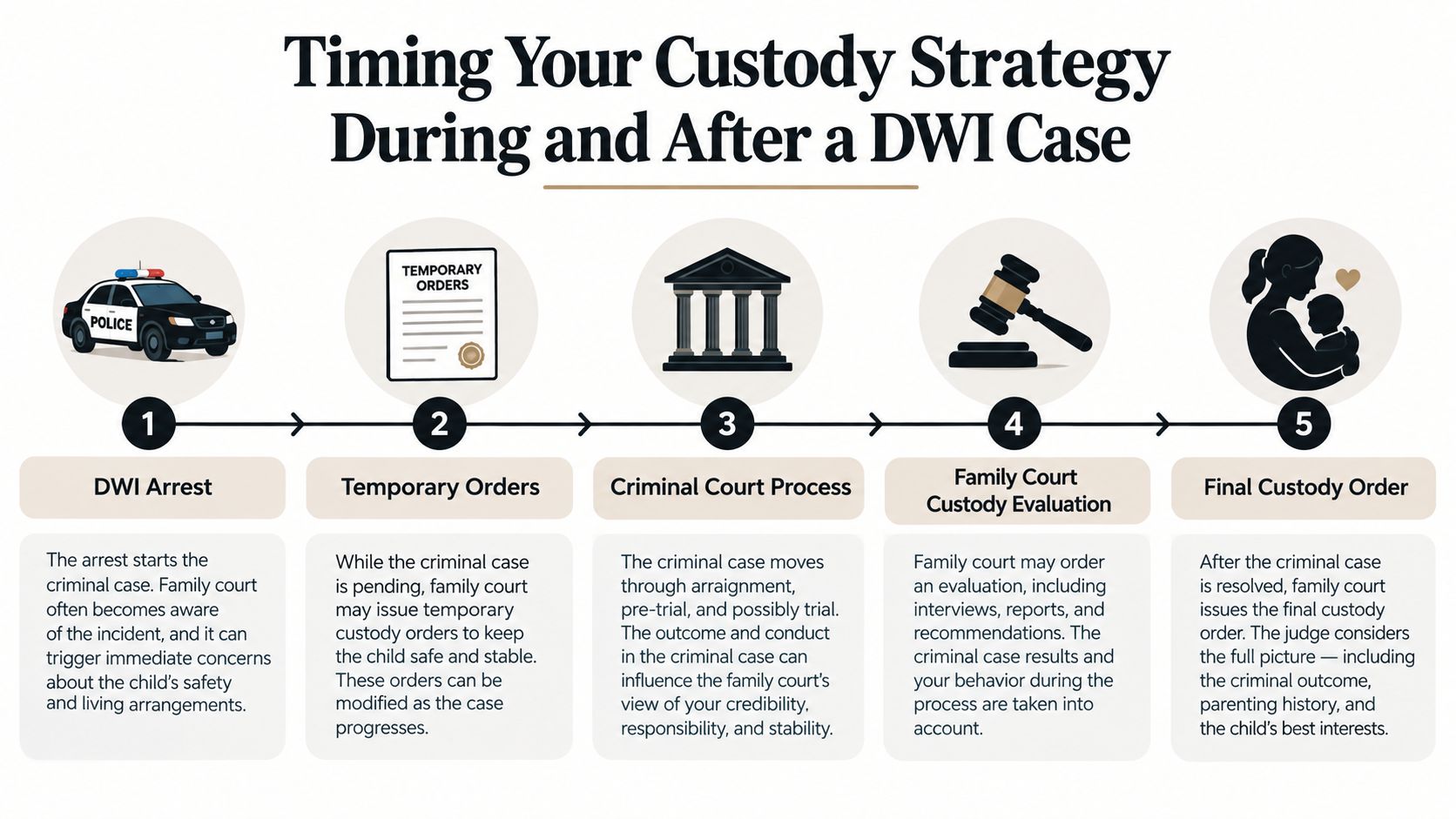
Timing Your Custody Strategy During and After a DWI Case
The criminal case and custody case can move on different schedules. A parent may still be waiting for a criminal court outcome while the other parent asks the family court for immediate restrictions. That's why waiting for a conviction, dismissal, or final plea result can leave a parent unprepared for temporary custody proceedings.
Start with the current order
Read your existing possession schedule carefully. Don't unilaterally deny court-ordered parenting time unless an immediate safety emergency and appropriate legal action support that decision. At the same time, don't agree to informal changes that could create confusion about your rights or expose the child to avoidable risk.
If the other parent files for emergency or temporary relief, respond promptly. The court may use temporary orders to require supervision, testing, sober exchanges, or other conditions while the underlying facts are developed.
Prepare evidence before the hearing
Gather the documents that explain both the incident and your response:
- Criminal records: Include the arrest information, charging documents, bond conditions, and any available disposition records.
- Safety materials: Identify whether the child was present, who transported the child, and what safeguards are now available.
- Compliance proof: Collect evaluations, treatment records, testing results, ignition interlock compliance, and completed requirements.
- Parenting evidence: Organize records showing stable involvement in the child's education, healthcare, activities, and daily routine.
- Communication history: Preserve respectful messages with the other parent, especially those showing efforts to coordinate safely.
A child's presence can also create a CPS concern. Texas legislative materials reported substance-use concerns in 43% of CPS investigations, 75% of family preservation cases, and 66% of removals in 2015, rising to 68% in 2017. DFPS reporting found parental substance abuse was a contributing factor in 66% of children removed from home in fiscal year 2019. These figures come from the Texas DWI and child-custody discussion, and they help explain why a DWI involving a child may be treated as a child-safety escalation rather than a routine traffic matter.
Coordinate carefully with both your criminal defense attorney and family lawyer. Don't discuss the facts casually with the other parent, CPS, or investigators without understanding the legal consequences.
Moving Forward With Confidence and Legal Support
A DWI is serious, but it doesn't have to define your future as a parent. Texas courts focus on the child's best interest, and they can use graduated safeguards that protect the child while preserving a safe parent-child relationship. The strongest response combines honest legal advice, consistent compliance, documented sobriety efforts, and a practical parenting plan.
The most important distinction is between an isolated incident and evidence of continuing risk. A child passenger younger than 15, repeated conduct, or serious intoxication-related harm can substantially increase custody exposure. Prompt action gives you a better opportunity to address the court's concerns before temporary restrictions become long-term arrangements.
If you need help navigating divorce, custody, or estate planning in Texas, contact The Law Office of Bryan Fagan today for a free consultation.
The Law Office of Bryan Fagan, PLLC can help you evaluate a DWI's effect on conservatorship, possession, visitation, temporary orders, and child support while coordinating the family-law strategy with your criminal case. Schedule a confidential consultation by visiting Law Office of Bryan Fagan, PLLC, so you can protect your parental rights and your child's safety with a plan suited to your circumstances.


