 Skip to content

You're looking at your divorce decree, a stack of bills, and a proposed bankruptcy payment, wondering whether you'll still owe your former spouse when the case ends. That uncertainty is understandable. A family-law judgment can combine child support, property payments, attorney's fees, and obligations involving your home, but bankruptcy doesn't treat them all alike.
Understanding how a Chapter 13 plan treats a Texas family law judgment starts with reading each obligation separately. The decree's wording matters, but so does what the payment accomplishes. A bankruptcy court looks beyond a label to decide whether an obligation provides support, divides property, or creates a secured claim.
Where Each Part of a Texas Judgment Lands in Chapter 13
Say your decree requires monthly child support, repayment of overdue maintenance, and an equalization payment for your former spouse's share of the marital estate. You may think of those amounts as one divorce debt. The bankruptcy court won't necessarily classify them together.
The starting point is the distinction between domestic support obligations, property-division debts, and secured claims. Under 11 U.S.C. § 507(a)(1), qualifying allowed unsecured domestic support claims receive first priority among unsecured priority claims.
Chapter 13 treatment of Texas judgment components
| Judgment component | Chapter 13 classification | Plan treatment | Survives discharge? |
|---|---|---|---|
| Past-due child support | Domestic support obligation with first priority | Generally paid in full through the plan before general unsecured creditors | Yes |
| Current child support after filing | Post-petition domestic support obligation | Generally paid directly to the recipient, outside the plan | Yes; must be current for confirmation and discharge |
| Spousal maintenance in the nature of support | Domestic support obligation when its function is support | Arrears paid through the plan with priority | Yes |
| Property equalization payment | Property-division debt, not support | Scheduled plan distributions or general unsecured treatment, subject to any security | Often dischargeable after successful plan completion and entry of discharge |
| Attorney's fees awarded in the divorce | Domestic support obligation if actually in the nature of support, including qualifying support-enforcement fees; otherwise a non-support debt | Priority if a support obligation; otherwise ordinarily general unsecured unless secured | Yes if support; otherwise often dischargeable |
| Judgment lien recorded against real estate | Secured claim to the extent a valid lien attaches to property | Address the secured claim through permitted plan treatment or seek appropriate lien relief | Lien generally survives unless avoided or otherwise legally extinguished |
Read the function, not just the heading
A decree's property-division heading doesn't conclusively establish that every payment beneath it is a property debt. The bankruptcy court may examine the payment's purpose, the parties' financial circumstances, and its economic effect.
The Bussiere bankruptcy decision explains the substance-based classification issue and the discharge exception for domestic support obligations under 11 U.S.C. §§ 523(a)(5) and 1328(a)(2). That distinction matters when a payment described as property division serves a maintenance function.
Attorney's fees deserve particular attention. Fees connected to support enforcement can receive different treatment from fees connected solely to dividing assets, and an award payable to an attorney still needs a functional analysis.
Practical rule: Don't classify an entire decree from its title. Classify each obligation from its language, purpose, and supporting facts.
Property debts also require a separate question: is the obligation unsecured, or does a valid lien secure it? Discharging personal liability and removing a lien are different legal outcomes.
Pull your signed decree and label every money obligation before making assumptions about your bankruptcy payment. This guide to reading your Texas family court order can help you identify operative provisions rather than relying on a summary or an informal understanding with your former spouse.
How to Build a Plan That Pays Support and Avoids Costly Slips
Order matters more than speed. A rushed filing based on an estimated support balance can produce a plan that looks affordable but doesn't address the actual judgment.
The Chapter 13 provisions of the Bankruptcy Code generally require full payment of priority claims through deferred cash payments unless the claimant agrees to different treatment, require post-filing support compliance for confirmation, and condition discharge on the required support-payment certification. Those are separate requirements, not interchangeable ways to satisfy the same obligation.
Assemble the records before proposing payments
Use this records-first process to organize the obligations before counsel prepares the plan.
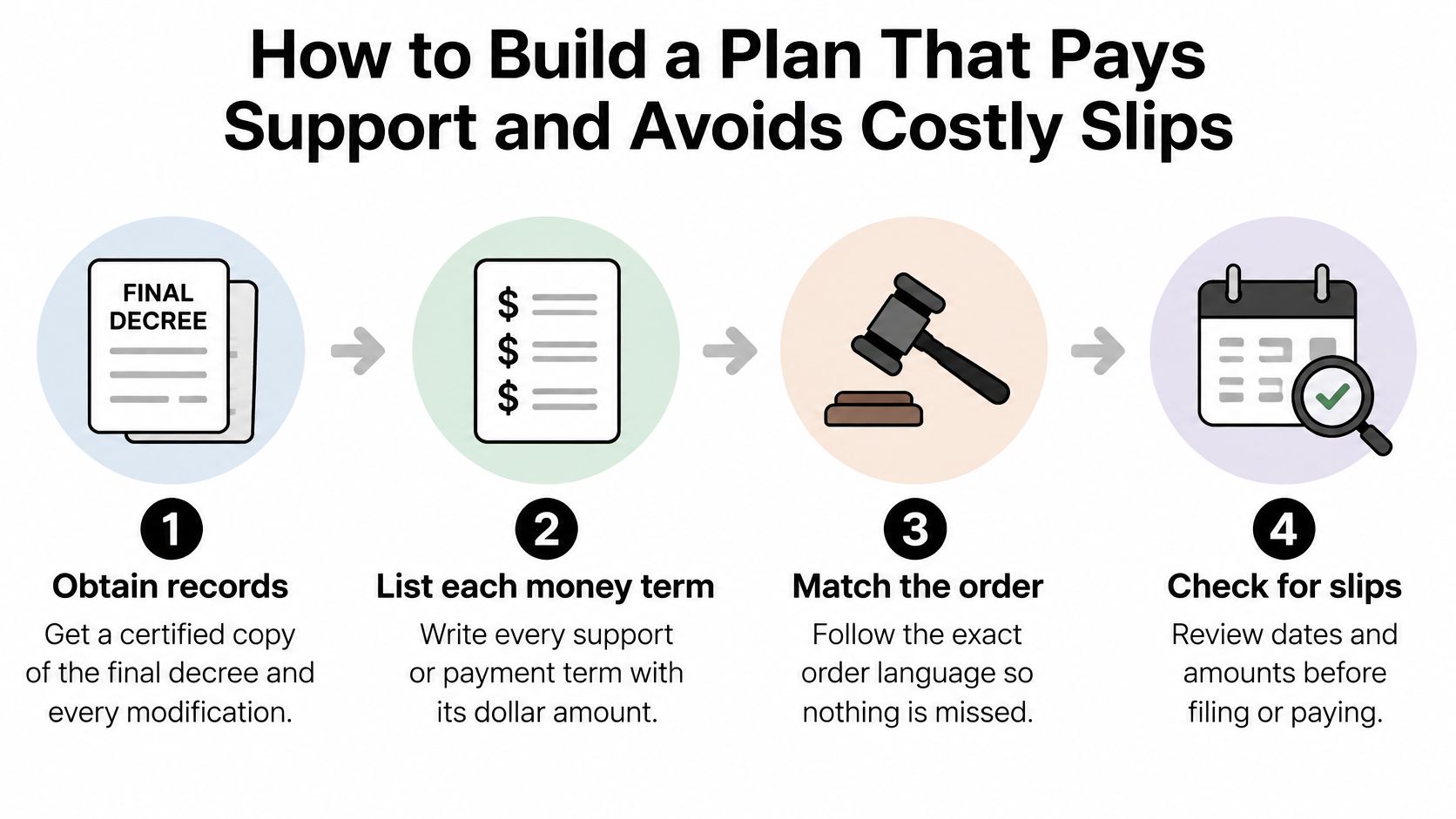
Obtain the signed orders. Get a certified copy of the final decree and every modification, then list each payment term and its dollar amount. A settlement summary, email, or recollection of the hearing isn't a substitute for the operative order.
Reconcile the arrearage. Request a current statement from the Texas Attorney General's Child Support Division or the person entitled to payment. Compare it with withholding records, bank statements, and receipts, and identify disputed credits rather than trusting memory.
Separate arrears from ongoing support. Identify what was due before filing and what becomes due afterward. The common mistake is assuming the trustee payment covers the current monthly obligation when the plan requires direct payment.
Test the budget against actual income. Include current support, the proposed trustee payment, housing, transportation, insurance, and ordinary household expenses. If the budget works only when overtime is unusually high or no unexpected expense occurs, counsel needs to address feasibility before proposing it.
Prepare a clearly classified proof of claim. The creditor should separate support, property, fees, and related amounts, with supporting orders and calculations. The debtor's counsel should review the claim rather than assuming the creditor's characterization controls.
Check compliance before confirmation. Make sure the plan expressly addresses the support obligation and that post-filing payments are current. A missed current installment can create a confirmation problem even when trustee payments are up to date.
Preserve proof through discharge. Keep evidence of every direct payment and obtain a final account reconciliation before signing the required certification. Don't certify payment based solely on the fact that the last trustee payment cleared.
For an account with disputed credits or missed payments, organizing child-support arrears and back-payment records helps counsel distinguish a calculation problem from an actual payment shortfall.
Correct the mistakes a payment schedule won't catch
A workable payment amount doesn't cure incomplete disclosures or incorrect claim classifications. Review these issues before filing:
- Missing former spouse. Include the former spouse in the appropriate schedules and creditor matrix even if you dispute the balance. Mark a disputed claim appropriately rather than omitting it.
- Misclassified fees or equalization payments. Match each amount to the decree provision and its actual purpose. Calling everything support can overstate priority; calling everything property division can understate it.
- Unaddressed support interest. Reconcile interest separately instead of using principal alone. The Southern District of Texas's bankruptcy and family-law materials discuss a decision requiring treatment of interest connected to a domestic support obligation even when unsecured creditors weren't paid in full.
- Unmatched payment records. Track the month each payment satisfies and whether it was direct, withheld, or distributed by the trustee. That makes duplicate charges and missing credits easier to resolve.
Finishing trustee payments isn't proof that every support installment has been paid.
An unpaid current installment can still prevent discharge. Most avoidable problems begin with an incorrect balance, an unrealistic budget, or a missing document, so a careful prefiling review is usually more useful than trying to repair the record at the end.
Property Division Judgments and the Two-Year Enforcement Clock
Texas law sets a short window for enforcing certain property awards. A suit to enforce a division of tangible personal property that existed when the decree was entered must be filed before the second anniversary of the decree's signing or its finality after appeal, whichever is later, under Texas Family Code Chapter 9.
A bankruptcy filing does not automatically stop or restart that state-law deadline. The stay, any applicable extension, and the proper forum must be assessed before enforcement action is taken.
An award of furniture isn't the same as a money award
Texas Family Code § 7.001 directs a divorce court to divide the marital estate in a manner it considers just and right, taking the spouses' and children's rights into account, as stated in the Texas property-division statute. The decree's remedy matters: an order awarding specific furniture may require delivery, while an order requiring payment of its value creates a monetary obligation with potentially different bankruptcy treatment.
Property Division can involve community property, debts, and complex assets. For bankruptcy purposes, identify exactly what the decree awards, who must act, and whether the obligation is secured.
Key deadlines for Texas judgments in a Chapter 13 case
| Deadline or limit | Rule | Source |
|---|---|---|
| Enforcing a division of tangible personal property | File before the second anniversary of decree signing or finality after appeal, whichever is later | Texas Family Code Chapter 9 |
| Proof of claim in Chapter 13 | Generally 70 days after the petition date for a nongovernmental creditor in a voluntary case; exceptions require review | Federal Rule of Bankruptcy Procedure 3002(c) |
| Chapter 13 plan length | Three years generally; five years applies when the debtor's current monthly income, multiplied by 12, is greater than the applicable state median family income | 11 U.S.C. § 1322(d) |
| Current post-petition support | Must be current before confirmation and discharge, with the required certification | Chapter 13 confirmation and discharge requirements |
Calendar the proof-of-claim deadline from the bankruptcy notice, not a general estimate.
Gather the records that establish the award and any failure to comply:
- Court documents. Final decree, modifications, and prior enforcement pleadings.
- Property evidence. Inventories, receipts, photographs, and valuations identifying the awarded items.
- Performance records. Payment records and correspondence about delivery, access, transfers, or refusal to comply.
If you are owed property, ask counsel promptly whether to file a claim, seek permission for enforcement, or pursue another permitted remedy. Waiting for the bankruptcy case to end may leave fewer options.
Judgment Liens, Your Homestead and Secured Claims
Your county records help determine whether a judgment is a lien on your house. In Texas, a properly abstracted and recorded judgment can attach to nonexempt real property in the county where it is recorded, subject to applicable legal requirements. The decree's wording and the title history matter because a divorce judgment does not automatically encumber every home.

Work through the title facts
A property-equalization award and a recorded abstract involving a Houston home do not, by themselves, establish a valid lien, the amount secured, or whether the lien can be removed. Those questions depend on the recorded documents, ownership, homestead status, value, and competing liens.
Review:
- Recording documents. Obtain the abstract, recording dates, legal description, and any release from the county real-property records.
- Ownership and homestead. Establish when the debtor acquired the property and whether it qualifies for homestead protection.
- Value and competing liens. Compare a defensible property valuation with mortgage payoff statements and other encumbrances.
- Available relief. Determine whether the claim requires secured treatment, whether the lien attached, or whether a motion to avoid it is appropriate.
A secured claim generally receives treatment based on the creditor's enforceable interest in the collateral. A valid secured claim should not be treated as ordinary unsecured debt solely because it arose from a divorce.
Homestead protection requires a separate analysis
Texas constitutional and Property Code protections can limit whether a judgment lien reaches a homestead. The debt's nature also matters, particularly when the decree creates an interest connected to dividing the property.
A debtor may seek to avoid a qualifying judicial lien that impairs an exemption under the Bankruptcy Code. A divorce-related lien is not automatically avoidable. How and when the debtor acquired the property interest can affect the result.
This video provides additional context for reviewing the overlap between the judgment and bankruptcy.
Before signing: Have counsel review the decree and title documents together. A clean payment history does not establish clear title.
Pull the abstract from the county clerk's records and compare its recording date with the bankruptcy petition date. That review can help counsel assess the lien's status before you file, refinance, sell, or make promises about what bankruptcy will remove.
What Keeps Running During the Case and What Gets Discharged
A Chapter 13 filing can pause some collection efforts while support withholding and family-court proceedings continue. The automatic stay has exceptions for matters such as establishing or modifying support and deciding custody. It also permits income withholding for domestic support obligations, so a filing alone does not authorize a debtor to tell an employer to stop deductions.
During the case versus at discharge
During the case, each proposed enforcement step needs to be checked against the stay. It may fall within an exception, require relief from the stay, or remain prohibited. Follow the support orders and confirmed plan while that question is resolved.
For example, wage withholding and trustee distributions may both appear on a support account. Compare each payment with the order and plan to determine which obligation it satisfies. Ask counsel to resolve any apparent overlap before requesting a change to withholding.
The Northern District of Texas Chapter 13 guidelines address administrative support requirements, including claimant information and certification. Add the certification deadline to the case calendar and reconcile the support account before submitting discharge paperwork.
The infographic highlights the practical distinction: a stay may pause some collection while support payments, withholding, or permitted family-court proceedings continue.

Keep the case and support account aligned
- Identify the applicable exception. Ask counsel to assess the specific action, such as withholding, a modification hearing, or collection against property.
- Verify withholding instructions. Compare payroll deductions with the support order and plan before requesting any change.
- Maintain a payment log. Record the date, method, recipient, and obligation credited for each payment.
- Confirm creditor disclosure. Check that the former spouse receives required bankruptcy notices, including when the claim is disputed.
The Texas divorce-enforcement framework preserves the rendering court's role in enforcing property division, subject to bankruptcy restrictions. A family-court filing is not automatically permitted just because it concerns a divorce decree.
A discharge does not end support that continues to come due. Keep paying under the operative order unless a court with authority changes it.
Confirm Your Judgment's Classification Before You File
Financial pressure can make filing quickly feel like the only available choice. A better decision begins with knowing which obligations bankruptcy can address and whether the current support order remains workable.
Use the records-first steps to prepare a classified obligation list, then compare the ongoing support amount with your present income. If your income has changed, ask whether a modification is legally appropriate rather than reducing payments yourself.
Decide whether modification belongs in the strategy
Custody and Support Modifications address changes to existing custody, visitation, and support orders. A bankruptcy payment proposal doesn't itself modify the family-court support order, and a private agreement shouldn't be treated as a replacement for a signed modification.
Child Support matters include establishment, modification, and enforcement of Texas child support. The consultation should distinguish a request to change future payments from a dispute about the existing arrearage.
Bring the organized decree file, payment reconciliation, arrearage statement, county lien search, and current budget. Identify the immediate decision you need help making:
- Affordability. Can you maintain current support and fund the proposed plan?
- Timing. Would filing before or after another family-court step change the practical strategy?
- Property exposure. Does a recorded lien require separate bankruptcy relief?
The discussion of bankruptcy before or after a Texas divorce can help you prepare timing questions for counsel. For additional background on collateral-based obligations, Morgan & Morgan Attorneys at Law P.C.’s explanation of how Chapter 13 handles secured debts provides context for the bankruptcy side of that conversation.
Law Office of Bryan Fagan, PLLC offers Texas family-law guidance on divorce judgments, support, modifications, and property enforcement, helping you identify issues to coordinate with bankruptcy counsel. If you need help navigating divorce, custody, or estate planning in Texas, contact The Law Office of Bryan Fagan today for a free consultation.


