Skip to content

When temporary orders, custody, property values, or discovery remain unresolved, each can affect how long a contested divorce takes. The 60-day waiting period under Texas law is a starting gate, not a finish line. In the planning ranges used here, a typical contested case takes about 6 to 12 months; a simpler case may take 4 to 6 months, while a complex case may take 12 to 18 months or longer. These are estimates, not promised completion dates.
If you're deciding who pays the mortgage, where your children will live, or how long you'll maintain separate households, begin by listing the disputes. The evidence, negotiations, and court orders needed to resolve them will shape the schedule.
Typical Contested Divorce Timelines at a Glance
A missed agreement over one financial issue can require document exchange and negotiation. Disputes involving parenting, business value, or the court's schedule call for different planning. The table shows how the work involved shapes a typical timeline.
Contested divorce timelines in Texas by case type
| Case Scenario | Typical Timeline | What Drives the Pace |
|---|---|---|
| Statutory minimum for any Texas divorce, subject to limited exceptions | 60 days from filing | Texas Family Code § 6.702 generally prevents an earlier divorce |
| Simple contested case that settles after early document exchange | About 4 to 6 months | Few disputed issues and quick agreement |
| Moderate contested case with custody or property disputes resolved in mediation | About 6 to 12 months | Mediation scheduling and temporary orders |
| Complex contested case with business valuation, custody evaluation, or trial | 12 to 18 months or more | Expert reports, discovery disputes, and the court calendar |
What the Court Statistics Measure, and What They Don't
The Texas Judicial Branch's Family Justice Initiative report reported that 75% of contested family-law cases were disposed of within 12 months, compared with 8 months for uncontested cases. It also identified model standards recommending disposition of 75% of divorce cases within 4 months, excluding mandatory statutory waiting periods. The report's observed figures describe case outcomes; its model standards set court-management goals.
Disposed means resolved through agreement, dismissal, or trial. The term covers different outcomes, including cases that end without a judge hearing evidence. A dismissal does not itself dissolve a marriage.
A scholarly analysis of contested divorce reported an average duration of 563 days, roughly 18.5 months. That broader finding is not a Texas-specific forecast. It illustrates why an average can differ from a case-specific planning estimate.
Use the row that best matches the disputed issues, then account for the work likely to drive the schedule. Temporary orders, discovery, custody questions, and valuation can require different steps and timing. The 60-day statutory period is a starting gate, not a completion target.
Planning rule: Build your budget around the work your case requires, not the earliest date you hope it will end.
Telling a Simple Case From a Complex One
A divorce can feel emotionally complicated without requiring extensive litigation. Conversely, spouses who communicate politely may still need expert help to divide a professional practice or identify separate property.
Start by checking the facts, not the level of frustration.
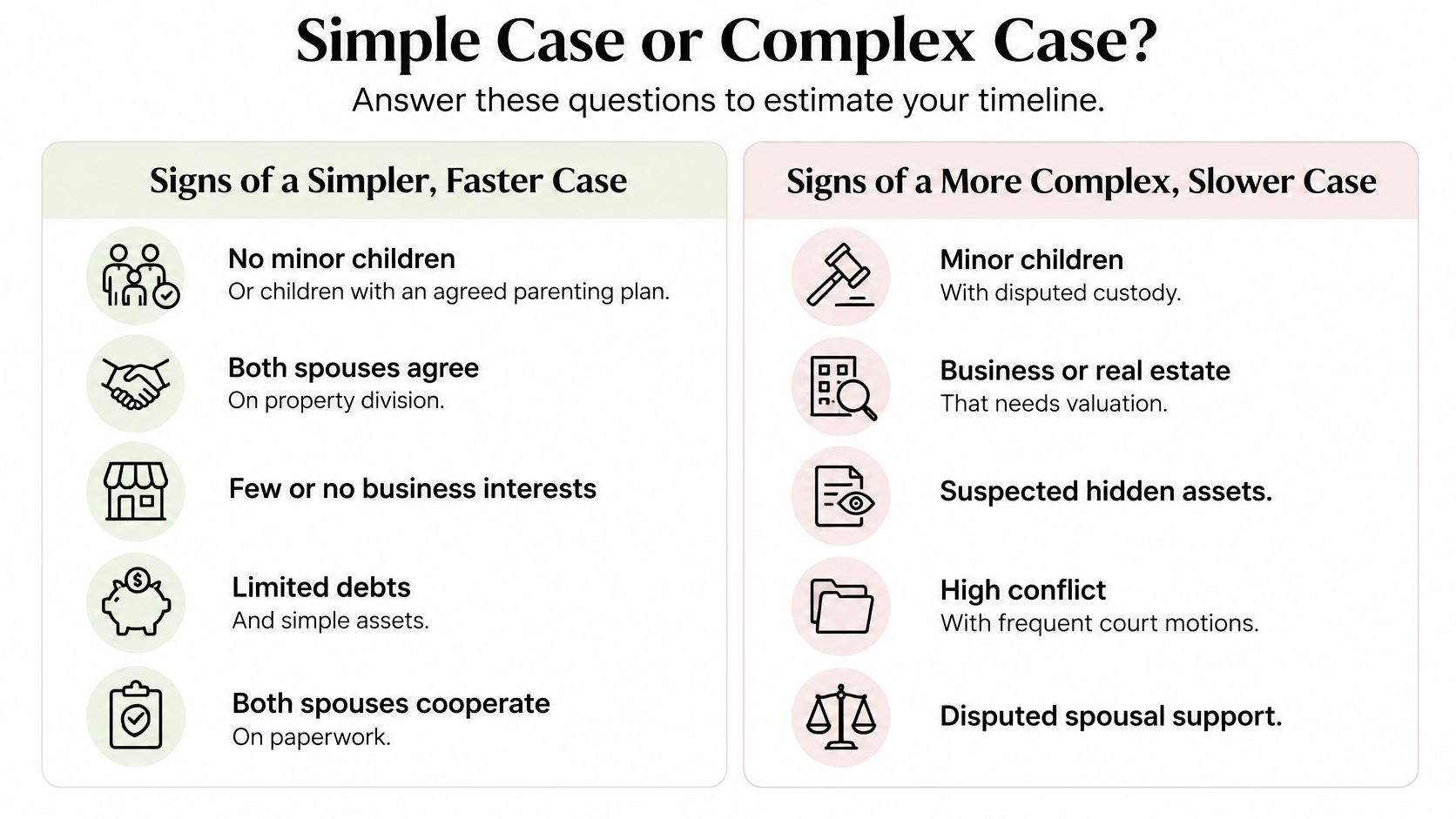
Signs of a Simpler, Faster Case
- Parenting is settled: You have no minor children, or you both accept a workable parenting plan.
- Property is mostly agreed: You agree on the major assets and debts, with no business valuation, pension dispute, or separate-property tracing.
- Records are available: Both spouses willingly share complete financial documents.
- Safety isn't disputed: There are no family-violence allegations or protective-order proceedings.
- Jurisdiction is straightforward: Both spouses live in Texas, without military or interstate complications.
Signs of a More Complex, Longer Case
- Parenting remains contested: You disagree about conservatorship, possession, or restrictions on contact.
- Assets require investigation: A business, professional practice, or substantial investment or retirement account needs analysis.
- Ownership or support is disputed: Separate-property claims or spousal-maintenance questions require evidence.
- Disclosure is unreliable: Assets appear hidden, records conflict, or your spouse responds slowly.
- Safety requires court intervention: A pending protective order affects how negotiations and hearings should proceed.
Most families fall somewhere between these groups. One difficult issue can determine the entire schedule, even when everything else is agreed.
Say spouses have a house and children, and they already agree on a parenting schedule and how to handle the home. Their remaining disagreement may be suitable for early settlement. Add a disputed medical practice, and they may need business records, an appropriate valuation, and a defensible plan for allocating the marital interest.
Write down the items that apply to you. Bring that list to your attorney so the timeline reflects your actual legal and financial needs.
Why the 60-Day Waiting Period Is Only the Starting Line
Say you file on January 1 and circle early March on your calendar. The example illustrates the waiting-period calculation, not a promised finish date: Texas Family Code § 6.702 generally prohibits granting a divorce before the 60th day after the original petition is filed, so the waiting period may expire around March 2, depending on the calendar.
If you still disagree about who keeps the home or which possession schedule serves your children, expiration of the waiting period doesn't resolve either issue. The court still needs an agreement it can approve or evidence supporting a decision.
Separate Permission to Finalize From Readiness to Finalize
Apply the statute in this order:
- Identify the filing date. The original petition starts the statutory waiting period.
- Check whether an exception applies. An attorney should evaluate qualifying family-violence circumstances rather than assume an exception exists.
- Assess the unresolved issues. Determine what information, negotiations, and hearings remain necessary.
- Prepare the final orders. A calendar date alone doesn't produce an enforceable property division or parenting arrangement.
The statute permits limited exceptions involving a qualifying family-violence conviction or deferred adjudication, or an active qualifying protective or emergency-protection order relating to family violence during the marriage. Those exceptions are specific; allegations alone don't automatically eliminate the waiting period.
Safety concerns deserve prompt attention, regardless of when the divorce might become final. Tell your attorney about threats, existing orders, access to weapons, or concerns about exchanging the children so protective measures can be evaluated.
You also don't have to leave every practical problem unresolved while waiting. Your attorney can assess what interim relief is appropriate and what preparation can proceed.
The waiting period controls when the court may grant the divorce. Resolving the disputed issues determines when your case is ready.
How a Contested Case Moves From Filing to Final Hearing
A divorce can be filed and still be far from trial-ready. Service, temporary arrangements, financial records, settlement discussions, and the court's schedule each affect when the judge can resolve the remaining disputes. Some work can happen at the same time, so focus on what is holding up the next decision.
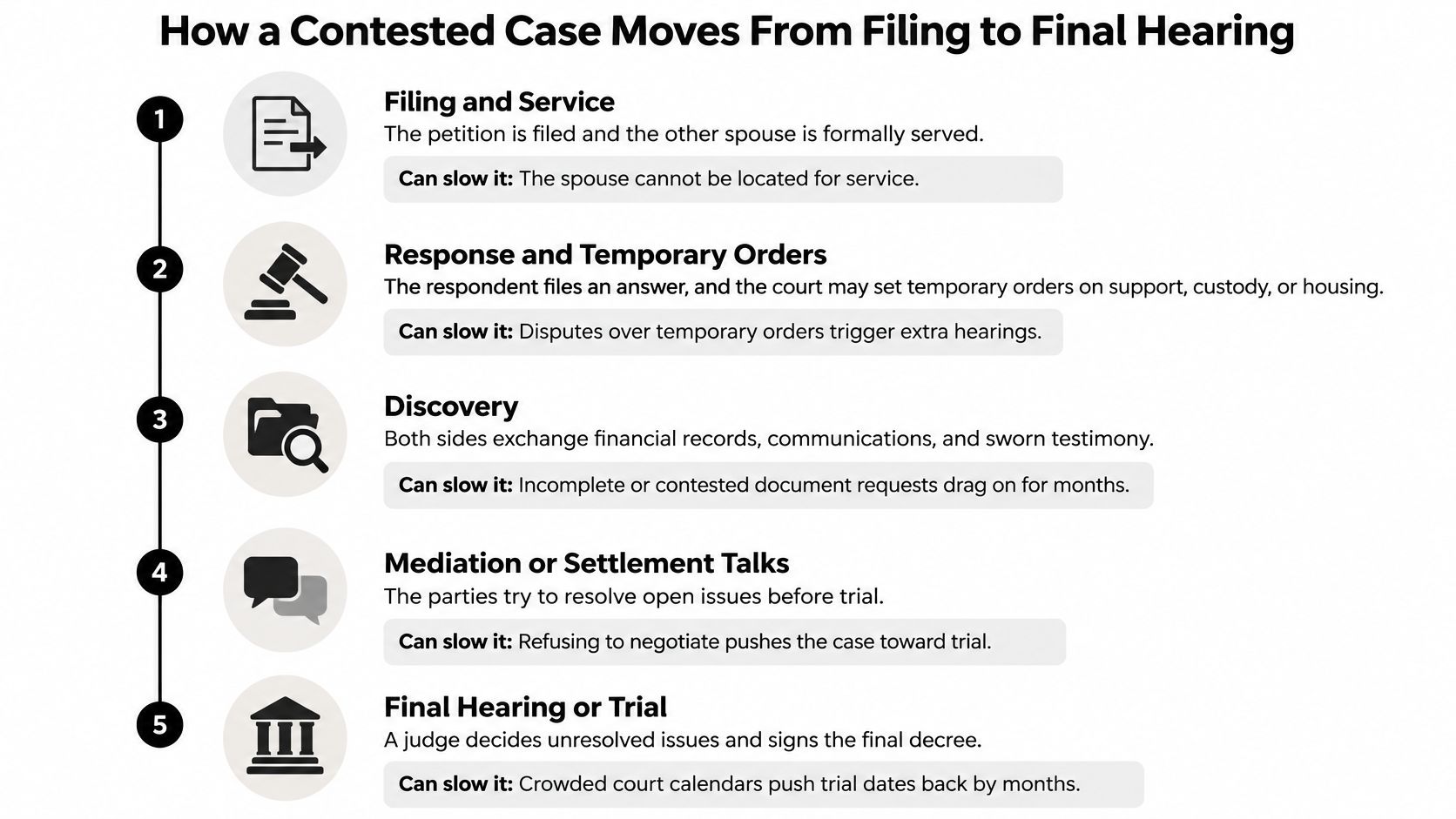
From Petition to Trial Readiness
The first phase establishes the case and addresses immediate needs. One spouse files the petition, then formally serves the other unless an appropriate alternative applies. An incorrect address, trouble locating the spouse, or a dispute about service can hold up the case. The responding spouse can file an answer to participate. If that spouse answers but won't sign the proposed decree, the case needs preparation for contested proceedings unless the parties later agree.
Temporary orders may address the home, bills, parenting, support, or restrictions on transferring property. If the spouses disagree about urgent arrangements, a hearing may be needed before they are ready to resolve permanent terms.
Next comes building a reliable record. Through discovery, both sides request and exchange financial records and parenting information, and may use depositions when appropriate. Missing statements, incomplete responses, and disputes over requests can leave the parties without enough information to negotiate. Mediation or settlement discussions may resolve some or all issues, but negotiating before key financial details are clear can mean more discussions later.
From Trial Setting to Signed Decree
Before requesting a trial setting, counsel should be ready to present the unresolved issues, the evidence supporting each position, and the witnesses or records needed to prove them. The Texas Law Help divorce guide notes that an answering spouse must receive at least 45 days' notice of a contested final hearing. At trial, the judge decides the issues the spouses have not resolved. What happens at a final trial in a Texas family court explains the preparation and courtroom process.
After the hearing, the judge signs the final decree. The case is not complete until the written orders accurately state the court's rulings. Disputes over proposed wording can delay that step, so preparing precise language matters.
Court Targets Aren't Guaranteed Finish Dates
Texas court-management standards set a target of disposing of contested family-law cases within 6 months from the appearance date or expiration of the statutory waiting period, whichever is later. That target is a scheduling benchmark, not a promised finish date. The specific unresolved tasks, such as discovery or settlement, and the court's availability determine whether the case is ready to proceed.
This video provides additional context for understanding the process.
Important distinction: A case-management target guides scheduling. It doesn't guarantee that discovery, settlement, or trial will be completed by that date.
What Adds Months to a Contested Divorce
A contested divorce can run long when one unresolved task blocks the next decision. An unanswered records request may delay a business valuation, leaving the parties without information for mediation and pushing the case toward a trial setting.
The added-time figures below are illustrative practice-based planning estimates, not statewide measured averages or fixed deadlines. They are not automatically cumulative because some tasks can proceed at the same time.
Factors that extend a contested divorce and typical added time
| Delay Factor | What Causes It | Typical Added Time |
|---|---|---|
| Discovery disputes | Missing records, objections, and motions to compel | Planning estimate of 1 to 3 months |
| Child custody evaluation | Evaluator interviews, home visits, and reports | Planning estimate of 3 to 6 months |
| Business or asset valuation | Appraisers or forensic accountants preparing reports | Planning estimate of 2 to 6 months |
| Temporary orders hearings | Interim possession, support, or property restrictions | Planning estimate of 2 to 6 weeks per hearing |
| Contested final hearing notice | Required notice to the responding spouse | At least 45 days, potentially overlapping other preparation |
| Court docket congestion | Trial availability on the county court calendar | Potentially several months |
Identify the Task That Controls Completion
Consider a couple with a family dental practice and children whose parenting arrangements are disputed. Their attorneys arrange the business valuation and custody evaluation to proceed in parallel, but missing business records and evaluator scheduling still push the case past the year mark. Starting both processes together saves time only if each has the information and access it needs.
The unfinished task that blocks the next decision controls the schedule. If a valuation expert is waiting for the practice's tax returns, collecting unrelated household receipts will not resolve the delay. Ask for a specific list of missing business records and assign responsibility for obtaining each item. A request for tax returns that goes unanswered may postpone the valuation report, which in turn can leave property negotiations without a reliable basis.

Keep Daily Life Stable Without Repeated Hearings
Texas Law Help's family-case guidance explains that temporary orders can remain in effect until final orders are entered. They establish interim arrangements during the case, but do not resolve every permanent issue.
A request to change temporary arrangements takes preparation and a place on the court's calendar. Before asking for another hearing, consider whether the issue calls for immediate judicial intervention or can be addressed through a documented agreement. Repeated hearings can consume time needed to prepare other issues for settlement or trial.
For formal discovery, guidance on responding to discovery requests in a Texas family case explains the response process. Do not delete messages, alter records, or provide incomplete information because a request feels intrusive. Raise objections through counsel while preserving the underlying material.
Strategies That Shorten a Contested Divorce
Mediation is often the first settlement tool to evaluate, provided the parties can negotiate safely and have enough information to make informed decisions. A neutral mediator helps identify workable compromises but doesn't decide the case or replace your attorney.
The fastest acceptable outcome isn't just the earliest signature. It's an agreement that protects your interests and can be implemented without predictable disputes.
A structured discussion can be more productive than repeated informal arguments.

Use the Right Agreement for the Job
Texas Family Code § 6.602 provides a framework for binding mediated settlement agreements in divorce cases. The agreement must satisfy statutory requirements, including required signatures and a prominently displayed statement that it isn't subject to revocation; not every signed mediation document automatically qualifies.
Where children are involved, additional family-law provisions and statutory exceptions may affect enforcement. Review the actual terms with counsel before signing, particularly provisions addressing parenting, property transfers, taxes, or payment obligations.
A Rule 11 agreement, governed by Texas Rule of Civil Procedure 11, can document agreements concerning a pending case and narrow what the court must decide. Its formal requirements matter: calling an informal exchange an agreement doesn't necessarily make it enforceable.
Collaborative divorce under Chapter 15 of the Texas Family Code offers a structured process in which spouses and their collaborative attorneys commit to pursuing resolution without contested litigation. It works best when both spouses accept candid disclosure and cooperative problem-solving; termination can require new litigation counsel, creating a significant trade-off.
Match the Tool to the Obstacle
Settlement tools that can shorten a contested divorce
| Tool | What It Does | Effect on Timeline |
|---|---|---|
| Early mediation | A neutral mediator helps spouses resolve disputed issues before trial | Can eliminate trial preparation and the wait for a trial setting |
| Agreed temporary orders | Establishes interim possession, support, and property arrangements by agreement | Reduces contested temporary hearings |
| Focused discovery schedule | Sets agreed deadlines for financial and parenting exchanges | Helps prevent motion delays and continuances |
Schedule mediation around readiness, not optimism. If the dispute concerns a business, exchange the essential valuation information first; if parenting is disputed, prepare concrete proposals addressing school, transportation, holidays, and communication.
The firm's explanation of what a Texas family-law mediator can and cannot do can help you prepare realistic expectations.
Cooperation also has limits. If a spouse conceals assets, ignores orders, or refuses meaningful negotiation, focused court action may be more effective than another unproductive settlement meeting.
The firm's Contested Divorce service provides advocacy when spouses disagree on key terms, while its Divorce representation includes contested, uncontested, and high-conflict cases. Discuss whether your immediate need is mediation preparation, enforcement of disclosure obligations, or trial readiness rather than assuming every case needs the same approach.
Confirm Your Timeline and Schedule a Free Consultation
At a first consultation, an attorney needs to know what remains disputed, what information is missing, and what is pressing. Those details help turn a broad timeline estimate into a practical next step.
Take These Steps Now
Identify your likely track. List the unresolved parenting, property, support, and safety issues. Separate points that may be negotiated from those that need more information, expert analysis, or a judge's decision.
Note what has already been filed and served. Keep the signed petition and citation, and record the service date. If you have been served, a written answer is generally due by 10:00 a.m. on the Monday after the 20-day period expires. Texas Family Code § 6.702 sets the 60-day waiting period before a divorce may be finalized, not the answer deadline. Have counsel verify your answer deadline using the citation and service date. Keep safety documentation secure, and tell your attorney if sharing information or contacting your spouse could create a risk.
Ask what is holding the case back. A temporary-orders dispute, incomplete discovery, or unresolved custody or valuation issue may call for a different next step. If the case has stalled, ask about court status requirements and the risk of dismissal for want of prosecution. A plan should account for the issue delaying progress.
Bring any existing orders and a concise list of disputed issues to the consultation. An attorney can help assess whether negotiation, targeted discovery, temporary relief, or trial preparation should come next. The 60-day period is a starting gate, not a promised finish date; the court's schedule and the issues still in dispute affect the timeline.
The Law Office of Bryan Fagan, PLLC provides Texas family-law representation, including help assessing disputed issues, preparing for negotiations, and understanding what may affect a divorce timeline. If you can name the issue holding your case back, bring it to a free consultation with the firm.