
If you're served with discovery in a Texas family case, written responses are generally due within 30 days, but the deadline can be 50 days when you're a defendant served before your answer is due. Texas family discovery is deadline-driven under the Texas Rules of Civil Procedure and the Family Code, so start calculating the response date immediately.
You may be staring at a thick packet in a divorce, custody, or property case, wondering whether every question requires an answer and whether producing years of financial records is even possible. That reaction is understandable. Discovery can feel personal, intrusive, and urgent, but a methodical response protects your position far better than a rushed response or silence.
The practical sequence is straightforward: identify the requests, calendar the correct deadline, preserve relevant information, answer what you can, assert specific objections where justified, and address privileged or unavailable material carefully. The rules governing your particular case matter, and a response that looks reasonable at first glance can still create problems if it waives an objection, treats an admission casually, or overlooks a duty to supplement.
Receiving Your Discovery Request – What It Means for You
A client once described receiving discovery as “a box of accusations disguised as questions.” That feeling is common. Interrogatories may ask about income, employment, relationships, or alleged conduct. Requests for production may demand bank records, messages, photographs, calendars, and school information. Requests for admissions can look simple while carrying serious consequences if they're ignored.
Discovery is the formal process for exchanging information relevant to the claims and defenses in your case. In a divorce, that may involve characterization and division of property. In a custody dispute, it may involve parenting facts, communications, school records, or information relevant to the child's best interests. The request isn't a personal conversation, and it shouldn't be answered emotionally.

Start with organization rather than answers
Before drafting anything, make a working copy of the requests and separate them by category. Mark each request with its number, subject, documents involved, and any concern about privilege, relevance, burden, or ambiguity.
A useful first review looks like this:
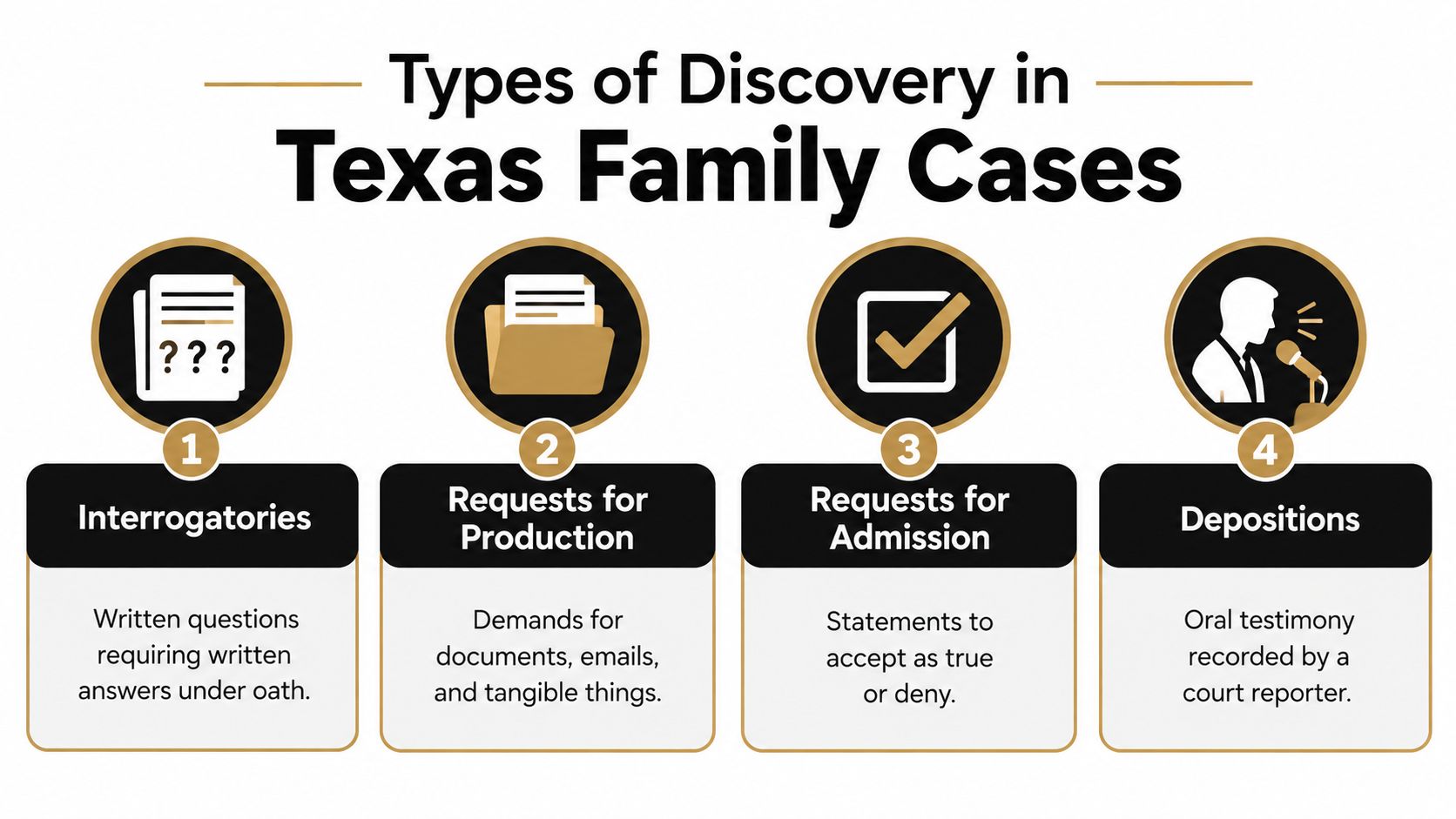
- Interrogatories: Written questions that require written answers, usually under oath.
- Requests for production: Demands for documents, electronically stored information, photographs, records, or tangible items.
- Requests for admissions: Statements you must admit, deny, or explain if you cannot truthfully do either.
- Disclosures: Information the rules or a request may require you to provide, depending on the case and filing date.
Don't begin by deleting messages, moving money, or “cleaning up” your accounts. Preserve potentially relevant records, including texts, emails, cloud files, and social media information. Your attorney can help determine what is relevant and how it should be collected.
Practical rule: Treat every request as a court-related obligation, not as an invitation to tell your entire life story.
Discovery can also reveal where the actual disputes lie. A request for records may expose a property issue, while an admission request may attempt to narrow what must be proved at trial. The right response is neither automatic resistance nor unlimited disclosure. It's a careful answer that protects your rights while meeting your legal obligations.
Understanding the Types of Discovery in Texas Family Cases
Texas family cases use several discovery tools, each designed to obtain a different kind of information. Classifying the request correctly helps you decide whether to answer directly, gather documents, object, or ask counsel to negotiate a narrower response.
Interrogatories
Interrogatories are written questions. They may ask you to identify witnesses, describe your position on property, explain a custody allegation, or provide details about income and expenses. Your answer should be complete and precise based on information reasonably available to you. If a question contains several separate subjects, address each one rather than offering a vague general response.
An interrogatory isn't the place for argument. If the request asks for facts, provide the facts you can provide. If part of the question is improper, your response may need to identify the specific defect and answer the unobjectionable portion.
Requests for production
Requests for production seek supporting material. In a property dispute, that could include account statements, loan records, deeds, tax documents, business records, or communications about assets. In a custody matter, the requests may concern calendars, messages, photographs, medical information, or school communications.
Review documents before producing them. Check for duplicates, unrelated private material, privileged communications, and information belonging to a third party. Don't assume that sending a large unorganized folder demonstrates cooperation. A clear production organized by request number is easier to verify and less likely to generate a dispute.
Requests for admissions
Admissions ask you to admit or deny a specific proposition. They can address ownership, authenticity, dates, communications, or other facts. Read each one carefully. An admission can remove an issue from the case, while an inaccurate denial can undermine credibility.
Disclosures and other tools
Texas family cases may also involve targeted disclosures, depositions, subpoenas, and requests directed to third parties. The discovery method should match the information sought. Oral testimony may be necessary where a written answer is incomplete, while a subpoena may be appropriate for records controlled by a bank, employer, or medical provider.
Marital property agreements can affect the facts a party must analyze in a divorce. The Prenuptial & Postnuptial Agreements service concerns drafting and review of marital property agreements, which may be relevant when discovery involves separate-property or contractual claims.
Calculating Your Response Deadlines Accurately
The most dangerous mistake is assuming every request has the same deadline. In a Texas Family Code case, the general written-response benchmark is 30 days after service, but a defendant served before the answer is due may have 50 days after service to respond. The governing rule is found in the Texas Rules of Civil Procedure, together with the Family Code and the case's discovery-control plan.
Use this deadline process
Identify the date and method of service. Keep the discovery packet, certificate of service, email, envelope, or electronic notice. The service date can control the calculation.
Confirm your procedural position. Determine whether you're the defendant and whether discovery was served before your answer deadline. That fact may trigger the 50-day rule rather than the ordinary 30-day period.
Calendar both the response date and the discovery cutoff. Family Code discovery begins when the suit is filed and continues until 180 days after the first request for discovery of any kind is served on a party. Discovery must be completed 30 days before trial in Family Code cases. These are separate calendar questions, and both can affect strategy.
Check the case papers and court orders. A discovery-control plan or scheduling order may provide additional deadlines or restrictions. Don't rely solely on a general internet summary.
Create an internal earlier deadline. Set a date well before the legal deadline to gather documents, review answers, identify privilege issues, and obtain signatures.
Written discovery responses are generally due within 30 days after service, while the early-service exception gives a defendant 50 days after service. The Texas Bar Practice guidance also explains that a responding party under Rule 194a.2(f) must provide requested information by the later of 30 days after service or the expert-disclosure cutoff tied to the discovery period, which demonstrates why the calendar must be reviewed as a whole.
Missing a deadline can create waiver issues and unnecessary motion practice. Ask for an extension before the deadline, not after it has passed.
The practical stakes arise in every kind of family case. A custody matter involving a CPS investigation may require coordinated work on records and allegations, including issues addressed through Child Protective Services Defense. The response date still needs to be calculated independently and documented carefully.
Drafting Your Responses and Asserting Objections
A legally sufficient response does two things at once. It answers the request to the extent required, and it preserves a valid objection with enough explanation for the other side and the court to understand the issue.
Texas discovery guidance requires objections to be made in writing and within the response period. The objection must state the legal or factual basis and identify the extent to which you refuse compliance. A response such as “overbroad, irrelevant, and burdensome” without explanation often does little to protect you.
Match each response to the request
Use the same numbering as the discovery served. For each request, decide whether to:
- Answer fully.
- Produce the requested material.
- State that responsive material doesn't exist after a reasonable search.
- Object to a defined portion and answer the remainder.
- Withhold privileged material and identify it appropriately.
- Explain why the request is unclear or cannot be answered as written.
An interrogatory asking for all accounts should not receive a bare statement that you have “various accounts.” Identify the information requested, subject to any valid objection. A production request seeking every message about a child may require a discussion of scope, date range, custodians, and privacy concerns rather than an immediate production of an entire phone.
Make objections specific
An overbreadth objection should identify what makes the request excessive and propose a workable limit, such as a relevant subject or time period. A burden objection should explain the burden rather than just announcing that compliance is inconvenient. Relevance objections should connect the request to the claims or defenses pleaded.
Privilege requires special care. Attorney-client communications and attorney work product aren't treated like ordinary documents, but privilege doesn't allow you to conceal underlying facts that happen to be discussed with an attorney. Separate the protected communication from discoverable records and obtain legal advice before producing or withholding anything uncertain.
Responses may need supplementation when information later becomes incomplete or incorrect. That doesn't mean sending every new thought to the other side. It means correcting or adding information when the rules require it, particularly where a prior answer would otherwise mislead.
Questions about custody and visitation may intersect with Grandparent's Rights, which concerns custody and visitation rights for grandparents. The underlying discovery response still must be tied to the actual claims and defenses in the case.
Handling Privileged and Bulky Document Production
Document production becomes manageable when you separate collection, review, and delivery. Mixing those stages leads to accidental disclosure, missing records, and production folders that nobody can audit.
For privilege, preserve the original document and identify the basis for withholding it. A privilege log generally describes the document without revealing the protected substance. It should give the opposing party and the court enough information to evaluate the claim, such as the date, general document type, participants, and asserted protection, while avoiding disclosure of the privileged advice itself.
Compare the disclosure framework
For claims arising under the Family Code on or after September 1, 2023, Rule 194a changed the disclosure structure. Required initial disclosures are no longer mandatory in family cases filed after that date, but parties still must serve discovery under Family Code chapter 301 and supplement responses when later information makes an answer incomplete or incorrect. The Texas legal aid guidance on family-law discovery summarizes this targeted approach.
| Earlier approach | Current practical approach |
|---|---|
| Parties often expected a mandatory initial-disclosure exchange under the older structure. | Parties use targeted discovery, including requests for production, interrogatories, admissions, and Rule 194a requests. |
| The baseline exchange could create a broad early production obligation. | The responding party must track the specific request and the applicable Rule 194a timing. |
| Supplementation remained important when information changed. | Supplementation remains important, even though mandatory initial disclosures are no longer required in qualifying post-change family cases. |
The shift doesn't mean you can withhold relevant information. It means you must understand what was requested, what the rules require, and what the scheduling order permits.
For bulky production, preserve an index of what you collected and where it came from. Use searchable files when possible, remove duplicates carefully, and coordinate with the people who control devices or accounts. If the request is disproportionate or technically difficult, propose a reasonable protocol, staged production, search terms, or protective arrangement. If cooperation fails, counsel may need to seek a protective order.
Next Steps After Responding to Discovery
Serving responses doesn't end the work. Keep a complete copy of what was served, the production set, the transmittal, and proof of service. Store documents in a way that lets you identify which request each file answers.
If the other side files a motion to compel, read the motion and the specific disputed responses rather than treating it as a personal attack. A strong response may involve supplementing a deficient answer, explaining why an objection applies, producing a nonprivileged portion, or asking the court to limit an excessive demand.
Protect the record after production
Continue preserving texts, emails, financial records, photographs, and other potentially relevant information. Don't alter a document after producing it, and don't assume that a later discovery of additional information automatically makes the original response improper. Tell your attorney promptly so the response can be evaluated and supplemented if required.
Depositions may follow written discovery. Review your responses and supporting records before testimony, and make sure your answers remain accurate. Discovery responses can shape settlement discussions because they clarify what each side can prove, where records conflict, and which issues still require testimony.
Ignoring discovery can lead to a motion to compel, sanctions, waived objections, or admissions that don't reflect your position. The safest response is early communication, careful preservation, and a written record of every step.
When to Seek Help from a Texas Family Law Attorney
You don't need to solve a complicated discovery packet alone. Legal help is particularly important when the requests involve a business, separate-property claims, hidden or disputed income, extensive electronic communications, medical or counseling records, CPS allegations, or communications with your lawyer.
An attorney can review the service date, determine whether the 30-day or 50-day deadline applies, assess the discovery-control plan, draft specific objections, and organize a defensible production. Counsel can also advise on privilege logs, protective orders, supplementation, and responses to motions to compel.
Discovery is not a test of how much paperwork you can tolerate. It is a structured part of your divorce or custody case, and careful preparation can reduce confusion while protecting the issues that matter most.
If you need help navigating divorce, custody, or estate planning in Texas, contact The Law Office of Bryan Fagan today for a free consultation.
The Law Office of Bryan Fagan, PLLC helps Texas clients organize discovery responses, evaluate objections, protect privileged information, and prepare for the next stage of divorce or custody litigation. Visit the Law Office of Bryan Fagan, PLLC to request a free consultation and discuss your discovery deadline with a Texas family-law attorney.