You just bonded out, your phone is full of missed calls, and your first thought isn't the criminal case. It's whether you'll see your child this weekend. Or you're the other parent, staring at a police report and wondering if you can legally keep your child safe tonight without violating an existing order. Divorce and custody are hard enough without handcuffs involved, but understanding how a criminal charge changes a Texas custody case gives you a plan instead of panic. The two cases don't run in separate lanes. Every statement, bond condition, and plea decision writes part of your custody record.
What Happens to Custody the Moment a Charge Is Filed
An arrest doesn't automatically transfer custody or terminate your parental rights. That's the first thing I tell parents in my office, and it's true. Texas family courts decide conservatorship and possession under the child's best-interest standard, not by treating a booking photo as proof. But don't mistake "not automatic" for "no immediate effect." The playing field changes the moment a charge is filed.
The other parent, a grandparent with standing, or the court itself can ask for temporary relief right away. Under Texas Family Code §105.001 on temporary orders, the court may temporarily appoint a conservator, restrict a parent's possession or access, prohibit removal of the child from a specified geographic area, restrain conduct that disturbs the peace, or exclude a parent from possession or access altogether while the case is pending. The judge doesn't have to wait for a criminal verdict to use any of those tools.
What the First Days Usually Look Like
Expect speed, not deliberation. Bond conditions may already bar you from your home, your child's school, or contact with the other parent, which makes ordinary exchanges impossible even before a family judge acts. Then comes a motion for temporary orders, often with the offense report attached. At that first hearing, the judge is asking one narrow question: what arrangement keeps this child safe until we know more?
- Supervised possession: Visits move to a supervision center or a trusted third party.
- Supervised or neutral exchanges: You and the other parent never meet face to face.
- Geographic restriction: The child can't be taken outside a defined area.
- Temporary exclusion: In serious cases, access pauses entirely pending further review.
Practical rule: Treat every bond condition and temporary order as if the custody judge will read your compliance record out loud, because the other side will make sure that happens.
Here's my direct advice. Don't try to explain the arrest to your child, don't text the other parent your version of events, and don't test unclear bond language. Preserve the charging paperwork you were handed, write down what happened for your lawyer only, and get family-law counsel involved before the temporary orders hearing, not after. Temporary orders have a way of becoming the status quo, and judges are reluctant to loosen restrictions that appear to be working. The parent who shows up organized, compliant, and with a concrete safety-focused possession proposal usually fares far better than the parent who shows up only insisting the charge is unfair.
The Two Courts Working at the Same Time
Parents constantly ask why the family court won't just wait to see if they're convicted. The answer is structural. These are two separate proceedings with different purposes, different judges, different timelines, and different burdens of proof. Criminal court decides guilt and punishment, and the state must prove its case beyond a reasonable doubt. Family court decides conservatorship and possession under civil standards centered on the child's best interest, which means the judge can act on credible evidence that would never, by itself, support a conviction.
The comparison below shows why the same night can produce two very different outcomes.
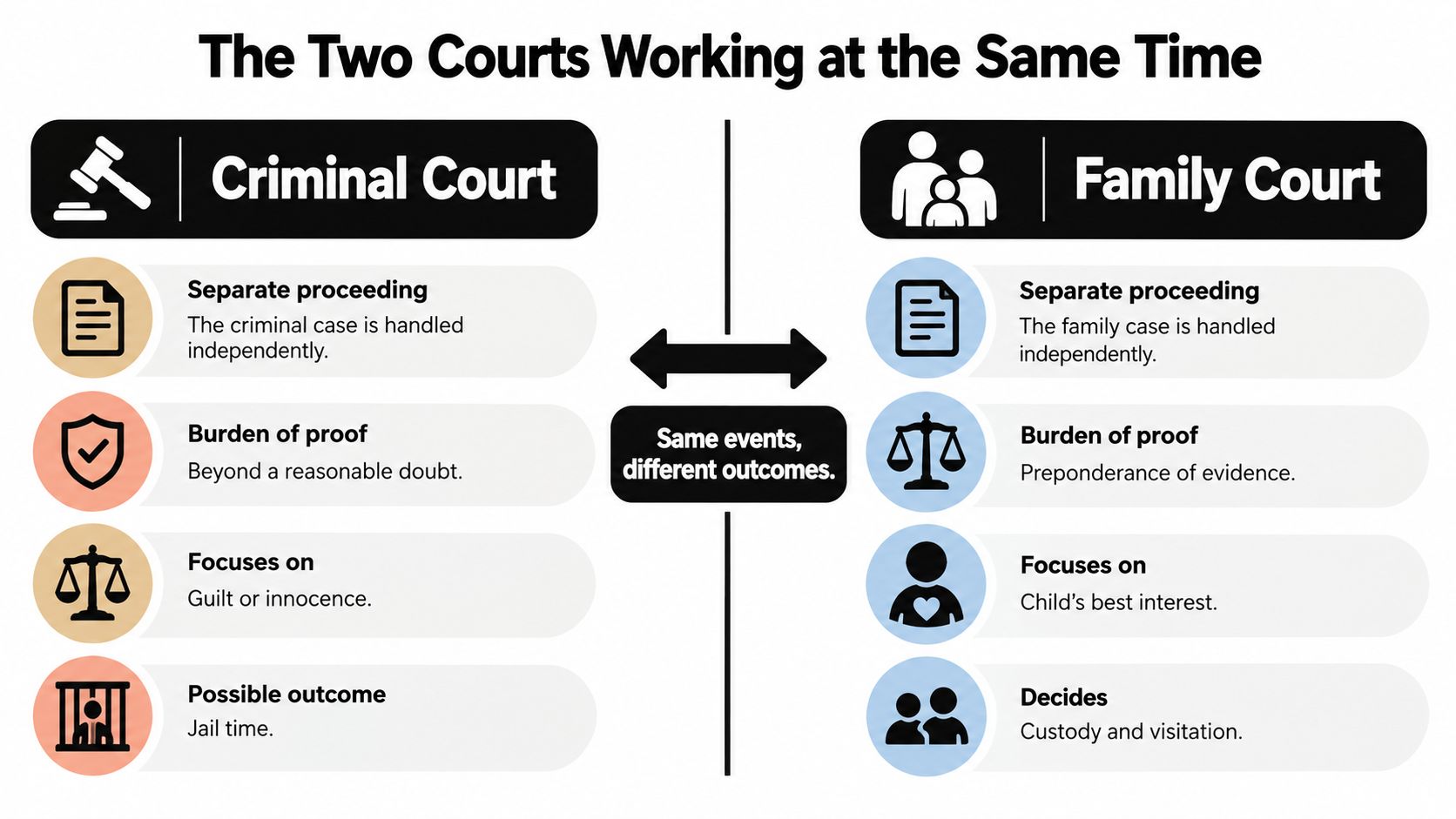
Timing makes this gap wider. Under Texas Family Code §153.004 on family violence in conservatorship decisions, courts must consider evidence of family violence occurring within the 2 years before the custody case was filed and conduct committed while the case is pending, which can produce custody consequences before any criminal prosecution ends. The family judge independently reviews police reports, testimony, medical records, photographs, messages, and protective orders rather than deferring to a future jury.
Why Coordination Is Not Optional
What you say in one case follows you into the other. Testimony at a protective order hearing, statements in a custody affidavit, and even admissions made to secure bond can be used by prosecutors. Meanwhile, a quick plea that looks convenient in criminal court can hand the other parent a conviction to wave around in family court for years. Conversely, staying completely silent in the custody case while the criminal matter drags on can leave the judge with only one side's evidence.
That's why your criminal defense lawyer and your family-law lawyer need to talk to each other, with your written permission, from week one. They should agree on who testifies where, whether to seek a continuance in the custody case, how plea timing affects temporary orders, and what evidence each side will volunteer. If your two lawyers have never spoken, you don't have a strategy. You have two half-strategies that can easily contradict each other, and the judges in both courtrooms will notice the inconsistency long before you do.
Emergency Orders and Protective Order Effects
Emergency relief is where most parents first feel the force of a charge. A judge can act on an expedited basis, sometimes initially without the other parent present, and then set a prompt hearing to test the evidence. These orders are temporary on paper, but they reshape daily life immediately. They control where exchanges happen, whether contact is supervised, and sometimes whether contact happens at all.
The flow from an arrest to lasting restrictions usually moves faster than parents expect.
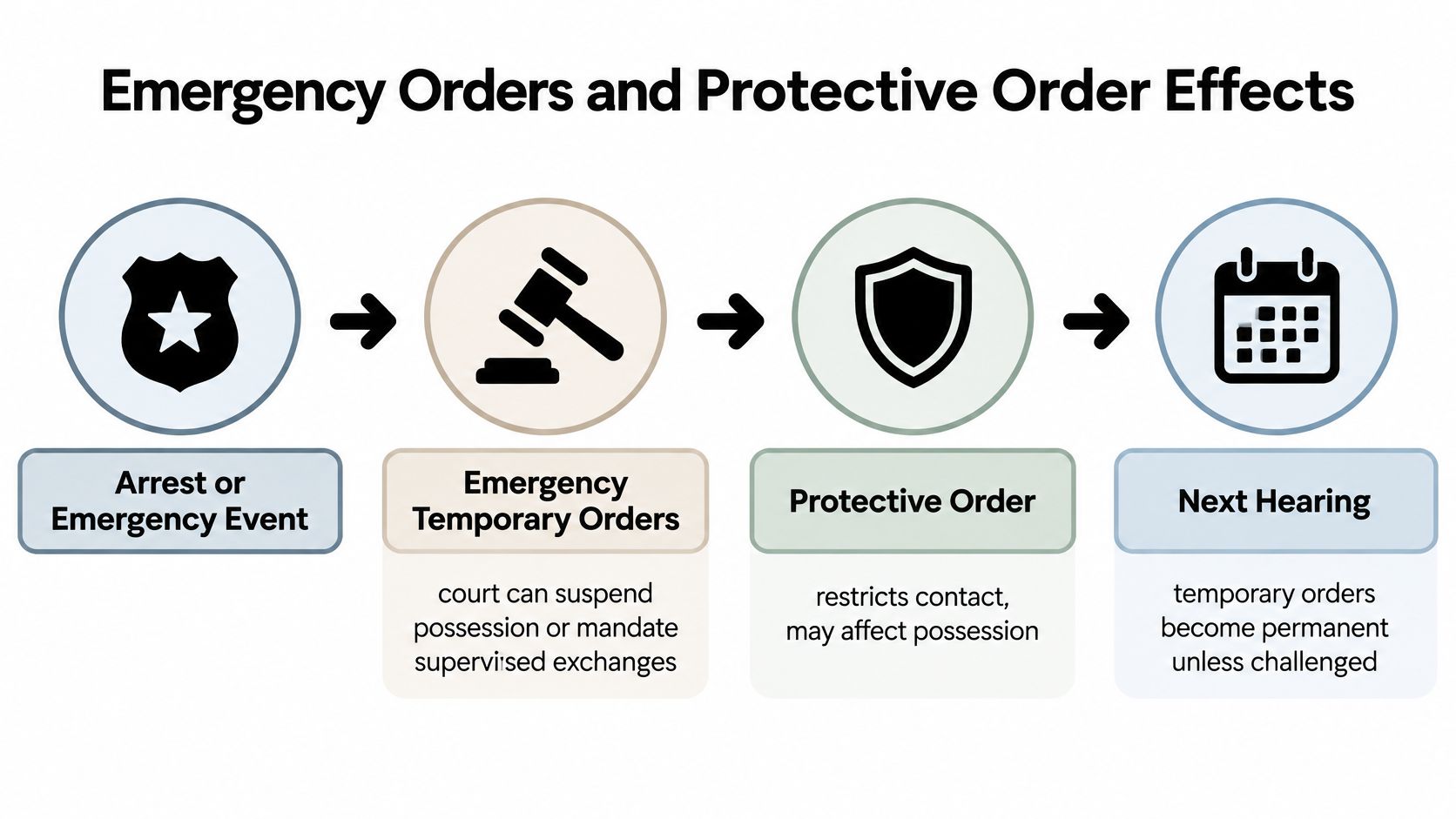
Protective orders sit alongside temporary orders, and they're related but distinct. Texas Family Code §81.001 and the Protective Order Registry work together this way: §81.001 requires a court to render a protective order when it finds that family violence has occurred, and the Texas Courts Protective Order Registry gives justice-system participants access to applications and orders while limiting public access to protect victims of family violence, stalking, sexual assault, and trafficking. So the order isn't a public posting for anyone to browse, but law enforcement and courts can see it, and you should assume the custody judge will have the full record.
Duration matters too. A protective order lasting more than two years requires clear and convincing findings and consideration of the child's best interest, which tells you how seriously Texas treats longer restrictions. Parents exploring Protective Orders in domestic violence and family safety matters should understand that scope before assuming an order either decides custody permanently or means nothing at all.
Scenarios That Trigger Immediate Restrictions
Consider three common filings. A father is charged with assaulting the mother during an exchange, and the court orders supervised visits with exchanges through a third party. A mother is arrested for DWI with the child in the car, and the court bars her from driving with the child and orders testing before unsupervised time resumes. A parent gets served with an ex parte protective order and discovers he can't attend the child's recital because the other parent will be there.
Each scenario has the same trap. An accidental violation, a friendly text, showing up anyway, driving "just this once," becomes fresh, easily proven evidence that you disregard court orders. That evidence often hurts more than the original allegation because it's undisputed. Read every order closely, calendar every deadline, and ask your lawyer before you improvise.
How Different Types of Charges Change Custody Outcomes
The type of charge matters enormously. Judges don't react to the label alone, they ask how closely the alleged conduct connects to child safety, household stability, and parenting ability. A charge involving violence in the home lands differently than an unrelated financial offense, and both land differently than intoxicated driving with your child in the back seat.
Family violence sits at the top of the concern scale because the statutes are explicit. Under Texas Penal Code §25.11 on continuous violence against the family, continuous violence against the family means 2 or more assaultive acts against a family or household member, or dating partner, during a 12-month period, and a history or pattern of family violence can prevent appointment as a joint managing conservator while creating a presumption against appointment as sole managing conservator. Pattern is the word to remember. One incident draws scrutiny; a documented pattern rewrites the conservatorship analysis.
How Different Charge Types Influence Custody Decisions
| Charge Category | Likely Court Response | Key Statute |
|---|---|---|
| Family violence or assault | Supervised visitation, presumption against unsupervised possession, possible conservatorship limits | Texas Family Code §153.004, Penal Code §25.11 |
| Child abuse, neglect, or sex-related offenses | Strongest restrictions, possible exclusion from access, DFPS scrutiny | Texas Family Code §153.004 |
| DWI or drug offenses | Testing, treatment conditions, driving limits, supervised time until compliance is shown | Best-interest standard, Chapter 153 |
| Weapons charges | Safety conditions, storage requirements, possible possession restrictions tied to household risk | Best-interest standard, Chapter 153 |
| Non-violent offenses unrelated to the child | Narrower response focused on stability, availability, and any incarceration risk | Best-interest standard, Chapter 153 |
Two hypotheticals show the spread. A parent charged with shoplifting, with no child present and no safety allegation, may face questions about judgment and stability but often keeps an ordinary schedule with modest conditions. A parent charged with assaulting the other parent while the child watched faces statutory presumptions, supervised possession, and an uphill fight for joint conservatorship, all before trial. Same courthouse, same judge, completely different case.
My advice is blunt. Don't argue that all charges are equal, and don't let the other side argue it either. If your charge has no factual link to your child, build that record with evidence about caregiving, stability, and supervision. If it does touch child safety, acknowledge the court's concern and propose verifiable safeguards. Judges reward parents who address risk concretely instead of minimizing it.
DFPS and CPS Involvement When Children Are Involved
A third system can enter your life without either parent filing anything. When a charge involves allegations touching a child, or when police, medical providers, teachers, or others report suspected abuse or neglect, the Texas Department of Family and Protective Services may open an investigation through Child Protective Services. That investigation can run in parallel with both your criminal case and your custody case, and it follows its own logic.
The map below outlines how a report can become a full DFPS case.
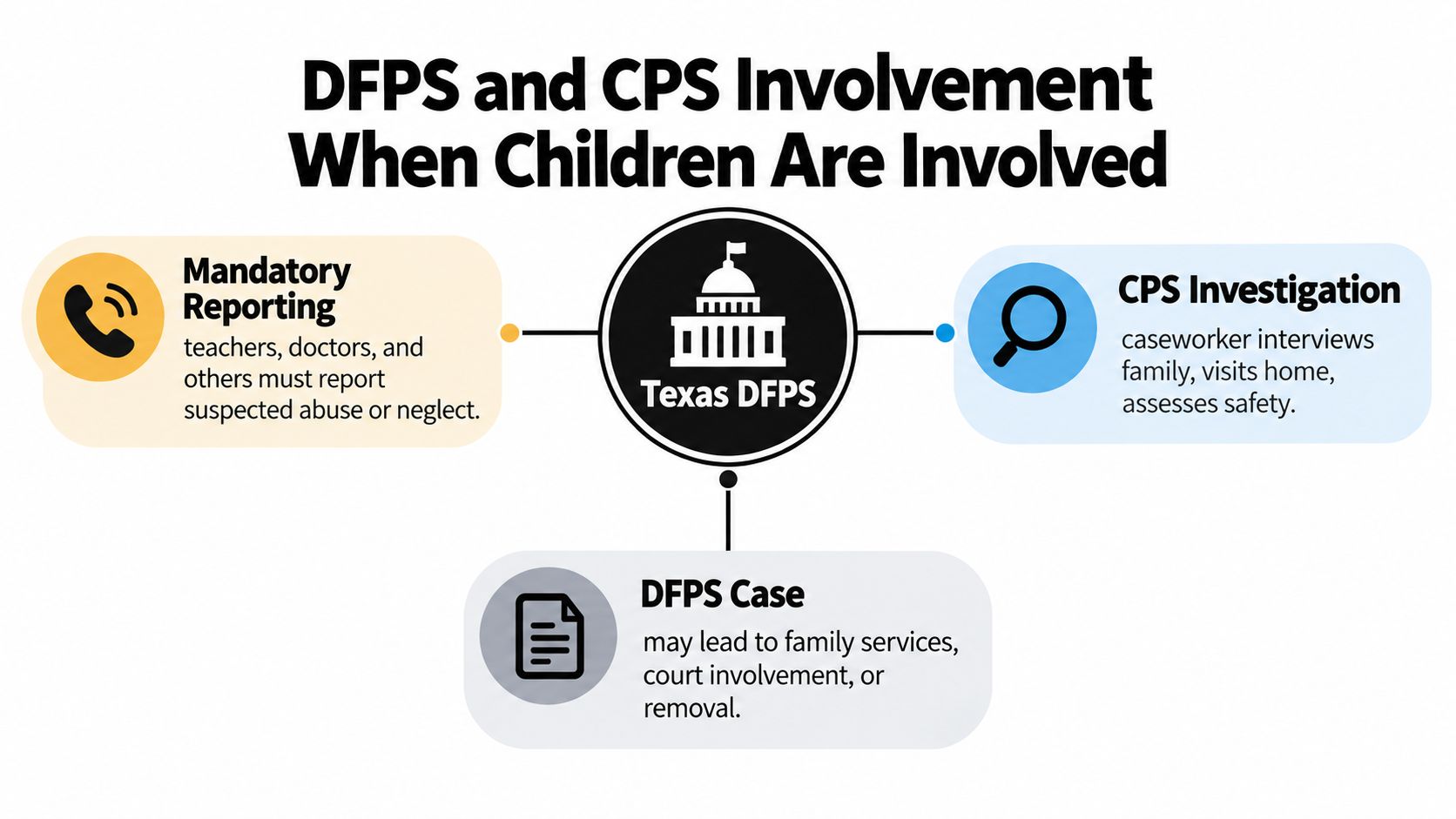
Parents are routinely shocked by one fact: an accusation can launch this process. DFPS doesn't need a conviction, an indictment, or even a filed charge to investigate. A caseworker may visit your home, interview your child at school, speak with relatives, and ask you to sign a safety plan placing the child with someone else temporarily. From there, the department may close the case, offer family-based services, seek court-ordered services, or pursue removal if it believes the child faces immediate danger.
The Stakes at the Far End
Most investigations don't end in termination, and you shouldn't assume yours will. But you need to know the outer boundary. Under Texas Family Code §161.001(b)(1)(Q) on termination involving incarcerated parents, termination is permitted when clear and convincing evidence shows a parent knowingly engaged in criminal conduct, was convicted, received confinement, and will be unable to care for the child for at least two years from the petition's filing. That's a specific, demanding pathway, most relevant when DFPS or the other parent argues that incarceration makes you functionally unavailable as a caregiver.
Do not give a caseworker a recorded, uncounseled explanation of the alleged offense. Be polite, take the card, and call a lawyer before you sit down for a substantive interview.
Cooperate with lawful directions about your child's immediate placement, engage seriously with services you're ordered to complete, and document everything. But treat every interview as evidence creation, because it is. What you tell DFPS can reach the prosecutor and the custody judge. Coordinated counsel helps you protect your child without casually handing three separate systems statements they'll each use differently.
Modification and Termination After a Conviction
The criminal case eventually resolves, but the custody consequences keep moving. A conviction, deferred adjudication, probation outcome, dismissal, or acquittal each becomes part of the record the other parent can use in a later modification suit. Courts look at changed circumstances and the child's best interest, and a criminal disposition that affects safety, stability, or availability is exactly the kind of change that gets a modification hearing taken seriously.
Before sorting outcomes, watch this overview of how Texas custody decisions get revisited.
Incarceration creates the hardest version of this problem. A parent in confinement can't exercise ordinary possession, attend medical appointments, or provide daily care, so courts often narrow the arrangement with supervised visitation, geographic limits, treatment requirements, or communication rules instead of ending the relationship entirely. Termination is different. As the earlier section noted, the incarcerated-parent ground requires clear and convincing proof, including inability to care for the child for the statutory period. Imprisonment alone isn't automatic termination, and the parent seeking it still must prove the elements and the child's best interest.
If you're the incarcerated or recently convicted parent, build the counter-record now. Document your expected release date, the relatives who can help, your communication history with the child, any support provided, services completed, and a realistic transition schedule. If you're the other parent, present concrete caregiving gaps, missed decisions, and instability, rather than assuming the conviction label wins the case by itself.
The Trap Frustrated Parents Create for Themselves
Watch for a dangerous reflex. A parent loses time in a modification, gets angry, and keeps the child past the ordered return. Under Texas Penal Code §25.03 on interference with child custody, interference with child custody is an offense when a person takes or retains a child knowing the conduct violates the express terms of a court judgment or order, including a temporary order. So responding to a custody restriction by withholding the child can create a new criminal case stacked on top of the old one. File for modification, clarification, or enforcement instead. Courts help parents who use the process, even when the process feels painfully slow.
Plea decisions deserve the same long view. A deal that avoids jail but includes a family violence finding, lengthy probation conditions, or admissions about the underlying conduct may cost you more custody ground than a different resolution would. Never sign plea paperwork without asking both of your lawyers one question: how will the custody judge read this document next year?
Common Misconceptions That Cost Parents Custody
Most damage I see comes from confident, wrong assumptions repeated by well-meaning relatives. Let's clear out the three that hurt parents most.
Myth one: an arrest means the case is already lost. It doesn't. An arrest alone is weaker evidence because it doesn't establish that the alleged conduct occurred. Family judges weigh corroborating evidence, credibility, and the actual risk to the child. Parents who assume defeat stop gathering records, miss hearings, and hand the other side an uncontested narrative.
The courtroom image below captures where these myths collide with real evidence and real judges.

Myth two: a dismissed or acquitted charge erases everything. It doesn't do that either. As guidance on pending domestic violence charges in Texas custody cases explains, a pending charge isn't itself a conviction, but family courts may consider credible evidence relevant to safety even when the criminal case remains unresolved, and a dismissed case isn't automatically proof of family violence, yet the custody court may examine the alleged conduct and surrounding evidence independently. Dismissal helps you. It just doesn't delete photographs, medical records, messages, or witness testimony from the family judge's view.
Myth three: a protective order is just paperwork. Tell that to the parent who loses unsupervised possession because a history or pattern finding triggered a statutory presumption. A protective order isn't a criminal conviction and shouldn't be treated as conclusive proof of every allegation, but it carries registry consequences, restricts your movements, and signals to the custody court that another judge found a safety concern credible enough to act on.
There's a fourth, quieter myth worth naming: that refusing to say anything in the custody case automatically protects you. Silence may be the right criminal strategy, but in family court an empty record can read as unmanaged risk. The fix isn't talking freely. It's making deliberate, counseled choices about what safe, verifiable information the custody judge gets, such as compliance records, treatment enrollment, stable housing, and a supervised possession plan you are following.
Practical Next Steps for Both Parents
Your next moves depend on which chair you're sitting in, but both chairs require discipline and documentation starting today.
If You're the Accused Parent
- Follow every requirement exactly: Comply with bond conditions, protective orders, and temporary orders even when they seem overbroad, and challenge them through counsel instead of self-help.
- Stop creating evidence: Don't contact the alleged victim, don't discuss the facts by text, and don't post about the case.
- Build your file: Collect the charging instrument, offense report, disposition records, protective orders, and certified judgments rather than relying on docket labels or memory.
- Propose safe contact: Offer supervised visits, neutral exchanges, testing, or treatment verification where relevant, and document every compliant visit.
If You're the Protective Parent
- Preserve evidence cleanly: Save messages, photographs, medical records, and incident notes with dates, and share them with counsel instead of editing or annotating originals.
- Use the court's tools: Request temporary orders or protective relief where warranted rather than unilaterally denying court-ordered possession, which can backfire badly.
- Communicate through approved channels: Written, app-based communication creates a clear record and protects you from claims that you invented events later.
- Stay child-focused: Judges distinguish between a parent pursuing safety and a parent pursuing advantage, so tie every request to specific conduct and specific risk.
Parents dealing with Child Custody matters involving custody and conservatorship representation, including high-conflict disputes, should get advice on the actual documents in their case instead of general internet reassurance. If you need help navigating divorce, custody, or estate planning in Texas, contact The Law Office of Bryan Fagan today for a free consultation. Bring your orders, your bond paperwork, and your questions, and we'll map the criminal and custody timelines together so one case stops ambushing the other.
If a charge has thrown your custody case into uncertainty, the Law Office of Bryan Fagan, PLLC can review your temporary orders, protective orders, and criminal timeline together and help you pursue a safe, workable possession plan for your child. You don't have to sort through two court systems on your own. Visit Law Office of Bryan Fagan, PLLC to schedule your free consultation and get clear, compassionate guidance on your next step.