 Skip to content

Yes, a handwritten will can be legal in Texas as a holographic will, but only if it is written entirely in the testator's handwriting, signed by the testator, and clearly expresses testamentary intent. Even then, proving it in probate can be a separate, harder fight.
You may be sitting at the kitchen table after a medical scare, wondering whether the instructions you've just written will protect your children. Or you may have found a parent's handwritten note and need to know whether the family can rely on it. Those are understandable concerns. The useful question isn't just “Is a handwritten will legal?” It's whether this particular document can survive scrutiny when its author can no longer explain it.
When a Handwritten Will Actually Counts in Texas
A Texas parent writes on a notepad after an unexpected hospital visit. The note names the children, describes some property, and ends with a signature. The paper doesn't look formal, but its appearance isn't the deciding issue.
Texas recognizes a specific route for handwritten wills under Estates Code Chapter 251. The maker, called the testator, generally must be at least 18 years old and of sound mind, with statutory exceptions for certain younger married or military testators. The document must also satisfy the requirements for a holographic will, not merely contain handwritten wishes. Texas Estates Code Chapter 251 sets out the execution and capacity requirements.
Follow the statutory path, not the appearance of formality
Start by separating a completed will from a planning note:
- Make a present decision. The document should express instructions intended to operate as your will after death, rather than ideas you might adopt later.
- Write the will yourself. The holographic route depends on the document being wholly in the testator's handwriting.
- Sign the document. A handwritten list of wishes without the maker's signature doesn't satisfy the signature requirement.
The relationship between these requirements matters more than the stationery you use.
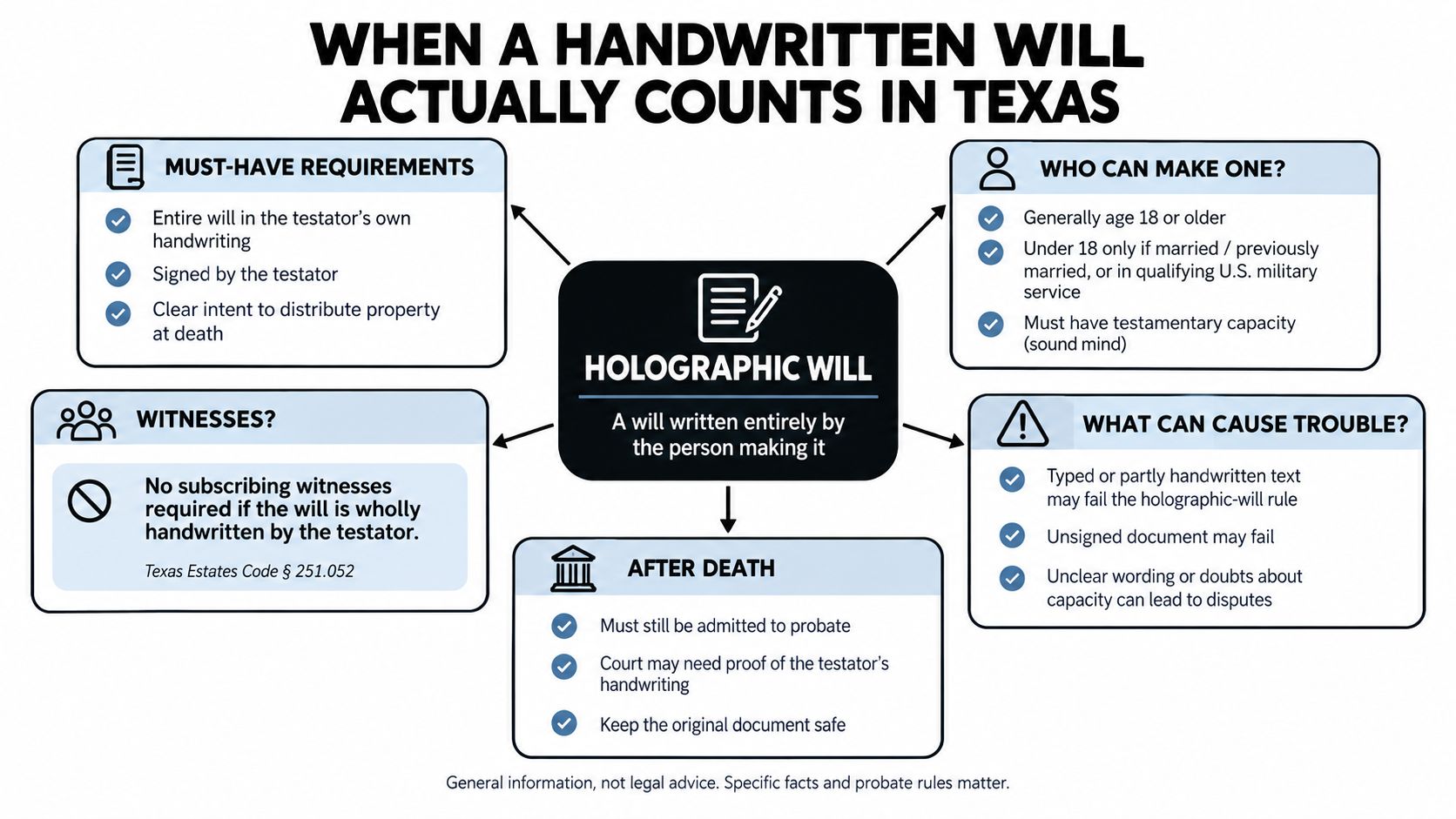
A notepad isn't automatically disqualifying. A polished document isn't automatically sufficient. Focus on whether the maker completed the legal act of making a will.
Practical rule: Don't ask your family to infer a final decision from a page of possibilities.
If you're writing during an emergency, clarity matters more than elaborate wording. Identify yourself, explain that the document is your will, and make your intended gifts understandable. Don't assume that adding a signature will resolve uncertainty elsewhere in the text.
My recommendation is straightforward: treat a handwritten will as a legal document from the moment you begin drafting it. Informality at the kitchen table shouldn't become uncertainty for your family later.
Holographic Will vs Attested Will in Texas
Witnesses at signing and witnesses needed later are different issues. Understanding that distinction prevents a common mistake: assuming that a document requiring fewer signing formalities will necessarily be easier for the family to use.
Under the ordinary Texas rule, an attested will must be written, signed, and witnessed by at least two credible witnesses who are at least 14 years old. The holographic exception removes the subscribing-witness requirement when the document is wholly in the testator's handwriting. TexasLawHelp's guidance on Texas Supreme Court-approved will forms explains these execution paths.
Attested Will vs Holographic Will in Texas
| Requirement | Attested Will | Holographic Will |
|---|---|---|
| Written document | Required; may use typed text | Required; wholly in the testator's handwriting |
| Signature | Required under the applicable execution rules | Testator's signature required |
| Subscribing witnesses | Required under the ordinary rule described above | Not required |
| Practical drafting concern | Complete the signing and witnessing process correctly | Avoid mixing typed text or another person's writing into the will |
| Planning recommendation | Use clear, coordinated instructions | Apply the same drafting care despite simpler execution |
The table doesn't make either route immune from challenge. A properly executed attested will still needs clear instructions, and a holographic will can still be effective when drafted carefully. Execution is the starting point, not a guarantee of trouble-free administration.
Don't overlook who will carry out your instructions
Texas legal-aid guidance also recommends naming an independent executor and stating that the executor should serve without bond. Those instructions can help avoid a bond requirement and make administration more efficient, as the linked guidance explains.
That's a useful reminder that a will does more than name beneficiaries. Someone must carry out its instructions.
- Choose deliberately. Consider who can handle paperwork, communicate with relatives, and follow directions under stress.
- Discuss willingness. Don't assume that the person you name wants the responsibility.
- Get the language reviewed. Naming an executor and authorizing the intended form of administration shouldn't be left to guesswork.
I generally recommend a professionally prepared, properly executed will over an improvised document when there's time to plan. That recommendation rests on drafting discipline and coordinated execution, not on a claim that typed words are stronger than handwriting.
What Texas Courts Actually Look For in a Holographic Will
The central drafting question is whether a reader can distinguish a completed will from unfinished thinking. Testamentary intent means that the maker intends the document to operate as a will, not merely as a reminder to prepare one.
Texas's statutory framework requires a holographic will to be wholly handwritten and signed, alongside the broader age and capacity requirements. Texas Estates Code Chapter 251 provides the governing framework.
Use this checklist to review the document before focusing on individual gifts.

Make the final intention unmistakable
Compare these original drafting examples, which aren't quotations from a statute:
- Clearer intent: “This is my will. At my death, I leave my property as follows.”
- Unfinished intent: “I should probably leave the house to my daughter.”
- Future planning: “Ask a lawyer to make a will with these ideas.”
The difference is the decision expressed. The first example presents operative instructions. The others suggest that the writer hasn't finished deciding or expects another document to follow.
Avoid conditional, conversational wording when you mean to make a final disposition. Your family shouldn't have to explain what you probably intended.
Keep the writing and signature unambiguous
A typed paragraph or another person's handwritten addition can create a dispute about whether the document qualifies for the holographic exception. Don't combine a printed template with handwritten answers and assume you've created a wholly handwritten will.
For practical drafting, place your signature after the completed instructions so the document reads as finished. That's a recommendation for clarity, not a claim that the cited statute mandates one precise signature location. Likewise, adding a date is strongly advisable even though the supplied Texas guidance does not make a date mandatory for validity.
Before signing, review the following:
- Identity: Can someone identify the maker and each intended beneficiary?
- Property descriptions: Can the reader understand what each gift covers?
- Completion: Does the document read as a finished decision rather than a draft?
For another explanation of handwritten-will issues, this video provides additional context.
Don't confuse careful wording with complicated wording. Plain instructions are useful only when they're complete enough to carry out.
Valid and Invalid Holographic Will Examples
The following are hypothetical examples, not reported cases or promises about a court's ruling. They illustrate why seemingly small drafting differences deserve attention.
Martha's Ranch Will
Martha writes a document entirely by hand. She identifies herself by full name, states that it is her will, identifies her beneficiaries, describes her intended gifts, and signs after the completed instructions. She also dates the document.
For example, her instructions identify her daughter Elena by full name rather than referring only to “my girl.” Her description of the ranch is specific enough that a reader isn't left choosing between different properties.
On those assumed facts, Martha's document illustrates compliance with the core holographic execution requirements. It still requires assessment of capacity, authenticity, and the other circumstances surrounding the will. A well-written page isn't a judicial finding.
This visual comparison highlights the difference between completed instructions and informal notes.

Daniel's Notes
Daniel types a document, adds handwritten edits, and signs only the last page. It contains phrases such as “divide things fairly” and “family should decide.” He doesn't clearly identify the intended recipients, and nobody signs as an attesting witness.
Daniel's paper doesn't fit the wholly handwritten route. On the assumed facts, it also lacks the witnessing required for the ordinary attested route. The signature doesn't cure either problem.
His signature appearing only on the last page isn't, by itself, the decisive defect. The mixed typed-and-handwritten format and missing attestation are the execution problems; unclear instructions create additional uncertainty.
A signature can confirm a decision. It can't supply decisions the writer never clearly made.
Use the examples as a review exercise
Don't copy Martha's outline and assume that every family needs the same provisions. Instead, ask whether your draft leaves comparable questions unanswered:
- Who receives the gift? Replace nicknames or broad family labels when they could cause confusion.
- What is being given? Avoid descriptions that require relatives to negotiate your meaning.
- Is the document finished? Remove unresolved alternatives before execution, with legal guidance about how to finalize the document properly.
The lesson isn't that short wills fail or long wills succeed. Martha makes identifiable decisions through a recognizable execution path. Daniel leaves his family with both execution defects and unanswered questions.
Proving a Handwritten Will in a Texas Probate Court
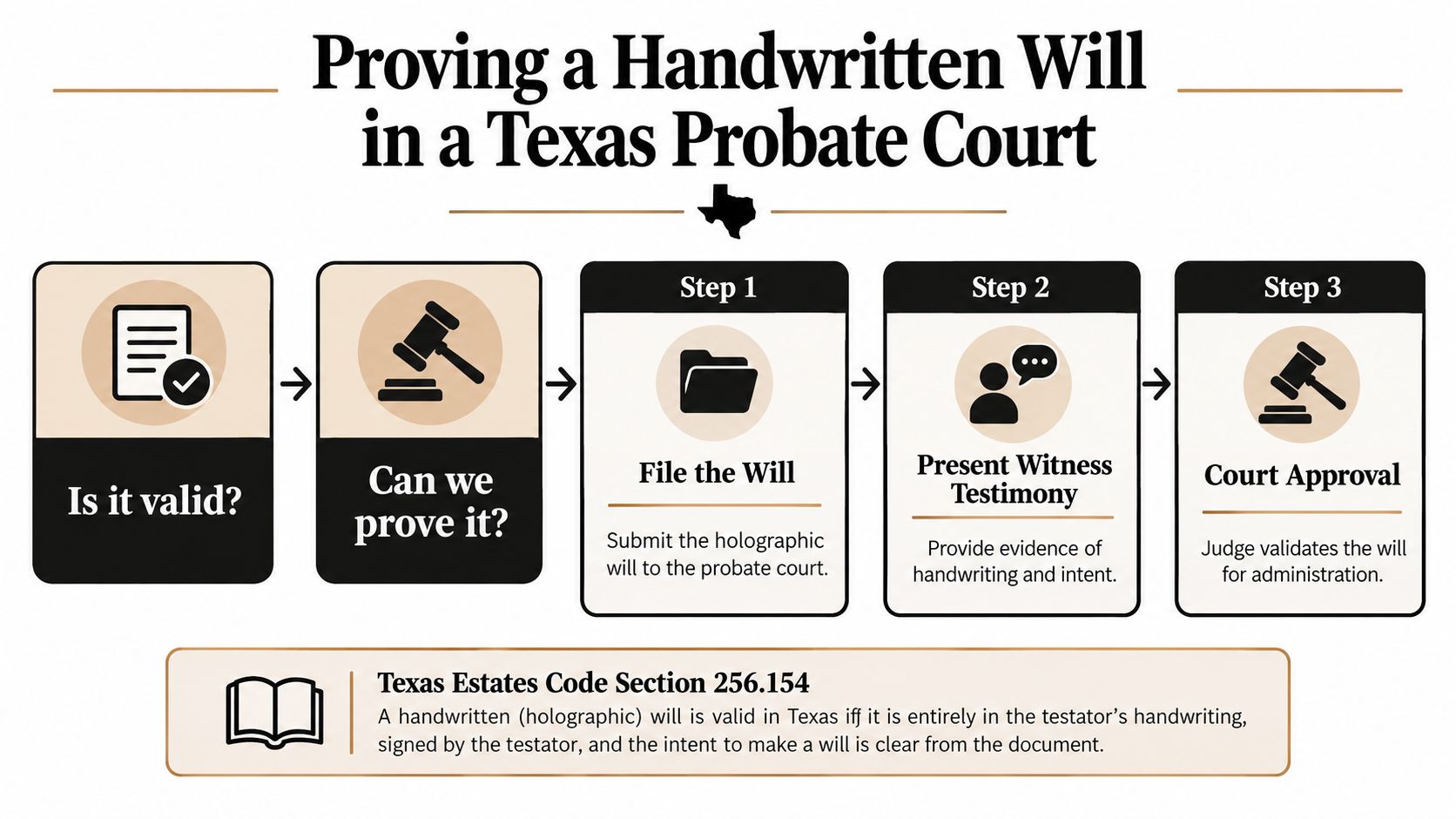
A document can satisfy the requirements for a holographic will and still require evidence before a probate court will admit it. Validity and proof are separate questions. The convenience of writing alone can become additional work for the people left behind.
Texas Estates Code Section 256.154 permits a non-self-proved holographic will to be established through two witnesses familiar with the testator's handwriting. Their evidence may be given through sworn testimony or affidavits in open court. Section 256.154 describes the proof required for a holographic will.
When the will isn't self-proved
The handwriting witnesses need not have watched the person write the will. Their role is to provide the required evidence identifying the handwriting.
A longtime coworker, relative, or friend who regularly saw the deceased person write may be a potential witness. Familiarity matters; knowing the deceased socially doesn't necessarily answer the handwriting question.
For witnesses who live outside the county or cannot attend, the statute permits written or oral depositions under the applicable procedural rules. The official Texas Estates Code probate-proof provisions explain those alternatives.
The practical process involves more than finding the document.
Self-proof addresses an avoidable evidence problem
A holographic will doesn't need a notary merely to be valid. Self-proof is a separate sworn-affidavit process, completed during the maker's lifetime before an officer authorized to administer oaths, such as a notary, with the affidavit attached to the will.
The affidavit establishes specified facts concerning the instrument, the maker's age or qualifying status, sound mind, and nonrevocation. Texas guidance on self-proving wills explains the affidavit requirements and timing.
Don't assume a notary stamp alone accomplishes that process. Use the appropriate affidavit and obtain advice about execution.
- Preserve the original. Keep it secure and tell the proposed executor where it is.
- Consider handwriting evidence. Identify people who recognize your handwriting.
- Address self-proof while you can. Don't leave an avoidable authentication problem for your family.
The firm's Probate service covers probate administration and estate settlement in Texas. If you've already found a handwritten will after someone's death, seek guidance before marking, altering, or attempting to “correct” the original.
Common Risks of Relying on a Handwritten Will
The most dangerous assumption is that meeting the handwriting requirements settles every estate-planning question. It doesn't. A document may be genuine and properly signed while leaving serious disagreements about its meaning or the circumstances in which it was made.
My concern isn't that every handwritten will will fail. It's that people often stop reviewing the plan once they believe the document is technically legal.
Separate a signing problem from a family problem
Consider a hypothetical parent in a second marriage who writes a new will during a serious illness. An adult child believes the spouse pressured the parent; the spouse believes the parent independently changed their mind. Even before anyone interprets a gift, the family may disagree about capacity and undue influence.
A diagnosis alone shouldn't become your family's substitute for a careful assessment of the circumstances. If illness, medication, dependence on another person, or anticipated disagreement raises concerns, discuss those facts with counsel while the maker can still participate.
Other practical warning signs deserve the same attention:
- Competing papers: A later note may create disagreement about whether earlier instructions were changed or revoked.
- Incomplete gifts: Vague directions or omitted property may leave unresolved questions about distribution.
- Unclear relationships: Nicknames and phrases such as “the children” can invite disagreement in blended families.
- Pressure surrounding execution: Someone else's involvement may prompt allegations that the instructions weren't freely chosen.
Planning perspective: A will should reduce the number of decisions grieving relatives must argue about.
Review ownership, not just the written gifts
Texas legal-aid guidance flags community-property rights, beneficiary designations, and family-law issues as reasons to obtain individualized advice. Don't assume that writing someone's name in a will resolves every question involving retirement accounts, jointly held property, or a spouse's rights.
Instead, bring the underlying account and ownership records to the review. Ask which assets the will can govern and which require separate coordination.
If you're divorcing, don't make isolated changes based on a general article. Ask counsel to review the estate documents alongside the divorce circumstances and any applicable orders. The safer approach is coordinated advice, not a handwritten attempt to solve several different legal problems at once.
Building a Safer Texas Estate Plan Around a Handwritten Will
Start by improving what you already have, but don't spend effort formalizing a document whose instructions are fundamentally unclear. Review the substance before arranging self-proof. An affidavit addresses evidence; it doesn't rewrite an ambiguous gift.
If the existing handwritten will is otherwise suitable, ask about completing the statutory self-proving process. If it isn't suitable, discuss replacing it through a properly supervised execution process rather than layering more notes onto it.
Bring a usable planning packet
A productive review starts with information your attorney can evaluate:
- Existing documents: Bring the original handwritten will and any earlier wills, later notes, or related affidavits.
- People and relationships: Identify beneficiaries, proposed executors, minor children, and family members whose interests may conflict.
- Ownership records: Gather deeds, account statements, business documents, and beneficiary information.
- Current concerns: Explain a pending divorce, health issue, expected disagreement, or uncertainty about a proposed gift.
You don't need perfectly organized files before seeking help. You do need to disclose the facts that might change the advice.
Choose tools around your family's needs
A formal attested will is worth discussing when you want professionally drafted instructions and a coordinated signing process. For larger or blended estates, ask whether a revocable living trust belongs in the plan rather than assuming that a trust is automatically necessary.
Also raise beneficiary coordination, powers of attorney, and medical directives with counsel. These are planning topics to evaluate alongside the will, not interchangeable substitutes for it.
| Your concern | What to ask during the review |
|---|---|
| Minor children | How should the plan address their care and financial needs? |
| Second marriage | How can instructions account for the spouse and children clearly? |
| Business interests | What ownership and management documents need coordination? |
| Real estate across counties | What property records and administration questions need review? |
| Expected disagreement | How can drafting and execution reduce avoidable uncertainty? |
The firm's Estate Planning service includes wills, trusts, and estate plans to protect assets and wishes.
My recommendation is to stop treating a handwritten will as a complete solution when your situation includes these complications. It can be a starting point. Let the family circumstances determine what belongs around it.
Talk With a Texas Estate Planning Attorney Before You Sign
Return to that kitchen-table moment. You weren't trying to create a legal puzzle. You were trying to make sure the people you love would be protected if something happened.
There's no reason to feel embarrassed about starting with handwritten instructions. They can be a recognized legal tool in Texas. The important next step is deciding whether your document is ready to be relied on or still needs work.
Bring the questions you're worried about
You don't have to translate your concerns into legal terminology. Tell the attorney what you want to happen, who depends on you, and what you're afraid relatives might disagree about.
- If you haven't signed: Bring the draft for review before finalizing it.
- If you already signed: Bring the original and explain when and how you prepared it.
- If the maker has died: Preserve the document and seek advice about proof rather than changing anything.
A useful consultation should focus on your actual family, property, and instructions. The goal is a plan your loved ones can use, not just a document you can describe as legal.
The Law Office of Bryan Fagan, PLLC offers guidance on wills, trusts, and estate planning, including whether a handwritten will fits your circumstances. Bring your existing document and questions so you can discuss clearer instructions and the proof your family may need later. If you need help navigating divorce, custody, or estate planning in Texas, contact The Law Office of Bryan Fagan today for a free consultation.


