 Skip to content

A family has gathered the paperwork after a loved one's death. Someone wants to sell the house or put the title in the heirs' names, but nobody is sure whether a court case is necessary. A Texas affidavit of heirship may help document who inherited the property, but it has a specific job and important limits.
What a Texas Affidavit of Heirship Form Does
A Texas affidavit of heirship form is a sworn statement about a deceased person's family history and heirs. It's recorded in real-property records and used mainly to identify who inherited the decedent's interest in land or a house. For a family trying to handle a property without a formal court determination of heirship, it may be a useful starting point.
Think of a family whose relative died owning a house. The surviving family members need to establish the family relationships that determine who may have inherited the property. An affidavit can create a recorded chain of family-history evidence for people reviewing the land records later.
That record isn't the same as a court judgment. It doesn't decide a will contest, settle a fight over ownership, locate an omitted heir, or resolve creditor problems. If those issues arise, the family may need a court proceeding rather than relying on an affidavit.
A record of family history, not just a list of names
Texas Estates Code §§203.001–203.002 provide the statutory framework for heirship affidavits. The document needs to state facts about family history and heirship, and it must be sworn and acknowledged before an authorized officer. For property records, it must be recorded with the county clerk in the appropriate county. The statute gives the affidavit a potential evidentiary role, but the form's value depends on accurate information and proper execution. Texas Estates Code §203.001
The practical question is whether the family can accurately document the relevant relationships and whether the people who need to rely on that record will accept it. A buyer or title reviewer may want a court determination instead, particularly if the family history is incomplete or disputed.
Plain-language takeaway: The affidavit helps document who the heirs are. It doesn't automatically transfer every property interest or settle every question about the estate.
For related information about Texas estate planning and probate, families can browse the resources available through The Law Office of Bryan Fagan. The right first step is to identify the property, the family relationships, and any known will or dispute before anyone signs a form.
How Texas Heirship Options Differ
Families sometimes use “heirship affidavit” as a catch-all for paperwork that serves different legal purposes. Texas has distinct routes for recording family-history evidence about real property, asking for a court-supervised small-estate distribution, or having a court determine heirship.
| Procedure | Court required | Core contents | Main limit |
|---|---|---|---|
| Recorded affidavit of heirship, Chapter 203 | No court order is required just to record the affidavit. | Family history and facts identifying heirs, prepared and recorded for real-property title evidence. | It isn't a judgment and may not resolve a dispute or satisfy a buyer or title reviewer. |
| Small-estate affidavit, Chapter 205 | Yes. It's a court-supervised distribution procedure. | Statutory conditions, known assets and liabilities, every distributee's name and address, and family-history facts. It's sworn by two disinterested witnesses and legally capable distributees, with a representative for a minor or incapacitated distributee when appropriate. | It's not a general heirship form and may not fit the estate's circumstances. |
| Court determination of heirship, Chapter 202 | Yes. The court determines heirship. | Evidence and filings that allow the court to decide who the heirs are. | The family must proceed through the court process rather than relying only on a recorded statement. |
The Chapters 203, 205, and 202 routes don't do interchangeable jobs. If the immediate issue is documenting family history for land records and the facts are reliable, a recorded affidavit may be considered. If the family is seeking a small-estate distribution, Chapter 205 has its own conditions and required contents. If the identities of heirs or other facts must be decided by a judge, a Chapter 202 proceeding may be appropriate.
Start with the job the paperwork must do
A family seeking to transfer a house should ask whether it needs a record of heirship, court authorization to distribute estate property, or a judicial decision. A family considering what happens when a person dies without a will can review this guide to Texas probate without a will, then confirm which procedure fits the actual property and family circumstances.
The table gives a starting point, not a guarantee that a particular form will be accepted. The estate's facts, the property involved, and the people who must rely on the documents all matter.
Required Entries on the Statutory Form
Texas Estates Code §203.002 provides a substantially prescribed form. It's designed to capture family and estate history, not just list the people a signer believes should receive property. Each entry helps identify relationships that may affect who inherited. Texas Estates Code §203.002
The form begins with the affiant's name and address. The affiant must explain how they knew the decedent and how long they knew them. That information lets a reader assess whether the person making the statement has personal familiarity with the family history.
Next, the form asks for the decedent's date of death and complete marital history. A prior marriage can matter to understanding the family record, so don't assume that the most recent relationship tells the whole story.
Trace each branch of the family
For every child, the form calls for the child's name, birth date, other parent, and current address. If a child died, the form asks for that child's descendants. If the decedent left no descendants, the form moves to parental information and, where relevant, information about siblings. These successive relationships help identify heirs through the family tree instead of stopping at the most visible relatives.
Consider a decedent whose child died before them and left children of their own. If the affidavit names only the decedent's surviving children and omits the deceased child's descendants, it can misstate who inherits through that branch under per-stirpes inheritance principles. A later title reviewer could question whether the recorded document identifies all heirs.

The form also asks for people who know about the decedent's family and heirship, whether the decedent left a written will, and whether unpaid estate or inheritance taxes exist. Those questions encourage disclosure of facts that may affect how others evaluate the affidavit.
Practical rule: Don't treat an unknown answer as permission to leave out a relative. Investigate the family relationship and record the facts as accurately as possible.
A complete affidavit gives future readers a traceable genealogical record suitable for land and probate records. Its purpose is to disclose the family facts and potential competing heirs, not to assume them away.
Recording Rules and the Five-Year Rule
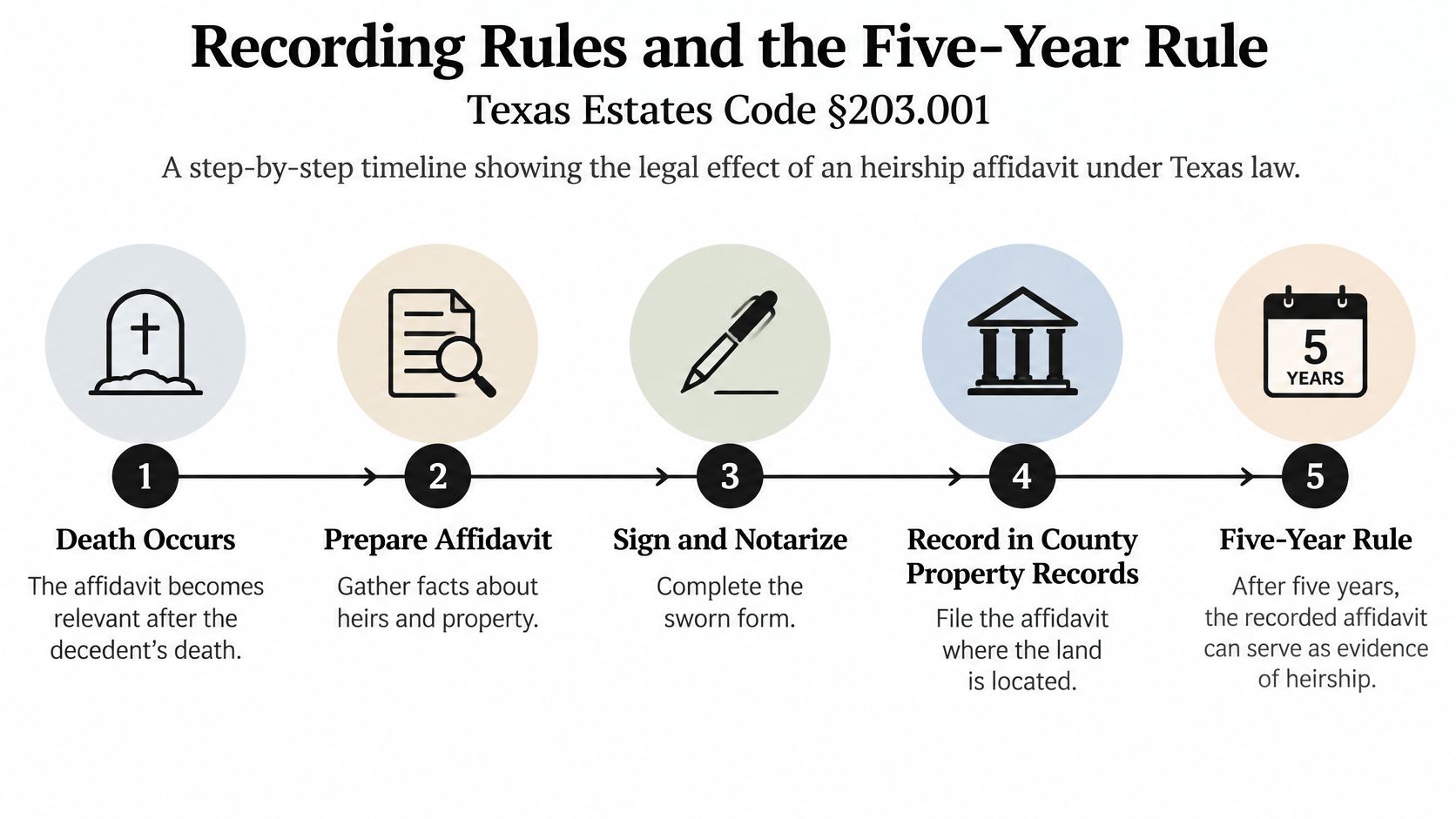
A properly executed and acknowledged affidavit of heirship can have a specific evidentiary role under Texas Estates Code §203.001. If it contains facts about family history, genealogy, marital status, or the identity of heirs, it may be admitted as prima facie evidence in a proceeding to declare heirship or in a lawsuit involving property title. Prima facie evidence can support a finding unless it's overcome by other evidence. Texas Estates Code §203.001
The statute sets an important milestone: the affidavit generally must have been recorded in the deed records for at least five years before it receives that statutory prima-facie status. That's why recording isn't a minor administrative detail. The document's later evidentiary treatment depends on the record and the time it has been there.
The recording county matters
The statute identifies the relevant place for recording as the county where the property is located when the title dispute begins, or the county where the decedent was domiciled or maintained a fixed residence at death. A family should not assume that filing in any Texas county will provide the intended record for a particular property.
The current statutory approach continues an earlier Texas Probate Code rule that also used a five-year recording period. That continuity underscores the significance of the recorded document over time, but it doesn't mean the affidavit automatically becomes a judgment after the period passes.
The form entries matter here. As covered above, the affidavit needs accurate genealogy and proper execution. The acknowledgment and recorded history give later readers a basis to assess the statement, but they can't correct omitted relatives or resolve contradictory records.
Recording creates evidence, not a court order. A dispute, a missing heir, conflicting documents, or a question about a will may still require judicial proceedings.
Who May Sign as a Disinterested Witness
An heir may know the family well, but an heir who stands to benefit from the property has an interest in the outcome. Texas heirship practice relies on disinterested witnesses so that the family-history record doesn't rest only on statements from the people who may inherit.
Texas judicial guidance for heirship filings calls for statements of fact or affidavits signed by two disinterested witnesses. The witnesses identify all heirs and explain how they knew the decedent. In a formal application to determine heirship, they may also need to appear at the hearing. Texas judicial guidance on heirship filings
What personal knowledge looks like
Suppose an unmarried person dies without a will. A longtime neighbor, family friend, or member of the clergy may have firsthand knowledge of whether the decedent had a spouse, children, or a child who died leaving descendants. The witness should be able to explain the basis for that knowledge, not merely repeat what one heir told them.
A careful witness also discloses facts that may change the family picture, including a prior marriage, an adoption, or a child who died before the decedent. This information connects to the statutory form's questions about the affiant's familiarity with the decedent and the family. A witness doesn't need to have been part of every family event, but they must be able to explain what they know and how they know it.
Avoid choosing a witness merely because they're easy to reach. If the witnesses give inconsistent accounts of the decedent's relationships, the mismatch can delay recording, title review, or a court hearing.
A separate signature rule for small estates
Small-estate practice also uses two disinterested witnesses, but it adds signatures from legally capable distributees. That procedure has different requirements from a recorded affidavit of heirship, so the family should confirm which document it's preparing before asking anyone to sign.
An heir who may receive property is a poor sole source for the inheritance record. Independent witnesses can provide a clearer account of the decedent's family history and help expose gaps before the affidavit becomes part of the land records.
Choosing Heirship Affidavit or Probate
The right procedure depends on what the family needs to accomplish and what facts remain uncertain. A recorded Chapter 203 affidavit may support real-property heirship evidence, while a Chapter 205 small-estate affidavit seeks court-supervised distribution under separate conditions. A Chapter 202 proceeding is the judicial route when a court needs to determine heirship.
Pause before preparing an affidavit if there's a known will, an omitted or hard-to-identify heir, disputed ownership, or a buyer or title reviewer who won't rely on an affidavit alone. A conflicting will or family account may call for a court to resolve the issue. An affidavit records evidence; it doesn't settle a contest just by being signed.
When a small-estate affidavit may fit
Under Estates Code §205.002, a small-estate affidavit must be sworn by two disinterested witnesses and each legally capable distributee. When appropriate, a representative for a minor or incapacitated distributee must also participate. The affidavit must show that the statutory conditions for the small-estate process exist and list all known estate assets and liabilities, each distributee's name and address, and the family-history facts establishing each distributee's right to receive property. Texas Estates Code §205.002
For example, a family asking the court to authorize distribution of a modest estate needs to account for known debts as well as identify every distributee. A form that names only the family members expected to receive something, without the required financial and genealogical information, isn't a substitute for the Chapter 205 procedure.
Substantial liabilities, disputed assets, omitted heirs, or a minor or incapacitated distributee may require closer legal review. The family shouldn't assume that a small-estate affidavit or a general heirship affidavit resolves those issues.
The probate administration and estate settlement resource describes probate as a Texas process for administering and settling an estate. The estate administration lawyer resource may also help readers understand legal support for administering an estate.
Match the choice to the family's facts
A lawyer can help review whether a will or trust exists, whether guardianship or powers of attorney issues affect the family, and whether the matter concerns an affidavit or probate administration. The Law Office of Bryan Fagan, PLLC assists Texas families with those estate-planning and probate questions, including evaluating which statutory vehicle fits before anyone signs.
Use the witness guidance above to consider whether independent people can reliably establish the family history. Then consider the five-year rule and recording location before relying on a Chapter 203 affidavit as future title evidence. If the facts require a judge to decide who inherited, a Chapter 202 proceeding may be more appropriate than trying to make an affidavit do a court's job.
How to Complete and Record the Form
Once the family has confirmed that an affidavit of heirship is the right route, careful preparation can help preserve its value as a land-record document. A defective affidavit may be rejected by the county clerk or may fail to provide reliable title evidence. Texas legislative materials describe execution formalities for an affidavit concerning heirship to real property, including the affiant's signature, acknowledgment or oath before two credible subscribing witnesses, and certification before an officer authorized to take acknowledgments or oaths. Texas legislative materials on heirship affidavits
Prepare the information before signing
Start by gathering certified death and marriage records where available. Compare those records with what family members know, then list every potential heir and successor heir, including descendants of anyone who died before the decedent. Check the statutory entries described above so the form captures family relationships rather than just the names of people currently participating.
Identify people with firsthand knowledge who can serve as disinterested witnesses. Before scheduling signatures, verify that the document names all relevant heirs and that each statement is accurate. The execution materials also call for acknowledgment by each living, legally capable heir named in the affidavit.
Use this sequence as a working checklist:
- Gather records: Collect certified death and marriage records where available.
- Trace the family: Identify all potential heirs, including descendants of a deceased child.
- Complete the form: Check the family and estate information against the statutory form.
- Arrange execution: Obtain the required signatures, oath or acknowledgment, witness participation, and officer certification.
- Record the document: File the executed affidavit with the county clerk in the proper county before relying on it in a deed or title transaction.
- Confirm local filing rules: Ask the county clerk about recording fees and formatting requirements rather than assuming one statewide fee or format.

A deed or title transaction should not rely on an unrecorded draft when the family intends the affidavit to form part of the property record. For questions about how a deed document relates to the transaction, review this Texas warranty deed form resource.
The clip below provides additional context for families dealing with heirship documents.
Before filing, confirm that the document uses the correct statutory vehicle. The steps above apply to the property-based heirship affidavit route, not a substitute for a small-estate affidavit or a Chapter 202 court proceeding.
Quick Reference Pitfalls and Next Steps
Before anyone signs or records an affidavit, check that the family has addressed the issues most likely to undermine the document's usefulness. This final review is especially important when a property transfer, sale, or title review depends on the recorded family history.
- An heir is the only source: Review the witness guidance above. A person who may inherit has an interest in the result, so independent witnesses with personal knowledge provide a more reliable account.
- A deceased child's descendants are missing: Return to the statutory form entries. The child's descendants may be relevant to identifying the heirs, so don't stop at the decedent's surviving children.
- A prior marriage or adoption is overlooked: Recheck the family history before anyone signs. A fact that changes a family relationship can affect who must be identified.
- The affidavit is filed in the wrong county: Confirm the correct recording location under the county rules described above before relying on the land-record filing.
- The five-year milestone is misunderstood: Don't treat a newly recorded affidavit as if it already has the statutory prima-facie status described in the recording section.
- The wrong procedure is being used: Compare the purpose of Chapters 203, 205, and 202. A property-title affidavit, a small-estate distribution request, and a court determination of heirship don't serve the same job.
An affidavit remains evidence of heirship, not a ruling that clears contested ownership, creditor issues, or a conflicting will. If an heir is missing, family members disagree, or a title reviewer requires a court decision, ask for legal guidance before treating the recorded affidavit as enough.
For a final review, return to the form entries, witness rules, recording milestone, and procedure comparison above. The estate-planning and probate resources at The Law Office of Bryan Fagan can help families understand the questions to raise about their circumstances.
If you need help navigating divorce, custody, or estate planning in Texas, contact Law Office of Bryan Fagan, PLLC for a free consultation. The firm helps families evaluate estate-planning and probate questions, including whether an affidavit of heirship fits the property and family history. Reach out to discuss your situation before anyone signs or records a document that may affect title.


