When a parent or spouse dies and there's no will in the desk drawer, the room changes fast. The grief is still fresh, but the questions start anyway. Who can speak for the estate, which accounts can be touched, and whether the house has to go through court are usually the first things Texas families ask.
In Texas, probate without a will is the court process that takes over when there's no valid will directing what happens next. That doesn't mean the family is left without answers. It means Texas law supplies a default path, and the court uses that path to collect assets, pay valid debts, and transfer what's left to the people the law recognizes as heirs.
Families are often surprised by how much turns on a few early choices. Who serves as administrator, whether the estate can use a simplified process, whether the court can approve a more efficient administration, and which assets never enter probate at all can shape the whole experience. A calm, organized approach matters here, especially when the family is already dealing with loss.
When a Texas Loved One Dies Without a Will
The most common version of this story starts at the kitchen table. Someone has gone through a parent's papers, checked a safe, and asked every relative they can think of, but no will turns up. The family still has to deal with bills, a home, a bank account, maybe a vehicle, and a house full of memories, all while trying to avoid conflict.
Texas law steps in because the court still has to authorize someone to act. Without a will naming an executor, no one has automatic authority to collect assets or retitle property. The legal system needs a person the court can recognize so banks, title companies, and other institutions have someone to deal with.
That is where the probate process begins. In practical terms, the family is moving from private grieving into public administration, which means paperwork, notices, and a court order. The process is not about guessing what the person would have wanted, it is about following the statutory default path Texas uses when no written plan exists.
Practical rule: the earlier the family identifies assets, relatives, and account titles, the fewer delays they usually face later.
There are four decisions that usually drive the rest of the case. The family has to figure out who can serve as administrator, whether the case should move through independent or dependent administration, whether the estate qualifies for a small estate process, and how Texas intestacy rules divide the property that remains after debts and non-probate transfers are handled.
For readers who want a broader overview of probate procedure, Probate is the service page that covers probate administration and estate settlement in Texas. The basic idea is simple, even if the paperwork isn't. Once there's no will, the court and the Estates Code provide the roadmap, and a Texas probate attorney helps the family follow it without unnecessary detours.
What Intestate Probate Actually Means Under Texas Law
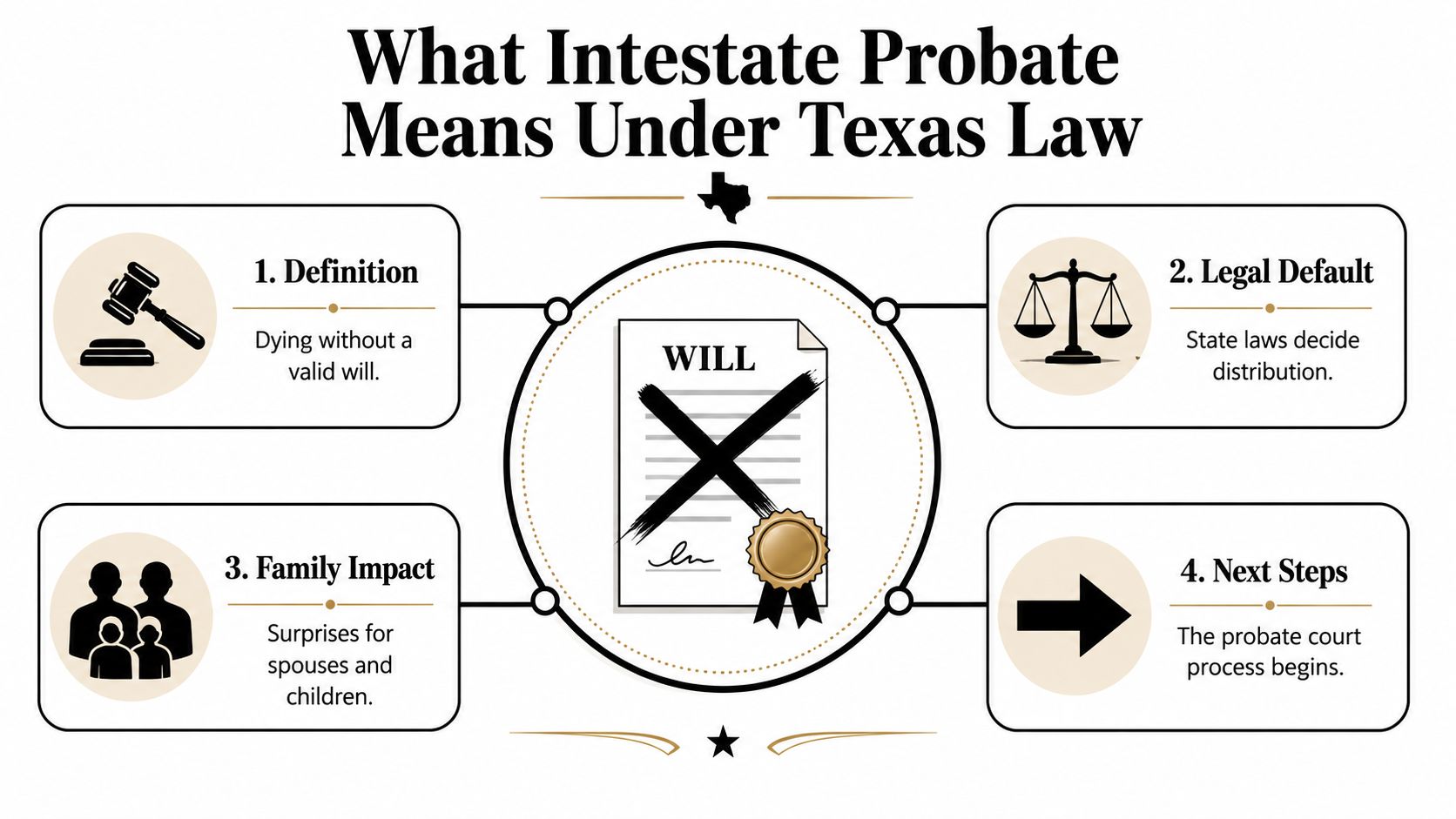
When Texas lawyers say someone died intestate, they mean the person died without a valid will. That matters because a testate estate follows the will, while an intestate estate follows the default rules the legislature wrote into the Texas Estates Code. The judge is not free to improvise a distribution plan just because one seems fair.
An unwritten seating chart at a wedding provides a good analogy. If the couple never assigned the tables, the venue doesn't invent its own guest list. It uses a default system. Texas intestacy works the same way, except the “seating chart” is the legal order of heirs, and the “tables” are the assets left behind.
The legal default replaces personal instructions
The court does not ask what the deceased probably would have wanted. It asks who qualifies under the statute and what kind of property is at issue. That distinction matters because Texas treats community property and separate property differently, and family structure can change the result a great deal.
The most important point is that intestacy is not a failure of the system. It is the system. The law is filling in the gaps because the person never made a private plan of their own. That default can be predictable, but it can also surprise spouses, children, and blended families who assumed the result would be more flexible.
Why the court gets involved at all
A court has to identify someone with authority to collect assets, pay debts, and distribute what remains. Until that happens, financial institutions usually won't release funds or retitle property. The estate can't move forward just because the family agrees informally, because third parties need legal authority, not a handshake.
A helpful plain-English overview of the probate trigger in the no-will setting appears in the Texas probate explainer at What Is a Probate Proceeding in Texas. The article here is focused on the practical reality families feel first, which is that the lack of a will changes who gets to act and how the law fills in the blanks.
How an Administrator Gets Appointed in Texas
The first hurdle is authority. A family member may already be paying bills or calling creditors, but that does not give that person legal power yet. In Texas, someone must file with the probate court so the court can appoint an administrator or another personal representative.
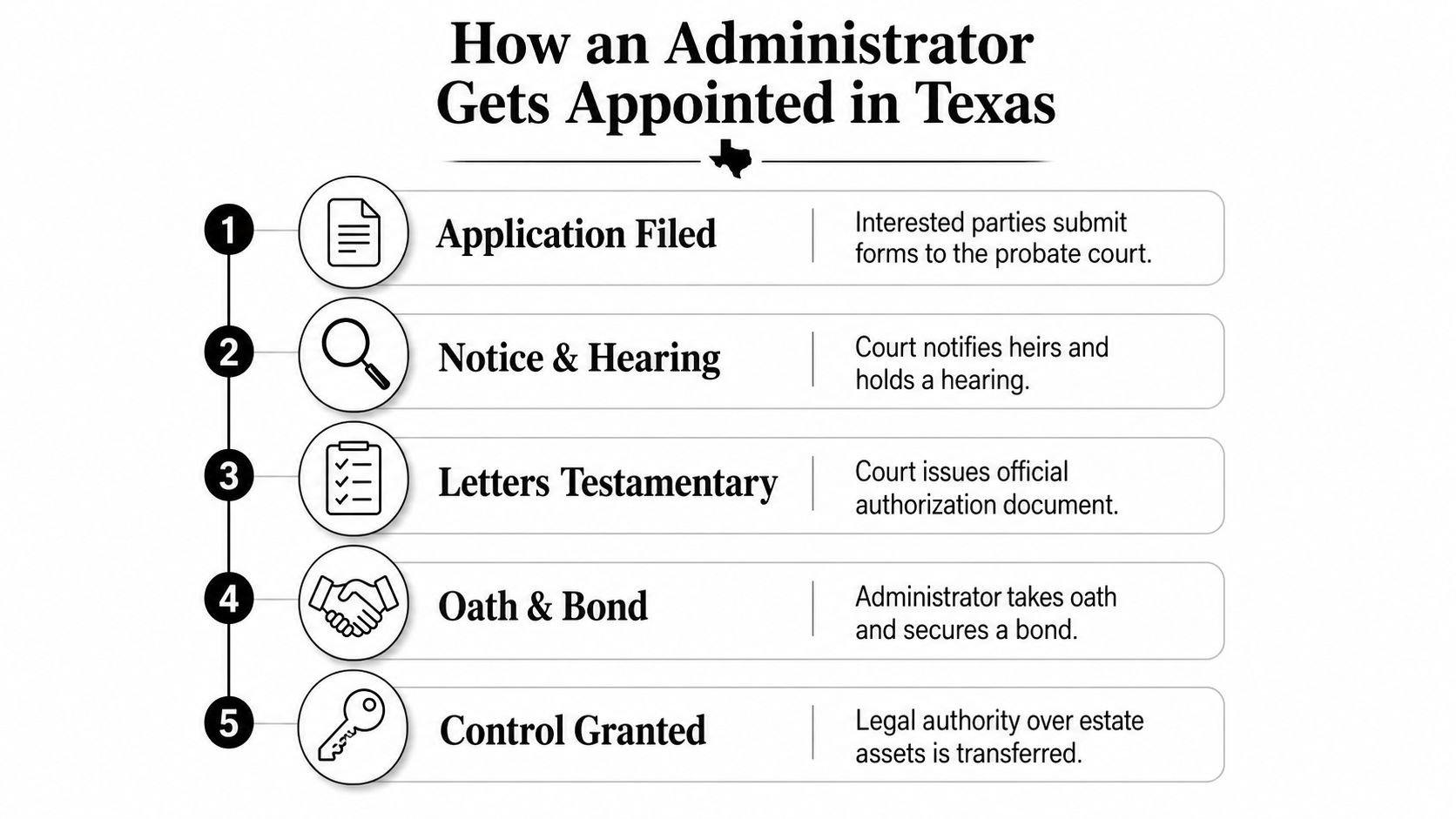
The process begins with a petition, not a phone call. The filing usually names the deceased, identifies the heirs, describes the property in broad terms, and explains why administration is needed. The court also expects supporting paperwork, including the death certificate, notice to interested parties, and, once the administration is underway, an inventory or a similar list of assets. Texas families can also use the state's probate guidance for no-will estates, which explains that the court needs the heirs identified, the papers filed, and formal authority in place before institutions will release property. A practical starting point is UK probate procedure for no-will estates, but Texas families should rely on Texas procedure, not a foreign probate system.
The hearing is where the court checks the basics. The judge wants to know who has standing to apply, whether the heirs agree, whether anyone objects, and whether the proposed administrator can carry the estate through to the end. In many families, the surviving spouse is the first person considered, then adult children, then other heirs, but the final outcome still turns on the facts and the court's order.
Practical rule: banks and title companies usually wait for formal authority, not family agreement.
That is why the appointment stage matters so much. Even when everyone at the kitchen table agrees on who should handle things, the estate can still stall if no one has legal power to sign. Once the court approves the appointment, the administrator can collect assets, deal with financial institutions, and begin the formal work of settling the estate.
Texas families sometimes compare this process to other court matters they have seen, including contested family disputes, because the filings and hearing can feel familiar. The purpose is different, though. Probate exists to identify, preserve, and distribute property, not to sort out a living family's rights in the same way a contested divorce does.
A good way to sort the practical application is to separate the assets that need probate from the ones that do not. Property that already passes by beneficiary designation, survivorship, or other non-probate means may never need the administrator's hand at all. Property that is titled only in the deceased person's name usually does.
The choice of administration also matters from the start. Some estates can move with less court oversight, while others need more supervision before anyone can act. For a helpful discussion of whether bond is required in a more supervised estate, see when bond is required in dependent administration probate in Texas.
Independent Versus Dependent Administration in Texas
Once the court agrees that someone needs authority, Texas families still have a second major choice. The estate can move through independent administration or dependent administration, and the difference affects almost every practical step after appointment. The right choice depends on whether the heirs are aligned or already pulling in different directions.
Two very different levels of court supervision
In independent administration, the administrator can usually manage the estate with much less court involvement. That means fewer approvals, fewer hearings, and less waiting around for the next court date. In dependent administration, the court supervises nearly every meaningful step, which can offer stronger oversight but usually creates more delay and more expense.
Texas estates often benefit from independence when the family is cooperative. If the heirs trust one another, the assets are clear, and the creditor picture is manageable, there is little reason to force the estate into a heavier courtroom process. That is why many Texas probate lawyers push for independent administration when the facts allow it.
| Factor | Independent Administration | Dependent Administration |
|---|---|---|
| Court oversight | Minimal after appointment | Frequent court approval required |
| Speed | Usually faster | Usually slower |
| Family conflict | Better for cooperative heirs | Better when conflict is high |
| Cost pressure | Often lower because there are fewer hearings | Often higher because supervision continues |
| Best fit | Straightforward estates with aligned heirs | Estates with disputes, creditor issues, or mistrust |
The common comparison is not perfect, but it helps. Independent administration works more like a family that has already agreed on the plan and just needs a legal signoff. Dependent administration works more like a courtroom-managed checklist where the judge must approve almost every significant move.
Texas law can also allow heirs to agree in writing to an independent administration even without a will. That written agreement is what gives the court a path to order a less burdensome process. More detail on whether bond is required in the supervised setting appears in this discussion of is bond necessary in dependent administration probate Texas.
A family facing a legal dispute may already have a sense of how quickly disagreement can slow everything down. That's why the approach in a Contested Divorce matters as a comparison point, since probate conflict can also turn simple decisions into drawn-out hearings.
Which Assets Go Through Probate and Which Do Not
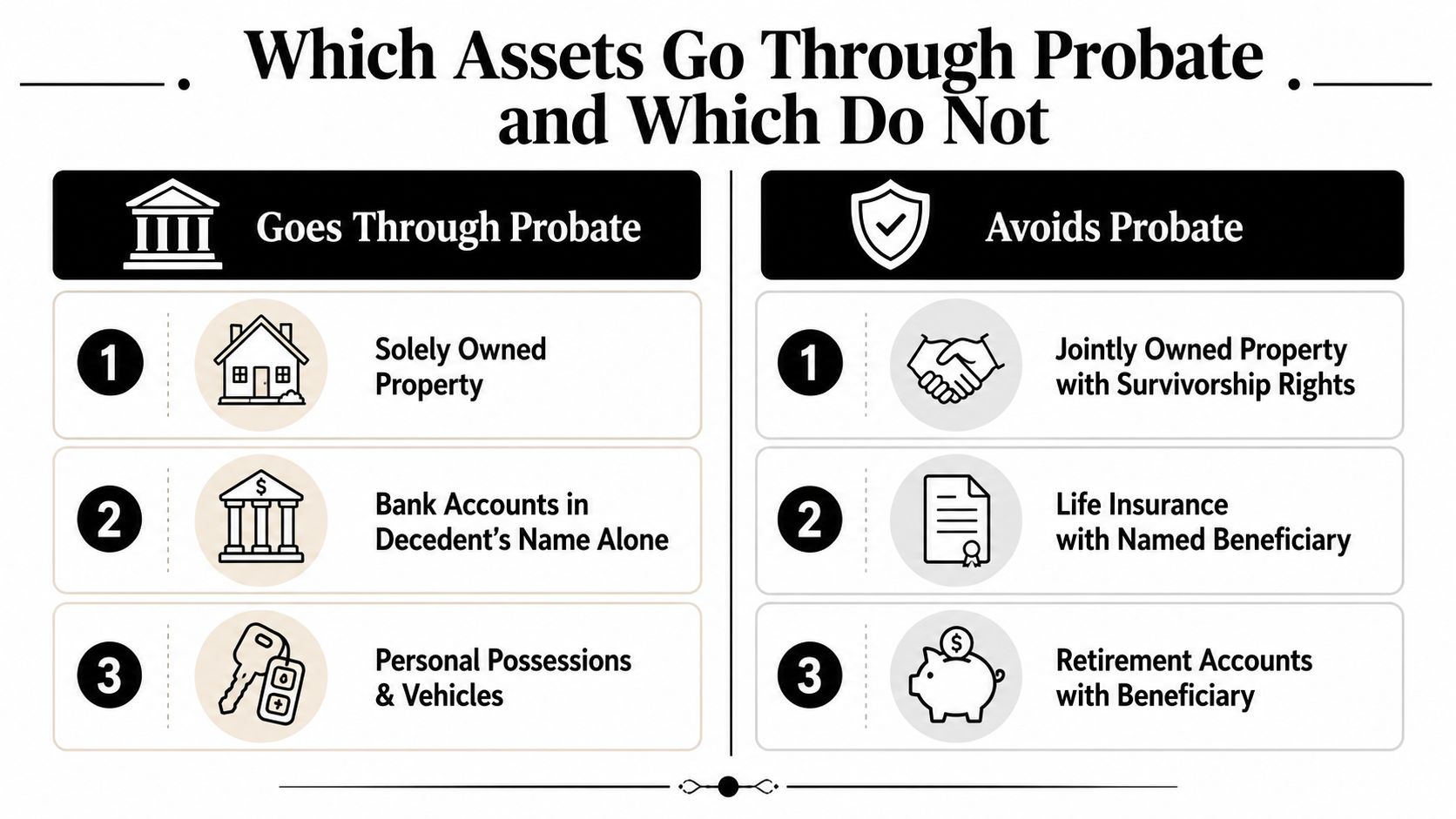
One of the biggest mistakes families make is assuming everything the deceased owned has to go through the court process. That is not how Texas estate administration works. The central question is whether an item is probate property or non-probate property.
Assets that usually avoid probate
Some property passes outside probate because it already has a separate transfer mechanism. Common examples include life insurance with a named beneficiary, payable-on-death bank accounts, jointly owned property with survivorship rights, and retirement accounts with beneficiary designations. Texas guidance explains that property with designated beneficiaries can pass outside probate, which is why the family's first job is often to sort the estate into the right buckets.
That distinction matters because a small administration can become a much larger one if the family assumes every account belongs in court. A clean title review can save time later, and for valuables such as jewelry, a resource like Antwerp Diamond on valuing your pieces can help families think about appraisal questions before anything is sold or distributed.
Assets that commonly do go through probate
Property titled solely in the deceased person's name often has to be administered by the court. That can include a house, a vehicle, personal possessions, and bank accounts without beneficiary designations. If the estate is simple enough and falls under Texas's $75,000 small-estate threshold noted in probate guidance, some families may qualify for an expedited process instead of full administration (Texas probate threshold overview).
The point is not that probate is always required or never required. The point is that you have to identify each asset and ask how title is held. A bank account in one name only is treated very differently from an account with a payable-on-death designation, and that difference often determines whether the family needs a full court case.
For families who also hold land, transfer planning can matter a great deal. A useful Texas resource on that topic is transfer on death deed Texas, because land can often be positioned to move outside the traditional probate pathway.
How Texas Intestacy Rules Actually Divide the Estate
A blended-family estate can surprise people fast. One spouse dies with no will, the surviving spouse expects everything to stay simple, and then the family discovers that the distribution depends on whether the property is community or separate, and whether children are from the current marriage or another relationship. Texas intestacy is fact-specific, not formulaic in the everyday sense families usually mean.
A blended family changes the result
If a decedent leaves a surviving spouse and children, the spouse's share can look very different depending on the family structure. Shared children, children from a prior relationship, and the type of property involved all matter. Texas intestacy law, organized in the Estates Code, is designed to follow those family facts rather than guess at an all-purpose result.
A surviving spouse with no children may end up in a much simpler position than a surviving spouse who shares children with the decedent or who inherits alongside children from a prior relationship. In the latter setting, the court has to sort out legal priority, not family assumptions. That is why two families with similar assets can walk away with very different distributions.
Why the details matter in real life
Remote heirs, like parents, siblings, nieces, and nephews, only come into the picture when there is no closer family under the statute. That can be hard for families to hear, especially when an informal promise was made years earlier or everyone assumed a certain relative would “take care of everything.” Intestacy doesn't reward informal expectations, it follows the statute.
When a house or parcel of inherited land is involved, title questions can become just as important as heirship questions. A practical walkthrough of land-sale issues in Texas appears in Swift Land Buyers inherited land process, which can help families think through property that may need to be sold after administration. The legal takeaway stays the same, though. The court follows the intestacy rules, and the family structure controls the result.
The statute decides who inherits, not the family story people remember at the dinner table.
Timelines, Costs, and Common Pitfalls to Avoid
Even a straightforward intestate estate doesn't wrap up overnight. Families should expect a process measured in months, not days, because the court has to appoint someone, identify heirs, collect assets, handle creditor issues, and then authorize distribution. The pace gets slower when the estate is contested, when records are missing, or when property titles don't line up with the family's assumptions.
The problems that slow families down
The biggest avoidable issues are usually administrative. Missing creditor notice deadlines can create problems later. Failing to file required notices can stall the case. Mixing up community property and separate property can lead to bad distribution assumptions, and overlooking the rights of a surviving spouse can create a fight that never needed to happen.
The money side matters too. Probate-focused summaries note that probate expenses can reach 3% to 7% of an estate's value in some cases, and other estate-planning sources report that the process can take six months to two years (Morningstar reporting on probate costs and timing). Those figures are a reminder that probate is not just a legal event, it is a financial one.
What families can do early
A family can make progress by gathering the death certificate, a list of assets, account statements, deeds, titles, and the names and contact information of likely heirs. It also helps to sort property into probate and non-probate categories before the first filing. That simple organization can keep the case from spreading into unnecessary disputes.
If a family wants a Texas estate lawyer to help map the next step, the options usually include petitioning for administration, checking whether a small estate path fits, and confirming whether the estate can move forward with independent administration. The right answer depends on the actual asset list and family relationships, not on a template.
If you need help navigating probate without a will in Texas, contact The Law Office of Bryan Fagan today for a free consultation. Our team helps families sort probate assets from non-probate assets, choose the right administration path, and move the estate forward with less stress. You can visit Law Office of Bryan Fagan, PLLC to take the next step with a Texas probate attorney who can tailor guidance to your family's situation.