An irrevocable trust is a legal arrangement where the grantor permanently transfers ownership of assets to a trust, gives up the ability to modify or revoke it, and removes those assets from the taxable estate. In 2026, the federal estate and gift tax exclusion is $15 million, which is one reason this tool still matters most for larger Texas estates and long-range asset protection planning (Investopedia).
A lot of families first hear about this structure during a divorce, after a parent's health starts changing, or when they're trying to protect a ranch, business interest, or investment account for children. In those conversations, the question usually isn't academic. It's practical: what can you safely move out of your name, and what are you giving up when you do it?
Understanding Irrevocable Trusts in Texas Estate Planning
A Texas couple sitting across the table from an estate planning attorney may be dealing with several pressures at once. One spouse may be worried about nursing home costs for an aging parent, another may want to keep family land from being pulled into the wrong hands, and a third may be trying to protect wealth while a divorce is unfolding. Those are the kinds of situations where an irrevocable trust moves from theory to strategy.
An irrevocable trust is a trust in which the grantor gives up the legal ability to change or end the trust after it is created, and the assets are no longer treated as the grantor's property for legal purposes. That sounds technical, but the idea is straightforward. You place property into a separate legal structure, and that structure holds it for the people you name.
That difference matters in Texas estate planning because the trust changes ownership now, not later. A will speaks at death. An irrevocable trust starts affecting control as soon as the transfer is made, which is why families often compare it with a revocable trust before deciding whether to act. If you are still sorting out whether a trust belongs in your plan, our guide to wills and trusts in Texas can help you understand the basic choices.
A practical rule helps here. If you still want full access, full control, and the right to change your mind later, an irrevocable trust probably is not the right starting point.
Texas estate planning works best when the documents match the family's actual goals. That means looking at who needs protection, who needs access, and whether the trust is meant to preserve assets, reduce estate inclusion, or support a beneficiary over time. For modern planning teams, see how CasePulse modernizes planning can be useful context for how attorneys organize those moving parts.
How an Irrevocable Trust Works Under Texas Law
A Texas family often turns to an irrevocable trust when a house, ranch, business interest, or investment account needs a different kind of legal wrapper. The property is moved into a separate trust, and from that point on, the trust terms control who can benefit, who can manage, and under what conditions. That shift can matter in Medicaid long-term care planning, and it can also matter in a high-net-worth divorce where one spouse wants clearer separation between personal property and protected assets.
The three roles that matter
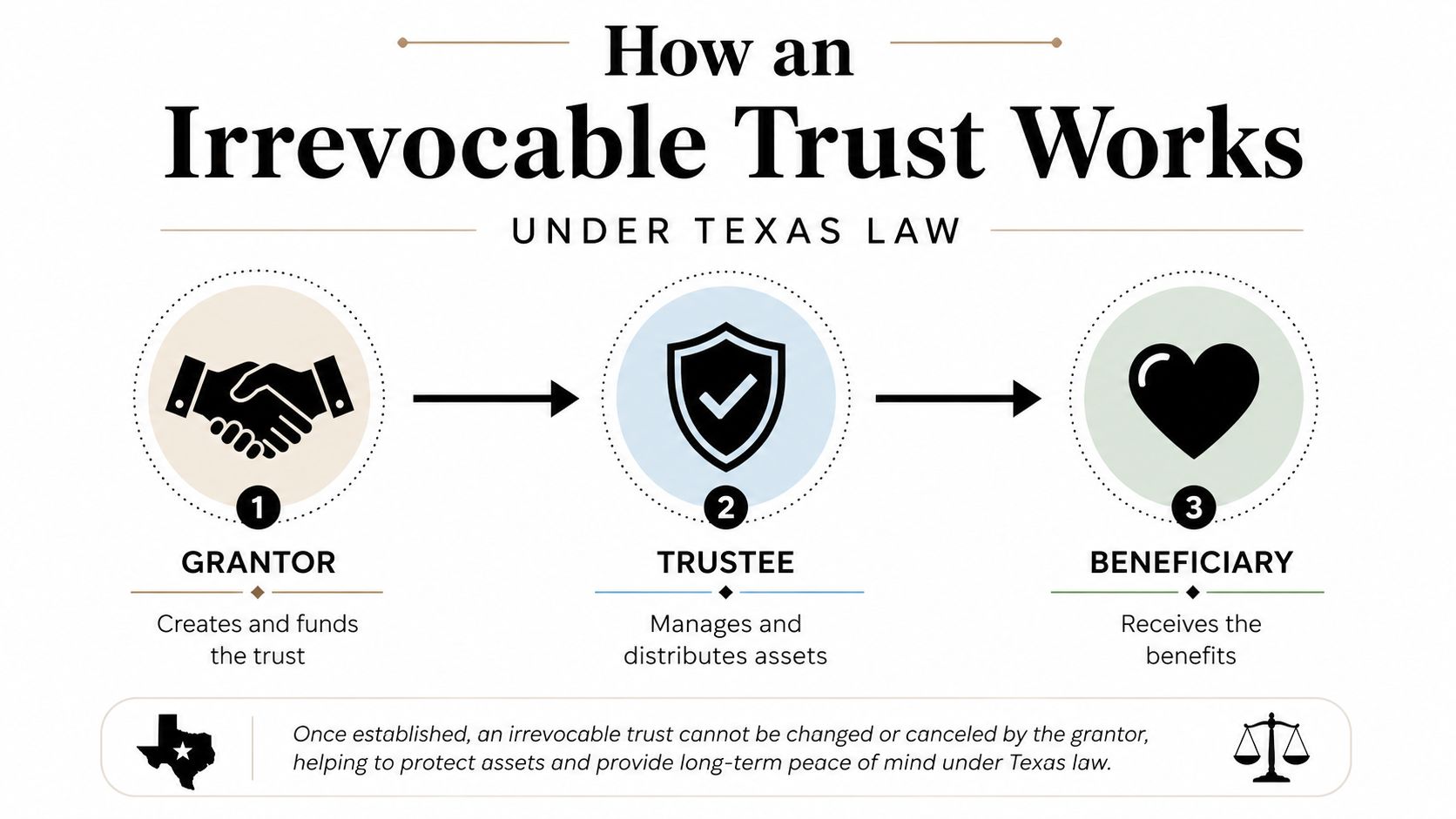
The grantor creates and funds the trust. The trustee holds and manages the property under fiduciary duties. The beneficiary receives the benefit, whether that means income, principal, or another distribution the trust document allows (MetLife).
Once the transfer is complete, the trust, not the individual who created it, is the legal home for the property. The grantor generally cannot revoke the arrangement, retake control, or rewrite the terms alone, unless the trust document, the beneficiaries, or a court allows that kind of change. That separation is what gives the trust its practical strength in Texas estate planning, because it changes ownership and control at the same time.
What the trustee does
A trustee does not hold the assets for personal use. The trustee manages them according to the trust document, keeps records, makes distributions when the document allows, and follows fiduciary duties under Texas law. That role is a little like being the steady hand on the steering wheel, while the trust instrument sets the route and the stops along the way.
If the grantor later dies, the trust usually keeps operating. The trustee continues carrying out the written instructions, whether the trust is designed to support a spouse, provide for children, or hold property for later distribution. For families who are trying to avoid the delay and court involvement often tied to probate, that ongoing administration can be a major advantage.
Families also use this structure to keep an eye on future tax exposure. For broader context, some readers also review inheritance tax insights for 2025 while comparing estate planning tools.
The easiest way to understand the arrangement is simple, the grantor sets the trust in motion, the trustee manages the property, and the beneficiary receives whatever the trust document says is available.
Revocable vs Irrevocable Trusts Compared
A Texas family often hears the word “trust” and assumes it means one thing. The better question is which problem the trust is meant to solve. A revocable trust and an irrevocable trust work differently, and that difference matters in probate avoidance, creditor exposure, Medicaid planning, and even in a high-net-worth divorce.
| Feature | Revocable Trust | Irrevocable Trust |
|---|---|---|
| Control | The grantor usually keeps control | The grantor gives up control |
| Ability to change terms | Flexible | Generally fixed unless a court or beneficiaries allow changes |
| Asset protection | Limited | Stronger, because the assets are no longer treated as the grantor's property |
| Tax planning | Usually used for convenience and probate avoidance | Often used for estate reduction and long-term planning |
| Medicaid planning impact | Usually not the main tool | Often considered for long-range planning |
| Best use | Probate avoidance and flexibility | Preservation, protection, and more specialized planning |
Texas law gives these two trusts very different practical effects. A revocable trust still leaves the grantor with broad control, which is why it works more like a management folder for the family's assets than a barrier between the family and outside claims. An irrevocable trust, by contrast, can create real separation because the property is no longer sitting in the grantor's hands in the same way. That separation is often what families are trying to create when they are thinking about long-term care planning or shielding assets from future family disputes.
A common mistake is treating every trust as if it offers the same protection. It does not. A revocable trust can still help a family avoid probate and keep administration private, but it usually does not give the stronger insulation that people mean when they ask about asset protection. If you want a more detailed side-by-side discussion, the firm's guide on revocable living trust vs irrevocable living trust breaks down the tradeoffs in plain language.
Texas families also need to look at the state planning rules around trust administration and property classification. Under the Texas Trust Code and the Texas Estates Code, the legal structure of the trust changes how much control remains with the grantor and how much authority shifts to the trustee. That is one reason a revocable trust may fit a family that wants flexibility, while an irrevocable trust may fit a family trying to create distance between personal ownership and the assets inside the trust.
A revocable trust often helps with convenience and probate avoidance. An irrevocable trust is chosen more often when the goal is to separate property from the grantor for protection, long-range planning, or a more controlled transfer of wealth.
If you are comparing options as part of a broader Estate Planning strategy, the right answer turns on access, control, taxes, and family circumstances, not just the label on the document.
Why Texas Families Choose Irrevocable Trusts
Texas families usually turn to irrevocable trusts for one of three reasons. They want protection from creditors, they want to reduce the size of a taxable estate, or they're planning ahead for long-term care costs. Those goals overlap, but they're not identical.
Asset protection and family risk
A business owner with personal liability exposure may want to move certain assets out of the path of future claims. That move is about legal separation, not secrecy. Once the trust owns the property, the grantor no longer holds it in the ordinary sense, and that shift is what gives the trust its protective value (MetLife).
Estate tax reduction for larger estates
The federal estate and gift tax exclusion is $13.99 million in 2025 and $15 million in 2026, which is why irrevocable trusts matter most for higher-net-worth households seeking to remove assets from a taxable estate (Investopedia). That kind of planning is often discussed when families own real estate, business interests, or investment portfolios they expect to grow.
For broader context on tax-sensitive planning, readers sometimes compare trust strategies with estate and inheritance tax discussions such as inheritance tax insights for 2025. The exact legal consequences still depend on the trust terms and the family's full asset picture.
Medicaid and long-term care planning
Many Texans also look at irrevocable trusts when they're worried about nursing home costs and want a plan that preserves assets for a spouse or children. That conversation needs careful timing and careful legal drafting, because transferring assets too late can create problems. It's a planning tool, not a shortcut.
A family-owned ranch shows why this matters. If a parent wants to preserve land for the next generation, an irrevocable trust may help separate the property from the grantor's personal ownership while keeping a roadmap for future distributions.

Steps to Create and Fund an Irrevocable Trust in Texas
The trust document matters, but funding matters just as much. A trust that sits on paper without assets in it does not do the job people usually want it to do.
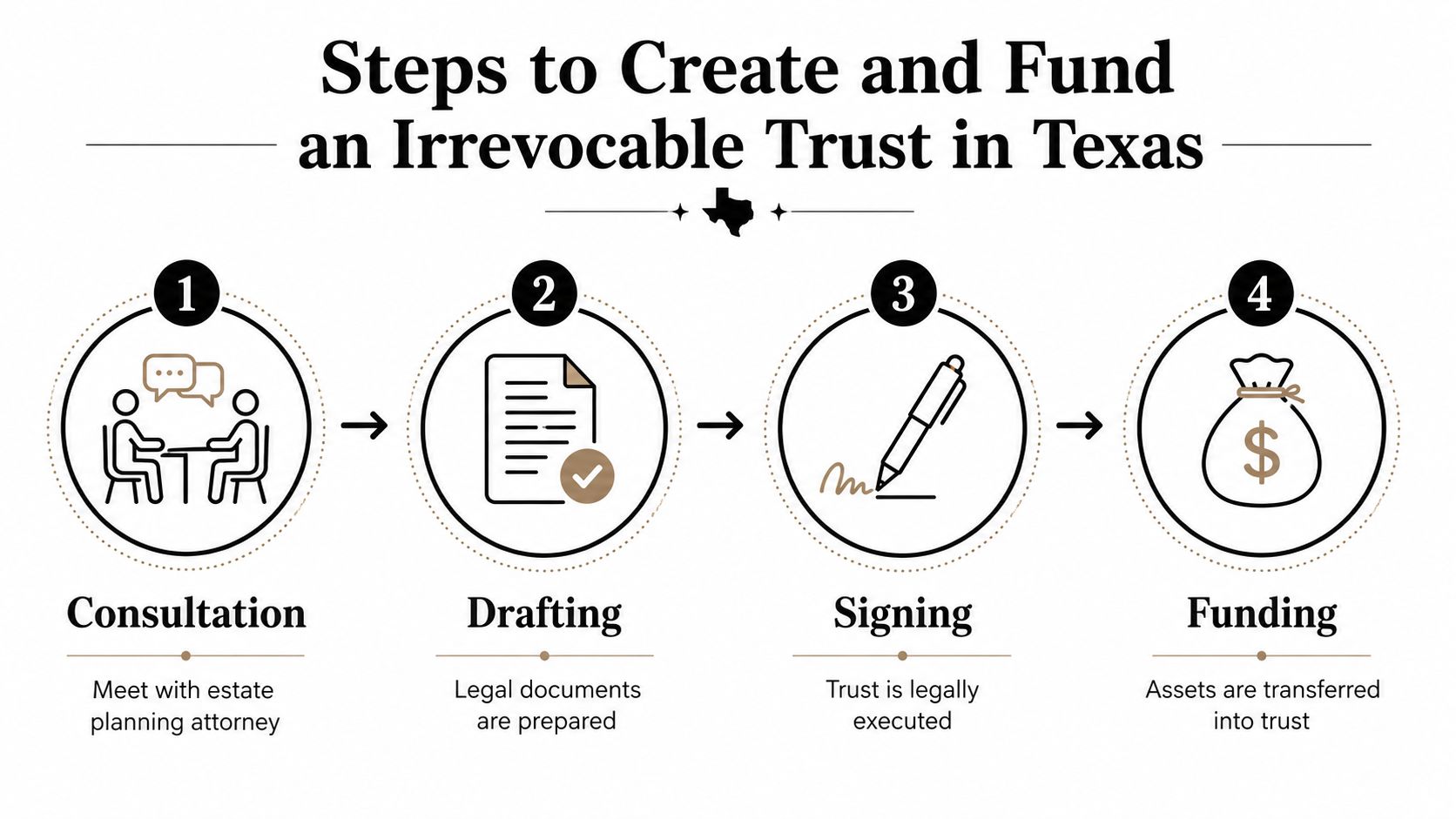
Start with the right planning conversation
The first step is a detailed estate planning meeting about goals, family structure, and what property is being considered. That conversation should also cover whether a married couple's assets are separate or community property, because that distinction affects what can be transferred and how. If the family is also dealing with divorce or property division, the issue can become even more delicate.
Draft the trust and choose the trustee
The trust document needs to spell out powers, limits, distributions, and successor arrangements. The trustee should be someone who can follow instructions, keep records, and handle assets responsibly. A family member can work in some cases, but independence often matters when the goal is to create real separation.
Fund the trust correctly
That means transferring the intended assets into the trust's name, not merely signing paperwork and hoping for the best. Real estate, bank accounts, and investment holdings all require different transfer steps. The point is legal ownership, not just good intentions.
Practical rule: if the property is still titled in your name, you probably still own it for legal purposes, no matter what the draft trust says.
The firm's page on setting up a trust in Texas is a helpful starting point if you're comparing trust options. And if you want a visual walkthrough, this short video covers the mechanics of trust creation and funding in a straightforward way.
Risks and Limitations You Should Know Before Committing
The biggest drawback is also the reason the trust can work so well. Once you move property into an irrevocable trust, you usually can't just take it back because circumstances changed. That loss of flexibility is the price of separation.
Permanent control loss and administration burdens
If a family needs ongoing access to the same assets for living expenses, an irrevocable trust may create more friction than relief. The trustee controls distributions, and that can feel uncomfortable if the grantor is used to making all the decisions. Families going through high-conflict cases, including custody disputes that overlap with property planning, should be especially careful not to mix emotional decisions with legal transfers. In those situations, Child Custody issues can make timing and control questions harder, not easier.
Tax and timing issues
Transfers into an irrevocable trust can trigger tax questions, and the paperwork has to be done carefully. That's especially true when the trust is being used near a long-term care need, because late planning can undermine the very protection the family was seeking. The document should match the timeline, not just the wish list.
Irrevocable trusts also make less sense for modest estates that don't need advanced tax or creditor planning. If a family mainly wants flexibility, a different structure may be more practical. The right answer depends on the people, the assets, and the risk.
Frequently Asked Questions About Irrevocable Trusts
Can the grantor serve as trustee? Usually not if the goal is true separation, because the point is to give up direct control. If the grantor keeps running the trust like personal property, that can defeat the legal purpose.
How do irrevocable trusts affect divorce in Texas? They can make property tracing more complicated, especially when spouses disagree about whether an asset is separate or community property. The trust doesn't magically erase family-law issues, so the timing of the transfer and the source of the property both matter.
Can an existing trust be changed into an irrevocable trust? Sometimes the answer depends on what kind of trust you already have and who has legal authority to approve changes. You should not assume that signing a new document fixes the old one.
What happens if a beneficiary dies first? The trust language controls. A well-drafted trust names alternate beneficiaries or explains what should happen next, which is why the wording matters so much.
If you're trying to protect property, support loved ones, or plan around Texas estate and family-law issues, the safest next step is a personalized review. Every family has different assets, risks, and goals, and those details change the answer.
If you need help navigating divorce, custody, or estate planning in Texas, contact The Law Office of Bryan Fagan today for a free consultation. Our team helps Texas families evaluate trusts, probate concerns, and property-protection strategies with clear guidance suited to your situation. Visit Law Office of Bryan Fagan, PLLC to start the conversation and get practical support for your next step.